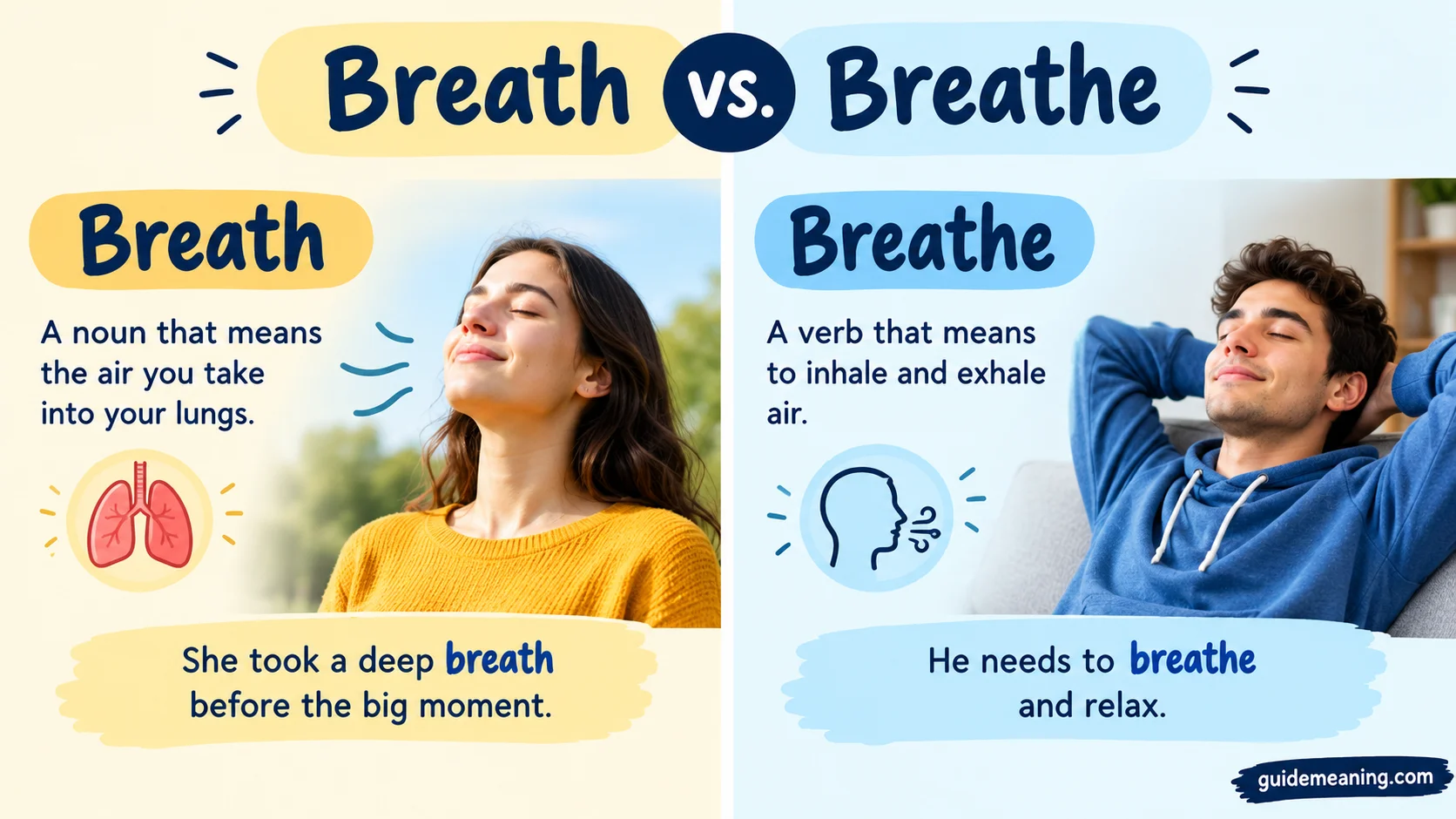

Breath vs. Breathe can confuse English learners because one letter changes the spelling, pronunciation, and grammatical role of these words.
In English, learning the difference between breath and breathe can feel like a walk in the park or a hike up a steep hill. These closely related words look almost the same, but their meaning, spelling, and grammatical role differ. One letter makes a world of difference. You might remind yourself to take a deep breath or breathe deeply. This confusion affects people who have been speaking English for years, including native speakers. The main difference comes down to parts of speech: breath is a noun, while breathe is a verb. Understanding this basic contrast is a game-changer when you want to use each word correctly. Although people sometimes use these commonly confused words interchangeably, they have slightly different meanings and belong in different contexts. Careful usage helps you write proper sentences.
Use breath when referring to air taken into or released from the lungs. It can describe one act of respiration, a pause, or a faint amount of something. For example, “Take a deep breath before you speak.” Here, the noun names the air or the act. In contrast, breathe means to draw air into the lungs and expel air. It describes the act of inhaling and exhaling, which is vital for living. An example sentence is, “It is hard to breathe in this room.” You can also say, “Try to breathe deeply and relax.” On a cold day, you might see your breath when the air is cold enough. However, you cannot see the act of breathing in the same way. Once you understand the distinction, you can say and write these two words with confidence.
Pronunciation also helps explain the difference. Breath, with no E at the end, ends with a short, sharp, unvoiced TH sound. Place your tongue near your teeth, keep it relaxed, and let the air flow freely. Its vowel is the EH sound, as in the BED vowel. Your jaw drops while the middle of your tongue lifts slightly. Add an E at the end to make the verb breathe, and the pronunciation changes. It uses the EE sound, as in the SHE vowel. The tongue tip stays down while the front part of the tongue arches toward the roof of the mouth. The tongue reaches high up, and the consonant becomes a voiced TH made with the vocal cords. Although the tongue position is similar, the sound changes from unvoiced to voiced. This affects word length because the voiced consonant often makes the stressed syllable longer. Try to hold out the vowel when saying “breathe” and notice the length. A video from the Rachel’s English channel can help you learn these sounds. When writing, remember that the letter E makes the verb. The word VERB also contains E, which may help you remember. For instance, a Facebook comment once said, “I love Michelle Obama so much I can hardly breath
Let’s dive in!
Quick Answer:
Breath and breathe have related meanings, but they serve different grammatical purposes.
- Breath (noun): The air you inhale or exhale, or one act of breathing. Example: She took a deep breath before speaking.
- Breathe (verb): To draw air into your lungs and release it. Example: She tried to breathe slowly.
The easiest way to remember the difference is to ask whether your sentence needs a noun or a verb.
| Word | Meaning | Part of speech | Example |
| Breath | Air inhaled or exhaled | Noun | Take a deep breath. |
| Breathe | To inhale and exhale | Verb | Remember to breathe. |
Quick memory trick: You take a breath, but you breathe. The extra e in breathe helps distinguish the verb from the noun.
Comparison Overview
Although breath and breathe share the same basic concept, their spelling, pronunciation, and grammatical functions differ.
| Feature | Breath | Breathe |
| Part of speech | Noun | Verb |
| Basic meaning | Air taken into or released from the lungs | The action of inhaling and exhaling |
| Spelling | B-R-E-A-T-H | B-R-E-A-T-H-E |
| IPA pronunciation | /brɛθ/ | /briːð/ |
| Final consonant sound | Unvoiced /θ/ | Voiced /ð/ |
| Example | His breath was warm. | He breathed slowly. |
| Common expression | Hold your breath | Breathe deeply |
| Typical grammatical use | A breath, your breath, several breaths | To breathe, she breathes, breathing |
The main difference isn’t just that one word contains an extra letter. The two words also have different vowel sounds and final consonants.
For example, breath rhymes with death, while breathe rhymes with seethe. Listening for these differences can help you distinguish them during conversation.
Main Differences Between Breath and Breathe
The most reliable way to choose between these words is to understand how each one works in a sentence. Their meanings are connected, but their grammatical roles aren’t interchangeable.
Breath Is a Noun
A breath is something you take, hold, lose, or regain. The word identifies air or a single act of breathing rather than describing the action itself.
You can use breath with articles, possessive words, and adjectives.
Examples include:
- Take a breath before answering.
- He held his breath underwater.
- She could feel her breath getting faster.
- We took three deep breaths before the presentation.
- His morning breath smelled unpleasant.
Notice how each sentence treats breath as a thing or concept. You can count individual breaths, describe their qualities, or refer to someone’s breath.
Breathe Is a Verb
Breathe describes what a person or another living organism does when drawing air into and releasing it from the lungs.
Because it is a verb, breathe can express an action, instruction, or ongoing process.
Examples include:
- Try to breathe slowly.
- Babies breathe differently from adults in certain situations.
- She breathes through her nose while running.
- He struggled to breathe after climbing the stairs.
- Remember to breathe before you begin speaking.
The word also appears in different verb forms, such as breathes, breathed, and breathing. These forms help express tense, subject agreement, and ongoing activity.
How to Identify the Correct Word
When you’re unsure which spelling belongs in a sentence, examine the words around it.
Use breath when the sentence refers to a thing:
- Take a deep ___.
- She held her ___.
- He was out of ___.
Use breathe when the sentence requires an action:
- Try to ___ slowly.
- It’s difficult to ___ here.
- Remember to ___ naturally.
This approach works because English grammar often signals a word’s function through the surrounding words. Once you recognize the sentence structure, the correct choice becomes much easier.
What Does Breath Mean?
The word breath refers to the air you inhale or exhale through your respiratory system. It can also describe one act of breathing or appear in expressions that convey emotions, effort, and relief.
As a noun, breath can be countable or used in certain uncountable expressions. For instance, you can take a breath or several deep breaths. In phrases such as bad breath, the word describes the air coming from someone’s mouth.
Breath as a Noun
In everyday English, breath commonly appears in sentences about physical activity, speech, health, and emotional reactions.
Consider these examples:
- After running: Mark needed a few minutes to catch his breath.
- Before speaking: She took a breath before delivering her presentation.
- During exercise: The instructor reminded everyone to take slow, steady breaths.
- In cold weather: You could see his breath in the freezing air.
- During a stressful moment: I held my breath while waiting for the results.
In each example, breath names something rather than expressing an action. Even in the phrase catch his breath, the noun refers to breathing that someone needs to recover or regulate.
One useful grammatical clue is the word’s ability to follow determiners such as a, the, your, and his. You can say your breath or a breath, but you wouldn’t normally say a breathe.
Common Expressions With Breath
English contains many expressions that use breath. Some describe literal breathing, while others communicate feelings or situations figuratively.
| Expression | Meaning | Example |
| Take a breath | Inhale, often to pause or relax | Take a breath before you respond. |
| Hold your breath | Stop breathing temporarily or wait anxiously | We held our breath during the final seconds. |
| Out of breath | Breathing heavily after physical effort | I was out of breath after running upstairs. |
| Catch your breath | Recover normal breathing | She stopped to catch her breath. |
| A breath of fresh air | Something refreshing or different | His new ideas were a breath of fresh air. |
| Waste your breath | Speak without achieving the desired result | Don’t waste your breath arguing with him. |
| Under your breath | Speak quietly enough that others may barely hear | He muttered something under his breath. |
| With bated breath | With intense anticipation or suspense | They waited with bated breath for the announcement. |
A particularly interesting expression is with bated breath. The word bated means restrained or reduced, so the phrase describes waiting with suspense or anticipation. It is not baited breath.
These expressions show that breath can describe much more than the physical air entering and leaving your lungs.
Example Sentences Using Breath
Here are additional examples that show how the noun works in different contexts.
- Everyday conversation: Give me a moment to catch my breath.
- Medical context: The nurse listened to the patient’s breathing and checked his respiratory rate.
- Emotional situation: She let out a long breath of relief.
- Creative writing: His breath formed a faint cloud in the winter air.
- Figurative expression: The renovation gave the old building a new lease on life and a breath of fresh air.
The key point is simple: when you’re naming air, a single act of breathing, or an expression built around the noun, use breath.
What Does Breathe Mean?
Breathe is a verb that means to inhale and exhale air. It describes a biological process that allows humans and many other living organisms to exchange gases with their surroundings.
The word also appears in figurative expressions. For example, someone can breathe life into a project by adding energy, creativity, or new ideas.
Unlike breath, the verb changes form depending on the sentence’s tense and grammatical structure.
Breathe as a Verb
The base form breathe appears after certain verbs, after the infinitive marker to, and in commands.
Examples include:
- Try to breathe through your nose.
- Please breathe slowly during the exercise.
- I can finally breathe easier now.
- They learned how to breathe more efficiently while swimming.
The verb also changes according to its subject. In the simple present tense, third-person singular subjects take breathes.
For example:
- I breathe slowly.
- You breathe slowly.
- We breathe slowly.
- She breathes slowly.
- The athlete breathes steadily during the exercise.
In the past tense, the correct form is breathed. For ongoing actions, use breathing.
Literal and Figurative Uses of Breathe
The verb breathe doesn’t always refer to the physical movement of air. Writers and speakers also use it to describe relief, energy, freedom, and space.
Literal examples:
- The swimmer surfaced to breathe.
- It’s easier to breathe through my nose.
- The baby breathed normally while sleeping.
- The runner stopped to breathe after the race.
Figurative examples:
- The new director breathed life into the struggling business.
- I can finally breathe a sigh of relief.
- The designer left enough white space for the page to breathe.
- The team needs time and room to breathe between major projects.
These examples illustrate why context matters. In the page needs to breathe, the page doesn’t literally inhale air. Instead, the sentence describes a design with enough open space to feel balanced and readable.
Example Sentences Using Breathe
Use the following examples to see how breathe functions as a verb.
| Sentence | How breathe is used |
| Remember to breathe during your workout. | An instruction to perform an action |
| She breathes slowly when she meditates. | A repeated or habitual action |
| He breathed deeply before answering. | A completed action in the past |
| Breathing slowly helped her relax. | An ongoing activity used as the sentence’s subject |
| The fresh design breathed new life into the website. | A figurative use meaning to revitalize |
A useful rule is to check whether the word expresses something happening. If it does, breathe or one of its verb forms may be the correct choice.
Breath vs. Breathe: Pronunciation Differences
The words breath and breathe differ in both their vowel sounds and their final consonants. These differences are especially noticeable in American English.
The noun breath is pronounced /brɛθ/. Its vowel sounds like the one in bed, and its final consonant is the unvoiced th sound found in think.
The verb breathe is pronounced /briːð/. Its vowel is a long ee sound, and its final consonant is the voiced th sound found in this.
| Word | IPA | Rhymes with | Final sound |
| Breath | /brɛθ/ | Death | Unvoiced /θ/ |
| Breathe | /briːð/ | Seethe | Voiced /ð/ |
How to Pronounce Breath and Breathe Correctly
To pronounce breath, place your tongue lightly near your upper teeth and push air through the gap. Keep your vocal cords from vibrating during the final sound.
To pronounce breathe, use a similar tongue position. However, allow your vocal cords to vibrate and stretch the vowel into a longer ee sound.
Try saying these pairs aloud:
- A deep breath.
- Remember to breathe.
- Hold your breath.
- Just breathe.
The contrast becomes easier to hear with practice. Correct pronunciation also helps you recognize the words when listening to native English speakers.
Breath vs. Breathe: Different Verb Forms
Although breath remains a noun, breathe changes form to fit different grammatical situations. Understanding these variations helps you avoid errors when writing about past events, regular habits, or ongoing actions.
| Word | Part of speech or form | Example |
| Breath | Noun | Her breath was steady. |
| Breathe | Base verb | Try to breathe slowly. |
| Breathes | Third-person singular present | He breathes deeply. |
| Breathed | Simple past | She breathed a sigh of relief. |
| Breathed | Past participle | They have breathed cleaner air since moving. |
| Breathing | Present participle or gerund | Breathing slowly can help you relax. |
Breath vs. Breathing
The difference between breath and breathing depends on whether you’re naming a single act or referring to the activity itself.
Breath often refers to one act of inhaling or exhaling, or to the air involved.
- Take another breath.
- His breath smelled like peppermint.
Breathing usually refers to the ongoing process or activity.
- Slow breathing helped her feel calmer.
- The doctor monitored his breathing.
The word breathing can function as a gerund, which means a verb form acts as a noun. In breathing slowly helps, the word names an activity. In she is breathing slowly, it forms part of the verb phrase.
Breathe vs. Breathed
Use breathe for the base verb and breathed for the simple past or past participle.
- Present: I breathe fresh air every morning.
- Past: I breathed fresh air during yesterday’s walk.
- Present perfect: I have breathed more easily since the dust settled.
- Past perfect: She had breathed deeply before the presentation began.
Remember that breathed ends in -ed, even though its pronunciation doesn’t add a separate syllable in ordinary speech. It sounds approximately like breedhd, with the final voiced consonant.
Common Expressions: Breath or Breathe?
Some phrases are particularly easy to confuse because they contain similar words. Learning the complete expressions makes choosing the correct spelling much easier.
Take a Breath vs. Take a Breathe
Take a breath is correct because the sentence needs a noun after the article a.
Correct: Take a breath and try again.
Incorrect: Take a breathe and try again.
The verb take requires an object in this expression. That object is breath, not breathe.
Just Breathe vs. Just Breath
Just breathe is correct when you’re encouraging someone to calm down or regulate their breathing.
Correct: Just breathe and focus on the next step.
Incorrect: Just breath and focus on the next step.
Here, breathe describes an action. The sentence works as an instruction, so it requires the base form of the verb.
Hard to Breathe vs. Hard to Breath
Hard to breathe is the standard construction because to introduces the infinitive form of the verb.
Correct: It was hard to breathe in the smoky room.
Incorrect: It was hard to breath in the smoky room.
The same grammatical pattern appears in phrases such as need to breathe, learn to breathe, and want to breathe.
Catch Your Breath vs. Catch Your Breathe
Catch your breath is correct because your modifies the noun breath.
Correct: We stopped halfway up the hill to catch our breath.
Incorrect: We stopped halfway up the hill to catch our breathe.
In this expression, the noun refers to recovering your normal breathing after exertion, surprise, or another demanding experience.
Breath of Fresh Air vs. Breathe of Fresh Air
The correct expression is a breath of fresh air.
For example: Her practical suggestions were a breath of fresh air during the meeting.
The phrase can describe actual fresh air, but people often use it figuratively to describe a welcome change. A new colleague, a creative idea, or a refreshing approach can all be a breath of fresh air.
Common Mistakes to Avoid When Using Breath and Breathe
Even experienced writers sometimes mix up these words when typing quickly. Fortunately, a few simple checks can prevent most mistakes.
Using Breath Instead of Breathe After To
When to introduces an infinitive verb, use breathe.
- Incorrect: I need to breath.
- Correct: I need to breathe.
However, remember that to doesn’t always introduce an infinitive. In I look forward to breathing fresh air, the phrase look forward to takes a noun or gerund, so breathing is correct.
Using Breathe Instead of Breath After an Article
Articles such as a and the often introduce nouns.
- Incorrect: She took a breathe.
- Correct: She took a breath.
This doesn’t mean every word after an article must be a noun. Adjectives can appear between the article and the noun, as in a deep breath.
Confusing Breathes With Breath’s
These spellings have different grammatical meanings.
- Breathes: The third-person singular present form of breathe. Example: He breathes slowly.
- Breath’s: The possessive form of the noun breath. Example: The breath’s warmth faded in the cold air.
The apostrophe can also mark a contraction in certain constructions, although contractions involving breath’s are uncommon.
Forgetting the Different Verb Forms
Don’t use breath when the sentence requires breathed or breathing.
- Incorrect: She has breath deeply.
- Correct: She has breathed deeply.
- Incorrect: He is breath slowly.
- Correct: He is breathing slowly.
When editing, identify the verb phrase and check whether it needs the base form, past tense, or present participle.
Easy Ways to Remember Breath vs. Breathe
A simple memory trick can save you from second-guessing yourself every time you write these words.
Remember this sentence: “Take a breath, then breathe.”
It contains both words in their correct grammatical roles. The first names something you take, while the second describes an action you perform.
Here are a few other ways to remember the distinction:
- Try the article test: If a fits naturally before the word, you probably need breath.
- Try the action test: If you’re describing what someone does, use breathe or the appropriate verb form.
- Check the ending: Breath ends in -th, while breathe ends in -the.
- Listen to the vowel: Breath has a short vowel, while breathe has a longer vowel.
- Learn complete phrases: Memorize take a breath, hold your breath, just breathe, and hard to breathe.
The phrase-based method works especially well because your brain begins to recognize familiar grammatical patterns. With repeated exposure, the correct spelling becomes easier to recall without consciously applying every rule.
Real-Life Examples: Choosing Breath or Breathe
Imagine three everyday situations where the wrong spelling might slip into a message.
Case Study: Preparing for a Presentation
A student feels nervous before giving a speech. Her friend offers advice.
Incorrect: Take a deep breathe before you start.
Correct: Take a deep breath before you start.
Why? The student needs to take something, and breath names that thing.
The friend might then say, Breathe slowly and begin when you’re ready. In that sentence, breathe describes the action the student should perform.
Case Study: Recovering After Exercise
A runner finishes a long race and sends a message to a friend.
Incorrect: I need to catch my breathe.
Correct: I need to catch my breath.
The expression uses the noun breath because it refers to recovering normal breathing. The runner could also write, I need a minute to breathe, where the infinitive requires the verb.
Case Study: Writing a Wellness Article
A writer drafts a sentence about relaxation.
Incorrect: Slow, steady breath can help you relax.
Correct: Slow, steady breathing can help you relax.
The second sentence names an activity using the gerund breathing. However, Take a slow, steady breath would also be correct because that sentence refers to a particular act of breathing.
These examples show that context and sentence structure matter more than the topic itself.
Breath vs. Breathe: Practice Exercises
Test your understanding by filling in each blank with the correct word or form. Choose from breath, breathe, breathes, breathed, or breathing.
Fill-in-the-Blank Questions
- Please take a deep ___ before you answer.
- I find it difficult to ___ when the room gets stuffy.
- She ___ slowly whenever she practices meditation.
- He was out of ___ after climbing five flights of stairs.
- The doctor asked whether the patient had trouble ___.
- We ___ a sigh of relief when the storm passed.
- Remember to ___ naturally during the exercise.
- Slow ___ can help some people feel calmer.
- The athlete has ___ more comfortably since recovering.
- Just ___ and take things one step at a time.
Answers and Explanations
| Question | Answer | Explanation |
| 1 | Breath | The sentence needs a noun after a deep. |
| 2 | Breathe | The infinitive after to requires a verb. |
| 3 | Breathes | The subject she takes the third-person singular form. |
| 4 | Breath | Out of breath is a standard expression. |
| 5 | Breathing | The phrase trouble breathing uses a gerund. |
| 6 | Breathed | The past-tense verb describes a completed action. |
| 7 | Breathe | The sentence gives an instruction. |
| 8 | Breathing | The gerund functions as the subject of the sentence. |
| 9 | Breathed | The present perfect uses has plus the past participle. |
| 10 | Breathe | The sentence uses the base verb as an instruction. |
If you answered most of these correctly, you’ve grasped the central distinction. If a few were tricky, revisit the grammatical clues rather than memorizing isolated spellings.
FAQs:
What is the main difference between breath and breathe?
Breath is a noun that refers to air taken into or released from the lungs. Breathe is a verb that describes the action of inhaling and exhaling air. For example, you take a breath and then breathe slowly.
Is breath a noun or a verb?
Breath is a noun. It names the air you inhale or exhale, an act of respiration, or a pause. For example, “Take a deep breath before speaking” uses breath as a noun.
Is breathe a noun or a verb?
Breathe is a verb because it describes an action. It means to draw air into your lungs and release it. For example, “Try to breathe deeply and relax” uses breathe to describe an action.
How do you pronounce breath and breathe?
Breath ends with an unvoiced TH sound and has the short EH vowel, as in bed. Breathe uses the EE vowel, as in she, and ends with a voiced TH sound. The final E helps distinguish their pronunciation.
Why do people confuse breath and breathe?
People often confuse these words because their spelling is nearly identical and their meanings are closely related. However, their grammatical roles differ. Remember that breath is a noun, while breathe is a verb.
Is it correct to say “I can hardly breath”?
No. The correct sentence is “I can hardly breathe.” The sentence describes an action, so it needs the verb breathe. You would use breath when naming the air itself, as in “I took a deep breath.”
What is an easy way to remember breath vs. breathe?
Remember that breathe has an E at the end and functions as a verb. You breathe in and out, while a breath is the air or act of respiration. Practicing both words in example sentences can help you remember their correct usage.
Conclusion:
Understanding Breath vs. Breathe becomes easier when you focus on their grammatical roles, meanings, and pronunciation. Breath is a noun, while breathe is a verb. You take a breath, but you breathe to draw air into your lungs and release it. The final E in breathe can also remind you that it describes an action. With regular practice, you can use both words confidently in everyday conversations and writing.