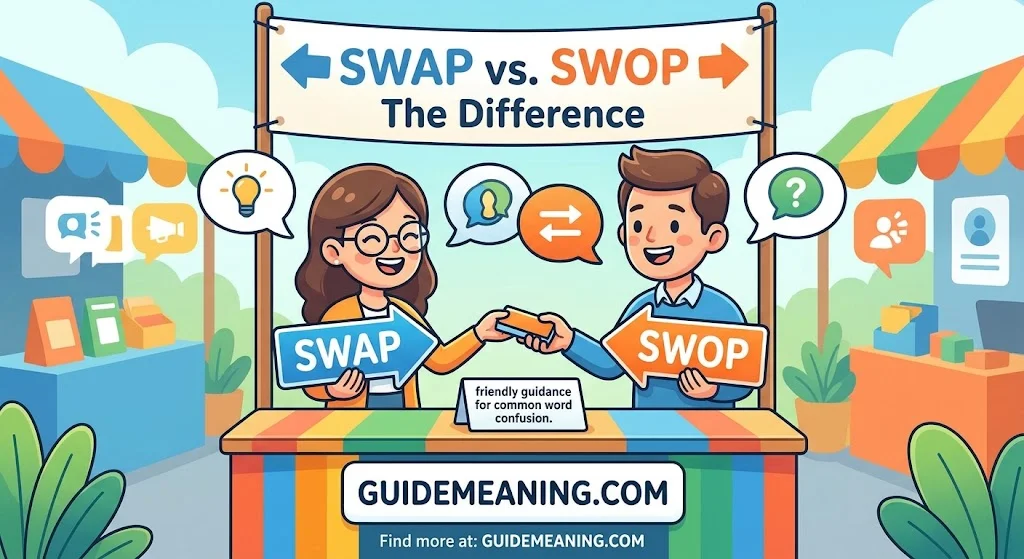

Swap vs. Swop can confuse English learners because both words share a similar sound and meaning, while their spelling and regional usage differ. The basic meaning of both is to exchange or trade one thing for another, so you can swap clothes with a friend, swap seats, or swap one item for another. In a simple sentence, you might say, “I’ll swap my sandwich for your apple,” while older UK texts may contain swop cards exchanged at lunch. The definition is simple, but context matters. Swap is the global, common, and much more common form in modern English, particularly in American English and general international usage. Swop is a traditional British form, mainly associated with British English, and it appears less often, which is why many readers find swap more familiar and natural.
Dictionaries may list both forms, while a dictionary or style guide can give different recommendations. Their historical roots, regional usage trends, and regional preferences help explain this difference between the two words. For writers and learners, the practical advice is to use swap as the safer choice, default choice, and widely preferred spelling for most everyday writing, exams, professional communication, and general learning. Swop can still be acceptable when you follow British English or the context uses it. Knowing both words helps people avoid mistakes learners make, understand formal English and informal English, and confidently use the right spelling according to where they are writing.
The real difference is not in the same basic meaning, but in spelling, history, and usage. Once you know what swap means, what swop means, and why their usage differs, the confusion becomes easier to manage. This article explains the point through simple, clear English, real-life examples, grammar, and practical rules, so you can fully understand the choice. If you have wondered which spelling fits, the answer depends largely on your audience and setting. Consider the relevant style guide, choose the form that suits your intended writing, and remember that the two forms should not always be freely replaced in every sentence.
Let’s jump in!
Quick Answer: Swap vs. Swop
Swap and swop generally have the same basic meaning: to exchange one thing, person, position, or responsibility for another.
| Word | Meaning | Usage | Best general choice |
| swap | To exchange one thing for another | Very common | Yes |
| swop | To exchange one thing for another | Mainly UK and less common | Usually swap |
For example:
- I want to swap seats with you.
- I want to swop seats with you.
Both sentences can describe the same action. The first spelling is much more familiar to a broad modern English audience.
Cambridge lists swap as a verb meaning to give something and receive something else in return. It also lists swop as a mainly UK equivalent. Oxford similarly gives swop as another form of swap.
The easiest rule is simple:
Use “swap” when you want the most widely recognized modern spelling.
What Does “Swap” Mean?
The word swap works as both a verb and a noun. Its central idea is exchange.
Swap as a Verb
As a verb, swap means to give something to someone while receiving something else in return.
Consider these examples:
- Can we swap seats?
- She swapped her blue jacket for a black one.
- They swapped phone numbers after the meeting.
- We swapped jobs for the afternoon.
- The children swapped snacks at lunch.
The exchange doesn’t necessarily involve money. That’s an important point.
If you trade your sandwich for your friend’s fruit, you can swap them. If two coworkers exchange shifts, they can swap shifts. If two people exchange stories, they can swap stories.
Cambridge also records uses such as swap addresses, swap places, and swap stories.
Common Grammar Patterns With “Swap”
Several sentence patterns appear naturally with swap.
Swap something with someone
I swapped books with my classmate.
Swap something for something
She swapped her old phone for a newer model.
Swap places
Let’s swap places. I can’t see the screen.
Swap roles
The actors swapped roles for the final scene.
Swap stories
We spent the evening swapping stories about our travels.
The preposition can matter because it shows the relationship between the two things being exchanged.
Swap as a Noun
Swap can also refer to an exchange itself or to something that has been exchanged.
For example:
- We made a swap.
- That was a fair swap.
- They agreed to a straight swap.
- The two teams arranged a player swap.
Oxford gives swap as a noun for an act of exchanging something or someone and also for something or someone that has been exchanged.
The word also appears in specialized fields. In finance, for example, a currency swap involves exchanging certain financial arrangements, while a debt-for-equity swap involves exchanging debt for an ownership interest. Cambridge’s Business English Dictionary documents these financial uses.
What Does “Swop” Mean?
Here’s where the spelling becomes interesting.
Swop is a real English word. It isn’t simply a typographical error that dictionaries ignore. Cambridge lists it as a verb and noun, while Oxford lists both forms separately and identifies swap as its alternative form.
The core meaning remains the same: to exchange one thing for another.
Swop as a Verb
Examples include:
- Can I swop seats with you?
- She swopped her red scarf for a blue one.
- They swopped jobs for the afternoon.
- We swopped stories after dinner.
Oxford records constructions such as swop something with somebody, swop something for something, and swop places.
Swop as a Noun
Swop can also function as a noun.
For example:
- Let’s do a swop.
- That was a fair swop.
- They agreed to a straight swop.
Oxford specifically defines the noun as an act of exchanging one thing or person for another. It also gives examples of swops referring to things that have been exchanged.
So grammatically, swop can do much of the same work as swap.
The main distinction isn’t meaning. It’s usage and spelling preference.
Swap vs. Swop: What Is the Main Difference?
The central difference between swap and swop is their frequency and regional usage, not their basic definition.
Cambridge labels swop as mainly UK for swap. Its swap entry identifies swop as a UK alternative.
Here’s the practical comparison:
| Feature | Swap | Swop |
| Basic meaning | Exchange | Exchange |
| Verb | Yes | Yes |
| Noun | Yes | Yes |
| American English | Common | Very uncommon |
| British English | Common | Used as a variant |
| General international writing | Widely recognizable | Less familiar |
| Meaning difference | Usually none | Usually none |
| Recommended general spelling | Yes | Usually not |
Think of the two spellings as two doors leading to the same room. The destination is essentially the same. One door simply gets used far more often.
Is “Swop” a Correct Word?
Yes. Swop is a correct and recognized English word.
Calling it completely wrong oversimplifies the situation.
The important distinction is between correctness and frequency. A word can be legitimate without being the most common choice.
For example, Cambridge doesn’t define swop as an error. Instead, it identifies it as a mainly UK form of swap. Oxford likewise lists swop as a recognized verb and noun.
That means these two statements are both reasonable:
- “Swap is the more common spelling.”
- “Swop is a legitimate variant.”
What isn’t accurate is saying:
- “Swop is always incorrect.”
That claim ignores documented dictionary usage.
Is “Swap” or “Swop” More Common?
In modern general writing, swap is the safer and more familiar spelling.
Historical usage has not always been perfectly uniform. An older Webster’s Dictionary of English Usage discussion notes that swap is the usual spelling in American English and says British dictionaries preferred swap, while also documenting historical British use of swop.
Modern dictionaries present a clearer practical picture. Cambridge gives swap the main entry and treats swop as a UK variant. Oxford does the same basic thing by presenting swap as the main form while listing swop as an alternative.
That distinction matters when you’re choosing a spelling for an article, business document, school assignment, or website.
If you don’t have a specific reason to use the variant, swap is the sensible default.
Swap vs. Swop in British English
British English deserves special attention because swop is particularly associated with British usage.
That doesn’t mean British speakers must use swop. In fact, swap is also completely normal in British English.
Cambridge’s dictionary labeling is useful here: it describes swop as “mainly UK for swap.”
So you might encounter:
I swapped seats with Tom.
You could also encounter:
I swopped seats with Tom.
The second sentence isn’t automatically wrong because it uses swopped. It simply uses the less common variant.
Oxford provides similar evidence by listing swop alongside swap and giving British examples of the verb.
Swap vs. Swop in American English
For American English, swap is overwhelmingly the more natural choice.
Cambridge’s American dictionary entry gives swap as the standard verb and noun for exchanging one thing for another.
For example:
Can we swap seats?
sounds entirely ordinary in American English.
By contrast, swop can look unusual to an American reader even though the meaning can still be understood.
Therefore, if you’re writing specifically for a US audience, swap should be your default spelling.
Read More: Double Check or Double Confirm: Which One Is Correct?
Swap vs. Swop in Different Contexts
The right choice can also depend on the type of writing.
Everyday Conversation
Swap is the natural choice for most speakers.
Can we swap seats?
Do you want to swap snacks?
Let’s swap numbers.
These expressions are short, familiar, and conversational.
Business Writing
Business English frequently uses swap in both everyday and technical contexts.
Examples include:
- job swap
- office swap
- currency swap
- debt-for-equity swap
- swap agreements
Cambridge’s Business English Dictionary documents swap for financial transactions as well as ordinary exchanges.
Academic Writing
Academic writers should normally choose the form that matches their intended variety of English and their publication’s style.
For general US English, swap is the natural choice.
If you’re discussing a historical source that uses swop, however, retaining the original spelling may be appropriate.
Informal Online Writing
Both forms may appear online, especially when writers come from different English-speaking regions.
Still, swap is far more immediately recognizable to a broad audience.
If your website targets international readers, that familiarity has practical value.
Common Expressions With “Swap”
Some expressions with swap are so common that replacing the word with swop can make the sentence feel noticeably less familiar.
Swap Places
Would you swap places with me?
This means exchanging positions or imagining yourself in someone else’s situation.
Swap Seats
Can we swap seats?
This means exchanging where two people are sitting.
Swap Roles
The students swapped roles during the exercise.
Each person takes the other’s role.
Swap Stories
We sat around the table swapping stories.
Here, swap means sharing stories with each other rather than physically exchanging objects.
Swap Shifts
Can you swap shifts with me on Friday?
Two workers exchange scheduled work periods.
Swap Something for Something
She swapped her old laptop for a newer model.
The structure clearly identifies what was given and what was received.
Swap Something With Someone
I swapped books with my friend.
The construction emphasizes the person involved in the exchange.
Swap vs. Swop: Grammar and Sentence Patterns
One useful point often gets overlooked: changing swap to swop generally doesn’t change the grammatical structure.
Compare:
I swapped my red shirt for a blue one.
I swopped my red shirt for a blue one.
Both use the verb in the past tense.
Likewise:
We swap stories after dinner.
We swop stories after dinner.
The grammatical role remains the same.
Oxford documents both forms with similar structures, including exchanging something with someone, exchanging something for something else, and changing places.
Verb Forms
For swap:
- Present: swap
- Third-person singular: swaps
- Past: swapped
- Present participle: swapping
Oxford lists these forms explicitly.
For swop, the corresponding forms include:
- swop
- swops
- swopped
- swopping
The spelling retains the double p before endings.
Swap vs. Exchange vs. Trade
Not every situation involving two things requires the word swap.
These words overlap, but they aren’t always interchangeable in tone or context.
| Word | General idea | Typical feel | Example |
| Swap | Exchange one thing for another | Informal, everyday | We swapped seats. |
| Exchange | Give something and receive something else | Neutral or formal | We exchanged contact information. |
| Trade | Exchange goods, services, or assets | Commercial or practical | They traded the car for a truck. |
Swap often sounds casual and direct.
Exchange is broader and works especially well in formal writing.
Trade can suggest a commercial transaction, although everyday speech uses it more broadly too.
For example, two friends might swap snacks. A company might trade goods. Two countries might exchange information.
Context does the heavy lifting.
Common Mistakes With Swap and Swop
Mistake: Assuming “Swop” Is Always Wrong
This is the biggest misconception.
Dictionaries recognize swop as a variant. Cambridge explicitly describes it as mainly UK for swap.
Mistake: Assuming They Have Different Meanings
In ordinary usage, they generally refer to the same basic idea: exchange.
The spelling doesn’t normally create a different definition.
Mistake: Assuming British English Requires “Swop”
It doesn’t.
British English uses swap too. Swop is a recognized variant rather than a mandatory British spelling.
Mistake: Switching Between the Spellings
If you’re writing an article, report, or story, consistency matters.
Don’t write:
We decided to swap seats before we swopped our bags.
unless you have a deliberate stylistic reason.
Choose one form and stick with it.
Mistake: Confusing “Swap” With “Switch”
These words overlap, but they can emphasize different actions.
Swap usually involves an exchange:
We swapped seats.
Switch can simply mean changing from one thing to another:
I switched to a different seat.
The distinction becomes especially clear when only one person changes something.
A Practical Case Study: Choosing the Right Spelling
Imagine you’re writing an American English article about exchanging work shifts.
You could write:
Employees can swap shifts when they need schedule flexibility.
That sentence uses the most familiar form for a US audience.
Now imagine you’re quoting a British source that says:
Workers can swop shifts when necessary.
Changing the original spelling to swap might make the quotation inaccurate if you’re reproducing the wording exactly.
The lesson is straightforward:
Your audience and purpose should guide the spelling.
For ordinary US English writing, use swap. For a quotation or source-specific discussion, preserve the original form when accuracy requires it.
How to Remember Swap vs. Swop
You don’t need a complicated memory trick.
Just remember:
Swap = the common modern choice.
Swop = a recognized variant, mainly associated with UK English.
If you’re unsure while writing, choose swap.
That single rule will work in the vast majority of everyday situations.
Which One Should You Use?
Use “Swap” When:
- You’re writing in American English.
- You’re writing for an international audience.
- You’re writing a school assignment.
- You’re creating website content.
- You’re preparing professional documents.
- You want the most familiar modern spelling.
- You don’t have a regional reason to choose the variant.
Use “Swop” When:
- You’re intentionally following British regional usage.
- You’re discussing the variant itself.
- You’re preserving the spelling of a historical or modern source.
- A publication or project specifically uses that spelling.
- The regional character of the writing makes the variant appropriate.
For most writers, though, there’s no need to overthink it.
Swap is the dependable default.
FAQs:
Is “swap” or “swop” correct?
Both swap and swop are recognized English words with the basic meaning of exchanging or trading something. However, swap is much more common in modern English, while swop is more strongly associated with British English.
What is the difference between swap and swop?
The main difference is spelling and usage rather than meaning. Swap is the widely used form in American English and general international English. Swop is less common and is traditionally used in British English.
Is “swop” still used in British English?
Yes. Swop still appears in British English, although swap is also widely used in the UK. You may encounter swop in some British writing, especially in informal or traditional contexts.
Can I use “swap” in formal writing?
Yes. Swap is a standard English word and can be used in formal and informal writing when its meaning fits the context. For example, “The two companies agreed to swap information” is grammatically acceptable.
Is “swop” acceptable in American English?
Swop may be understood by American readers, but it is much less common than swap in American English. For most American writing, swap is the more familiar spelling.
Does swap mean exchange?
Yes. Swap means to exchange one thing for another. For example, “I’ll swap my sandwich for your apple” means that one person will exchange a sandwich for an apple.
Which spelling should I use: swap or swop?
For most modern writing, swap is the safer and more widely recognized choice. If you’re following a particular British style or intentionally using swop in a context where it is appropriate, swop can also be used.
Conclusion:
Swap and swop have the same basic meaning, but they differ in frequency and regional usage. Swap is the common modern spelling and works well in American English, British English, and general international writing. Swop is a less common form that is traditionally associated with British English. When you’re unsure, swap is generally the straightforward choice because more readers will recognize it immediately.



1 thought on “Swap vs. Swop: Meaning, Usage, and the Difference Explained for 2026”