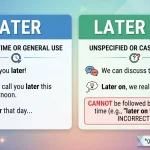

Someday vs. Some Day explains how spelling and spacing change meaning, helping writers choose the right expression for future events and clear communication.
At first glance, someday and some day may look like identical twins because they sound alike when spoken. However, their meanings differ. Someday is a one-word adverb that describes an indefinite future time. It expresses a hope, dream, or possibility without specifying when something will happen. For example, “I’d like to see him again someday” shares a wish, while “I hope to travel the world someday” expresses a general idea about the future. The exact timing does not matter. This flexible expression suits loose planning and a journey toward a dream.
Some Day, by contrast, uses two words and refers to a particular day, even when its date remains unknown or unspecified. For example, “I have an appointment some day next month” gives a timeframe without naming the exact date. Similarly, “We’ll meet some day next week” suggests a specific day within a known period. This distinction matters in modern English writing, casual sentences, and formal communication. Although writers sometimes use both expressions almost interchangeably, careful word choice helps avoid confusion. Grammar, semantics, and English usage influence how each sentence communicates meaning. The right choice improves overall communication and ensures clarity. Ask yourself whether you mean a general possibility or a particular day ahead.
Think of someday as a brush painting a broad journey, while some day marks a point on that picture. You may believe a dream will happen at some point without choosing a date, but a planned event may require a more precise reference. These subtle shades of meaning help express intentions with finer strokes and remove unnecessary suspense. Strong examples, better sentence construction, and clear usage rules build confidence, correctness, and polished English. Attention to detail also supports smarter language decisions, flexibility, and accuracy. Language tools such as NLP and syntax analysis can examine separate expressions in context. Even an unexpected term like weatherization systems does not change the main distinction: each expression carries a different level of expectation and tone. Understanding this comparison helps you express time naturally and recognize how one small space changes meaning.
Let’s dive in!
Quick Answer:
Someday is an adverb that usually means at an unspecified time in the future. Some day is a two-word phrase that refers to one day, often without identifying exactly which day.
| Expression | Meaning | Typical Use | Example |
| Someday | At an unspecified future time | Hopes, dreams, and possibilities | I hope to write a novel someday. |
| Some day | One unspecified or particular day | Referring to an individual day | We should spend some day exploring the old town. |
| One day | A particular or unspecified day; also an indefinite future time | Stories, memories, and future expectations | One day, she’ll understand the decision. |
The easiest rule to remember is this:
- Use someday when you mean at some point in the future.
- Use some day when you mean one day or refer to a day as a unit of time.
- Use one day when it sounds more natural for a specific day or a future event in a story.
Example: “I’ll visit Japan someday” expresses a future hope. “We spent some day together” is grammatically possible in certain contexts but sounds unnatural in ordinary American English. Most speakers would say, “We spent a day together” or “We spent one day together.”
The distinction is about meaning, not simply spelling preference.
Comparison Overview
The difference between someday and some day becomes clearer when you examine how each expression functions in a sentence.
Although they share the same basic words, they don’t always communicate the same idea. One usually describes when something might happen in the future, while the other identifies a day.
| Feature | Someday | Some Day |
| Word form | One word | Two words |
| Grammatical role | Adverb | Determiner and noun forming a noun phrase |
| Main meaning | At an indefinite future time | One day, identified or unidentified |
| Typical time reference | Future | Past, present, or future, depending on context |
| Common contexts | Dreams, goals, wishes, predictions | Particular days, dates, memories, and durations |
| Example | I’ll learn Italian someday. | Some day in April, we met by chance. |
| Can it stand alone? | Yes, as an adverbial expression | Yes, when the surrounding sentence supports the noun phrase |
| Main emphasis | Unspecified future timing | The day itself |
One important detail is worth remembering: some day doesn’t automatically mean a specific day. It can refer to an unidentified day, too. The key difference is that the phrase treats day as a noun, while someday functions as an adverb describing time.
For example:
- Someday: She hopes to become a pilot someday.
- Some day: Some day in the summer, the entire family gathered at the lake.
In the first sentence, the exact timing doesn’t matter. In the second, the speaker has a particular day in mind, even though its date remains unspecified.
Main Differences Between Someday and Some Day
The most reliable way to distinguish these expressions is to look at what the sentence emphasizes. Someday emphasizes an indefinite future time, whereas some day emphasizes a day itself.
Let’s explore the main differences in greater detail.
Meaning and Usage of Someday vs. Some Day
The word someday generally expresses an event that may happen in the future. It doesn’t identify a date, month, or year. Instead, it leaves the timing open.
Writers often use someday when discussing ambitions, hopes, promises, and possibilities. The word works especially well when someone expects an event to happen but can’t say exactly when.
Examples of someday:
- I want to open my own restaurant someday.
- You’ll understand why I made this decision someday.
- She dreams of traveling around the world someday.
- Someday, we’ll look back on these difficult times and smile.
- He hopes to publish his first book someday.
In each sentence, someday refers to an indefinite point in the future. The speaker doesn’t specify a particular day.
By contrast, some day treats the word day as a noun. The phrase can refer to one unidentified day, a day with particular characteristics, or a day identified by the surrounding words.
Examples of some day:
- Some day in October, we need to visit the pumpkin farm.
- I remember some day during my childhood when it snowed heavily.
- We should choose some day when everyone is available.
- She mentioned some day in the future when we could discuss the proposal.
Notice that these examples emphasize an individual day. Words such as in October, during my childhood, and when everyone is available help identify the day being discussed.
However, everyday American English often favors alternatives such as a day, one day, or a particular day. Although some day is grammatically valid, it isn’t always the most natural choice.
Grammar and Sentence Structure
Grammar provides another helpful way to distinguish someday from some day. The expressions have different structures, so they perform different jobs in a sentence.
Someday is an adverb. It describes when an action might occur without specifying an exact time.
Consider these examples:
- We’ll meet again someday.
- He’ll discover his talent someday.
- Someday, I hope to live near the ocean.
In these sentences, someday modifies the timing of the action or event. You can move it to different positions without changing the basic meaning.
For example:
- Someday, she’ll understand.
- She’ll understand someday.
- She’ll someday understand.
All three sentences are grammatical, although the first two sound more natural in many everyday contexts.
Some day contains a determiner and a noun. The word some determines the noun day, creating a noun phrase that can function as a subject, object, or part of a prepositional phrase.
Consider these examples:
- Some day in June would work perfectly.
- We selected some day during the final week.
- On some day in the future, the project may become possible.
In the first sentence, some day in June acts as the subject. In the second, it functions as the object of selected. In the third, the phrase appears within a prepositional phrase.
Here’s a quick grammatical test:
- If the word describes when something will happen, someday is often appropriate.
- If the sentence discusses a day as a noun, some day may fit.
- If a date or day isn’t important to the message, someday is often the simpler choice for future possibilities.
Time Reference: Someday vs. Some Day
Time reference is one of the clearest differences between these expressions.
Someday usually points toward the future. It describes something that hasn’t happened yet but may happen later.
For example:
Someday, I’ll return to the town where I grew up.
The speaker expresses a future intention without committing to a particular date.
Meanwhile, some day can refer to the past, present, or future. Its time reference depends on the sentence.
Examples include:
- Past: Some day in my childhood, I realized how much I loved music.
- Present or general scheduling: We need to choose some day that works for everyone.
- Future: Some day in the coming months, we’ll discuss the next phase.
The past and present examples refer to an individual day, but they don’t necessarily establish its exact date. The future example also refers to a day rather than simply expressing an indefinite future possibility.
Keep in mind that some day often sounds more natural when additional information identifies the day. For example, “Some day next week” is understandable, but “One day next week” or “A day next week” may sound smoother.
Someday vs. Some Day in Different Contexts
Context can make the distinction easier to understand. The following examples show how the correct choice depends on your intended meaning.
| Context | Correct or More Natural Expression | Example |
| Future ambition | Someday | I’ll start my own business someday. |
| Future hope | Someday | Someday, I hope to see the Northern Lights. |
| Unspecified day in a memory | Some day, often with additional context | I remember some day in December when the roads froze. |
| Choosing a date | Some day, though a day or one day may sound more natural | We need to pick some day for the meeting. |
| Describing an eventual possibility | Someday | She may become a famous artist someday. |
| Identifying a day by its circumstances | Some day | Some day when the weather is warmer, let’s go hiking. |
| Describing an unspecified future event in a story | Someday or one day | Someday, he’ll discover the truth. |
The final example shows an important overlap. Both someday and one day can refer to an indefinite future time. The choice often depends on tone, rhythm, and the kind of sentence you’re writing.
What Does Someday Mean?
Definition of Someday
Someday is an adverb meaning at some unspecified time in the future. It usually refers to an event, action, or possibility without stating exactly when it will happen.
The word combines some and day into a single adverb. Modern English uses it as a standard spelling when expressing an indefinite future time.
For example:
- I’ll learn to play the piano someday.
- Someday, we’ll have more time to travel.
- She wants to become a doctor someday.
Each sentence describes something that may happen later. None identifies a particular date.
Someday can express confidence, hope, uncertainty, or even gentle determination. Compare these examples:
- Hope: I hope to visit Greece someday.
- Possibility: This small company could become a major brand someday.
- Determination: Someday, I’ll finish the book I’ve been writing.
Although the word often appears in positive statements, it doesn’t guarantee that an event will happen. It simply places the possibility at an unspecified point in the future.
When to Use Someday
Use someday when the exact timing isn’t important or isn’t known. It works particularly well in conversations about long-term goals and events that don’t have a fixed schedule.
Common situations include:
Personal goals
- I want to run a marathon someday.
- He hopes to buy a house someday.
- Someday, she’ll start her own design studio.
Dreams and ambitions
- Someday, I want to explore every national park in the country.
- They dream of opening a family bakery someday.
- She believes she’ll write a bestselling novel someday.
Future possibilities
- This technology might transform education someday.
- We may work together again someday.
- Someday, researchers could find a better solution.
Promises and reassurance
- You’ll see the results of your hard work someday.
- Someday, things may feel easier.
- We’ll have another chance someday.
In each example, the word leaves the timing open. The sentence focuses on the event or possibility rather than a scheduled day.
Examples of Someday in Sentences
Here are additional examples showing how someday works in everyday American English.
| Sentence | Meaning |
| I’ll visit New York someday. | The visit may happen at an unspecified future time. |
| Someday, I want to learn Japanese. | Learning Japanese is a future goal. |
| She hopes to own a bookstore someday. | She has a long-term ambition. |
| We’ll laugh about this someday. | The speaker expects a future perspective on the situation. |
| He might understand the decision someday. | Understanding may develop later. |
| Someday, this garden will be full of flowers. | The speaker imagines a future result. |
| I’d love to see the Grand Canyon someday. | The speaker expresses a future wish. |
Writing tip: When someday fits naturally in place of at some point in the future, the single-word spelling is usually correct.
For example, “I want to learn French someday” means the same thing as “I want to learn French at some point in the future.”
What Does Some Day Mean?
Definition of Some Day
Some day is a two-word phrase consisting of the determiner some and the noun day. It refers to one day that isn’t fully identified or doesn’t need an exact name in the sentence.
Unlike someday, the phrase doesn’t function as an adverb meaning an indefinite future time. Instead, it refers to a day as a unit of time.
For example:
- Some day in September, we should visit the apple orchard.
- I remember some day when my grandfather taught me to fish.
- We need to find some day that suits everyone’s schedule.
These sentences refer to an individual day, even though the date might remain unknown.
The phrase can also appear in contexts involving duration or a specific day’s characteristics. For example, “Some day of the week is always busier than the others” treats day as a noun, although a more natural sentence might be “One day of the week is always busier than the others.”
The important point is that some day refers to a day, while someday generally refers to an indefinite future time.
When to Use Some Day
Use some day when your sentence focuses on an individual day rather than an open-ended future possibility.
However, the phrase often needs context to sound natural. Additional words can explain which day you mean or what makes it relevant.
When identifying an unspecified day
- Some day in November, we should organize a family reunion.
- I remember some day during the winter when the power went out.
- She mentioned some day in July when the entire team could attend.
When discussing a suitable day
- We need to choose some day when the office is less busy.
- Let’s find some day that works for both families.
- They wanted to schedule the inspection on some day before the deadline.
When describing a day with particular circumstances
- Some day when the skies are clear, we’ll take the boat out.
- We should plan the picnic for some day without rain.
- Some day during the festival, the streets become completely crowded.
Although these sentences illustrate the grammatical structure, American English speakers may prefer a day, one day, or a particular day in several cases.
For example, “Let’s find a day that works for both families” sounds more natural than “Let’s find some day that works for both families.”
Examples of Some Day in Sentences
| Sentence | Explanation |
| Some day in May would be ideal. | The speaker has an unspecified day in May in mind. |
| We should select some day before the holiday. | The sentence refers to one day that meets a condition. |
| I remember some day in my youth when I felt completely fearless. | The speaker recalls an individual day. |
| Some day during the conference will be devoted to training. | The phrase identifies an individual day within an event. |
| She wants to schedule the appointment for some day next week. | The sentence refers to a day within a future period. |
A note about natural phrasing: Correct grammar doesn’t always produce the most idiomatic sentence. In everyday writing, a day next week, one day in May, or a particular day may communicate the same idea more smoothly.
Someday vs. Some Day: Examples Side by Side
Sometimes, both forms can appear in similar sentences. The difference becomes clearer when you examine the intended meaning.
Examples About Dreams and Future Goals
Consider these sentences:
- Someday: I’ll own a house near the beach someday.
- Some day: Some day in the summer, we should visit houses along the coast.
The first sentence expresses a long-term goal. The second identifies an individual day during the summer when an activity might take place.
Here are more comparisons:
| Someday | Some Day |
| I hope to become a chef someday. | Some day during culinary school, I realized I wanted to become a chef. |
| Someday, we’ll travel across Europe. | Some day in June, we’ll begin our European trip. |
| She wants to meet her favorite author someday. | Some day during the book festival, she hopes to meet her favorite author. |
| He plans to learn to swim someday. | Some day this summer, he plans to take his first swimming lesson. |
The single-word form emphasizes an indefinite future possibility. The two-word form emphasizes a day connected to an event or period.
Examples About Past Events
The distinction also matters when you describe memories.
Example with some day:
“I remember some day during my childhood when my family moved into our first home.”
Here, the speaker refers to an individual day in the past. The phrase during my childhood provides additional context.
However, a more natural version would often be:
“I remember the day my family moved into our first home.”
The revised sentence sounds more direct because the speaker identifies a particular event.
Can someday describe a past event?
Generally, no. In standard contemporary English, someday normally refers to an unspecified future time. When discussing an event that occurred in the past, use alternatives such as one day, once, or on a particular day.
For example:
- Natural: One day, I found an old photograph in the attic.
- Natural: I once found an old photograph in the attic.
- Awkward: Someday, I found an old photograph in the attic.
The final sentence mixes the usual future meaning of someday with a past-tense verb. That makes it unsuitable for ordinary storytelling.
Examples Where Both Forms Are Possible
Some sentences allow both expressions, but the meaning or emphasis changes.
Consider the following pair:
- “Someday, we’ll visit the museum.”
- “Some day, we’ll visit the museum.”
The first sentence clearly expresses an indefinite future intention. The second is possible if the writer treats some day as a noun phrase meaning one day. However, without additional context, it sounds less natural to most American English readers.
Now consider a more informative comparison:
- Someday: She’ll understand why the decision mattered.
- Some day: Some day during her internship, she’ll understand why the decision mattered.
The first sentence leaves the timing open. The second connects the realization to a day during her internship.
When in doubt, choose the expression that matches your intended meaning and sounds natural in context.
Common Mistakes When Using Someday and Some Day
Even experienced writers occasionally confuse these expressions. Fortunately, a few simple corrections can prevent most errors.
Using Someday to Refer to a Particular Day
The word someday usually refers to an indefinite point in the future, not a day identified by a date or event.
Less precise: I’ll schedule the interview someday next week.
More natural: I’ll schedule the interview for a day next week.
Also natural: I’ll schedule the interview sometime next week.
The first sentence isn’t necessarily impossible to understand, but it combines an indefinite future expression with a specific period. The alternatives communicate the scheduling idea more naturally.
Using Some Day to Express a General Future Hope
When discussing dreams or ambitions, someday is usually the better choice.
Less natural: I want to become a professional photographer some day.
More natural: I want to become a professional photographer someday.
The single-word form expresses a future ambition without suggesting that one particular day matters.
Assuming Someday and Some Day Are Always Interchangeable
These expressions overlap in meaning, but you shouldn’t treat them as automatic substitutes.
For example:
- Correct: Someday, I’ll understand this complicated subject.
- Correct: Some day during the course, I’ll understand this complicated subject.
The first sentence expresses a general expectation. The second places the expected understanding within a course and emphasizes an individual day.
Context determines whether the two-word phrase makes sense. If the sentence doesn’t focus on a day as a noun, someday will often be the better choice.
Confusing Someday With One Day
Both someday and one day can describe an indefinite future time. However, one day has additional uses that someday doesn’t share as freely.
For example:
- Someday, I’ll tell you the whole story.
- One day, I opened the door and found a package outside.
The first sentence refers to an unspecified future time. The second introduces a past event in a narrative.
Although you could write “One day, I’ll tell you the whole story,” the expression also works as a storytelling device for past events. Someday generally doesn’t serve that same role.
Someday vs. One Day vs. Some Day
The expressions someday, one day, and some day are related, but each has its own uses.
| Expression | Main Meaning | Past Events | Future Possibilities | Example |
| Someday | At an indefinite future time | Generally no | Yes | I’ll visit Australia someday. |
| One day | A particular or unspecified day; also an indefinite future time | Yes | Yes | One day, I found an old diary. |
| Some day | One day treated as a noun phrase | Yes, with suitable context | Yes | Some day in August, we met again. |
When to Use Someday
Choose someday when you want to express an indefinite future possibility, ambition, or expectation.
Example: “Someday, I’ll learn to play the violin.”
The sentence focuses on a future goal rather than an individual day.
When to Use One Day
Choose one day when referring to an individual day, introducing a story, or describing a possible future event.
Examples:
- One day, she discovered a letter hidden in the drawer.
- One day, I’ll visit every state in the country.
- We spent one day exploring the national park.
The expression is flexible because it can describe past events, future expectations, or an actual duration of one day.
When to Use Some Day
Choose some day when the sentence needs a noun phrase referring to one day.
Example: “Some day in the fall would be perfect for the outdoor ceremony.”
However, a day in the fall or one day in the fall may sound more natural in many situations.
Practical takeaway: Use someday for an indefinite future time, one day for a flexible reference to a day, and some day when the two-word noun phrase fits your sentence.
How to Remember the Difference Between Someday and Some Day
You don’t need to memorize a complicated grammar rule. A simple memory trick will help you choose the correct spelling quickly.
Use the Future-Time Test
Ask yourself whether you could replace the word with at some point in the future.
- I’ll learn to bake bread someday.
- I’ll learn to bake bread at some point in the future.
Both sentences express the same basic idea. Therefore, someday is the natural choice.
Try another example:
- She hopes to visit Canada someday.
- She hopes to visit Canada at some point in the future.
Again, the single-word form fits.
Use the One-Day Test
If the sentence refers to a day as a noun, the two-word form may work.
For example:
“Some day in December would be ideal for the celebration.”
The phrase refers to one day during December. You could also say, “One day in December would be ideal for the celebration.”
However, don’t force some day into every sentence that mentions a day. In many cases, a day or one day sounds more natural.
Remember This Simple Rule
- Someday = sometime in the future.
- Some day = one day.
- One day = a flexible expression for a day or future possibility.
When you apply this rule to everyday writing, the correct form usually becomes obvious.
Case Study: Choosing Between Someday and Some Day
Imagine that Emma wants to start a small bakery. She’s writing a journal entry about her plans and her recent experiences.
Consider these sentences:
Sentence A: “I want to own a bakery someday.”
This sentence uses someday correctly because Emma expresses a future ambition. She doesn’t know exactly when she’ll open the bakery.
Sentence B: “Some day during my first baking class, I realized that I loved making bread.”
This sentence uses some day as a noun phrase referring to an individual day during her first baking class.
Sentence C: “Someday during my first baking class, I realized that I loved making bread.”
This sentence sounds unnatural because someday usually points to the future, while realized places the event in the past.
Sentence D: “One day during my first baking class, I realized that I loved making bread.”
This version sounds natural. The phrase one day introduces a past event without requiring an exact date.
Emma’s example highlights an important principle: choosing the correct expression involves more than counting spaces. You must consider the time reference, grammatical role, and meaning of the entire sentence.
FAQs:
What is the main difference between Someday and Some Day?
Someday refers to an indefinite time in the future, while some day usually refers to one particular day. Someday expresses a hope or dream without a fixed date. Some day points to a day within a known or possible timeframe.
Is Someday one word or two words?
Someday is one word. It works as an adverb that describes an unspecified future time. For example, “I hope to travel the world someday” expresses a future dream without giving an exact date.
When should I use Some Day in a sentence?
Use some day when you mean a particular day, even if you do not know its exact date. For example, “We will meet some day next week” suggests a meeting on one day during the following week.
Are Someday and Some Day pronounced the same?
Yes, someday and some day are generally pronounced the same in English. The difference appears in their spelling, meaning, and usage rather than their pronunciation. Understanding the context helps you choose the correct form.
Can I use Someday when talking about dreams?
Yes, someday is ideal for discussing dreams, hopes, and future possibilities. For example, “I want to visit Paris someday” expresses a wish without specifying when the trip will happen.
Is Some Day grammatically correct?
Yes, some day is grammatically correct when it refers to a particular day. For example, “I have an appointment some day next month” indicates that the appointment will occur on one day during the month, although the exact date remains unknown.
How can I remember the difference between Someday and Some Day?
Remember that someday expresses a general future possibility, while some day points to a particular day. If you are talking about a dream without a deadline, choose someday. If you mean one day within a specific timeframe, some day is often the better choice.
Conclusion:
Someday vs. Some Day becomes easier to understand when you focus on the intended meaning. Use someday for hopes, dreams, and events that may happen at an unspecified time in the future. Choose some day when referring to a particular day, even if you have not selected an exact date. Although both expressions sound alike, their spelling and context help distinguish them. With regular practice, careful word choice, and clear examples, you can use both forms confidently in everyday conversations and formal writing.