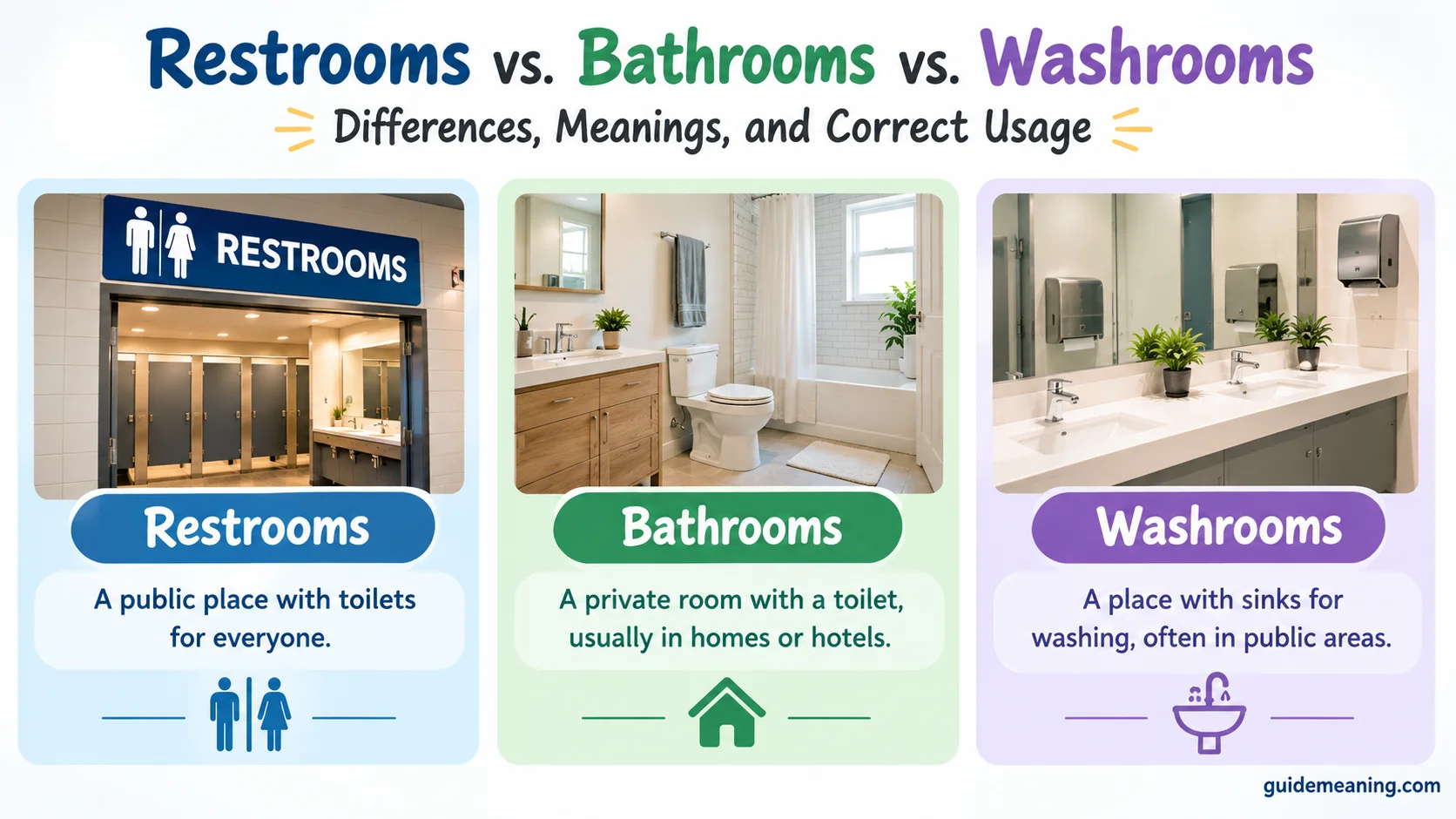

Restrooms vs. Bathrooms vs. Washrooms explains how local language habits shape everyday choices when people travel between different countries.
When traveling through public places, such as official complexes, buildings, shopping malls, airports, restaurants, and offices, you may notice different signs for similar facilities. These everyday word choices can confuse English speakers because the terms are often used interchangeably. However, regional usage, culture, social habits, geography, and cultural norms influence which word sounds familiar. The same room may have different names across English-speaking countries, even when the basic purpose remains the same.
In the United States, American English commonly uses bathroom in everyday speech. This normal and extremely common word describes a room in a home with a toilet, sink, bath, or shower. People use it to use the toilet, wash their hands, and freshen up. At someone’s home, a friend might have directed you to the bathroom because it is the standard choice in a home setting. By contrast, restroom is a polite word and a common choice for public facilities, especially in theaters, stores, and other public settings. A sign for the restroom helps visitors find public restrooms, which provide a public toilet and hygiene facilities. In Canada, Canadian usage often prefers washroom, particularly in public places. A sign for the washroom may be familiar when traveling up north, while a sign for the bathroom is common in homes. British English often uses toilets. Resources from Oxford, Cambridge, and Canadian government terminology help explain these regional patterns in English usage.
The difference between these terms depends on the setting, context, and particular English-speaking community. Their meanings refer to a similar physical room, but established usage determines which term sounds natural. American usage often favors restroom for public facilities, while bathroom remains familiar in homes. Canadian usage makes washroom a natural choice in many public settings. The correct choice depends on where you live, who you are talking to, and whether the place is private or public. At a foreign airport, signs pointing to these facilities may use different labels. Although these labels can seem confusing, they may lead to the same place, without any real difference in the facility itself. The key differences involve regional variation, regional preference, the preferred term, and cleanliness expectations, rather than strict definitions. These interchangeable terms are used worldwide, but local usage can change. Learning how people choose and use words differently improves speaking and understanding across different regions. Even Bath Decor may appear in a home design context rather than refer to a public facility.
Let’s dive in!
Quick Answer:
- Restroom: A common American English term for a public toilet facility, especially in restaurants, airports, stores, and offices.
- Bathroom: A common American English term for a room with a toilet, whether or not it contains a bathtub or shower. It also refers literally to a room used for bathing.
- Washroom: A widely used Canadian English term for a room with toilet and washing facilities, particularly in public buildings.
The main difference is regional usage, not a strict difference in meaning. In American English, restroom and bathroom often refer to the same facility. In Canada, washroom is a common alternative. In British English, toilet is generally the more natural everyday term for the facility.
Comparison Overview
The following table summarizes the main differences between restrooms, bathrooms, and washrooms.
| Feature | Restroom | Bathroom | Washroom |
| Main meaning | A facility with toilet access | A room associated with bathing or toilet use | A room for washing and toilet use |
| Common regional usage | United States | United States | Canada |
| Typical setting | Public buildings and businesses | Homes and public places | Public buildings and shared facilities |
| Must contain a bathtub? | No | No, in common American usage | No |
| Common tone | Polite and neutral | Casual and neutral | Neutral |
| Common American example | Where is the restroom? | Where is the bathroom? | Understood but less typical |
| Common Canadian example | Understood and used | Understood and used | Where is the washroom? |
| Common British alternative | Less typical in everyday speech | Often associated with bathing | Understood, but less typical than toilet |
These distinctions describe common patterns rather than universal rules. People use different terms depending on their location, habits, and the building they’re discussing.
For instance, an American visiting Toronto might hear someone ask for the washroom. In New York, the same person might see a restroom sign or ask for the bathroom. Neither choice is inherently more correct.
Main Differences Between Restrooms, Bathrooms, and Washrooms
The clearest way to understand these terms is to examine their meanings, regional preferences, and everyday applications.
Restroom vs. Bathroom vs. Washroom: Difference in Meaning
Restroom usually refers to a facility where people can use a toilet and freshen up. The word is especially common in American public settings.
Bathroom traditionally describes a room used for bathing. However, American English frequently uses it for any room containing a toilet, even when the room has no bathing facilities.
Washroom emphasizes washing and personal hygiene. In Canadian English, it commonly describes a public or shared facility containing a toilet and sink.
Consider three everyday examples:
- At an American airport, a traveler might ask, “Where is the restroom?”
- At an American friend’s house, a guest might ask, “Can I use your bathroom?”
- At a Canadian shopping mall, a visitor might ask, “Where is the washroom?”
All three questions can refer to the same basic need. The difference lies mainly in local vocabulary and context.
Restroom vs. Bathroom vs. Washroom: Regional Usage
Regional preference is one of the most important differences between these terms.
- American English: Bathroom and restroom are both common. People often use bathroom at home and restroom in public settings.
- Canadian English: Washroom is widely used, especially for public facilities. Canadians also understand and use bathroom and restroom.
- British English: Toilet is a common everyday term for the facility. Bathroom often refers to a room containing a bath or shower, although usage varies.
These preferences aren’t strict rules. Someone in the United States can say washroom and be understood, just as a Canadian can ask for the restroom.
However, choosing the locally familiar term usually makes communication sound more natural.
Restroom vs. Bathroom vs. Washroom: Difference in Formality
People sometimes assume that restroom sounds more polite than bathroom. That impression comes partly from American public and commercial language.
Restaurants, hotels, offices, and airports often use restroom on signs because it sounds neutral and professional. In ordinary conversation, though, bathroom is also perfectly acceptable.
In Canada, washroom is a standard, polite choice for public facilities. It doesn’t necessarily sound more formal than the alternatives.
Here’s a practical comparison:
| Situation | Natural wording |
| Asking a server in a US restaurant | Where is the restroom? |
| Asking a friend at home in the US | Can I use your bathroom? |
| Asking a receptionist in Canada | Where is the washroom? |
| Asking for facilities in the UK | Where are the toilets? |
| Writing a public sign in the US | Restrooms |
| Writing a public sign in Canada | Washrooms |
The best term is the one your audience expects to hear. You don’t need to memorize a rigid politeness hierarchy because local custom matters more.
What Does Restroom Mean?
A restroom is a room or facility in a public building where people can use the toilet and wash their hands. The term is especially common in American English.
English meaning – Cambridge Dictionary
Despite its name, a restroom doesn’t need to provide a place to sit, relax, or take a break. The word functions as a conventional label for a public toilet facility.
Examples of Restroom in a Sentence
Here are some natural examples showing how Americans use restroom in everyday conversation.
- Excuse me, where is the restroom?
- The airport restroom is near Gate 12.
- Please keep the restroom clean for other customers.
- The restaurant has separate restrooms for human beings.
- I stopped at a gas station to use the restroom.
- The office restroom is down the hall.
Notice that each example involves a shared facility or a public-facing setting. Although people can use restroom in other contexts, this is where the word feels especially natural in American English.
Where Is Restroom Commonly Used?
You’ll frequently encounter restroom in the following places:
- Restaurants: Staff members might direct customers to the restroom.
- Airports: Signs identify restroom locations throughout terminals.
- Shopping malls: Public directories often list restrooms near elevators or food courts.
- Offices: Employees may refer to shared facilities as restrooms.
- Schools and theaters: The term appears in everyday speech and facility signage.
The word also works well in customer service because it sounds neutral and professional without being overly formal.
For example, a hotel employee might say, “The restrooms are just past the lobby.” That sounds perfectly natural in the United States.
What Does Bathroom Mean?
A bathroom is a room associated with bathing and personal hygiene. In American English, however, the word commonly refers to a room containing a toilet and a place to wash your hands.
A bathtub or shower may be present, but neither is necessary for the everyday American meaning.
definition in the Cambridge English Dictionary
This distinction explains why Americans often ask for the bathroom in restaurants, stores, and other public places. They’re asking for toilet facilities, not necessarily a room where they can take a bath.
Examples of Bathroom in a Sentence
Here are several examples of how people use bathroom naturally.
- The bathroom is next to the kitchen.
- May I use your bathroom?
- The hotel room has a spacious bathroom.
- She washed her hands in the bathroom.
- The restaurant bathroom needs cleaning.
- Our house has two bathrooms and three bedrooms.
The word works in both residential and public settings. Its meaning usually becomes clear from the surrounding conversation.
For instance, when a guest asks to use your bathroom, you don’t need to explain whether it has a bathtub. The request ordinarily means the guest needs to use the toilet or wash their hands.
Does a Bathroom Need a Bathtub or Shower?
No. In everyday American English, a bathroom can contain a toilet and sink without a bathtub or shower.
The word’s practical meaning has expanded beyond its literal association with bathing. As a result, people commonly call several different room layouts bathrooms.
Consider these examples:
- Full bathroom: Typically contains a toilet, sink, and bathtub or shower.
- Half-bath: Usually contains a toilet and sink but no bathtub or shower.
- Powder room: Often a small guest bathroom containing a toilet and sink.
- Primary bathroom: A bathroom associated with a home’s primary bedroom.
These labels describe common residential arrangements, although terminology and design conventions can vary.
The distinction matters when discussing real estate. A listing advertising three bathrooms might include a mixture of full bathrooms and half-baths, depending on the listing’s terminology and counting conventions. Check the property’s actual specifications rather than assuming every bathroom contains a bathtub.
What Does Washroom Mean?
A washroom is a room equipped for washing and using the toilet. The term is widely associated with Canadian English, particularly when people discuss facilities in public buildings.
The Cambridge Dictionary’s washroom entry defines it as a room with a toilet and a place to wash your hands, often in a public place such as a restaurant or school.
English meaning – Cambridge Dictionary
In Canada, washroom is a familiar, neutral word. You might hear it in a shopping center, office, restaurant, school, or hotel.
Although the word emphasizes washing, a washroom doesn’t need a bathtub or shower. Like restroom, it commonly refers to a facility intended for toilet use and handwashing.
Examples of Washroom in a Sentence
Here are examples showing how people use washroom in everyday conversation.
- Excuse me, where is the washroom?
- The washroom is beside the elevators.
- The restaurant has clean, accessible washrooms.
- Please wash your hands before leaving the washroom.
- The school washrooms close during maintenance.
- There’s a public washroom near the park entrance.
These sentences sound natural in Canadian contexts, especially when referring to public facilities.
An American speaker would usually understand them, too. However, restroom or bathroom might be the more familiar choice in many American settings.
Where Is Washroom Commonly Used?
The word washroom appears in several everyday settings:
- Canadian shopping centers: Signs direct visitors toward public washrooms.
- Restaurants and cafés: Staff members may tell customers where the washroom is located.
- Schools and universities: The word commonly describes shared facilities.
- Workplaces: Employees may refer to the washroom near their offices.
- Public buildings: Visitors may find washroom signs near corridors, elevators, and waiting areas.
The term isn’t exclusive to Canada. English speakers elsewhere may use it as well, and its meaning can depend on local habits.
The useful rule is simple: if you’re communicating with a Canadian audience, washroom is a natural option for public toilet facilities.
Is a Restroom the Same as a Bathroom?
Often, yes. In American English, restroom and bathroom can refer to the same physical facility.
The difference usually concerns context rather than the room’s layout. A restaurant might label its facilities restrooms, while a customer casually asks the server where the bathroom is.
Both expressions can describe a room containing toilets and sinks without bathtubs.
However, the terms aren’t perfect synonyms in every context.
A private bathroom in a home might contain a bathtub, shower, toilet, and sink. A public restroom generally serves people using a shared building and may contain several toilet stalls.
The words can overlap even when the facilities differ in size, purpose, and layout.
Restroom vs. Bathroom: Practical Examples
Imagine three situations:
- At home, you tell a family member, “I’m cleaning the bathroom.”
- At a restaurant, you ask, “Could you tell me where the restroom is?”
- At a hotel, you tell a receptionist, “The bathroom sink is leaking.”
Each sentence uses a natural expression. Replacing bathroom with restroom in every example might sound less natural, even though the words overlap in meaning.
Is a Washroom the Same as a Restroom?
Yes, the terms often refer to the same type of public facility. Their most noticeable difference is regional preference.
In the United States, people commonly say restroom. In Canada, washroom is a familiar alternative and often the preferred term in public settings.
Imagine an airport with a toilet area, sinks, mirrors, and several stalls. An American traveler might call it a restroom, while a Canadian traveler might call it a washroom.
Neither speaker needs to be describing a different room. They’re using different regional vocabulary for the same facility.
Washroom vs. Restroom: Example Sentences
| American English | Canadian English |
| Where is the restroom? | Where is the washroom? |
| The restroom is near the entrance. | The washroom is near the entrance. |
| The airport restrooms are downstairs. | The airport washrooms are downstairs. |
These examples illustrate common preferences rather than strict national rules. Canadians can use restroom, and Americans can use washroom without making a grammatical error.
Is a Bathroom the Same as a Washroom?
Sometimes. Both words can describe a room with a toilet and sink, but their everyday use varies by region and context.
In American English, bathroom is common in homes and everyday conversation. It can also refer to public toilet facilities. In Canadian English, washroom is especially familiar when discussing shared facilities.
Consider a family visiting a Canadian hotel. They might refer to the bathroom inside their room but ask hotel staff where the public washroom is located.
This example shows why the terms shouldn’t be treated as mutually exclusive regional labels. People can use more than one term depending on the facility they’re discussing.
Bathroom vs. Washroom: Which Is More Appropriate?
Choose bathroom when referring to a home’s bathing or toilet room, especially in American English.
Choose washroom when discussing public or shared facilities in a Canadian context.
When writing technical documents, property listings, or construction plans, use precise descriptions if the room’s fixtures matter. For example, specifying “a room with a toilet and sink but no shower” communicates more than simply labeling it a washroom.
Restroom vs. Bathroom vs. Washroom in American, Canadian, and British English
English speakers may describe the same facility differently depending on where they live. Understanding these regional differences helps you choose the right term without overthinking the conversation.
American English: Restroom vs. Bathroom
In the United States, restroom and bathroom are both widely understood and commonly used.
The setting often influences which word people choose. At home, bathroom is a natural choice. In public buildings, restroom frequently appears on signs and in customer service conversations.
For example:
- At home: “The bathroom is upstairs.”
- At a restaurant: “The restroom is next to the kitchen.”
- At a shopping mall: “Where’s the nearest restroom?”
- At a friend’s house: “Can I use your bathroom?”
These are common preferences, not mandatory rules. An American might ask for the bathroom in a restaurant without sounding unusual.
Canadian English: Washroom vs. Bathroom
In Canada, washroom is a familiar term for public toilet facilities. You’ll often encounter it in restaurants, shopping centers, schools, and workplaces.
The word bathroom is also widely understood and used in Canada. Some speakers favor it when referring to a private room in a home, while washroom often feels natural for shared facilities.
washroom
For example:
- At a shopping mall: “The washroom is on the second floor.”
- At home: “The bathroom is next to the bedroom.”
- At a restaurant: “Could you point me toward the washroom?”
Canadian speakers may use these words differently depending on personal habits and local conventions. The examples illustrate common patterns rather than rules that apply to every person.
British English: Toilet vs. Bathroom
British English uses a different set of everyday preferences. Toilet is a common term for the facility, while loo is a familiar informal alternative.
The word bathroom generally refers to a room with a bath or shower. Therefore, asking for the bathroom in Britain can sometimes suggest a room used for bathing rather than simply asking where the toilets are.
Examples include:
- “Excuse me, where are the toilets?”
- “The loo is upstairs.”
- “The public toilets are near the station.”
- “The bathroom has a separate shower.”
Although British speakers generally recognize restroom and washroom, these words may sound more American or less typical in everyday British conversation.
Which Term Should You Use?
Choosing between restroom, bathroom, and washroom becomes easier when you consider your audience and the situation.
You don’t need to memorize every regional variation. Start with the country you’re in and whether you’re discussing a private room or a public facility.
When to Use Restroom
Use restroom when referring to public toilet facilities in American English.
It’s particularly suitable for polite requests, customer service, and public signs.
Examples:
- “Excuse me, where is the restroom?”
- “The restrooms are located near the main entrance.”
- “Please use the restroom on the first floor.”
For businesses targeting American customers, restrooms is a familiar label for shared toilet facilities.
When to Use Bathroom
Use bathroom when discussing a residential bathroom or referring casually to toilet facilities in American English.
Examples:
- “The bathroom needs a new sink.”
- “May I use your bathroom?”
- “There’s another bathroom upstairs.”
- “The bathroom has a bathtub and separate shower.”
The term works well in ordinary conversation because most American listeners understand its intended meaning from context.
When to Use Washroom
Use washroom when speaking with a Canadian audience, particularly about public or shared toilet facilities.
Examples:
- “Where is the nearest washroom?”
- “The washrooms are beside the elevators.”
- “The office washroom is closed for repairs.”
The word is also understood elsewhere. However, if you’re writing signs for a Canadian building, washroom is often a natural choice.
Which Term Works Best for Public Signs?
Public signs should use the term visitors will recognize most easily. The location and audience matter more than a universal preference.
| Location or audience | Suggested sign |
| American restaurant | Restrooms |
| American home | Bathroom |
| Canadian shopping center | Washrooms |
| British train station | Toilets |
| International airport | Follow established local signage conventions |
For international facilities, clear pictograms and accessible directions can help visitors regardless of their first language.
Restroom, Bathroom, and Washroom: Common Usage Mistakes
Although these terms overlap, several misconceptions can lead to awkward wording or misunderstandings.
Assuming Every Bathroom Must Have a Bathtub
This is a common misunderstanding among English learners. In American English, bathroom can describe a room containing only a toilet and sink.
For example, a small guest bathroom may have no shower or bathtub. Calling it a bathroom is still perfectly natural.
Assuming People Actually Rest in a Restroom
The word restroom doesn’t require a place to relax. It conventionally refers to public toilet facilities in American English.
Don’t assume a restroom contains chairs, couches, or sleeping areas just because of its name.
Treating Washroom as Incorrect Outside Canada
Although washroom has a strong association with Canadian English, it isn’t inherently incorrect elsewhere. Dictionaries recognize the word, and English speakers outside Canada may use it.
Regional familiarity determines how natural the term sounds in a particular setting.
Assuming All Three Words Always Mean Exactly the Same Thing
The terms often overlap, but they don’t describe every room identically.
A bathroom in a home might contain a bathtub, shower, toilet, and sink. A public restroom might contain several toilet stalls and shared sinks. A washroom can describe a similar shared facility.
When the physical layout matters, describe the actual fixtures instead of relying on the room’s name.
Assuming One Term Is Always More Polite
No single word is the most polite choice everywhere.
Restroom often sounds professional in American public settings. Bathroom is common in casual American speech, and washroom is a normal choice in Canada.
Using the familiar local term usually sounds more natural than choosing a word simply because you think it sounds formal.
A Real-World Usage Case Study
Imagine an American traveler visiting Toronto before continuing to London. The traveler needs to find toilet facilities in three different locations.
Stop One: An Airport in the United States
The traveler sees a sign marked Restrooms and asks an employee, “Where is the restroom?” The wording fits common American public usage
Stop Two: A Shopping Center in Toronto
The traveler sees a sign marked Washrooms. A Canadian employee might use the same term when giving directions. The facility serves the same basic purpose.
Stop Three: A Train Station in London
The traveler sees a sign marked Toilets. Asking “Where are the toilets?” would sound natural in this setting.
The important lesson is that the facility doesn’t need to change for the vocabulary to change. The most natural word depends on local English conventions.
FAQs:
What is the main difference between a restroom, bathroom, and washroom?
The main difference is regional usage. Bathroom is common in American homes, restroom is often used for public facilities in the United States, and washroom is widely used in Canada.
Is restroom more polite than bathroom?
In American English, restroom often sounds more formal and polite in public places. However, bathroom is also polite and widely accepted in everyday conversation.
Do Americans say bathroom or restroom?
Americans use both words. They commonly say bathroom when referring to a room in a home, while restroom often appears in restaurants, airports, theaters, and other public places.
Why do Canadians say washroom?
Washroom is a familiar term in Canadian English. People commonly use it when asking for or identifying a public toilet facility.
Is washroom correct in British English?
People can understand washroom in Britain, but toilet is generally more common when referring to a public facility. Bathroom usually refers to a room with a bath or shower.
Can bathroom refer to a room without a bathtub?
Yes. In American English, bathroom commonly describes a room with a toilet and sink, even if it does not have a bathtub. The word does not always mean that the room contains a bath.
Which word should I use when traveling abroad?
Use the word that is familiar in your destination. Restroom is a safe choice in many public places in the United States, while washroom is common in Canada. In Britain, asking for the toilet is generally natural.
Conclusion:
Understanding Restrooms vs. Bathrooms vs. Washrooms helps you choose the right words in everyday conversations. Although all three terms can refer to similar facilities, their usage varies by country and setting. Americans commonly use bathroom at home and restroom in public places. Canadians often prefer washroom, while British English commonly uses toilet. When traveling, pay attention to local signs and listen to how people speak. Choosing the familiar regional term makes communication easier and helps you feel more confident wherever you go.