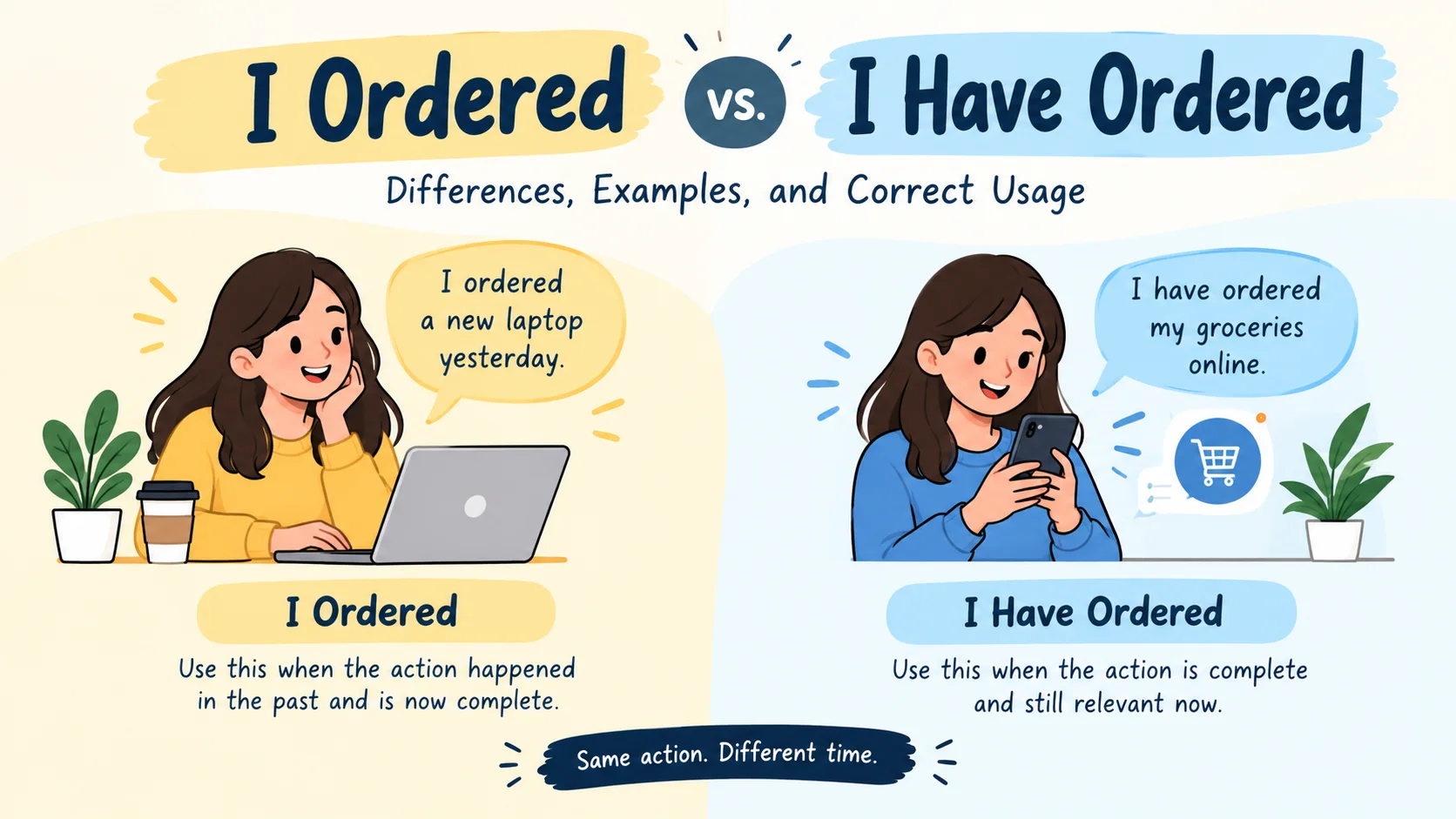

When you’re scratching your head or feeling uncertain about the correct way to describe a pizza order, remember that I Ordered vs. I Have Ordered depends on timing and meaning, not just grammar.
The English language can feel like a tricky beast when describing past actions. A tiny change in tense can make two phrases seem similar, but their appearances can be deceiving. This difference may not seem like a big deal in the world of English, yet understanding the distinction is a key to clearer communication and accurate communication. This nuance can impress your friends, demonstrate your grammatical prowess, and help you avoid potential misunderstandings. If you’ve ever paused to decide which form to use, you’re in the right place. The best part is that the answer may surprise you. Understanding this difference can improve your English and make every sentence easier to follow.
The simple past tense describes an action that happened in the past at a specific time. For example, I ordered pizza last night tells the reader that the action is complete. The present perfect tense shows that an action happened at an unspecified time before now. Here, the focus is on the result of the action, rather than when it was done. Saying I have ordered pizza suggests that the order is complete and the pizza could arrive at any moment. The current state and ongoing effects of the past action matter more than the exact time. These clear examples show how tense changes meaning in everyday English. One phrase highlights a finished action at a known time, while the other emphasizes a present connection to the past. Both phrases are correct, but their usage depends on the message you want to share.
In daily conversation, I ordered sounds natural when you share exact details and clear timing, such as telling a friend about an order from last night. This wording provides quick understanding and supports real communication. Meanwhile, I have ordered works well when the result matters more than the exact time. Learners should understand this distinction in spoken English and written English, especially in professional writing and formal contexts, where unclear wording can cause misunderstandings. Readers and writers may experience confusion when choosing between these phrases. However, consulting a helpful article can make the concept easier to understand. This brief guide aims to explain the difference between two phrases through practical examples and simple rules you can use whenever you discuss past actions.
Let’s dive in!
Quick Answer:
“I ordered” describes a completed action in the past, often with attention to when it happened. “I have ordered” describes a completed action that has a connection to the present.
- I ordered: Use the simple past when discussing a finished past event. Example: “I ordered lunch yesterday.”
- I have ordered: Use the present perfect when the completed action matters now. Example: “I have ordered lunch, so we can eat soon.”
Consider these additional examples:
- “I ordered the book last week.” The sentence identifies a specific past time.
- “I have ordered the book.” The sentence confirms that the order has been placed, without specifying when.
- “I ordered coffee before the meeting.” The sentence describes an event that happened earlier.
- “I have already ordered coffee.” The sentence emphasizes that the task is complete.
The easiest rule to remember: Use I ordered for a past event and I have ordered when its present relevance matters. Context determines which expression sounds most natural.
Comparison Overview
Although both expressions use the verb order, they follow different grammatical patterns. Knowing how each tense works makes choosing between them much easier.
| Feature | I Ordered | I Have Ordered |
| Grammatical tense | Simple past | Present perfect |
| Verb structure | Subject + past-tense verb | Subject + have + past participle |
| Main purpose | Describes a completed past action | Connects a past action with the present |
| Specific finished time | Common and natural | Generally avoided |
| Focus | The past event or its timing | Completion, result, or present relevance |
| Common time expressions | Yesterday, last week, two hours ago | Already, just, yet, so far |
| Example | I ordered dinner last night. | I have ordered dinner, so it’s on its way. |
| Typical question | When did you order it? | Have you ordered it yet? |
One important point deserves attention: the present perfect doesn’t automatically mean an action happened recently. You can say, “I have ordered from that restaurant many times.” The sentence describes past experiences that remain relevant now, not necessarily a recent order.
Similarly, the simple past doesn’t mean an action has no present consequences. An order placed yesterday may still be on its way today. The difference concerns how you present the action, not whether its consequences continue.
Main Differences Between “I Ordered” vs. “I Have Ordered”
The most useful way to understand these expressions is to look at their time references, grammatical structures, and purposes. Both describe an order placed before the moment of speaking, but each tense frames that action differently.
“I Ordered” Focuses on a Past Event
The expression “I ordered” uses the simple past tense. It tells the reader or listener that an action happened and is complete.
You don’t need to explain what happened afterward. The sentence can stand on its own when the context makes the meaning clear.
For example:
- I ordered a new phone last Monday.
- I ordered chicken instead of fish.
- I ordered the supplies before the office closed.
- I ordered a coffee when I arrived.
- I ordered those shoes during the holiday sale.
Each example presents the order as a past event. Some sentences include a specific time, while others rely on the surrounding conversation.
Imagine that a friend asks, “What did you do after work yesterday?”
You might answer, “I ordered takeout and watched a movie.”
Here, the simple past fits naturally because you’re describing completed events in a past period.
“I Have Ordered” Connects the Past With the Present
The expression “I have ordered” uses the present perfect tense. It tells someone that an order was placed before now, with some connection to the current situation.
That connection might involve a completed task, a present result, or an experience that matters now.
For example:
- I have ordered the replacement parts.
- I have ordered dinner, so you don’t need to cook.
- I have ordered from that store several times.
- I have ordered the documents you requested.
- I have ordered the supplies we need for tomorrow.
Notice how these examples emphasize completion, experience, or present relevance. They don’t specify an exact, finished time for the order.
Suppose your manager asks whether you’ve arranged the supplies for tomorrow’s meeting. You can respond, “I have ordered everything we need.”
The sentence reassures your manager that you’ve completed the task. The important information isn’t when you placed the order. It’s that the arrangements are complete.
The Difference Depends on Context, Not Just the Words
Sometimes, both expressions describe the same event without changing the basic facts.
Consider these sentences:
- “I ordered the printer.”
- “I have ordered the printer.”
Both can mean that you placed an order for a printer. However, the speaker may have a different reason for choosing each tense.
The first sentence might answer, “What did you order yesterday?” The second might answer, “Have you arranged the printer purchase?”
Grammar helps you frame the event according to your purpose. It doesn’t necessarily change the event itself.
What Does “I Ordered” Mean?
“I ordered” is the simple past form of the verb order. You use it to describe an action that happened before the present and is now complete.
The verb ordered is the past-tense form of order. It stays the same for every subject in the simple past:
- I ordered.
- You ordered.
- She ordered.
- We ordered.
- They ordered.
This consistency makes the simple past relatively easy to use. You don’t need an auxiliary verb to form an ordinary affirmative statement.
When to Use “I Ordered”
Several situations call for the simple past tense.
When you mention a specific past time: Use “I ordered” with expressions such as yesterday, last night, last month, and three days ago.
Examples:
- I ordered groceries yesterday.
- I ordered the laptop two weeks ago.
- I ordered dinner last night.
These time expressions identify completed periods in the past.
When you tell a story: The simple past is the natural choice when narrating a sequence of completed actions.
For example:
“I arrived at the restaurant, checked the menu, ordered pasta, and paid the bill.”
Each verb describes an event in the sequence. The simple past keeps the story moving smoothly.
When you describe a previous decision: Use this tense when explaining what you chose or requested at an earlier time.
For example, “I ordered the blue jacket because the black one was unavailable.”
The sentence explains a past decision and its reason.
When the timing matters: If someone wants to know when you placed an order, the simple past often provides the clearest answer.
For example:
- Question: “When did you order the package?”
- Answer: “I ordered it on Tuesday.”
The response directly identifies the time of the action.
Examples of “I Ordered” in Sentences
| Example | Why the Simple Past Works |
| I ordered pizza last night. | The sentence identifies a completed past time. |
| I ordered a new laptop in September. | The purchase happened during a specified past period. |
| I ordered coffee before class. | The order occurred before another past event. |
| I ordered the wrong size by mistake. | The sentence reports a past action. |
| I ordered from that restaurant during my vacation. | The order belongs to a completed past experience. |
| I ordered the documents and sent them to my manager. | The sentence narrates two completed actions. |
Keep in mind that the simple past can describe an action without an explicit time expression. For instance, “I ordered the wrong item” is perfectly natural when you’re explaining a problem.
What Does “I Have Ordered” Mean?
“I have ordered” is the present perfect form of the verb order. It combines the auxiliary verb have with the past participle ordered.
The basic structure is:
Subject + have/has + past participle
Examples include:
- I have ordered.
- You have ordered.
- We have ordered.
- They have ordered.
- She has ordered.
- He has ordered.
Use have with I, you, we, and they. Use has with he, she, and it.
The present perfect places a past action in a frame connected to the present. It doesn’t usually identify exactly when the action happened.
When to Use “I Have Ordered”
When the current result matters: Use the present perfect to confirm that you completed an action relevant to the situation now.
Example: “I have ordered the food, so we can stop looking at the menu.”
The order is complete, and that information affects what happens next.
When you report completion: The present perfect works well when someone asks whether you’ve completed a task.
Example:
- Question: “Have you ordered the office supplies?”
- Answer: “Yes, I have ordered them.”
The response confirms completion without focusing on the exact time.
When you discuss experience: You can use the present perfect to describe repeated experiences over an unfinished period or experiences relevant to the present.
Example: “I have ordered from that website several times.”
This statement tells the listener about your experience. It doesn’t specify the dates of those orders.
When you discuss an unfinished time period: The present perfect can describe actions within a period that continues through the present.
Example: “I have ordered three books this week.”
This sentence works when the week is still in progress and the speaker is counting orders made so far. If the week has ended, the simple past may be more appropriate: “I ordered three books last week.”
Examples of “I Have Ordered” in Sentences
| Example | What It Communicates |
| I have ordered dinner. | Dinner has been ordered, and that fact matters now. |
| I have already ordered the replacement part. | The task is complete. |
| I have ordered the books you requested. | The requested action is complete. |
| I have ordered from this company before. | The speaker has previous experience. |
| I have ordered twice this month. | The sentence counts orders during a period that may still be continuing. |
| I have just ordered your coffee. | The order was placed recently, with present relevance. |
One detail matters here: placing an order doesn’t mean receiving the item. If you say, “I have ordered the laptop,” you’re confirming the purchase order, not necessarily delivery.
Read More: Insight vs. Incite: Differences, Examples, and Correct Usage Just for You
When Should You Use “I Ordered” Instead of “I Have Ordered”?
Choosing the simple past becomes easier when you focus on the time of the event or the way you’re telling the story.
Use “I Ordered” With Specific Past Times
When you mention a definite time in a completed past period, the simple past is usually the correct choice.
Common examples include:
- Yesterday
- Last night
- Last Friday
- Two hours ago
- In 2024
- When I visited New York
For example:
- Correct: “I ordered the package yesterday.”
- Generally incorrect in standard English: “I have ordered the package yesterday.”
Why? The word yesterday identifies a finished period in the past. The present perfect usually doesn’t pair with that kind of specific finished-time reference.
Here’s another example:
“I ordered the office furniture last month, but it hasn’t arrived yet.”
The first clause uses the simple past because the order happened last month. The second uses the present perfect because the delivery status remains relevant now.
This combination is completely natural. Different clauses can use different tenses because they communicate different time relationships.
Use “I Ordered” to Narrate Past Events
Stories often describe actions in the order they happened. The simple past helps readers follow the sequence.
Consider this example:
“On Saturday, I visited the bookstore, ordered a novel, paid for it, and went home.”
Every action belongs to a completed past event. Using the present perfect for each verb would make the story sound unnatural in this context.
You can also use the simple past to explain how a problem developed:
“I ordered the wrong model last week, noticed the mistake the next day, and contacted customer service.”
The simple past connects each event to a clear sequence.
Use “I Ordered” When Reporting What Happened
Sometimes, you’re simply telling someone about an event. You aren’t emphasizing its current result.
For example:
“My colleague asked for a vegetarian meal, so I ordered a vegetable pizza.”
The sentence explains what happened in response to a request. The simple past suits this narrative purpose.
Compare that with:
“I have ordered a vegetable pizza, so there’s something everyone can eat.”
The second version highlights the current benefit of completing the order.
Both sentences are correct. The difference lies in the speaker’s emphasis.
When Should You Use “I Have Ordered” Instead of “I Ordered”?
The present perfect works best when a past action connects naturally to the current conversation. It often appears when you report completion, describe experience, or explain a present situation.
Use “I Have Ordered” When the Result Matters Now
Imagine that your family is deciding what to eat. Everyone is hungry, and nobody wants to start cooking.
You might say, “I have ordered dinner, so we can relax.”
The sentence emphasizes the current result. Dinner has been ordered, and that fact affects the family’s next steps.
Here are more examples:
- “I have ordered the medicine, so we need to wait for delivery.”
- “I have ordered the replacement charger, so the new one should arrive soon.”
- “I have ordered the supplies, so the team can prepare for tomorrow.”
- “I have ordered the gift, so that birthday task is taken care of.”
In each case, the order matters because of its effect on the present situation.
However, the present perfect doesn’t guarantee that the expected result has already happened. An order can be complete while delivery remains pending.
Use “I Have Ordered” When the Exact Time Doesn’t Matter
Sometimes, the listener needs confirmation rather than a timestamp.
For example:
Question: “Have you ordered the printer?”
Answer: “Yes, I have ordered it.”
The answer confirms that the action is complete. The exact ordering time isn’t important to the question.
Compare that exchange with another:
Question: “When did you order the printer?”
Answer: “I ordered it on Monday.”
The second question asks about a specific past time, so the simple past is more natural.
This distinction also appears in customer service conversations, workplace updates, and personal messages.
Use “I Have Ordered” With “Already,” “Just,” and “Yet”
These words commonly appear with the present perfect, although American English also uses them with the simple past in many situations.
Already indicates that an action has happened sooner than expected or before the current point.
- “I have already ordered the food.”
- “I’ve already ordered the replacement cable.”
Just often indicates that an action happened a short time ago.
- “I have just ordered your coffee.”
- “I’ve just ordered the new keyboard.”
Yet commonly appears in questions and negative statements about whether something has happened by now.
- “Have you ordered the tickets yet?”
- “I haven’t ordered the tickets yet.”
American English speakers also commonly say, “I already ordered the food” and “I just ordered your coffee.” These simple past forms are natural in everyday conversation.
The best choice depends on the sentence, the context, and the variety of English you’re using.
Can You Say “I Have Ordered Yesterday”?
In standard English, “I have ordered yesterday” is generally incorrect when yesterday refers to the specific time of the order.
The problem isn’t the verb ordered. The problem is combining the present perfect with a specific, completed past-time expression.
Use the simple past instead:
- Incorrect in standard usage: I have ordered the package yesterday.
- Correct: I ordered the package yesterday.
- Correct: I have ordered the package.
- Correct: I ordered the package, and it arrived yesterday.
The third example doesn’t specify when the order happened. The fourth uses the simple past to report the order and its delivery within a past-time context.
Other finished-time expressions follow the same general rule.
| Avoid in Standard English | Natural Alternative |
| I have ordered it last night. | I ordered it last night. |
| I have ordered the books two days ago. | I ordered the books two days ago. |
| I have ordered lunch on Monday. | I ordered lunch on Monday. |
| I have ordered the item in 2023. | I ordered the item in 2023. |
Remember that “I have ordered it” is correct on its own. You don’t need to add a past-time expression to make the sentence complete.
“I Ordered” vs. “I Have Ordered” in Everyday Conversations
Real-life examples make tense differences easier to understand. The following situations show how both expressions work in natural American English.
Ordering Food
Suppose you went to a restaurant yesterday and tried a new dish. When your friend asks about the experience, you might say:
“I ordered the chicken pasta, and it was delicious.”
The simple past describes what happened during that visit.
Now imagine you’re at home and your family wants to know whether dinner is arranged.
“I have ordered pizza, so dinner is taken care of.”
The present perfect emphasizes that the task is complete and relevant now.
Shopping Online
Online shopping provides another clear comparison.
“I ordered the headphones last Friday, but they haven’t arrived.”
This sentence identifies the order’s timing. The present perfect in the second clause describes the current delivery status.
Now consider a different conversation:
“Have you ordered the headphones?”
“Yes, I have ordered them. I’m waiting for the confirmation email.”
Here, the present perfect confirms the completed task and connects it to the current situation.
Work and Business
In professional settings, tense choice can help make updates more precise.
Imagine your manager asks whether you’ve purchased supplies for an upcoming project.
“I have ordered the supplies we need.”
This response confirms that the task is complete.
However, if your manager asks when you placed the order, you might answer:
“I ordered the supplies last Tuesday.”
The first sentence reports completion. The second provides a specific past time.
Both are professional and grammatically correct.
Reporting a Completed Task
The distinction also applies to tasks beyond purchasing.
Consider these examples:
- “I submitted the report yesterday.” This emphasizes the past event and its timing.
- “I have submitted the report.” This confirms completion, often because someone needs the information now.
- “I booked the appointment last week.” This reports when the booking happened.
- “I have booked the appointment, so you can update the calendar.” This emphasizes the current consequence.
These examples demonstrate a useful principle: choose the tense that answers the question your listener actually needs answered.
Common Mistakes to Avoid
Even experienced English speakers sometimes hesitate between the simple past and present perfect. A few common mistakes explain why.
Using the Present Perfect With a Finished Past Time
Avoid combining the present perfect with expressions such as yesterday, last year, or three hours ago when they identify the exact time of the action.
- Incorrect in standard English: “I have ordered it two hours ago.”
- Correct: “I ordered it two hours ago.”
If the time isn’t specified, “I have ordered it” works naturally.
Assuming “I Have Ordered” Means the Item Has Arrived
Placing an order and receiving a delivery are separate events.
For example, “I have ordered a new desk” means you’ve placed the order. It doesn’t tell anyone whether the desk has shipped or arrived.
To describe delivery, use a sentence such as “My new desk has arrived.”
Forgetting the Past Participle
The present perfect requires have or has + past participle.
Because order is a regular verb, its past tense and past participle share the same form: ordered.
- Correct: I have ordered the food.
- Incorrect: I have order the food.
- Correct: She has ordered the food.
- Incorrect: She have ordered the food.
Believing the Present Perfect Always Means “Recently”
The present perfect can describe experiences that span a much longer period.
For example, “I have ordered from that restaurant many times” describes repeated experiences. The orders may have happened over several years.
The tense connects those experiences with the present rather than limiting them to recent events.
Assuming Both Expressions Always Mean Exactly the Same Thing
The expressions can communicate similar basic facts, but context affects their emphasis.
“I ordered the parts” reports a past action. “I have ordered the parts” often confirms completion in a current situation.
Neither tense is universally better. Each serves a different purpose.
Is “I Ordered” or “I Have Ordered” More Natural in American English?
Both expressions are natural in American English. The best choice depends on what you’re trying to communicate.
American speakers frequently use the simple past for completed actions, including recent events.
For example:
- “I just ordered lunch.”
- “I already ordered the tickets.”
- “I ordered it this morning.”
These sentences sound natural in everyday American conversation.
The present perfect is also common when speakers emphasize completion, experience, or present relevance.
For example:
- “I have ordered lunch.”
- “I’ve already ordered the tickets.”
- “I have ordered from that company before.”
British English often favors the present perfect in some situations where American English commonly uses the simple past. However, this isn’t an absolute rule. Both varieties use both tenses.
For American English, remember this practical guideline: Use the simple past when reporting a completed event, especially with a finished past time. Use the present perfect when the completed action matters to the current situation.
FAQs:
What is the main difference between “I ordered” and “I have ordered”?
“I ordered” uses the simple past tense to describe a completed action at a specific time. “I have ordered” uses the present perfect tense to connect a past action with the present.
Is “I ordered” grammatically correct?
Yes, “I ordered” is grammatically correct. You can use it when discussing a completed action in the past, especially when the time matters. For example, “I ordered pizza last night.”
When should I use “I have ordered”?
Use “I have ordered” when the exact time isn’t important, but the result matters now. For example, “I have ordered dinner, so we can wait for it to arrive.”
Can I say “I have ordered pizza last night”?
No, this sentence is generally incorrect in standard English. The phrase “last night” refers to a specific, finished time, so use the simple past: “I ordered pizza last night.”
Does “I have ordered” mean the order has arrived?
No, it doesn’t necessarily mean the order has arrived. It means you placed the order, and the result may still matter in the present. The pizza could be on its way or waiting to be prepared.
Which phrase is better for everyday conversation?
Both phrases are natural in everyday conversation. Use “I ordered” when mentioning a specific past time. Choose “I have ordered” when the current result or situation matters more.
Can I use “I ordered” in professional writing?
Yes, you can use “I ordered” in professional writing when describing a completed past action. For example, “I ordered the required supplies on Monday.” Use “I have ordered” when the present status of the order is more important.
Conclusion
Understanding I Ordered vs. I Have Ordered becomes easier when you focus on time and context. Use “I ordered” for a completed action at a specific past time. Choose “I have ordered” when the action’s result connects to the present. Both forms are correct when used in the right situation. With regular practice and clear examples, you can use these tenses confidently in everyday conversations, emails, and professional writing.

1 thought on “I Ordered vs. I Have Ordered: Differences, Examples, and Correct Usage”