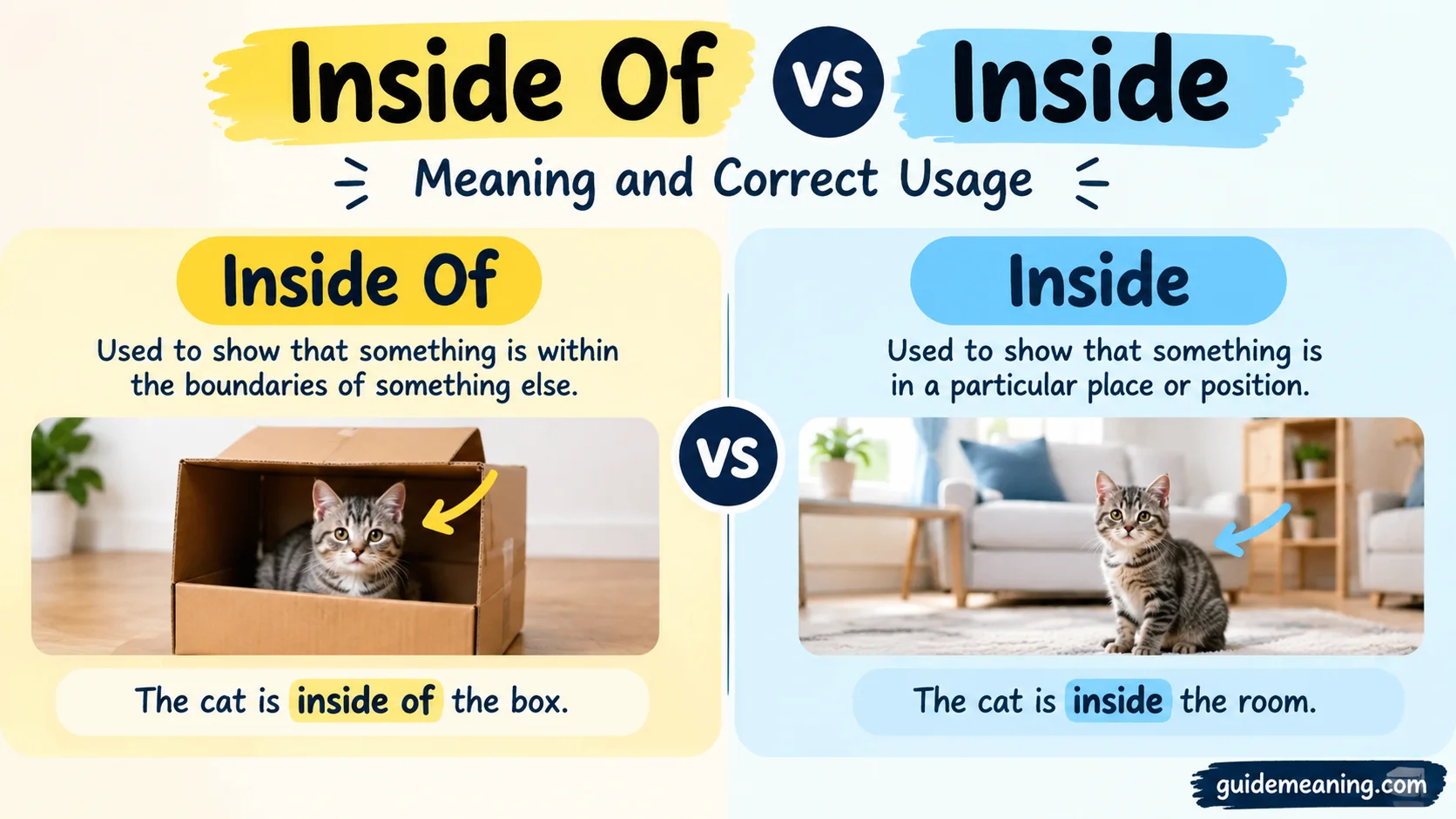

Inside Of vs. Inside becomes easier to understand when you compare their usage, meaning, and grammatical functions in everyday English.
Both expressions describe location, enclosure, or an interior part of something. For example, you might discuss the inside of a museum, car, closet, or computer. These interiors may contain art, tapestries, furniture, electric wires, microchips, soft material, or elegant decorations. Understanding these small grammar differences improves sentence structure, meaning and clarity, and language use in modern English writing.
Inside can function as a noun, adjective, adverb, or preposition, depending on the sentence. Inside of commonly appears in the construction “the inside of,” as in “The inside of the car looks clean.” Although the expressions can be interchangeable in certain contexts, their grammatical functions and sentence structure matter. Through reading aloud practice and listening to native speakers, you can notice their natural, casual, formal, or emphatic feeling. These examples clarify correct usage and improve communication flow.
To understand the topic, focus on practical applications instead of memorizing rules or studying complex structures. Misused sentences often come from overthinking rather than following natural rhythm. Select examples from daily communication and practice them through regular writing practice, speaking practice, and listening exposure. Learning gradually helps you use expressions automatically, with less hesitation and doubt. Consistent practice builds intuition, accuracy, confidence, strong conversational skills, and native like proficiency. These habits make real communication smoother and help you explain each phrase’s meaning clearly.
Let’s dive in!
Quick Answer:
What Is the Difference Between Inside Of and Inside?
In American English, inside and inside of can both describe something located within a place or container. However, inside is generally more concise, while inside of can sound more conversational. Use inside for most everyday and formal writing, and use inside of when it fits your natural speaking style or sentence rhythm.
TL;DR
- Inside is a preposition, adverb, adjective, and noun.
- Inside of can describe the same physical location as inside.
- Both forms are acceptable in many American English sentences.
- Formal writing generally benefits from the shorter expression.
- The inside of identifies an object’s inner surface or area.
- With time expressions, both forms can mean within a specified period.
What Does Inside Mean?
The word inside describes a position within something’s boundaries. It can refer to a physical location, an enclosed space, or someone’s private thoughts and feelings.
Examples of Inside
Consider these sentences:
- The cat is inside the house.
- Please put your wallet inside your backpack.
- Everyone went inside when it started raining.
- She kept her worries inside.
In the first two examples, inside functions as a preposition. In the third, it functions as an adverb because it doesn’t require an object after it.
The final example uses inside figuratively to describe hidden emotions. Therefore, the word isn’t limited to physical spaces.
Different Grammatical Roles
Inside serves several purposes depending on its position.
- Preposition: The package is inside the cabinet.
- Adverb: The children ran inside.
- Adjective: He used the inside pocket.
- Noun: The inside of the box was scratched.
These examples show why context matters. Although the word stays the same, its grammatical role changes.
What Does Inside Of Mean?
The phrase inside of usually means the same thing as inside when describing a physical location. It appears frequently in informal American speech, although it also occurs in other English varieties and contexts.
Examples of Inside Of
Here are some natural examples:
- The keys are inside of the drawer.
- We waited inside of the house.
- She found a letter inside of her bag.
- The dog stayed inside of the fence.
In each example, inside of describes a location within something’s boundaries. You can remove of without changing the basic meaning.
For example, “We waited inside the house” communicates the same idea. However, some speakers prefer the longer phrase because it matches their usual speaking style.
Is Inside Of Grammatically Correct?
Yes, inside of is an established construction in American English. Major dictionaries recognize its use as a prepositional expression.
However, grammatical acceptability doesn’t mean every version sounds equally natural. In edited writing, inside is often the cleaner choice when of adds no useful meaning.
Inside Of vs. Inside: Key Differences
Both expressions can describe physical location, but their grammatical patterns and style deserve attention. For American readers, the most useful distinction involves sentence structure, conciseness, and context.
Comparison Table
| Feature | Inside | Inside Of |
| Basic meaning | Within something | Within something |
| Physical location | Standard and natural | Acceptable in many contexts |
| Formal writing | Usually preferred | Often less concise |
| Casual conversation | Common | Common in some speaking styles |
| Interior as a noun | The inside of the car | Not interchangeable in this construction |
| Time expressions | Inside an hour | Inside of an hour |
Which Form Should You Choose?
Use inside when you want a direct, straightforward sentence. For example, “Keep the documents inside the folder” sounds natural in professional instructions.
However, inside of can work well in casual dialogue. “I left my phone inside of the car” is understandable American English, even though many editors would remove of.
The choice usually concerns style rather than a major difference in meaning.
When Should You Use Inside?
Use inside when describing a location, an interior area, or a position within boundaries. It works in casual conversations and formal writing alike.
Use Inside for Clear, Concise Writing
Consider these examples:
- Please remain inside the building.
- The children are playing inside the garage.
- Put the groceries inside the refrigerator.
- The information appears inside the report.
Each sentence communicates its meaning without an unnecessary extra word. Consequently, inside is an excellent default choice for most writing.
Use Inside as an Adverb
You can also use inside without naming the place immediately afterward.
For example:
- It’s cold outside, so let’s go inside.
- The guests are already inside.
- I looked inside but couldn’t find anything.
In these sentences, inside stands alone. Adding of would require a different sentence structure and usually wouldn’t improve the wording.
When Should You Use Inside Of?
Use inside of when it sounds natural in conversation or suits the rhythm of a sentence. It can also appear in established expressions involving time.
Use Inside Of in Casual American Speech
Many American speakers naturally say inside of when discussing everyday situations.
For example:
- There’s a package inside of the mailbox.
- We stayed inside of the cabin during the storm.
- I found the receipt inside of my jacket.
These sentences are understandable, and the longer form isn’t automatically a grammatical error. Nevertheless, the shorter versions are equally clear.
Use Inside Of With Time Expressions
Both inside and inside of can mean within a particular period.
For example:
- I’ll finish the assignment inside an hour.
- I’ll finish the assignment inside of an hour.
- We should arrive inside two hours.
- We should arrive inside of two hours.
These sentences indicate that an event will happen within the stated period. Depending on context, within an hour or within two hours may sound more natural in formal writing.
Inside Of vs. Inside in American English
American English accepts both constructions, although speakers may prefer different forms. The distinction reflects ordinary language variation rather than a strict division between correct and incorrect English.
Everyday Speech in the United States
In casual conversation, people often choose expressions based on habit, rhythm, and personal preference. As a result, you may hear inside of in family conversations, workplace discussions, and informal storytelling.
For example, someone might say, “The dog ran inside of the house.” Another speaker might simply say, “The dog ran inside the house.”
Both sentences express the same basic idea. However, the shorter version is usually more economical.
American English Compared With British English
The word inside is standard in both American and British English. The longer expression inside of is particularly associated with American usage, although it isn’t exclusive to the United States.
British speakers also understand the phrase, but the shorter form is a safe choice across different English-speaking audiences. Therefore, international writers can usually choose inside without losing clarity.
Inside Of vs. Inside in Formal Writing
Formal writing favors clear, direct language. Therefore, inside is generally the better choice for academic assignments, business documents, instructions, and professional communication.
Examples in Professional Writing
Compare these pairs:
Less concise: The signed agreement is inside of the folder.
More concise: The signed agreement is inside the folder.
Less concise: Store the equipment inside of the cabinet.
More concise: Store the equipment inside the cabinet.
The shorter sentences communicate the same information. In formal contexts, removing unnecessary words can make instructions easier to follow.
When the Longer Form May Still Work
Formal writing doesn’t require removing every longer expression. Sometimes, dialogue, quotations, or a particular writing style may call for inside of.
For example, a novelist might preserve a character’s natural speech. Similarly, a writer may retain the phrase when it fits the rhythm of a passage.
The important point is to make a deliberate choice. Don’t assume the longer expression is wrong simply because a shorter alternative exists.
The Difference Between Inside and the Inside Of
One important distinction involves the grammatical role of inside. When you write the inside of, you’re usually naming an object’s interior rather than describing where something is located.
Inside as a Preposition
A preposition connects a noun or pronoun to another part of a sentence.
For example:
- The money is inside the envelope.
- The children waited inside the classroom.
- Keep your passport inside your bag.
Here, inside describes where something is located. You don’t need of between inside and the following noun.
The Inside Of as a Noun Phrase
When inside acts as a noun, the construction changes.
For example:
- The inside of the envelope was wet.
- We cleaned the inside of the refrigerator.
- The inside of the building looked beautiful.
In these sentences, the inside means the inner part or surface. The word of introduces the thing whose interior you’re describing.
This is different from saying, “The letter is inside the envelope.” In that sentence, inside describes location rather than naming the interior.
Common Mistakes With Inside Of and Inside
Most mistakes happen when writers confuse grammatical structure with stylistic preference. Fortunately, a few simple patterns make the distinction easier to remember.
Mistake: Calling Every Use of Inside Of Incorrect
Some writers believe inside of is always wrong. However, dictionaries recognize the construction, and American speakers regularly use it.
Better understanding: Both forms can be correct when describing location. Choose the shorter version when it communicates your meaning more clearly.
Mistake: Forgetting the Article in The Inside Of
When inside functions as a noun, writers often need the article the.
Incorrect: Inside of the box was covered in dust.
Correct: The inside of the box was covered in dust.
However, the first sentence could be rewritten with a different structure: “Inside the box was a dusty envelope.” Here, inside describes location, so the grammatical pattern changes.
Mistake: Adding Of After Inside Automatically
You don’t need to add of every time a noun follows inside.
For example, “The shoes are inside the closet” is perfectly natural. Adding of is optional in many comparable American English sentences.
Quick Tips to Avoid Confusion
- Use inside for straightforward descriptions of location.
- Write the inside of when naming an object’s interior.
- Keep inside of when it suits informal speech or dialogue.
- Read your sentence aloud to check its natural rhythm.
Emotional and Figurative Uses of Inside
The word inside can describe more than physical location. In American English, it frequently refers to thoughts, feelings, private experiences, or a person’s inner life.
Inside as a Metaphor for Emotions
Consider the expression, “She was smiling outside but hurting inside.” The word inside describes an emotional experience that other people can’t easily see.
Similarly, phrases such as deep inside and on the inside can suggest personal truth or hidden feelings. These expressions appear in everyday conversation, novels, films, and song titles.
Inside as a Sign of Belonging
The word also appears in expressions about groups and social relationships. For example, an insider may have special knowledge about an organization or community.
Likewise, being on the inside can suggest access, familiarity, or membership. In these cases, the word refers to social position rather than a physical space.
FAQs:
What is the main difference between inside and inside of?
Inside is a flexible word that can function as a noun, adjective, adverb, or preposition. Inside of is commonly used when referring to an interior, as in “the inside of the box.” Both can describe something located within a space.
Is inside of grammatically correct?
Yes, inside of is grammatically correct in many contexts. For example, “The keys are inside of the drawer” is understandable and acceptable in everyday American English. However, “The keys are inside the drawer” is usually shorter and more natural.
Should I use inside or inside of in formal writing?
In most formal writing, inside is a clear and concise choice when describing location. For example, write “The documents are inside the cabinet.” Use the inside of when discussing an interior itself, as in “The inside of the cabinet needs cleaning.”
Can inside and inside of be used interchangeably?
Sometimes, yes. For example, “She waited inside the house” and “She waited inside of the house” communicate the same basic meaning. However, the expressions do not fit every sentence in exactly the same way, so consider the grammatical structure and context.
Is inside a preposition or an adverb?
Inside can function as a preposition, adverb, noun, or adjective. In “The cat is inside the house,” it acts as a preposition. In “The cat is inside,” it functions as an adverb because it does not take an object.
What does the phrase the inside of mean?
The inside of refers to the interior part of something. For example, “The inside of the car is clean” describes the car’s interior. You can also use this construction for a room, closet, computer, container, or building.
How can I learn to use inside and inside of correctly?
Practice writing simple sentences and reading them aloud. Listen to native speakers and notice how they use these expressions in everyday conversations. Regular writing practice and speaking practice can help you recognize natural sentence structures and choose the correct phrase with greater confidence.
Conclusion:
Understanding Inside Of vs. Inside becomes easier when you focus on meaning, grammar, and everyday usage. Both expressions can describe something within a space, but inside is often more concise when indicating location. Meanwhile, the inside of works well when discussing an object’s interior or its features.
For clear English, choose the phrase that fits your sentence naturally. Read examples, practice speaking, and pay attention to how people use these expressions in real communication. With regular practice, you can improve your grammar, avoid common mistakes, and express your ideas more confidently.