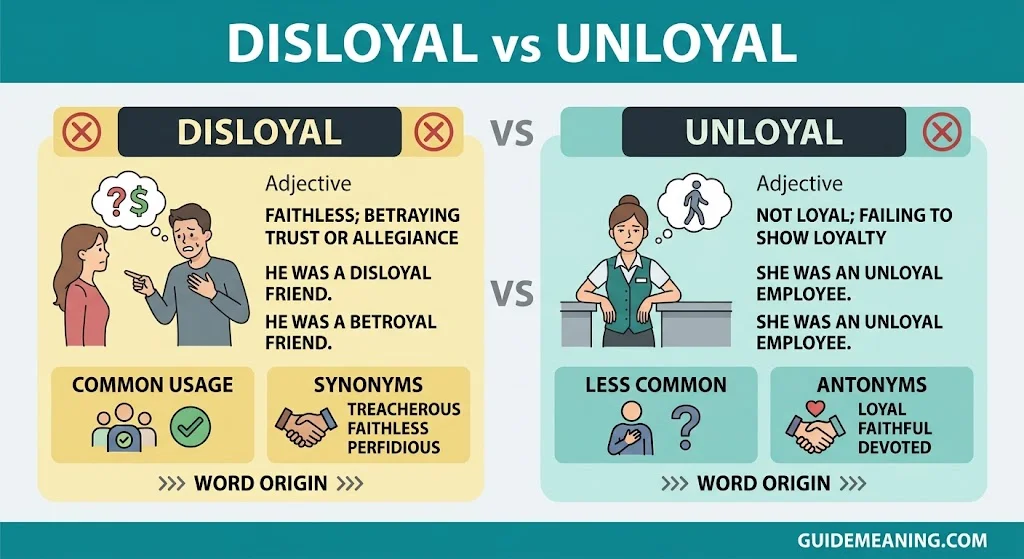

Disloyal vs. Unloyal can confuse English learners and native speakers because these words look similar, yet they are used differently. At first glance, both seem to mean the same thing, the opposite of loyal, but real English usage shows an important difference. English does not always follow the patterns our brain expects. The prefixes dis- and un- can form negative forms, as seen with happy, unhappy, kind, and unkind. However, language history, word usage, and modern English explain why disloyal is the standard, widely accepted, and more natural choice, while unloyal appears rarely and may sound unusual or awkward to readers. The truth is that these terms have different levels of acceptance, even though their basic meaning seems close.
In everyday writing, speech, emails, essays, social media posts, professional documents, school, workplace, and academic settings, writers generally use disloyal because it is the more idiomatic and correct word. Its definition relates to lacking loyalty, faithfulness, support, or allegiance, including an absence of allegiance, devotion, or faith. Merriam-Webster provides this general meaning, supporting its established usage in contemporary English. From an English-writing perspective, the easiest way to choose the right term is to rely on how words are actually used in real sentences, rather than following language logic alone.
Disloyal or Unloyal also differs from dishonest, unfaithful, treacherous, and unpatriotic. Someone may be disloyal without being dishonest, while unfaithful can refer to personal fidelity, treacherous suggests betrayal or danger, and unpatriotic concerns loyalty to a country. This practical guide helps explain the meanings, origins, and usage of these related words so you can communicate clearly and sound natural in any situation.
Let’s dive in!
Quick Answer:
Disloyal is the standard and most natural word in modern English. It means not loyal, faithful, or supportive toward a person, group, organization, country, or cause.
Unloyal can be understood to mean “not loyal,” and the form has appeared in English usage. However, it is uncommon and may sound awkward, dated, or nonstandard to many readers.
|
Word
|
Meaning
|
Modern usage
|
Best choice
|
| — | — | — | — |
|
Disloyal
|
Not loyal, faithful, or supportive
|
Common and established
|
Use this word
|
|
Unloyal
|
Not loyal
|
Rare and much less familiar
|
Usually avoid it
|
For most situations, choose disloyal.
- Correct and natural: He was disloyal to his closest friend.
- Uncommon wording: He was unloyal to his closest friend.
The second sentence may be understandable, but the first sounds much more natural in contemporary English.
Merriam-Webster defines disloyal as failing to support or remain true to someone or something. Oxford Learner’s Dictionaries and Cambridge Dictionary give similar explanations.
Merriam-Webster+2
What Does “Disloyal” Mean?
Disloyal is an adjective that describes someone or something that does not show loyalty. Loyalty involves faithfulness, trust, commitment, or continued support.
A loyal person generally stands by someone, keeps important promises, respects a commitment, or remains faithful to a group or cause. A disloyal person acts against that trust or commitment.
For example:
- The disloyal friend shared a private conversation.
- The employee’s disloyal actions damaged the company’s reputation.
- She felt disloyal after breaking an important promise.
- The player was accused of being disloyal to the team.
The word does not always describe a single dramatic betrayal. It can also refer to a repeated pattern of behavior that shows a lack of commitment.
The Meaning of Loyalty
To understand disloyal, it helps to understand what loyalty means. Loyalty can involve several forms of commitment:
- Personal loyalty: Remaining faithful to a friend or family member.
- Romantic loyalty: Respecting the promises and boundaries of a relationship.
- Professional loyalty: Acting responsibly toward an employer, colleague, or organization.
- Team loyalty: Supporting teammates and respecting shared goals.
- National loyalty: Showing allegiance to a country.
- Loyalty to a cause: Continuing to support a belief, principle, or movement.
A person may be loyal in one area but disloyal in another. Someone might be a dependable friend but an unreliable employee. Therefore, the context usually matters.
How to Use Disloyal Correctly
The adjective disloyal commonly appears before a noun or after a linking verb.
Before a noun
- His disloyal behavior caused serious problems.
- The company dismissed the disloyal manager.
- She ended the friendship after several disloyal actions.
After a linking verb
- He was disloyal to his friends.
- The employee seemed disloyal to the organization.
- Their actions appeared disloyal and dishonest.
The phrase disloyal to is especially common.
Examples:
- She was disloyal to her partner.
- He remained disloyal to the team’s values.
- The official was accused of being disloyal to the government.
Is “Unloyal” a Correct English Word?
The word unloyal is understandable because the prefix un- often expresses the opposite of an adjective. For example, English has words such as unhappy, unfair, unhelpful, and unusual.
However, English does not allow speakers to attach un- freely to every adjective. Some forms become established through common usage, while others remain rare or sound unnatural.
Although unloyal has appeared in English, it is far less common than disloyal. This difference is important. A word can exist in historical or limited usage without being the best choice for modern writing.
Why “Unloyal” Sounds Unnatural
Most modern English speakers are familiar with the phrase disloyal behavior, disloyal friend, or disloyal employee. They encounter these expressions in ordinary conversation, books, news reports, and formal writing.
By contrast, unloyal appears much less often. Because readers do not encounter it regularly, the word may feel improvised, awkward, or unusual.
Compare these sentences:
- The politician was accused of being disloyal to his party.
- The politician was accused of being unloyal to his party.
The first sentence follows familiar modern usage. The second is understandable, but it does not sound as polished or conventional.
Does “Unloyal” Always Mean “Wrong”?
Not necessarily. It is better to distinguish between rare usage and impossible usage.
Some dictionaries and historical sources may record uncommon forms that modern writers rarely choose. Therefore, it is too absolute to say that unloyal can never appear in English. The more useful advice is practical:
Use “disloyal” when you want the clearest, most natural, and most widely accepted word.
If you encounter unloyal in an older text, a quotation, or an unusual piece of writing, its meaning can usually be understood from context. That does not mean you should prefer it in your own modern writing.
Disloyal vs. Unloyal: Main Differences
The central difference between disloyal and unloyal is not their basic meaning. Both can suggest a lack of loyalty. The real difference involves frequency, familiarity, standard usage, and naturalness.
Difference in Meaning
Both words can communicate the idea of failing to remain loyal.
- Disloyal means not loyal or not faithful.
- Unloyal can convey the same general idea.
There is no important modern meaning distinction that requires writers to use unloyal instead of disloyal. In most cases, the words would communicate the same message.
Difference in Common Usage
Disloyal is widely used in modern English. It works in casual, academic, professional, and formal contexts.
Unloyal is much less common. It may appear in older writing or unusual modern usage, but it is not the normal choice for most speakers and writers.
Difference in Tone
Disloyal sounds direct and familiar. It can carry a strong negative judgment because loyalty often involves trust and commitment.
Unloyal may sound strange simply because readers rarely see it. Its unusual sound can distract attention from the actual message.
For clear writing, familiar vocabulary usually works best. You want readers to focus on the meaning, not wonder whether the word is a mistake.
Difference in Grammar
Both forms function as adjectives when they appear in sentences.
|
Feature
|
Disloyal
|
Unloyal
|
| — | — | — |
|
Part of speech
|
Adjective
|
Adjective
|
|
Basic meaning
|
Not loyal
|
Not loyal
|
|
Common modern form
|
Yes
|
No
|
|
Common phrase
|
Disloyal to someone
|
Unloyal to someone, rarely
|
|
Suitable for formal writing
|
Yes
|
Usually avoid
|
|
Preferred choice
|
Yes
|
No
|
The important point is that grammatical possibility and natural usage are not always the same thing. A form may be understandable while still being a poor choice for polished writing.
Examples of “Disloyal” in Sentences
The following examples show how disloyal works in different situations.
Disloyal in Friendships
- His disloyal behavior ended their longtime friendship.
- She felt betrayed when her disloyal friend shared her private messages.
- A disloyal friend may damage trust even without openly attacking you.
In friendships, disloyalty often involves breaking confidence, spreading private information, abandoning someone during a difficult moment, or deliberately undermining the relationship.
However, disagreement does not automatically equal disloyalty. A good friend may challenge your choices while still respecting you.
Disloyal in Romantic Relationships
- He considered her actions disloyal because she had broken an important promise.
- The couple struggled to rebuild trust after his disloyal behavior.
- She believed that hiding the truth was disloyal to her partner.
In romantic relationships, disloyal can describe behavior that violates trust or commitment. The word is broad enough to cover many actions, including dishonesty, secrecy, and breaking agreed boundaries.
Still, unfaithful may be more precise when the subject involves romantic or sexual infidelity.
Disloyal in the Workplace
- The manager accused the employee of being disloyal after confidential information leaked.
- The company investigated the employee’s alleged disloyal conduct.
- A disloyal colleague may damage cooperation within a department.
Workplace loyalty does not mean agreeing with every decision. An employee can question a policy, report misconduct, or offer constructive criticism without being disloyal.
For example:
- The employee respectfully criticized the new policy. This describes disagreement.
- The employee secretly shared confidential company records with a competitor. This may describe disloyal conduct because it involves a serious breach of trust.
Disloyal in Teams and Organizations
- The coach believed that the player’s actions were disloyal to the team.
- The organization removed a member who repeatedly acted against its agreed principles.
- A disloyal teammate can weaken trust among the entire group.
Team loyalty often involves cooperation, honesty, and respect for shared goals. Yet loyalty should not require blind obedience. A person can remain committed to a team while questioning its leadership or decisions.
Read More: Entwined vs. Intertwined: Meaning, Usage, and Examples for 2026
Disloyal vs. Unfaithful: Are They the Same?
Disloyal and unfaithful overlap, but they are not perfect synonyms.
Disloyal is a broad term for failing to remain loyal or supportive. It can describe friendships, workplaces, teams, families, political groups, and romantic relationships.
Unfaithful often refers to failing to remain faithful to a romantic partner. It can also describe a failure to keep a promise, remain devoted, or follow a commitment.
|
Word
|
Main meaning
|
Example
|
| — | — | — |
|
Disloyal
|
Not loyal or supportive
|
His disloyal behavior hurt the team.
|
|
Unfaithful
|
Not faithful, especially in a romantic relationship
|
She discovered that her partner had been unfaithful.
|
|
Faithless
|
Lacking loyalty or fidelity
|
The novel describes a faithless ruler.
|
|
Betraying
|
Breaking someone’s trust through an action
|
Sharing the secret was a betraying act.
|
Consider these examples:
- He was disloyal to his employer. This sounds natural.
- He was unfaithful to his employer. This is possible but less common and may sound unusual.
- He was unfaithful to his wife. This is a natural use when referring to romantic infidelity.
The best word depends on the exact relationship and behavior.
Disloyal vs. Disobedient, Betraying, and Untrustworthy
Several words may describe negative behavior, but each one highlights a different idea.
Disloyal
Disloyal means failing to remain loyal or supportive.
- The disloyal employee shared confidential information.
Disobedient
Disobedient means refusing to follow an instruction, rule, or authority.
- The disobedient student ignored the teacher’s instructions.
A person can be disobedient without being disloyal. For example, an employee might refuse an unreasonable order while remaining committed to the organization.
Betraying
Betraying focuses on an action that breaks someone’s trust.
- Revealing the secret was a way of betraying her friend.
Disloyalty can describe a general attitude or pattern. Betrayal often emphasizes a particular act.
Untrustworthy
Untrustworthy means not deserving confidence or trust.
- The untrustworthy witness gave several conflicting accounts.
A person may be untrustworthy because they lie, exaggerate, manipulate others, or fail to keep promises. The word focuses on reliability rather than loyalty alone.
A Practical Case Study: Disagreement or Disloyalty?
Imagine that a company introduces a policy requiring employees to work additional weekend hours. One employee believes the policy is unfair and raises concerns during a staff meeting.
Some coworkers accuse the employee of being disloyal. However, disagreement alone does not prove disloyalty.
Now imagine a different situation. The same employee secretly sends confidential company documents to a competitor after promising to protect them.
The second situation provides stronger evidence of disloyal behavior because the employee violated a clear responsibility and damaged the company’s trust.
What This Case Study Shows
The word disloyal should describe behavior carefully. Before using it, consider:
- What commitment existed?
- What promise or responsibility was involved?
- Did the person deliberately violate trust?
- Was the action simply disagreement or genuine betrayal?
- Does the evidence support the judgment?
This approach makes writing more accurate and avoids using emotionally strong words without enough context.
Common Mistakes With Disloyal and Unloyal
Treating Both Words as Equally Common
The fact that two words have similar meanings does not mean they have equal status in everyday English.
Use disloyal when writing an essay, email, article, report, or formal message. It is the familiar and reliable choice.
Assuming Every “Un-” Word Is Automatically Correct
English uses un- to form many opposites, but not every adjective accepts the prefix naturally.
For example:
- happy → unhappy
- fair → unfair
- kind → unkind
- helpful → unhelpful
However, English also has established alternatives such as:
- loyal → disloyal
- obedient → disobedient
- honest → dishonest
- legal → illegal
Word formation depends on established usage, history, pronunciation, and convention. A form that looks logical may still sound unnatural.
Calling Every Disagreement Disloyal
Disloyalty involves a failure of loyalty. Disagreement involves holding a different opinion.
- She disagreed with the director’s decision.
- She secretly sabotaged the director’s work.
The first sentence describes disagreement. The second may describe disloyal conduct.
Using Disloyal Without Giving Details
The statement “He was disloyal” is grammatically correct, but it does not explain what happened.
A more informative sentence would be:
He was disloyal because he shared his friend’s private information without permission.
Specific details make the writing stronger and help readers understand the judgment.
Confusing Disloyalty With Dishonesty
Disloyalty and dishonesty can overlap, but they are not identical.
- Disloyalty concerns faithfulness, allegiance, or commitment.
- Dishonesty concerns lying, deception, or a lack of truthfulness.
A person may be dishonest without being disloyal. For example, someone might lie to a stranger for personal gain. The action is dishonest, but it may not involve a meaningful loyalty relationship.
How to Choose the Right Word
Use this simple process when deciding between disloyal, unloyal, and related terms.
Identify the Main Meaning
Ask what you want to express:
- A lack of loyalty?
- A broken promise?
- Romantic infidelity?
- Refusal to follow instructions?
- A specific betrayal?
- General unreliability?
Select the Most Precise Word
|
Intended meaning
|
Best word
|
| — | — |
|
Not loyal or supportive
|
Disloyal
|
|
Not following an order or rule
|
Disobedient
|
|
Breaking romantic faithfulness
|
Unfaithful
|
|
Breaking someone’s trust through an action
|
Betraying
|
|
Not deserving confidence
|
Untrustworthy
|
|
Serious betrayal of a cause or group
|
Traitorous
|
Prefer the Established Modern Form
If your intended meaning is simply “not loyal,” use disloyal.
You do not need to search for a more unusual word to make your writing sound sophisticated. Clear and established vocabulary usually communicates more effectively than rare alternatives.
Disloyal vs. Unloyal: More Sentence Comparisons
The following table shows how to replace the uncommon form with the preferred word.
|
Less common wording
|
Preferred wording
|
| — | — |
|
He was unloyal to his friends.
|
He was disloyal to his friends.
|
|
Her unloyal actions hurt the team.
|
Her disloyal actions hurt the team.
|
|
The employee seemed unloyal to the company.
|
The employee seemed disloyal to the company.
|
|
His unloyal conduct damaged the relationship.
|
His disloyal conduct damaged the relationship.
|
|
The leader considered the adviser unloyal.
|
The leader considered the adviser disloyal.
|
The preferred versions sound more natural because disloyal is the established adjective used in these contexts.
Synonyms and Alternatives for Disloyal
The best synonym depends on the situation and the strength of the criticism.
Faithless
Faithless means lacking loyalty or fidelity. It can sound more formal, literary, or dramatic.
- The story follows a faithless ruler who betrays his allies.
Treacherous
Treacherous suggests serious betrayal, deception, or danger.
- The treacherous adviser secretly worked against the king.
This word is stronger than disloyal and should not be used for minor disagreements.
Unfaithful
Unfaithful commonly refers to romantic infidelity or failure to remain faithful to a commitment.
- He was unfaithful to his partner.
Traitorous
Traitorous describes behavior involving betrayal of a person, group, country, or cause.
- The soldiers considered the act traitorous.
This term often carries a serious or political tone.
Inconstant
Inconstant describes someone whose feelings, loyalties, or commitments change frequently.
- His inconstant support made him difficult to trust.
Untrustworthy
Untrustworthy describes someone who cannot reliably be trusted.
- The untrustworthy contractor failed to honor several agreements.
These words overlap with disloyal, but none should replace it automatically. Choose the term that best describes the actual behavior.
FAQs:
Is “disloyal” or “unloyal” correct?
Disloyal is the standard word in modern English. It means not loyal or lacking loyalty, while unloyal is rare and may sound unusual to many readers.
What does “disloyal” mean?
Disloyal describes someone or something that lacks loyalty, faithfulness, support, or allegiance. It can refer to a person, action, behavior, or attitude.
Is “unloyal” a real English word?
Yes, unloyal has appeared in English, but it isn’t commonly used in modern everyday English. Most writers should choose disloyal because it is more familiar and idiomatic.
Why does English use “disloyal” instead of “unloyal”?
English doesn’t always form opposite words through one simple prefix rule. Although un- commonly creates negative forms such as unhappy and unkind, established word usage and language history make disloyal the normal form.
Can I use “disloyal” in formal writing?
Yes. Disloyal works well in academic, professional, workplace, school, and other formal writing. It’s also natural in everyday speech and informal communication.
What is the difference between “disloyal” and “unfaithful”?
Disloyal is broader and can describe a lack of loyalty or allegiance. Unfaithful can also mean lacking loyalty, but it often refers specifically to breaking a personal or romantic commitment.
Is “disloyal” the opposite of “loyal”?
Yes. Disloyal is the usual modern English opposite of loyal. For clear and natural communication, disloyal is generally the word to use.
Conclusion:
Disloyal and unloyal may look like equally logical opposites of loyal, but modern English usage treats them differently. Disloyal is the established, natural, and widely recognized choice for describing a lack of loyalty, support, faithfulness, or allegiance. Unloyal is understandable but uncommon, so choosing disloyal will usually make your writing and speech sound clearer and more natural.



1 thought on “Disloyal vs. Unloyal: Meaning, Correct Usage, and Examples 2026”