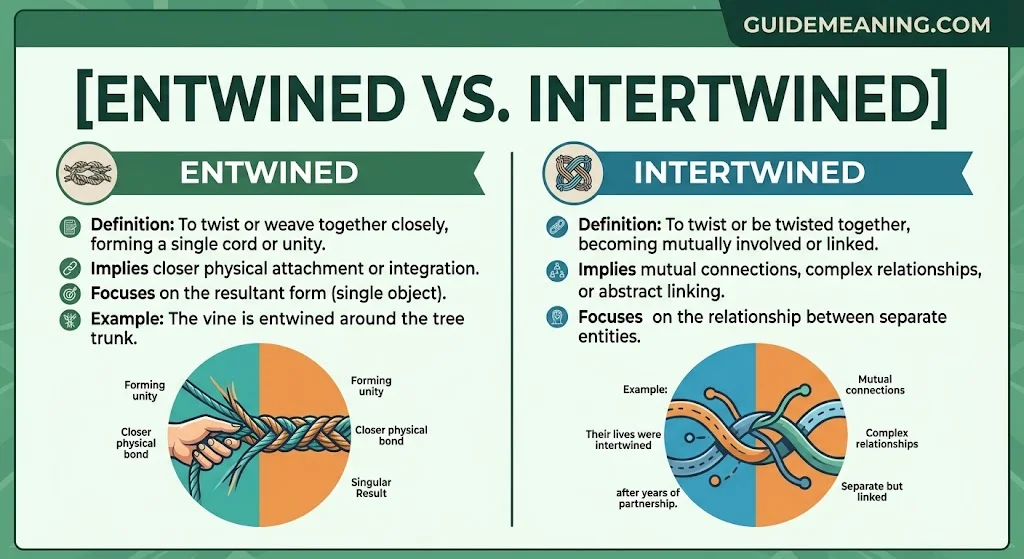

Entwined vs. Intertwined can confuse writers because each word carries a similar meaning, yet the tone and intention can differ. When I pay attention to real usage, the distinction becomes clear: entwined often suggests emotional closeness, poetic wrapping, or people twisted together, while intertwined usually describes a structural, mutual connection among multiple elements. These words may feel like playful twins that dance in an identical rhythm, but their subtle difference is significant. In practical examples, writers can treat entwined as a word for personal relationships, while intertwined works well for connected parts, complex integration, and relationships between ideas or systems. This writer-focused guide can help you learn the nuance, meanings, context, and structure of each word, so your writing gains clarity, credibility, ease, and confidence.
When I have wondered whether the wrong word might change a sentence, I’ve found that the best advice is to focus on what you truly want to express. The word entwined can suggest emotional closeness, poetic energy, wrapping, or a personal bond, while intertwined can emphasize structural relationships, connected elements, and complex integration. Their meanings are close enough to create confusion, but they are not always interchangeable. If you use each term correctly and confidently, your everyday English becomes more clear, clean, and precise. The answer may surprise you because this small distinction can set the words apart and change how you use these terms forever. The most useful tips are simple: learn the context, notice the nuance, and apply the right word immediately without filler or vague advice.
Let’s dive in!
Quick Answer:
Entwined and intertwined are both correct English words. They can describe physical objects that twist together or abstract things that become closely connected.
The main difference is one of emphasis, not strict grammar.
- Entwined often suggests that something is wrapped around, closely joined with, or emotionally connected to something else.
- Intertwined often emphasizes two or more things being woven together, mutually connected, or difficult to separate.
|
Word
|
Main meaning
|
Common emphasis
|
Example
|
| — | — | — | — |
|
Entwined
|
Twisted, wrapped, or closely joined
|
Closeness, attachment, or wrapping
|
The ivy was entwined around the fence.
|
|
Intertwined
|
Twisted or connected together
|
Mutual connection, complexity, or interdependence
|
The two countries have intertwined histories.
|
These distinctions are useful guidelines rather than unbreakable rules. In many sentences, either word may be grammatically acceptable. The best choice depends on what you want readers to notice.
What Does “Entwined” Mean?
Entwined is the past tense and past participle of the verb entwine. It can also function as an adjective.
The verb entwine means to twist, wind, or wrap something around another thing. It can also mean to become closely involved or connected with someone or something.
The word commonly describes:
- Vines growing around a tree
- Fingers or arms joined together
- Ribbons wrapped around an object
- Lives connected through shared experiences
- Memories associated with a place or event
- Fates or destinies linked together
The Oxford Advanced Learner’s Dictionary defines entwine as twisting or winding something around something else. It also recognizes the figurative meaning of being very closely involved or connected.
Oxford Learner’s Dictionaries+1
Literal Meaning of Entwined
In its literal sense, entwined describes something physically twisted, wrapped, or wound around another object.
For example:
- The ivy was entwined around the garden gate.
- A red ribbon was entwined around the handle.
- The climbing plant had become entwined with the fence.
- The two ropes were tightly entwined.
- Her fingers were entwined with his.
In these sentences, the word creates a clear physical image. Something is winding around, joining, or closely touching something else.
The phrase entwined around is especially useful when one object wraps around another:
The old vine was entwined around the stone column.
The focus is on the vine’s position around the column.
Figurative Meaning of Entwined
Entwined can also describe abstract relationships. In this use, it means closely connected, involved, or linked.
Examples include:
- Their lives became entwined after they met at college.
- Her childhood memories were entwined with the old house.
- The family’s history was entwined with the town’s development.
- Their personal and professional lives became deeply entwined.
- The character’s fate was entwined with the kingdom’s future.
The word often gives these sentences a sense of closeness or emotional importance. It suggests that separate people, events, or experiences have become connected over time.
The Tone of Entwined
The word entwined often sounds:
- Personal
- Intimate
- Emotional
- Poetic
- Symbolic
- Descriptive
For example, compare these sentences:
- Their lives were connected.
- Their lives were entwined.
The first sentence is neutral. The second feels more expressive. It suggests a closer, more meaningful bond.
Still, entwined is not limited to romantic situations. It can describe plants, objects, history, memories, business interests, and social relationships.
What Does “Intertwined” Mean?
Intertwined is the past tense and past participle of intertwine. It can also function as an adjective.
The word means twisted or woven together. It can also describe things that are closely connected in a complicated or mutually dependent way.
Cambridge Dictionary explains that intertwined can describe things that are physically twisted together or abstract subjects that are connected in a complicated way that makes separation difficult.
English meaning – Cambridge Dictionary+1
The word commonly describes:
- Tree roots
- Branches
- Threads and fibers
- Wires and cables
- Stories and plotlines
- Histories and cultures
- Politics and economics
- Ideas and themes
- Personal and professional lives
- Systems and processes
Literal Meaning of Intertwined
In its physical sense, intertwined describes two or more things that twist, cross, or weave together.
Examples:
- The roots of the trees were intertwined beneath the soil.
- The branches were intertwined above the narrow path.
- The threads were tightly intertwined.
- The wires became intertwined behind the machine.
- The two vines grew intertwined along the wall.
The word often suggests that the parts are mixed together rather than simply attached.
For example:
The roots of the two trees were intertwined underground.
This sentence suggests that the roots grew through and around one another. Their growth patterns became connected.
Figurative Meaning of Intertwined
Intertwined is especially common when discussing abstract relationships. It can show that two or more subjects affect each other or have developed together.
Examples include:
- Language and culture are deeply intertwined.
- Politics and economics are closely intertwined.
- The two countries have intertwined histories.
- Technology and education are increasingly intertwined.
- The characters’ stories became intertwined throughout the novel.
In these examples, the word does not describe physical twisting. Instead, it explains a strong relationship between ideas, systems, events, or experiences.
The Tone of Intertwined
The word intertwined often sounds:
- Neutral
- Analytical
- Descriptive
- Complex
- Structural
- Relational
It works well in academic writing, journalism, business reports, historical discussions, and formal explanations.
For example:
Economic growth and environmental policy are closely intertwined.
This sentence suggests that the two subjects influence each other. It does not necessarily express emotion or affection.
The Main Difference Between Entwined and Intertwined
The central difference between entwined vs. intertwined is the kind of connection each word tends to emphasize.
Entwined Often Highlights Wrapping or Closeness
Entwined frequently focuses on one thing winding around another or on two things becoming closely joined.
Examples:
- The vine was entwined around the tree.
- Their fingers were entwined.
- The ribbon was entwined around the bouquet.
- Their futures became entwined.
The image may involve physical wrapping or a close personal bond.
Intertwined Often Highlights Mutual Connection
Intertwined commonly emphasizes several things becoming woven together or influencing one another.
Examples:
- The branches were intertwined.
- The roots of the trees were intertwined.
- Their stories were intertwined.
- History, culture, and language are intertwined.
The focus is often on mutual connection. Each element forms part of a larger relationship.
A Simple Comparison
Consider these two sentences:
The vine was entwined around the fence.
This sentence highlights the vine wrapping around the fence.
The vines were intertwined with one another.
This sentence highlights the vines twisting and growing together.
Both sentences describe physical connection. The difference lies in the image and emphasis.
Entwined vs. Intertwined in Physical Situations
Both words can describe physical objects. The most natural choice depends on the arrangement of those objects.
Plants and Vines
Entwined often works well when a plant wraps around another object:
- The ivy was entwined around the gate.
- The roses were entwined around the garden arch.
- A creeper was entwined with the wooden fence.
Intertwined often works well when several plants grow through one another:
- The branches were intertwined above the path.
- The roots of the trees became intertwined.
- Several vines were intertwined along the wall.
The distinction is not absolute. You could also say:
- The ivy was intertwined with the fence.
- The branches were entwined above the path.
The meaning remains understandable, but the emphasis changes slightly.
Hands, Fingers, and Arms
Both words are common when describing people.
Examples with entwined:
- Their fingers were entwined as they walked.
- The couple sat with their hands entwined.
- They stood with their arms entwined.
Examples with intertwined:
- Their fingers remained intertwined throughout the ceremony.
- The dancers moved with their arms intertwined.
- The children held hands with their fingers intertwined.
In romantic or poetic writing, entwined may sound softer and more intimate. Intertwined may place more attention on the physical arrangement of the fingers or arms.
Ropes, Threads, and Wires
When several strands twist together, intertwined is often a natural choice:
- The threads were intertwined to create a strong fabric.
- The wires were intertwined behind the control panel.
- The fibers became intertwined during the manufacturing process.
However, entwined can also be correct:
- The rope was entwined around the post.
- The cord was entwined with the decorative ribbon.
The key question is whether the sentence emphasizes wrapping around something or multiple strands twisting together.
Read More: That’s Mean vs. That Means: Meaning, Grammar, and Correct Usage 2026
Entwined vs. Intertwined in Figurative Language
The two words are also used for relationships that cannot be seen physically.
Relationships and Love
Entwined often appears in emotional or romantic contexts.
Examples:
- Their lives became entwined after years of friendship.
- Their hearts seemed forever entwined.
- The couple’s dreams were entwined with their shared future.
- Their destinies became entwined after one unexpected meeting.
These examples suggest closeness, attachment, or emotional unity.
Intertwined can also describe romantic relationships:
- Their lives were deeply intertwined.
- Their personal and professional lives became intertwined.
- Their hopes and fears were intertwined.
However, intertwined can sound more neutral. It may emphasize how two lives affect each other rather than how emotionally close the people feel.
History and Culture
Intertwined is especially useful when discussing historical or cultural relationships.
Examples:
- The histories of the two nations are deeply intertwined.
- Language and culture are closely intertwined.
- The city’s growth is intertwined with the development of its railway system.
- Religion and politics have been intertwined throughout the region’s history.
Entwined is also possible:
- The town’s history was entwined with the river.
- The family’s story was entwined with the history of the village.
In these examples, entwined gives the writing a more narrative or literary tone.
Ideas, Themes, and Stories
Both words can describe literary themes or connected ideas.
Examples with entwined:
- The novel’s themes are entwined with the main character’s memories.
- The character’s identity is entwined with the history of the family.
- The story is entwined with questions of loyalty and sacrifice.
Examples with intertwined:
- The novel follows three intertwined stories.
- The themes of identity and belonging are intertwined.
- The characters’ decisions become increasingly intertwined.
Use intertwined when the focus is on several storylines or ideas developing together. Use entwined when the connection feels more symbolic, personal, or closely attached.
Business, Politics, and Economics
In professional and analytical writing, intertwined is often the more natural choice.
Examples:
- Global trade and national economies are closely intertwined.
- The company’s financial performance and reputation are intertwined.
- Political decisions and economic outcomes are deeply intertwined.
- Technology, labor, and productivity are increasingly intertwined.
The word suggests mutual influence or dependence.
Entwined can still work:
- The company’s reputation became entwined with its founder’s public image.
- The brand’s identity was entwined with its environmental mission.
Here, the word highlights a close association rather than a broad system of mutual influence.
Grammar: How to Use Entwined and Intertwined
Both words can function as verb forms and adjectives.
Entwined as a Verb
The base verb is entwine.
|
Form
|
Example
|
| — | — |
|
Present
|
The vines entwine around the tree.
|
|
Past
|
The vines entwined around the tree.
|
|
Past participle
|
The vines have entwined around the tree.
|
|
Progressive
|
The vines are entwining around the support.
|
The past participle often appears with forms of be:
- The branches were entwined.
- Their hands had become entwined.
- The plant was entwined around the pole.
Intertwined as a Verb
The base verb is intertwine.
|
Form
|
Example
|
| — | — |
|
Present
|
The branches intertwine above the path.
|
|
Past
|
The branches intertwined during the summer.
|
|
Past participle
|
The roots have intertwined underground.
|
|
Progressive
|
The vines are intertwining along the wall.
|
Examples with auxiliary verbs include:
- The two systems have become intertwined.
- Their stories were intertwined from the beginning.
- The roots had intertwined beneath the soil.
Entwined and Intertwined as Adjectives
Both words can describe the condition of something.
Examples:
- The entwined branches blocked the sunlight.
- The intertwined roots were difficult to separate.
- Their entwined hands rested on the table.
- The two histories are deeply intertwined.
When used as adjectives, the words describe the state of the noun rather than the action itself.
Common Prepositions Used With Entwined and Intertwined
The preposition following each word can help clarify the relationship.
Entwined With
Use entwined with when two things are closely joined.
- Her identity was entwined with the community.
- The vine was entwined with the fence.
- His memories were entwined with the song.
Entwined Around
Use entwined around when something wraps around another object.
- The plant was entwined around the column.
- The ribbon was entwined around the handle.
- The snake was entwined around the branch.
Entwined In
Use entwined in when something is involved in a situation or physically wrapped within something.
- The two dancers stood with their arms entwined.
- The characters became entwined in a complicated conflict.
Intertwined With
Intertwined with is very common when describing mutual connection.
- Culture is intertwined with language.
- The roots were intertwined with the soil.
- The company’s future is intertwined with technological change.
Intertwined Among
Use intertwined among when something is woven through several elements.
- Small flowers were intertwined among the branches.
- The wires were intertwined among the cables.
Entwined vs. Intertwined: Common Collocations
A collocation is a group of words that commonly appear together. Learning these combinations can make your writing sound more natural.
|
Common with entwined
|
Common with intertwined
|
| — | — |
|
Entwined fingers
|
Intertwined roots
|
|
Entwined hands
|
Intertwined branches
|
|
Entwined arms
|
Intertwined stories
|
|
Entwined vines
|
Intertwined histories
|
|
Entwined lives
|
Intertwined cultures
|
|
Entwined destinies
|
Intertwined systems
|
|
Entwined memories
|
Intertwined interests
|
|
Entwined with fate
|
Intertwined causes
|
|
Entwined around a tree
|
Intertwined relationships
|
These combinations are tendencies, not strict rules. For example, both entwined lives and intertwined lives are natural expressions.
Entwined vs. Intertwined: Side-by-Side Examples
The following examples show how the choice of word can slightly change the tone or focus.
Example: Hands
- Entwined: Their hands were entwined beneath the table. This emphasizes closeness and tenderness.
- Intertwined: Their fingers were intertwined beneath the table. This emphasizes the way the fingers crossed or fitted together.
Example: Vines
- Entwined: The vine was entwined around the old tree. This highlights the vine wrapping around the tree.
- Intertwined: The vines were intertwined along the garden wall. This highlights several vines growing together.
Example: Lives
- Entwined: Their lives became entwined after the marriage. This may suggest a close personal bond.
- Intertwined: Their lives became intertwined through years of shared work. This may suggest mutual influence and dependence.
Example: History
- Entwined: The family’s history was entwined with the village. This sounds personal and narrative.
- Intertwined: The histories of the two countries were deeply intertwined. This sounds more historical and analytical.
Example: Business
- Entwined: The company’s reputation was entwined with its founder’s image. This emphasizes a close association.
- Intertwined: The company’s finances and operations were intertwined. This emphasizes structural dependence.
Can Entwined and Intertwined Be Used Interchangeably?
Yes, in many situations. The words share a large part of their meaning, so replacing one with the other may not make a sentence incorrect.
For example:
- The branches were entwined.
- The branches were intertwined.
Both sentences describe branches that have twisted together.
Likewise:
- Their lives were entwined.
- Their lives were intertwined.
Both sentences describe lives that have become closely connected.
However, the replacement may change the tone:
- Entwined may sound more intimate, graceful, or poetic.
- Intertwined may sound more mutual, complicated, or analytical.
A useful approach is to ask what kind of image your sentence needs. If you want readers to picture something winding around another object, entwined may be a strong choice. If you want to show several elements influencing one another, intertwined may be more precise.
When Should You Use Entwined?
Choose entwined when you want to emphasize:
- One thing wrapping around another
- Physical closeness
- A personal or emotional bond
- A poetic or symbolic relationship
- A close association between people, places, or events
- A graceful or visually appealing image
Examples:
- The roses were entwined around the arch.
- Their fingers remained entwined.
- Her memories were entwined with the old photograph.
- Their destinies became entwined.
- The vines were entwined around the wooden post.
The word is especially effective when the connection feels close, meaningful, or visually clear.
When Should You Use Intertwined?
Choose intertwined when you want to emphasize:
- Two or more things weaving together
- Mutual influence
- Complex relationships
- Interdependence
- Connected systems or processes
- Shared histories or developing storylines
Examples:
- The roots were intertwined beneath the ground.
- Politics and economics are closely intertwined.
- The characters’ stories became intertwined.
- The two cultures have intertwined traditions.
- The company’s operations and finances are deeply intertwined.
The word is often useful in formal writing because it clearly communicates that separate elements are connected in a meaningful way.
Common Mistakes With Entwined and Intertwined
Mistake: Assuming Only One Word Is Correct
Some writers believe that intertwined is correct while entwined is incorrect. This is false.
Both are standard English words. They simply have overlapping meanings and different usage tendencies.
Mistake: Believing Entwined Is Always Romantic
Although entwined often appears in romantic or poetic writing, it can describe ordinary physical objects and non-romantic relationships.
Correct examples include:
- The vines were entwined around the fence.
- The wires were entwined behind the desk.
- The town’s history was entwined with the river.
Mistake: Believing Intertwined Always Means Complicated
Intertwined often suggests complexity, but it can also describe simple physical twisting.
For example:
- The two ribbons were intertwined.
- Their fingers were intertwined.
These sentences do not necessarily describe a complicated relationship.
Mistake: Treating the Prefixes as Absolute Rules
The prefix inter- often suggests “between,” “among,” or “mutually.” This can help explain why intertwined often emphasizes mutual connection.
However, word prefixes do not create strict grammar rules. You should not decide that entwined can only describe one object wrapping around another or that intertwined can only describe complex systems.
Mistake: Choosing a Word Only Because It Sounds More Formal
Intertwined may appear frequently in formal writing, but that does not make it automatically better.
For example:
- Their fingers were entwined.
This is natural and expressive.
- Their fingers were intertwined.
This is also correct, but it may place more emphasis on the physical arrangement.
The right word depends on meaning, not formality alone.
Entwined vs. Intertwined and Related Words
Several other words have similar meanings. Understanding their differences can make your vocabulary more precise.
Entwined vs. Interconnected
Interconnected means linked or related. It does not necessarily suggest twisting, wrapping, or weaving.
- The computers are interconnected.
- The economies are interconnected.
By contrast:
- The vines are entwined.
- The economies are intertwined.
Intertwined often suggests a stronger or more involved relationship than simply being connected.
Entwined vs. Interwoven
Interwoven strongly suggests that separate elements have been woven together into a pattern or whole.
- The colors were interwoven throughout the fabric.
- The story combines several interwoven themes.
Intertwined emphasizes twisting or close connection.
- The branches were intertwined.
- The characters’ lives were intertwined.
The words can overlap, but interwoven often creates a stronger image of weaving.
Entwined vs. Entangled
Entwined can sound graceful, intimate, or neutral.
- The flowers were entwined around the arch.
Entangled often suggests disorder, confusion, difficulty, or an unwanted situation.
- The cables were entangled beneath the desk.
- He became entangled in a legal dispute.
A relationship can be entwined without being troublesome. An entangled relationship often carries a more negative meaning.
Entwined vs. Connected
Connected is the broadest and most neutral word.
- The two events are connected.
Entwined and intertwined add a stronger image of closeness, twisting, or deep involvement.
- The two events are entwined.
- The two events are intertwined.
These versions suggest a more substantial relationship.
A Practical Way to Remember the Difference
Use this simple memory guide:
Entwined often suggests something winding around another thing or creating a close bond. Intertwined often suggests several things weaving together or influencing one another.
You can also ask yourself these questions:
- Is one object wrapping around another?
- Are several objects crossing or weaving together?
- Is the connection personal or emotional?
- Is the relationship complex or mutually dependent?
- Do I want a poetic or analytical tone?
- Would “closely connected” express the meaning more clearly?
Remember that this is a helpful guide, not a strict rule.
Practice: Choose Entwined or Intertwined
Complete each sentence with the most natural word.
- The ivy was ______ around the old gate.
- Politics and economics are deeply ______.
- The couple walked with their fingers ______.
- The roots of the two trees were ______ underground.
- Her memories were closely ______ with the song.
- The company’s finances and operations became ______.
- The two ribbons were ______ around the gift box.
Answers
- The ivy was entwined around the old gate.
- Politics and economics are deeply intertwined.
- The couple walked with their fingers entwined.
- The roots of the two trees were intertwined underground.
- Her memories were closely entwined with the song.
- The company’s finances and operations became intertwined.
- The two ribbons were entwined around the gift box.
Some alternatives may also be grammatically possible. These answers simply represent the most natural choice for the intended emphasis.
FAQs:
What is the main difference between entwined and intertwined?
Entwined often describes things closely wrapped or joined together, especially when an emotional or poetic feeling is involved. Intertwined usually focuses more on connected parts, ideas, systems, or relationships that depend on one another.
Can entwined and intertwined be used interchangeably?
Sometimes, yes. Both words can describe things that are linked or twisted together. However, entwined can carry a stronger emotional or poetic tone, while intertwined often suggests a more complex or structural connection.
Is entwined usually used for people?
It can be. For example, two people may be described as entwined when they are physically close or share a strong emotional bond. The word can also describe objects, vines, stories, or other things that are closely wrapped together.
When should I use intertwined?
Use intertwined when you want to show that different elements are closely connected or depend on each other. It works well for ideas, cultures, histories, systems, events, relationships, and other complex connections.
Does entwined have a more emotional meaning?
Often, yes. Entwined can suggest emotional closeness, affection, intimacy, or a poetic connection. The exact meaning still depends on the sentence and context.
What is an easy way to remember entwined vs. intertwined?
Think of entwined as something wrapped closely together, often with a personal or emotional feeling. Think of intertwined as several parts connected within a larger structure, system, or relationship.
Which word is more common in everyday English?
Both words are used in everyday and formal English. Intertwined is especially common when discussing connected ideas, events, or systems, while entwined often appears when describing physical closeness or emotional and poetic connections.
Conclusion:
Understanding entwined vs. intertwined becomes much easier when you focus on the type of connection you want to describe. Entwined often adds a sense of closeness, wrapping, or emotion, while intertwined emphasizes connected parts, relationships, and complex integration. The difference is subtle, but choosing the right word can make your English clearer and more precise.

1 thought on “Entwined vs. Intertwined: Meaning, Usage, and Examples for 2026”