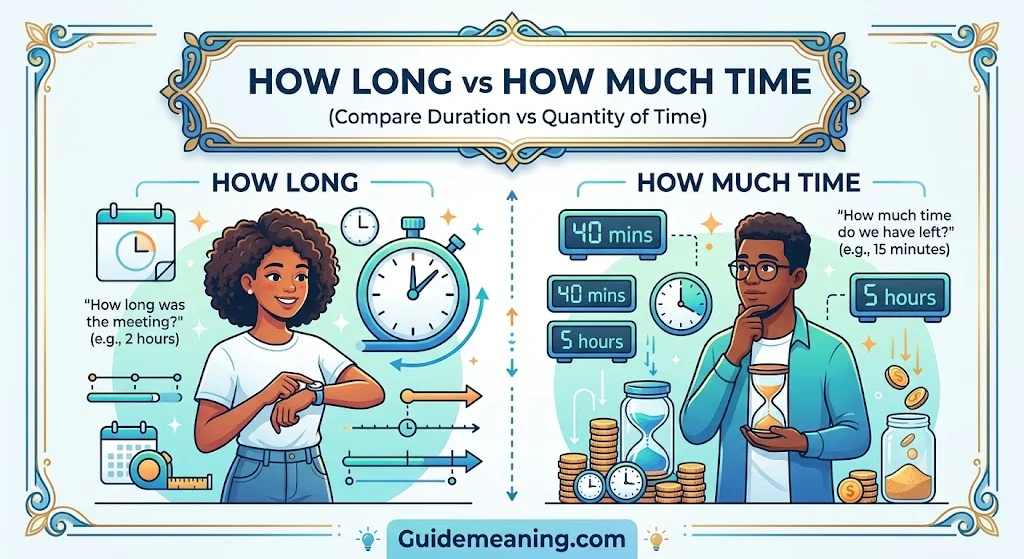

How Long vs How Much Time can confuse English learners, but clear usage helps you choose the right phrase for duration or available time in English. For English learners, these phrases may seem similar because they share a meaning, but their usage depends on the situation. In everyday speech and writing, writers and learners need the right phrase to keep a sentence clear and natural. Whether you’re drafting a professional business proposal or sending a text message to a friend, precision can prevent awkward or unclear communication. Misusing these expressions may suggest a lack of fluency, confuse the reader, and disturb the natural flow of communication. The key differences and subtle nuances become easier to understand through real-life examples, examples, and practical tips. As a simple guide, think of how long as a question about duration, while how much time usually asks about an amount of time or available time.
The main difference appears when you look at what each expression highlights. How long asks about the duration of an action or event and focuses on how long something lasts. For example, how long did the movie last asks about the continuous span of the movie. By contrast, how much time focuses on a measurable quantity or a physical resource that may be available or required. You can spend or save time and ask how much is available to finish a task or project. Understanding this distinction helps learners avoid common mistakes and know when to use each form. Although how, long, much, and time may appear in both expressions, they perform different grammatical roles. Once you stop trying to mix up these grammatical concepts, you can master both conversational English and formal English more confidently. This simple contrast also supports stronger writing skills and speaking skills, making the grammatical puzzle easier instead of forcing you to second-guess every choice.
Quick Answer:
How Long vs How Much Time usually differs in focus rather than basic meaning. In American English, how long is generally the more natural choice for asking about duration, while how much time often highlights time as an amount or resource.
TL;DR:
• How long normally asks about duration.
• How much time emphasizes an amount of time.
• Both can ask how many minutes, hours, days, or years.
• How long is especially natural in everyday American conversation.
• Never say “how long time” in standard English.
• Context determines which expression sounds more natural.
What Does “How Long” Mean?
“How long” is a question phrase used to ask about duration. In other words, it asks about the length of time something lasts, continues, or takes.
For example, you might ask, “How long is the movie?” The expected answer could be “Two hours.”
Asking About Duration
“How long” works naturally with events, activities, situations, and periods.
Common examples include:
• How long is the meeting?
• How long did the flight take?
• How long will the trip last?
• How long have you lived here?
The phrase can also refer to distance or physical length. For example, “How long is the table?” asks about its physical measurement, not time.
Why It Sounds Natural
In everyday American English, “how long” is extremely common. It’s short, direct, and easy to use.
For example, “How long will it take?” sounds very natural. The longer version, “How much time will it take?” is also correct, but the first version is often preferred in ordinary conversation.
What Does “How Much Time” Mean?
“How much time” asks about an amount or quantity of time. It treats time more like something that can be available, needed, spent, saved, or remaining.
For example, “How much time do we have?” asks about the amount of time currently available.
Time as a Resource
This expression becomes especially natural when time is being managed.
Consider these examples:
• How much time do we have before class?
• How much time do you need?
• How much time is left?
• How much time did you spend studying?
Here, the speaker isn’t simply describing duration. They’re thinking about time as something measurable or usable.
A More Specific Focus
“How much time” can sound especially appropriate when the amount itself matters.
For example, imagine a teacher giving students an assignment. “How much time do we have?” focuses on the available time.
However, “How long is the assignment?” asks about the expected duration or length of the task.
How Long vs How Much Time: The Main Difference
The difference becomes easier when you think about the question’s focus. How long usually points toward duration, while how much time often points toward quantity.
Still, these categories overlap. Native speakers may use either expression in several situations.
Quick Comparison
| Expression | Main Focus | Natural Example | Typical Answer |
| How long | Duration | How long is the movie? | Two hours. |
| How much time | Amount available | How much time do we have? | Thirty minutes. |
| How long | Duration required | How long will it take? | About an hour. |
| How much time | Amount needed | How much time do you need? | Ten minutes. |
| How long | Duration continuing | How long have you worked here? | Five years. |
The important point is that the expressions aren’t strict opposites. In many cases, they can produce essentially the same answer.
For instance, “How long does it take?” and “How much time does it take?” can both ask about the required duration.
When Should You Use “How Long”?
“How long” is usually your safest choice when asking about duration. It works naturally in casual conversation, questions about experiences, and questions involving ongoing situations.
Common Situations
Use “how long” when asking:
• How long an event lasts
• How long an activity takes
• How long someone has done something
• How long someone will remain somewhere
• How long something has continued
For example, “How long have you been waiting?” sounds completely natural.
Likewise, “How long have you lived in Chicago?” naturally asks about a period that began in the past.
Present Perfect Questions
“How long” is particularly common with the present perfect.
Examples include:
“How long have you known her?”
“How long have they worked here?”
“How long have you been waiting?”
These questions ask about duration continuing up to the present. The answer might use for or since, such as “for three years” or “since 2023.”
When Should You Use “How Much Time”?
“How much time” works well when you’re thinking about time as an amount. It’s particularly useful when discussing available, remaining, required, or spent time.
Planning and Scheduling
Consider a group preparing for an event.
Someone might ask, “How much time do we have before the guests arrive?”
That question focuses on the remaining amount. Similarly, “How much time do you need to finish?” focuses on the amount required.
Measuring Time Used
“How much time” also works naturally when discussing time someone spent on something.
For example:
“I spent three hours studying.”
“How much time did you spend studying?”
Here, the speaker is asking about the amount of time used.
However, “How long did you study?” is also perfectly natural. The difference is mainly one of focus and phrasing.
Is “How Long” More Natural Than “How Much Time”?
In American English, “how long” is often the more natural everyday choice. However, that doesn’t make “how much time” incorrect or unusual.
Everyday Conversation
Imagine asking about a drive across town.
“How long does it take to get downtown?”
That sounds very natural.
You could also say:
“How much time does it take to get downtown?”
The second sentence is grammatical, but many speakers would instinctively choose the first.
Situations Favoring “How Much Time”
However, “how much time” becomes especially natural when availability or limits matter.
For example:
“How much time do we have left?”
“How much time can you give me?”
“How much time should I allow?”
“How much time did you spend on it?”
So, rather than memorizing one rigid rule, listen for the intended focus.
How Long vs How Much Time in American English
American English generally favors concise, conversational questions. That helps explain why “how long” appears so often.
Natural American Examples
These sentences sound natural:
“How long will you be here?”
“How long does the movie last?”
“How long have you lived in Texas?”
“How much time do we have?”
“How much time do you need?”
“How much time is left?”
Both forms belong to normal American English. The difference is usually about what the speaker wants to emphasize.
Formal and Practical Contexts
In instructions, planning, or practical discussions, “how much time” may sound especially appropriate.
For example, a project manager might ask, “How much time will the team need?”
Still, “How long will the team need?” is possible in many contexts. The first version simply puts more attention on the quantity of time.
Read More: Northeast vs North-East vs North East: Which Is Correct? for 2026
“How Long” With Different Verb Tenses
One reason learners encounter “how long” so often is its flexibility. It works with several verb forms.
Present
“How long does the class last?”
This asks about the usual or expected duration.
Past
“How long did the meeting last?”
This asks about a completed event.
Future
“How long will the repair take?”
This asks about expected duration.
Present Perfect
“How long have you worked here?”
This asks about a situation that began in the past and continues now.
The expression therefore isn’t tied to one tense. Instead, the tense tells you when the duration occurs.
“How Much Time” With Different Situations
“How much time” is also flexible. However, its meaning often becomes clearer when the sentence involves availability, need, use, or a limit.
Available Time
“How much time do we have?”
The question asks about the amount currently available.
Required Time
“How much time will you need?”
The question asks how much time is required.
Remaining Time
“How much time is left?”
The question asks about the amount that remains.
Used Time
“How much time did you spend working?”
The question asks about the amount already used.
These examples show why “how much time” can feel slightly more quantitative than “how long.”
Common Mistakes With How Long and How Much Time
Most mistakes come from combining parts of the two expressions incorrectly. Fortunately, the fixes are simple.
Avoid “How Long Time”
One of the most common errors is:
❌ “How long time will it take?”
The standard form is:
✅ “How long will it take?”
You can also say:
✅ “How much time will it take?”
The word time is already built into the meaning of “how long” when you’re asking about duration.
Don’t Confuse “How Much Time” and “How Many Times”
These expressions have completely different meanings.
“How much time” asks about duration or an amount of time.
“How many times” asks about frequency.
Compare:
“How much time did you visit?”
“How many times did you visit?”
The second sentence asks how often something happened.
How Long vs How Much Time in Questions About “Take”
Both expressions can work with take, which often causes confusion.
“How Long Does It Take?”
This is usually the most natural everyday form.
Examples include:
• How long does it take to cook rice?
• How long does it take to drive there?
• How long does it take to learn this skill?
• How long did it take to finish?
These questions focus on duration.
“How Much Time Does It Take?”
This version is also grammatical.
For example:
“How much time does it take to complete the application?”
It may sound slightly more focused on the amount required. In casual American conversation, however, “How long does it take?” is often more natural.
How Long vs How Much Time in Everyday Conversations
Context can make the preferred expression obvious. Think about what the speaker is actually trying to discover.
Asking About a Movie
“How long is the movie?”
This asks for its duration.
“How much time do we have to watch the movie?”
This asks how much available time the people have.
The movie might be two hours long, while the viewers might have only 90 minutes.
Asking About Work
“How long will the project take?”
This asks about the project’s duration.
“How much time can you spend on the project?”
This asks about someone’s available time.
The distinction becomes clearer when you compare the situations rather than the individual words.
How Long vs How Much Time in Writing
Both expressions can appear in American writing, including emails, instructions, schoolwork, and professional communication.
Choosing a Natural Style
If you’re writing a simple question about duration, “how long” is usually a strong choice.
For example:
“Could you tell me how long the process takes?”
However, “how much time” can work better when the amount itself matters.
For example:
“Please estimate how much time you’ll need.”
The second sentence sounds practical because the writer wants an estimate for planning.
Does One Sound More Formal?
Not necessarily. “How much time” can sometimes feel more deliberate or precise, but it isn’t automatically formal.
Likewise, “how long” isn’t automatically informal. Both expressions are standard English.
How Long vs How Much Time: Emotional and Social Nuance
Although these phrases aren’t symbols in the traditional sense, language can still signal a speaker’s focus. Small wording choices can change how a question feels.
“How Long” Feels Direct
“How long will you be gone?”
This sounds like a straightforward question about duration.
It can also sound warm and conversational when asking about someone’s plans.
“How Much Time” Can Highlight Limits
“How much time do we have?”
This may suggest urgency, planning, or a limited resource.
For example, a student before an exam may ask how much time remains. The wording naturally draws attention to the clock.
Cross-Cultural and Language-Learning Perspective
English learners often struggle with these phrases because other languages may organize time questions differently. Direct translation can therefore produce forms that sound unusual in English.
Why Learners Say “How Long Time”
A learner may logically combine “how long” with the noun “time.” However, standard English normally uses how long by itself when asking about duration.
That’s why:
“how long time”
is not the normal English structure.
Instead, use:
“how long”
or
“how much time.”
A Useful Learning Shortcut
If you’re asking, “What is the duration?” choose how long.
If you’re asking, “What amount is available, needed, remaining, or used?” how much time may fit especially well.
This shortcut won’t cover every possible sentence, but it works in many everyday situations.
How the Usage Has Shifted Over Time
English has long used “long” to describe duration. Modern English continues that pattern, while “how much time” provides a more explicit quantity-based construction.
Older Patterns and Modern English
The word “long” has historically described length and duration. That makes “how long” a compact way to ask about temporal length.
Meanwhile, “how much time” directly names the thing being measured. Modern speakers use both patterns without needing to treat them as competing grammatical systems.
What Has Stayed Consistent
The core distinction remains fairly stable:
• “How long” measures duration.
• “How much time” measures an amount.
• Both can receive answers using minutes or hours.
• Context often determines the more natural choice.
FAQs:
What is the difference between “how long” and “how much time”?
How long asks about the duration of something. How much time asks about the amount of time that is available or needed.
When should I use “how long”?
Use how long when you want to know how long an action or event lasts. For example, “How long is the movie?”
When should I use “how much time”?
Use how much time when you’re asking about the amount of time available or required. For example, “How much time do we have?”
Can “how long” and “how much time” mean the same thing?
Sometimes they can ask about a similar idea, but they emphasize different things. How long focuses on duration while how much time focuses on quantity.
Is “How much time did the movie last?” correct?
It’s grammatically possible but sounds less natural when asking about duration. “How long did the movie last?” is the more natural choice.
Is “How long do we have to finish?” correct?
Yes. “How long do we have to finish?” naturally asks about the remaining duration. You can also say, “How much time do we have to finish?”
What is an easy way to remember the difference?
Remember this simple rule: how long = duration and how much time = amount of time. If you’re asking how something lasts, choose how long. If you’re asking about available or required time, choose how much time.
Conclusion:
Understanding How Long vs How Much Time becomes easier when you focus on what you’re actually asking. Use how long for duration and how much time for an amount of time that someone has, needs, can spend, or can save. With regular practice and real-life examples, you can use both phrases naturally in everyday English without second-guessing your choice.


1 thought on “How Long vs How Much Time: A Simple Guide for 2026”