
Respond vs. Response can confuse English learners because both words share a root, but their grammatical roles and functions differ.
The difference between respond and response is an essential part of clear communication in English. These words are closely related, yet respond works as a verb describing an action, while response is a noun referring to the reply itself. This key distinction helps learners and writers avoid errors in speaking and writing. Choosing the right words improves clarity, writing clarity, and communication skills, while mastering these terms can instantly sharpen written communication and spoken communication. This grammar point appears in many areas, including emails, essays, business messages, academic writing, professional documents, professional writing, everyday conversations, casual conversations, and everyday life.
The meaning, definition, and usage become easier when you understand how each word fits a sentence and follows specific grammar rules and usage differences.This complete guide takes a simple, practical, and conversational way to explain the key differences through examples, practical examples, real-life examples, memory tips, diagrams, and tables that provide useful practical insights. Everything is kept easy-to-read while showing how communication, psychology, and medicine may use these closely related terms in different contexts.
Understanding their meanings strengthens communication, writing, and overall communication skills. It also supports professional writing, academic writing, and ordinary conversations where a quick reply matters. By using the right grammatical form, you can avoid common mistakes, improve writing clarity, and feel more confident in any situation where a clear response or direct reply is needed.
Quick Answer:
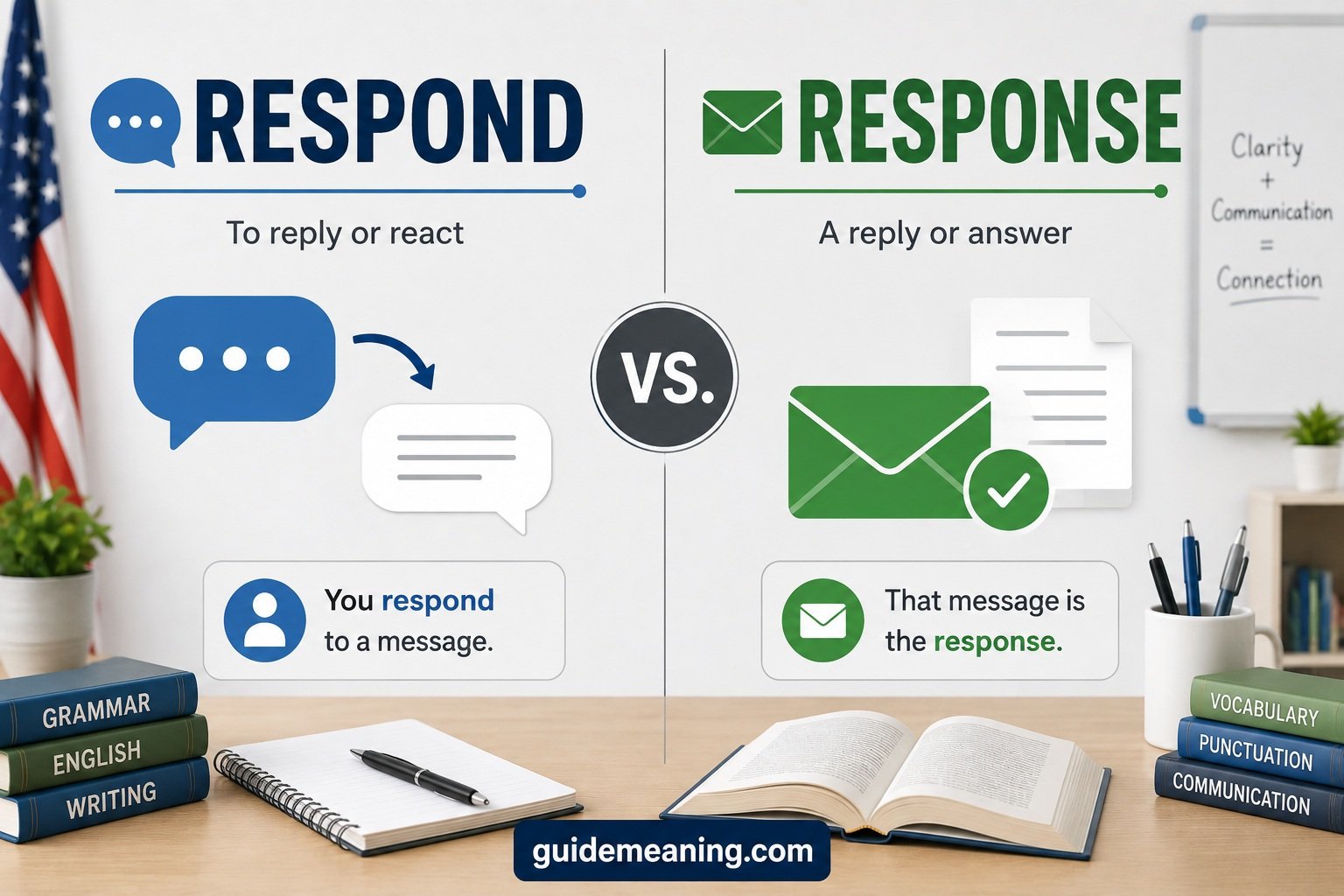
Respond vs. Response comes down to grammar: respond is a verb, while response is a noun. In American English, you respond to a message, but you receive or give a response to that message.
TL;DR:
• Respond is a verb describing an action.
• Response is a noun naming an answer or reaction.
• You respond to a question, message, request, or situation.
• You can give, receive, or expect a response.
• “Please respond” and “Thank you for your response” are both correct.
• The two words are related but aren’t interchangeable.
What Does Respond Mean?
The word respond functions as a verb. It describes the act of answering, reacting, or taking action after something happens.
Respond as an Action
For example, consider this sentence:
Please respond to my email.
Here, respond describes what the person should do. The person needs to take an action by answering the email.
You can also respond without using words. Someone might respond to a question with a smile, gesture, or facial expression.
For example:
She responded with a smile.
The sentence describes her action rather than naming the smile itself.
Common Uses of Respond
In American English, respond can describe reactions to many situations.
• Respond to a question
• Respond to an email
• Respond to a request
• Respond to criticism
• Respond to an emergency
• Respond to a situation
• Respond to a message
The word can therefore reach beyond ordinary conversation. You can respond to something spoken, written, physical, emotional, or situational.
What Does Response Mean?
Response is a noun. It refers to an answer, reaction, or action that follows something else.
Response as a Thing
Look at this example:
I received your response.
Here, response names the reply that was received. It doesn’t describe the act of replying.
You can also say:
Her response was thoughtful.
The word response identifies what she gave after hearing or seeing something.
Response Can Describe Reactions
A response doesn’t always have to be a written answer.
For example:
His response to the news was silence.
Silence can be a response because it represents a reaction. Likewise, a facial expression, physical action, or emotional reaction can sometimes be described as a response.
This broader meaning helps explain why response appears in everyday conversation, science, psychology, education, and many professional settings.
Respond vs. Response: The Main Difference
The central difference is action versus thing. This simple distinction works in most everyday sentences.
A Simple Comparison
| Word | Part of Speech | Basic Meaning | Example |
| Respond | Verb | To answer or react | Please respond soon. |
| Response | Noun | An answer or reaction | Thanks for your response. |
| Responded | Past-tense verb | Answered or reacted | She responded yesterday. |
| Responses | Plural noun | Multiple answers or reactions | We received several responses. |
| Responding | Verb form | Currently answering or reacting | He is responding now. |
Think of a conversation as a small sequence.
Someone asks a question. You respond. What you give afterward is your response.
For example:
She responded to the question with a clear response.
Both words work because they have different jobs.
The Quick Grammar Test
Ask yourself one question:
Am I describing an action or naming an answer?
If you’re describing the action, use respond.
If you’re naming the answer or reaction, use response.
This test works particularly well when writing quickly.
How to Use Respond in a Sentence
Because respond is a verb, it usually appears where an action word belongs. It can appear in present, past, future, and continuous forms.
Everyday Examples
Here are several natural examples:
• Please respond to my message.
• She responded to the question immediately.
• He didn’t respond to my text.
• The company responded to the complaint.
• They responded calmly to the criticism.
• We will respond as soon as possible.
Notice that respond often appears with to when identifying what prompted the action.
Respond in Different Tenses
The basic form is respond.
I respond quickly.
The past form is responded.
I responded quickly.
The continuous form is responding.
I am responding now.
The third-person singular present form is responds.
She responds quickly.
These forms all retain the same basic idea: someone is performing the action of answering or reacting.
How to Use Response in a Sentence
Because response is a noun, it can appear after words such as a, the, your, his, her, or their.
Everyday Examples
For example:
I’m waiting for your response.
She gave a quick response.
His response was unexpected.
We received a positive response.
The response to the announcement was mixed.
The word can refer to one specific answer or to a broader reaction.
Common Expressions With Response
Some combinations appear naturally in American English:
• A quick response
• A detailed response
• A positive response
• A negative response
• An immediate response
• A written response
• A strong response
• In response to something
The phrase in response to is especially useful in formal and professional writing.
For example:
The company changed its policy in response to customer feedback.
Here, response is clearly functioning as a noun.
Respond vs. Response in Emails
Email is one of the easiest places to notice this distinction. Americans commonly use both words in workplace and personal messages.
When You Ask Someone to Answer
Use respond when you’re asking someone to take action.
Please respond by Friday.
Could you respond to this email?
Please respond to my question.
You’re asking the other person to perform the action of answering.
When You Talk About the Answer
Use response when discussing the answer itself.
Thank you for your response.
I appreciate your quick response.
We’re still waiting for your response.
The difference becomes especially important in professional communication because small grammar mistakes can make a message sound less polished.
Read More: Become vs Became: Simple Grammar Guide 2026
Respond vs. Response in Texting and Social Media
Digital communication has made these words even more common. Americans use them when discussing texts, direct messages, comments, posts, and online conversations.
Responding to Messages
You might say:
Why didn’t you respond to my text?
Here, respond describes the action of answering.
You could also say:
I haven’t received a response yet.
Now response names the missing answer.
This distinction remains the same whether the communication happens through texting, email, a comment, or face-to-face conversation.
Why the Confusion Happens
The confusion often comes from their similar spelling and shared meaning.
Both words relate to answering or reacting. However, their grammatical roles remain different.
That means you shouldn’t write:
I will response later.
Instead, write:
I will respond later.
Likewise, don’t write:
Thanks for your quick respond.
Instead, write:
Thanks for your quick response.
Respond vs. Response in Professional Writing
Both words are common in American workplaces. However, choosing the correct form helps make business writing precise.
Professional Examples
Consider these sentences:
Please respond to the request by Monday.
We appreciate your response to the request.
The first sentence asks someone to act. The second refers to the answer they provide.
You may also see both words in reports:
The organization responded to the issue quickly.
Its response received attention from employees.
This pattern is useful because professional writing often describes both an action and its result.
Formal Writing Tip
When editing an email or report, look at the word’s position.
If it follows a subject and expresses what that subject does, respond may be appropriate.
If it follows an article, possessive word, or adjective, response may be appropriate.
For example:
She responded quickly.
Her response was quick.
The meanings connect, but the grammar changes.
Respond vs. Response vs. Reply
Reply can make the comparison slightly more confusing. Unlike respond, reply can work as both a verb and a noun.
How They Compare
| Word | Main Function | Typical Use | Example |
| Respond | Verb | Answer or react | Respond to the message. |
| Response | Noun | Answer or reaction | I received a response. |
| Reply | Verb or noun | Return a message | Please reply to me. |
| Answer | Verb or noun | Provide information | Answer the question. |
Reply often focuses on communication. Respond has a broader range.
For example, someone can respond to an emergency. Saying they “replied to an emergency” would usually sound unnatural.
Similarly, you can reply to a text because a text is a message.
A Useful Rule
Think of the three words this way:
You respond to a situation.
You reply to a message.
You give an answer to a question.
These aren’t absolute rules. English allows overlap. Still, they provide useful guidance for everyday American English.
Common Mistakes With Respond and Response
The most common errors happen when writers switch the verb and noun forms.
Mistake: “Please Response”
Incorrect:
Please response to my email.
Correct:
Please respond to my email.
The sentence needs a verb after please, so respond is required.
Mistake: “Quick Respond”
Incorrect:
Thank you for your quick respond.
Correct:
Thank you for your quick response.
Here, quick describes a noun. Therefore, response fits.
Mistake: “I Will Response”
Incorrect:
I will response tomorrow.
Correct:
I will respond tomorrow.
After will, English uses the base form of the verb. Therefore, respond is correct.
Mistake: “I Received Your Respond”
Incorrect:
I received your respond.
Correct:
I received your response.
The word after your needs to be a noun. Response is the noun form.
Why Respond and Response Are Related
The two words aren’t random look-alikes. They come from the same historical word family.
Respond ultimately traces back through Middle English and Anglo-French to Latin respondēre, meaning to answer or promise in return. Merriam-Webster records the verb’s first known English use in the 15th century.
How the Word Family Developed
Over time, English developed related forms around the idea of answering or reacting.
That family includes:
• Respond
• Responded
• Responding
• Response
• Responsive
• Responsiveness
Today, these forms serve different grammatical roles. However, they still share the central idea of reacting or answering.
Why This History Helps
Understanding the word family can make the difference easier to remember.
Respond focuses on the action.
Response focuses on the answer or reaction.
That relationship remains visible in modern American English.
Emotional and Social Meaning of a Response
Although this is primarily a grammar distinction, response can carry emotional meaning depending on context.
For example, saying someone gave a “warm response” suggests friendliness or approval. A “cold response” can suggest distance or lack of enthusiasm.
Tone Can Change the Meaning
Compare these examples:
She responded immediately.
This simply describes timing.
She responded warmly.
Now the sentence describes emotional tone.
Her response was enthusiastic.
Here, the noun helps describe the emotional character of the answer.
Therefore, response can describe more than words. It can also describe how someone reacts socially or emotionally.
Modern Usage in American English
Today, respond and response appear across nearly every form of communication. Their basic grammar hasn’t changed, but digital communication has created more situations where people use them.
Where You’ll See Them
• Text messages
• Workplace emails
• Customer service conversations
• School assignments
• Online discussions
• Social media comments
• News coverage
• Public statements
• Personal conversations
For example, a company might respond to customer feedback. The public might then discuss the company’s response.
Why Clarity Matters
Digital communication moves quickly. People often type messages without checking grammar.
However, confusing respond and response can make a sentence sound unnatural. Learning the distinction takes only a few seconds and can prevent many common mistakes.
How the Meaning Has Shifted Over Time
The basic distinction between the verb and noun has remained stable. However, the situations in which people use these words have expanded.
Earlier Uses
Historically, the idea of responding centered on answering or reacting. The word family developed through older forms of English and French, with roots reaching back to Latin.
Over time, the words gained broader uses.
People could respond not only to questions but also to events, actions, conditions, and physical stimuli.
Modern Uses
Today, respond can describe reactions to almost anything that creates a need for action.
For example:
The team responded to the emergency.
The audience responded positively.
The device responds to touch.
Meanwhile, response can name the resulting action or reaction:
The emergency response was immediate.
The audience response was positive.
This broader modern use explains why both words appear in so many fields.
When Should You Use Respond or Response?
If you’re still unsure, use the sentence structure as your guide. The surrounding words usually reveal which form you need.
Use Respond When
Use respond when the sentence describes someone doing something.
• Please respond to my message.
• I will respond soon.
• She responded politely.
• They responded to the request.
• He responded with a smile.
Use Response When
Use response when the sentence names an answer or reaction.
• I received your response.
• Her response was helpful.
• We need a quick response.
• His response surprised me.
• The response was positive.
One final test can help:
Can you replace the word with “answer” as a noun? If yes, response may be correct.
Can you replace it with “answer” as a verb? If yes, respond may be correct.
FAQs:
What is the main difference between respond and response?
Respond is a verb that describes the action of replying to someone or something. Response is a noun that refers to the reply itself. For example, “Please respond to my email” uses respond as an action, while “I received your response” uses response as a thing.
Is respond a verb or a noun?
Respond is a verb. It tells you what someone does when they answer, react, or reply. For example, “She will respond to the message tomorrow.” Here, respond describes the action.
Is response a verb or a noun?
Response is a noun. It describes an answer, reply, or reaction. For example, “His response was helpful.” You can often place words such as “a,” “the,” “your,” or “their” before response.
Can I use respond and response interchangeably?
No. Although respond and response are closely related, they have different grammatical roles. Respond describes an action, while response names the reply or reaction. Using one in place of the other can make a sentence grammatically incorrect.
Which is correct: “Thank you for your quick respond” or “Thank you for your quick response”?
“Thank you for your quick response” is correct. Because “your” is followed by a noun in this sentence, response is the right choice. Respond is a verb and doesn’t fit this grammatical structure.
Which is correct: “I will respond tomorrow” or “I will response tomorrow”?
“I will respond tomorrow” is correct. The sentence describes an action that someone will perform, so the verb respond is needed. “I will response tomorrow” is grammatically incorrect.
How can I easily remember respond vs. response?
Use this simple memory tip: respond = action, while response = reply. If you’re describing what someone does, choose respond. If you’re talking about the answer or reply itself, choose response.
Conclusion:
Understanding Respond vs. Response becomes easy once you remember their grammatical roles. Respond is a verb for the action of replying, while response is a noun for the reply itself. This simple distinction can help you avoid common grammar mistakes in emails, academic writing, professional communication, and everyday conversations.
When you’re unsure, check whether your sentence needs an action or a thing. If it needs an action, use respond. If it refers to the reply, use response. With regular practice and attention to sentence structure, choosing the correct word will become natural and automatic.