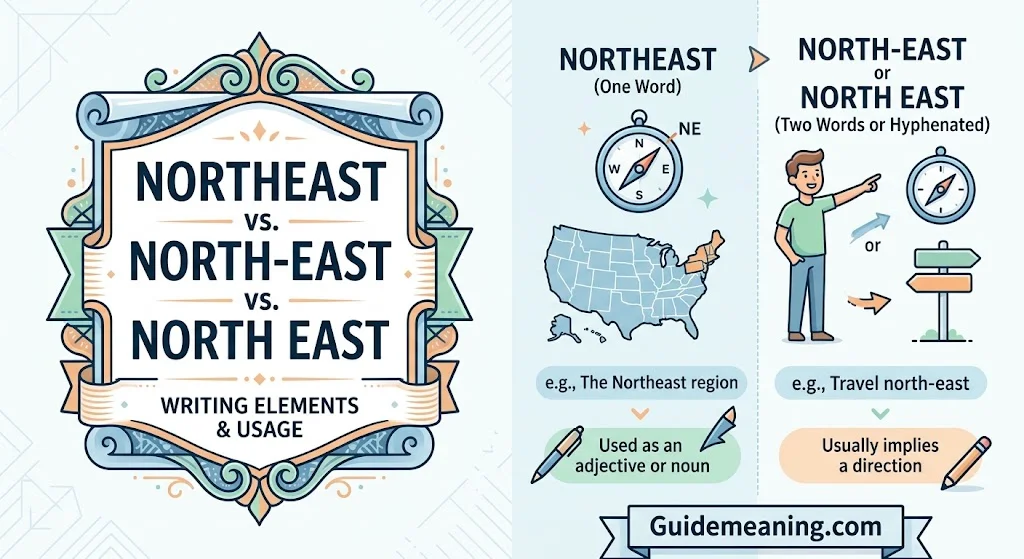

For clear English writing, Northeast vs North-East vs North East can cause confusion when geography, style guides, and context shape proper usage. As a professional editor, I’ve seen writers, editors, and geographers question which form is correct. Although the three forms may seem interchangeable, the wrong form can confuse readers or make writing look unpolished. A guide with clear nuances, examples, tables, and practical writing tips can help you choose the right one. The same general region can have different spelling because usage can differ by region and historical context. Northeast is one word and the US English standard, while North East uses two words and is linked with British English. North-East is hyphenated and often represents a historical or transitional form. These three forms show how language evolves and develops variants, while the real difference becomes easier to understand when you study directional terms and regional terms.
The choice also matters in academic writing, professional writing, and formal writing, especially in modern American English, British styles, and official naming systems. In my editing experience, English language rules can create uncertainty when a writer moves between an academic paper, business naming, and everyday writing tasks. Clarity becomes especially important when punctuation adds to the mystery. If you need to spell the directional noun in standard US usage, group the two parts as Northeast. The same rules can apply when you refer to another combined direction such as southeast. Since everyone recognizes these terms as directions, keeping them grouped makes the intended meaning easier to follow.
Quick Answer:
Northeast vs North-East vs North East usually involves spelling and regional convention, not a major difference in meaning. In American English, northeast is the standard choice for the direction and the U.S. region, while North East can appear in established British place names and north-east may reflect British or older editorial usage.
TL;DR:
• Northeast is the preferred form in modern American English.
• North-East is a hyphenated variant found in some British or older styles.
• North East commonly appears in established geographic names.
• The three forms generally describe the same compass direction.
• Capitalization depends on whether the word names a specific region.
• The U.S. Northeast has a distinct historical and cultural identity.
What Does Northeast Mean?
The word northeast names the compass direction halfway between north and east. On a standard compass, it is commonly represented by NE and sits at a 45-degree angle between those two cardinal directions.
For American readers, the word also has a strong geographic meaning. “The Northeast” often refers to a recognized U.S. region rather than simply a direction.
Northeast as a Direction
When used as a direction, northeast can describe movement or position.
For example:
- The storm moved northeast.
- The trail continues northeast.
- The house sits northeast of the lake.
In these examples, northeast remains lowercase because it describes direction rather than a named region.
Northeast as a Region
The word can also refer to a larger geographic area.
In the United States, the Northeast is one of the four broad regions used by the U.S. Census Bureau. Its states are divided into New England and the Middle Atlantic divisions.
That regional meaning explains why Americans often capitalize Northeast. It acts much like the names of other recognized regions, such as the Midwest or the South.
Why Is Northeast Written as One Word?
The closed form developed as English compounds became more firmly established. Frequently used combinations often become shorter and more unified over time.
The directional words are especially familiar examples. We commonly write northwest, southeast, and southwest as single words too.
A Long History
The word northeast has roots reaching back to Old English and Middle English. Major dictionaries record its use well before the modern period.
That history matters because the single-word form isn’t a recent invention. It has been part of English for many centuries.
Why American English Favors It
Modern American English generally treats northeast as a standard closed compound.
The same pattern appears with related forms:
- northeast
- northwest
- southeast
- southwest
- northeastern
- northwestern
- southeastern
- southwestern
As a result, writing northeast usually looks natural to American readers.
What Does North-East Mean?
North-east has essentially the same basic directional meaning. The difference is the hyphen.
The hyphen makes the two original directional words visually separate while showing that they function together as one compound idea.
Where the Hyphen Appears
The hyphenated form can occur in British English and in older or house-specific editorial styles.
For example:
The wind came from the north-east.
A reader understands the meaning immediately. The hyphen doesn’t create a different compass point.
Is North-East Wrong in America?
Not necessarily, but it isn’t the normal default for contemporary U.S. writing.
If you’re writing for an American audience, northeast is usually the cleaner choice. However, preserving a particular publication’s established style can justify a different form.
The important point is consistency. Mixing forms without a reason can make your writing look accidental.
What Does North East Mean?
North East is the open form, with a space instead of a hyphen or closed spelling.
It can appear in geographic names, especially outside the United States. One important example is North East England, a recognized region of England.
North East as a Place Name
Place names deserve special attention because you shouldn’t casually change their established spelling.
For example, North East England is commonly written with two words. The capitalization reflects its use as a regional name.
In that situation, replacing it with “Northeast England” could change the conventional name rather than simply improving grammar.
General Direction vs Proper Name
Compare these examples:
- The plane flew northeast.
- She lives in the Northeast.
- They visited North East England.
The first describes movement. The second identifies a U.S. region. The third uses an established geographic name.
That context matters more than simply memorizing one spelling.
Northeast vs North-East vs North East in American English
For most U.S. readers, the choice is straightforward. Northeast should normally be your first choice when you mean the direction or a general U.S. region.
The alternatives mainly become relevant when you’re preserving a geographic name, following another variety of English, or quoting older material.
Quick Comparison
| Form | Typical Use | American Preference | Example |
| northeast | Direction or region | Preferred | We drove northeast. |
| North-East | Older or regional style | Less common | A north-east wind arrived. |
| North East | Geographic name or open form | Context-dependent | North East England |
The important distinction is that these forms usually don’t represent three different meanings. They represent different spelling traditions and contexts.
When Should Northeast Be Capitalized?
Capitalization depends on whether northeast describes a direction or identifies a recognized region.
This distinction is especially important in American English because “the Northeast” has a well-established regional meaning.
Lowercase Northeast
Use lowercase when describing an ordinary direction.
For example:
The road turns northeast after the bridge.
Here, northeast simply tells readers where the road goes.
Capitalized Northeast
Capitalize it when referring to the recognized U.S. region.
For example:
She moved to the Northeast for college.
The capitalization signals that the word refers to a particular geographic region.
A Simple Test
Ask yourself whether you could replace the word with “the region.”
If yes, capitalization may be appropriate:
The Northeast has cold winters.
If you’re simply describing movement, lowercase is normally correct:
The birds flew northeast.
What States Are in the U.S. Northeast?
The American Northeast has a more specific meaning than “anywhere northeast in the country.” The U.S. Census Bureau defines the Northeast as a statistical region containing nine states.
The Nine States
The region includes:
• Connecticut
• Maine
• Massachusetts
• New Hampshire
• New Jersey
• New York
• Pennsylvania
• Rhode Island
• Vermont
These states fall into two divisions: New England and the Middle Atlantic.
New England and the Middle Atlantic
New England contains Connecticut, Maine, Massachusetts, New Hampshire, Rhode Island, and Vermont.
The Middle Atlantic division contains New Jersey, New York, and Pennsylvania.
This official structure explains why “Northeast” can mean more than a compass direction in American conversations.
Read More: Screen vs Monitor vs Display: Meaning and Use for 2026
What Does the Northeast Symbolize in American Culture?
Although northeast is fundamentally a directional term, the American Northeast carries strong cultural associations. People often connect the region with early U.S. history, older cities, higher education, industry, finance, and the Atlantic coast.
These associations aren’t universal truths about everyone who lives there. Instead, they’re cultural ideas shaped by geography and history.
Historical Associations
The Northeast contains many places closely connected with the early history of the United States.
For example, the region includes cities such as Boston, New York City, Philadelphia, and others with long colonial and national histories.
As a result, the word can evoke ideas such as:
• Early American history and colonial heritage
• Dense cities and older architecture
• Universities and intellectual institutions
• Atlantic trade and maritime culture
• Long-established immigrant communities
These associations help explain why “the Northeast” can carry an identity beyond simple geography.
How Has Northeast Been Used Throughout History?
Directional language is much older than the United States itself. People have always needed ways to describe location, travel, weather, and landscapes.
The concept behind northeast therefore predates modern American geography by centuries.
Ancient Directional Thinking
Ancient societies used the rising and setting sun, stars, landscapes, and winds to understand direction.
However, the exact modern English word northeast belongs to the history of the English language. It developed from the older words corresponding to north and east.
That distinction is useful. The idea of a direction between north and east is ancient, while the English spelling has evolved over time.
From Separate Words to Compound
English has repeatedly turned familiar word combinations into compounds.
The development from separate directional elements toward forms such as northeast follows this broader pattern.
Over centuries, different writers used spaces, hyphens, and closed compounds. Modern American English settled strongly on the closed form.
What Is the Difference Between Northeast and Northeastern?
The words northeast and northeastern are closely related, but they serve different grammatical roles.
“Northeast” can function as a noun, adjective, or adverb. “Northeastern” is primarily an adjective describing something connected with that direction or region.
Examples
Consider these sentences:
The storm moved northeast.
Here, northeast describes movement.
Now compare:
She attends a northeastern university.
Here, northeastern describes the university.
You might also see:
The northeastern states have varied climates.
The adjective connects something with the northeastern part of a larger area.
Why the Difference Matters
Using the right form makes a sentence more precise.
If you’re naming a direction, northeast is usually enough. If you’re describing a noun, northeastern may be the better choice.
What Does Northeast Mean Spiritually?
Unlike symbols with established religious meanings, northeast doesn’t have one universal spiritual interpretation.
However, directions have carried symbolic meanings in several cultures and spiritual traditions. Those meanings vary widely, so they shouldn’t be treated as one shared belief.
Direction as Symbolism
People have often connected directions with ideas such as movement, orientation, beginnings, seasons, or natural forces.
In some traditions, northeast has particular ceremonial or spiritual associations. In others, it simply identifies a physical direction.
For an American reader, the most important distinction is between cultural symbolism and universal meaning. There is no single spiritual definition that applies to everyone.
What Emotions Does Northeast Evoke?
The emotional meaning of northeast depends heavily on context.
For someone in the United States, the word might bring up memories of home, travel, family, school, weather, or a particular city.
Personal Associations
A person from Maine may experience “Northeast” differently from someone raised in Pennsylvania or New York.
For example, the word might suggest:
• Familiar hometown landscapes
• Cold weather and changing seasons
• Coastal towns and Atlantic scenery
• Busy cities and commuter life
• Family roots and regional identity
These reactions are personal rather than fixed meanings.
Direction and Movement
As a direction, northeast can also suggest movement toward a destination.
That can create a simple symbolic idea of orientation: knowing where you’re going and having a point of reference.
Still, this is an interpretation rather than an official symbolic meaning.
How Is Northeast Used Today?
Today, northeast appears everywhere from weather reports to maps and travel conversations.
It also appears in digital communication because short directional terms are useful for describing locations quickly.
Everyday Uses
You may encounter northeast in:
• Weather forecasts
• Navigation instructions
• Real estate descriptions
• Travel writing
• Sports and regional identities
• Geographic reporting
In American life, the word is practical first. Its cultural meaning usually comes from the place being described.
Social Media and Digital Maps
People may write “Northeast,” “NE,” or “northeastern” when describing where they live or travel.
Location-based posts can also turn regional terms into identity markers. Someone might describe themselves as being from the Northeast to communicate a broad sense of place.
The meaning is usually informal and personal rather than symbolic in a strict sense.
Why Do People Confuse These Three Forms?
The confusion comes from the fact that English allows multiple historical spellings for some compounds.
The words look almost identical, yet capitalization, spacing, and hyphenation can change according to context.
The Three-Part Rule
A useful way to remember them is:
Northeast = normal modern U.S. spelling.
North-East = hyphenated variant used by some styles and regions.
North East = open form that can be part of an established geographic name.
This rule won’t cover every editorial situation. However, it works well for everyday American writing.
Common Misunderstandings About Northeast
One common misunderstanding is assuming that the three forms always have different meanings. Usually, they don’t.
Another mistake is treating every capitalized use as a directional error. Capitalization can signal a recognized region instead.
Mistakes to Avoid
• Don’t hyphenate northeast automatically in American writing.
• Don’t capitalize lowercase directions without a regional reason.
• Don’t alter established geographic names casually.
• Don’t assume British and American conventions are identical.
• Don’t treat spelling variation as a difference in compass direction.
Context solves most of these problems.
How Has the Meaning Shifted Over Time?
The physical direction has remained stable, but the word’s cultural use has expanded.
In older contexts, northeast mainly served practical needs such as navigation and description. Today, it can also identify large geographic regions and regional identities.
From Direction to Identity
In the United States, “the Northeast” has become a familiar cultural label.
It can refer to a group of states, a historical region, or a general sense of place. That broader use gives the word more social meaning than a compass point alone.
Modern Usage Is More Consistent
Contemporary American writing strongly favors the closed form.
Meanwhile, hyphenated and open versions remain relevant when regional conventions or proper names require them.
That’s why older books may look different without actually being wrong.
FAQs:
Is “Northeast” one word or two?
Northeast is written as one word in standard US English when it functions as a directional or regional noun.
Is “North East” grammatically correct?
Yes. North East is a recognized form, especially in British English and certain regional or official contexts.
Should I write “North-East” with a hyphen?
North-East is a valid historical or transitional form. You may also encounter it in some British English writing and established names.
Which form should I use in American English?
For standard modern American English, Northeast is generally the preferred spelling when you use it as a noun or regional term.
Are Northeast, North East, and North-East interchangeable?
They can refer to the same general direction or region, but they aren’t always interchangeable in every context. Regional conventions, style guides, and official names can affect the preferred form.
Is “Northeast” also used for other directions?
Yes. English commonly combines directional words into forms such as southeast, northwest, and southwest.
How can I remember the correct spelling?
If you’re writing for a US audience, remember that Northeast is normally written as one word. For British English or an official name, check the relevant style guide or established spelling.
Conclusion:
Northeast, North-East, and North East describe the same basic direction or region, but their spelling reflects different language conventions. For most modern American English writing, Northeast is the safest standard choice. However, North East and North-East can still appear in British English, historical usage, or official names. When in doubt, consider your audience, context, and the style guide you’re following.




1 thought on “Northeast vs North-East vs North East: Which Is Correct? for 2026”