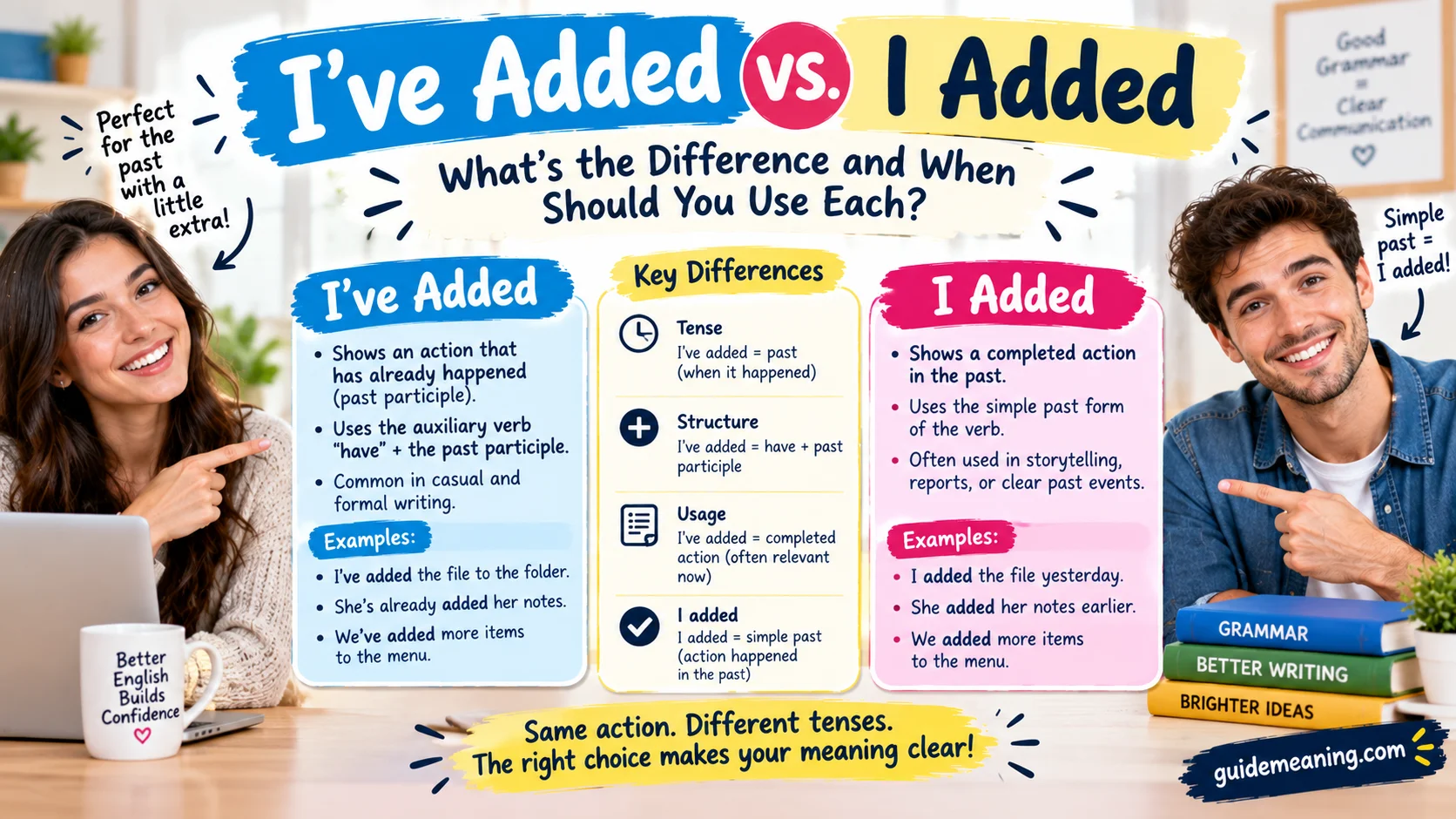

I’ve Added vs. I Added becomes easier when you understand how English grammar, context, and time reference affect meaning and everyday communication.
Both forms are perfectly correct, but they serve different purposes. These completed actions, recent actions, and completed tasks often have present relevance. During my teaching experience over the years, I’ve noticed that learners sometimes pause because similar phrases can create confusion. Understanding the time connection between the past and present helps English learners make better grammar choices in American English, where native speakers commonly use these expressions in real communication.
Expressions such as “yesterday” and “last week” help identify when something occurred. For example, “I added the file” or “I added the results on Monday” focuses on a past event. This verb form creates a clear timeline and explains how English tenses work. An effective method is to connect grammar rules with daily actions and real situations. In a workplace chat, saying “I’ve added the file” tells a colleague they can check it now. However, when writing a report about past events, tasks, or decisions, the simple past may be more suitable. Updating a document, finishing homework, and sending a message offer useful examples for students in class. Once learners recognize the difference, they often have an aha moment. Regular practice, small corrections, and memorizing simple examples can build confidence and reduce common mistakes.
In everyday use, this grammatical choice appears in small moments. Imagine typing a quick message to a friend or writing a casual note with your fingers resting over a keyboard. Both “I’ve added the file” and “I added the file” sound natural, but their meaning shifts with context and intent. The first emphasizes present relevance or a present effect, while the second focuses on a past event. Understanding this structure improves writing skills, spoken English, and grammar accuracy. You can communicate naturally in casual and professional situations, whether you’re writing emails, academic papers, or blog posts. The same distinction appears in an email, a message, everyday conversations, reports, and formal arguments.
Let’s dive in!
Quick Answer:
“I’ve added” is the contraction of “I have added.” It uses the present perfect tense to describe a past action that connects to the present or matters in the current situation.
“I added” uses the simple past tense to describe a completed action in the past. It often appears when discussing a specific past event or explaining when something happened.
Here are the main points to remember:
- Use I’ve added when confirming an update or emphasizing its present relevance.
- Use I added when reporting a completed past action or describing a past event.
- Use I added it yesterday, not usually “I’ve added it yesterday,” in standard American English.
- Both expressions can describe the same action. The surrounding context determines which one sounds more natural.
Comparison Overview
The following table highlights the key differences between “I’ve added” and “I added.”
| Feature | I’ve Added | I Added |
| Full form | I have added | I added |
| Verb tense | Present perfect | Simple past |
| Grammatical structure | Subject + have + past participle | Subject + past-tense verb |
| Main emphasis | A past action connected to the present | A completed past action |
| Specific past time | Usually not used with a finished past-time reference | Commonly used with specific past times |
| Common context | Confirming an update or current result | Reporting a past event or completed task |
| Example | I’ve added the file to the folder. | I added the file yesterday. |
| Professional use | Confirming that a requested change is complete | Explaining when a change occurred |
Remember: The difference isn’t simply about whether an action has finished. Both expressions can describe completed actions. The distinction lies in how the speaker connects the action to time and context.
Main Differences Between I’ve Added vs. I Added
Although “I’ve added” and “I added” both describe completed actions, their grammatical functions differ. Understanding these differences will help you choose the correct expression without second-guessing yourself.
Difference in Verb Tense
The most important difference between “I’ve added” and “I added” is their verb tense.
“I’ve added” uses the present perfect tense. This tense combines the auxiliary verb have with the past participle added. It connects an earlier action to the present in some way.
For example:
- I’ve added the missing information to the report.
- I’ve added your email address to my contacts.
- I’ve added three new references to the document.
In each example, the speaker reports a completed action that matters to the current situation.
“I added” uses the simple past tense. This tense describes an action that happened and finished in the past.
For example:
- I added the missing information yesterday.
- I added your email address last week.
- I added three new references before submitting the document.
These sentences report completed actions as past events. The speaker may mention when the action happened or describe it as part of a past sequence.
Difference in Time References
Time expressions often help you decide whether to use “I’ve added” or “I added.”
The present perfect commonly appears when the exact time isn’t important or when the result matters now. The simple past usually appears when the speaker identifies a finished past period.
Consider these examples:
| Present Perfect | Simple Past |
| I’ve added the attachment. | I added the attachment this morning. |
| I’ve added your name to the list. | I added your name yesterday. |
| I’ve added the latest figures. | I added the latest figures last Friday. |
| I’ve added the new section. | I added the new section before the meeting. |
The first column emphasizes the completed action and its relevance to the current conversation. The second column places the action within a specific past event or period.
However, the present perfect doesn’t always mean that an action happened recently. You can use it for something completed long ago if its present relevance remains important.
For example:
– I’ve added that book to my reading list.
This sentence doesn’t tell us when the speaker added the book. The action might have happened minutes or months ago.
By contrast, the simple past can describe something that happened only moments earlier.
– I added that book to my reading list a minute ago.
The key rule: Choose your tense based on the time frame and intended meaning, not merely on how recently the action occurred.
Difference in Meaning and Emphasis
Sometimes, both expressions describe exactly the same event. The difference comes from what the speaker wants the listener to notice.
Imagine that your manager asks whether you’ve updated a shared document.
You could answer:
– “I’ve added the new figures.”
This response emphasizes that the figures are now included. It directly addresses the document’s current state.
Alternatively, you could say:
– “I added the new figures after lunch.”
This response focuses on the past event and explains when the work happened.
Neither sentence is inherently better. Each communicates a slightly different emphasis.
Here’s another example:
Present perfect: I’ve added your phone number to my contacts.
Simple past: I added your phone number when we met last week.
The first statement confirms the current result. The second places the action within a past encounter.
What Does “I’ve Added” Mean?
“I’ve added” means “I have added.” It’s a common expression in everyday American English, especially when someone confirms a change or reports a completed task.
The phrase uses the present perfect tense, which links a past action to the present. Depending on the situation, the speaker may emphasize a current result, a recent update, or an experience that matters now.
For instance, suppose a colleague asks you to include a new section in a report. After making the change, you could respond:
“I’ve added the new section to the report.”
Your colleague understands that the requested information is now included. You don’t need to specify the exact time because the current result answers the question.
When to Use “I’ve Added”
Use “I’ve added” when you want to confirm an action that matters in the present.
Common situations include:
- Confirming a completed task: I’ve added the requested details.
- Updating a document: I’ve added your comments to the draft.
- Changing a contact list: I’ve added the new employee’s number.
- Sharing information: I’ve added the attachment to the email.
- Making a correction: I’ve added the missing reference.
- Responding to a request: I’ve added you to the group chat.
In each case, the speaker communicates that something has been included or changed.
The expression works particularly well when the listener cares about the outcome rather than the exact time of completion.
However, avoid pairing the present perfect with a finished past-time expression when standard American English calls for the simple past.
Incorrect in standard usage: “I’ve added the information yesterday.”
Correct: “I added the information yesterday.”
Examples of “I’ve Added” in Sentences
Here are practical examples showing how “I’ve added” works in different situations.
| Situation | Example Sentence | Why It Works |
| Workplace | I’ve added your suggestions to the proposal. | Confirms that the suggestions are included. |
| I’ve added the requested attachment. | Highlights the current availability of the attachment. | |
| Education | I’ve added two sources to my research paper. | Reports an update relevant to the current task. |
| Technology | I’ve added your account to the project workspace. | Confirms a change in access or membership. |
| Shopping | I’ve added milk and bread to the list. | Reports the current state of the list. |
| Personal communication | I’ve added your birthday to my calendar. | Confirms that the date is now recorded. |
Notice that none of these sentences requires a specific past-time expression. The speaker focuses on the completed addition and its relevance now.
Is “I’ve Added” Grammatically Correct?
Yes. “I’ve added” is grammatically correct because it follows the standard present perfect structure.
The formula is:
Subject + have/has + past participle
For the first-person singular subject I, the correct auxiliary verb is have.
- Full form: I have added the information.
- Contracted form: I’ve added the information.
The verb add is regular. Its simple past and past participle forms are both added.
Therefore, the phrase uses have to form the present perfect tense. The word added alone doesn’t establish the tense.
One common mistake is to write “I’ve add the information.” That construction is incorrect because the present perfect requires a past participle.
Correct: “I’ve added the information.”
What Does “I Added” Mean?
“I added” describes an action that took place and finished in the past. It uses the simple past tense and often appears when someone recounts an event, reports completed work, or identifies when an action occurred.
For example, consider this sentence:
“I added the final paragraph before submitting the article.”
The sentence describes two past actions. First, the speaker added the paragraph. Then the speaker submitted the article.
The simple past makes the sequence clear without connecting the first action grammatically to the present.
When to Use “I Added”
Use “I added” when you want to report a past action or place it within a past event.
Common situations include:
- Describing a specific time: I added the file yesterday.
- Explaining a sequence: I added the references before submitting the paper.
- Reporting completed work: I added three sections during Monday’s meeting.
- Recounting an event: I added your name when we reviewed the list.
- Clarifying a previous action: I added that information in the first draft.
These sentences focus on the action as a past event. Some identify a specific time, while others establish a sequence or provide background.
Remember that the simple past doesn’t require a time expression. You can say “I added the document” without explaining when the action happened.
The surrounding conversation may already provide enough information.
Examples of “I Added” in Sentences
The following examples demonstrate how the simple past works in different contexts.
| Situation | Example Sentence | Why It Works |
| Workplace | I added the new figures before the meeting. | Identifies when the action happened. |
| I added the attachment to yesterday’s email. | Places the action in a past context. | |
| Education | I added three sources before submitting my paper. | Describes a completed step in a sequence. |
| Technology | I added your account to the system last week. | Specifies a finished past period. |
| Shopping | I added coffee to the list this morning. | Reports an action at a definite past time. |
| Personal communication | I added your birthday to my calendar on Monday. | Identifies when the addition occurred. |
The simple past is especially useful when explaining what happened during a particular day, meeting, conversation, or project.
Is “I Added” Grammatically Correct?
Yes. “I added” is the correct simple past form of the verb add.
Its structure is straightforward:
Subject + simple past verb
Examples include:
- I added the final paragraph.
- I added the missing information.
- I added the new contact yesterday.
Because add is a regular verb, it forms its simple past by adding -ed.
The same spelling also serves as its past participle:
- Simple past: I added the information.
- Present perfect: I have added the information.
This shared spelling can confuse English learners. However, the auxiliary verb have makes the second sentence present perfect, while the first uses the simple past.
Can You Use “I’ve Added” and “I Added” Interchangeably?
Yes, sometimes. Both expressions can describe the same completed action, particularly when the exact time isn’t important.
However, they aren’t interchangeable in every sentence. The time reference and context can make one form more appropriate than the other.
Examples Where Both Expressions Work
Imagine that a colleague asks whether you included the requested details in a report.
You could answer:
- “I’ve added the details to the report.”
- “I added the details to the report.”
Both sentences are grammatical. The first emphasizes the completed update and its current relevance. The second reports the action as a past event.
Here’s another comparison:
Present perfect: I’ve added the new employee to our team directory.
Simple past: I added the new employee to our team directory.
Without additional context, both statements make sense. The speaker’s intended emphasis helps determine which one fits better.
In American English, the simple past is common in everyday conversation, even when the present result remains relevant. Therefore, don’t assume that every current update requires the present perfect.
Examples Where Only One Form Fits Naturally
A specific, finished past-time expression often determines the correct tense.
Consider these examples:
| Incorrect or Less Natural in Standard American English | Correct Version |
| I’ve added it yesterday. | I added it yesterday. |
| I’ve added the file last night. | I added the file last night. |
| I’ve added two sections last Monday. | I added two sections last Monday. |
| I’ve added your name in 2024. | I added your name in 2024. |
Why does this happen?
Words such as yesterday, last night, last Monday, and in 2024 identify finished past periods. The simple past normally describes actions that occurred during those periods.
Compare that with these sentences:
- I’ve added it already.
- I’ve just added the file.
- I’ve added your name to the list.
These examples don’t identify a specific finished past time. They focus on the action’s completion or present relevance.
Important distinction: A sentence can mention the past without requiring the simple past. What matters is whether you identify a specific finished time or connect the action to the present.
“I’ve Added” vs. “I Added” in Everyday Situations
Grammar becomes easier to understand when you see how people use these expressions in realistic conversations.
In Emails and Workplace Messages
Professional communication often involves confirming completed tasks. Both expressions work well, depending on the message.
Use “I’ve added” when confirming an update:
- I’ve added the requested information to the email.
- I’ve added your comments to the shared document.
- I’ve added the latest figures to the spreadsheet.
Use “I added” when explaining when or how the work happened:
- I added the information before sending the email.
- I added your comments during yesterday’s review.
- I added the latest figures after the finance meeting.
Practical tip: If someone asks, “Have you added the attachment?” you can answer, “Yes, I’ve added it.” The present perfect directly echoes the question’s tense.
You could also answer, “Yes, I added it.” That response is equally natural in many American English conversations.
In Documents and Assignments
Students, writers, and editors often need to explain changes to their work.
Examples of the present perfect:
- I’ve added the citations to the document.
- I’ve added another paragraph to the introduction.
- I’ve added the missing details to the assignment.
Examples of the simple past:
- I added the citations before submitting the assignment.
- I added another paragraph last night.
- I added the missing details after receiving feedback.
The distinction becomes clearer when you consider the purpose of the message. If you’re confirming the document’s current state, either form may work. If you’re explaining when a change occurred, the simple past is usually the natural choice.
In Apps, Lists, and Online Accounts
Digital tasks provide useful examples because users frequently confirm changes.
- I’ve added you to the shared folder.
- I added you to the shared folder yesterday.
- I’ve added the product to your wish list.
- I added the product to my wish list this morning.
- I’ve added the new event to my calendar.
- I added the event after our conversation on Monday.
The first and third examples in each pair emphasize a completed update. The second examples identify a past time.
One caution: adding someone to a folder doesn’t necessarily mean they’ve received access. If permission settings matter, describe the actual result rather than assuming the addition granted access.
In Conversations and Updates
Everyday conversations rarely follow a rigid script. Speakers choose tenses based on the question, context, and information they want to communicate.
Consider this short exchange:
Alex: Have you added the new items to the list?
Jordan: Yes, I’ve added them.
The present perfect fits naturally because Alex asks about a completed action using the same tense.
Now consider another exchange:
Alex: What did you do after lunch?
Jordan: I added the new items to the list.
The simple past fits the question because both speakers are discussing a past period.
These patterns are useful, but they’re not strict rules requiring you to repeat the question’s tense every time. Natural English allows either form when the context supports it.
Practical Case Studies: Choosing the Right Expression
The following illustrative case studies show how context affects the choice between “I’ve added” and “I added.”
Case Study: Confirming a Work Update
Maria’s manager asks her to include three new figures in a spreadsheet. Maria makes the changes and sends a message confirming completion.
Her message reads:
“I’ve added the three figures to the spreadsheet.”
This wording emphasizes the spreadsheet’s current state. The manager wants to know whether the figures are included, not necessarily when Maria entered them.
If Maria were explaining the work during a review of the previous day, she might say:
“I added the three figures yesterday afternoon.”
The simple past fits the specific time reference.
Case Study: Explaining an Assignment Revision
David receives feedback on an essay and adds two sources to support his argument.
When he tells his instructor about the current revision, he writes:
“I’ve added two sources to strengthen the argument.”
If the instructor asks what David changed before submitting the earlier draft, he might explain:
“I added two sources after our meeting last Tuesday.”
The underlying action is the same. The context changes the most natural tense.
Case Study: Updating a Customer Account
A support agent adds a customer to a mailing list after receiving permission.
The agent might write:
“I’ve added your email address to the mailing list.”
This confirms the current update.
If a supervisor asks when the agent processed the request, the agent could reply:
“I added the address at 10 a.m. yesterday.”
Here, the simple past reports a completed action at a specific time.
These examples demonstrate one central principle: Choose the tense that best expresses your intended time frame and emphasis.
Common Mistakes to Avoid
Even experienced English writers sometimes confuse these expressions. Fortunately, a few simple checks can prevent most errors.
Using the Present Perfect With a Finished Past-Time Expression
In standard American English, avoid combining the present perfect with a specific finished past-time reference when the sentence reports an action during that period.
Incorrect: I’ve added the document last night.
Correct: I added the document last night.
The problem isn’t the verb added. The problem is the relationship between the present perfect tense and the finished time reference.
Confusing the Past Participle With the Simple Past
The verb add has the same spelling in both forms, which can make the distinction less obvious.
Compare:
- I added the information.
- I have added the information.
Both use added, but only the second uses the present perfect tense. The auxiliary verb have changes the grammatical structure.
Assuming “I’ve Added” Always Means Recently
The present perfect doesn’t guarantee that an action happened a few seconds or minutes ago.
For example:
“I’ve added that book to my reading list.”
The sentence doesn’t reveal when the speaker added the book. It simply presents the action as relevant to the current situation.
If the exact time matters, provide it separately or use the simple past when appropriate.
Treating the Expressions as Completely Different in Meaning
Both expressions can describe the same action. The distinction often concerns emphasis rather than a different event.
For example, “I’ve added the file” and “I added the file” can both confirm that someone completed an upload.
The surrounding conversation determines which version communicates the intended meaning most naturally.
Forgetting the Past Participle
The present perfect requires have plus a past participle.
Incorrect: I’ve add the new section.
Correct: I’ve added the new section.
This rule applies to regular and irregular verbs, although their past participles may differ in form.
How to Choose Between “I’ve Added” and “I Added”
When you’re unsure which expression to use, follow these practical steps.
Check the time reference. Does the sentence identify a finished past time, such as yesterday or last week? If so, the simple past is usually appropriate.
Consider your main message. Are you confirming an update that matters now? The present perfect often works well.
Look at the surrounding conversation. A question about a current result may naturally invite “I’ve added it.” A question about what happened yesterday may call for “I added it.”
Check the grammar. Use “I’ve added,” not “I’ve add.” Use “I added” when the simple past fits the context.
Use this quick decision table as a final check.
| If You Want to… | Natural Choice | Example |
| Confirm that an update is complete | I’ve added | I’ve added the missing details. |
| Explain when an action happened | I added | I added the details yesterday. |
| Describe a step in a past sequence | I added | I added the details before submitting the report. |
| Respond to a question about a current result | Either may work | I’ve added it. / I added it. |
| Report an action during a finished past period | I added | I added it last Friday. |
FAQs:
What is the difference between “I’ve Added” and “I Added”?
I’ve added connects a past action to the present, while I added describes a completed past action. For example, “I’ve added your name to the list” emphasizes the current result.
Is “I’ve Added” grammatically correct?
Yes, I’ve added is grammatically correct. It is the contracted form of “I have added.” It uses the present perfect tense to describe an action that may have a current result or relevance.
Is “I Added” correct English?
Yes, I added is correct English. It uses the simple past tense to describe an action completed in the past. For example, “I added the details to the report yesterday.”
Can I use “I’ve Added” with “yesterday”?
Generally, no. In standard English, you should use the simple past with a finished time expression such as “yesterday.” Say “I added the file yesterday,” not “I’ve added the file yesterday.”
Should I say “I’ve added the file” or “I added the file”?
Both are correct, depending on the context. Use “I’ve added the file” when informing someone that the file is now available. Use “I added the file” when discussing a past event, especially when its timing matters.
Which tense is better for professional emails?
Both tenses work well in professional emails. Use I’ve added to confirm a recent update that matters now, such as “I’ve added the requested changes.”
How can I remember when to use “I’ve Added” and “I Added”?
Think about whether you want to emphasize the present result or the past event. If the result matters now, I’ve added is often appropriate. If you are explaining what happened at a particular time, I added is usually the better choice.
Conclusion:
Understanding I’ve Added vs. I Added becomes easier when you focus on the time and meaning behind each phrase. Use I’ve added when a past action has a connection to the present or produces a result that matters now. Choose I added when describing a completed action in the past, especially when mentioning a specific time such as yesterday or last Monday. Both forms are grammatically correct, but they serve different purposes. With regular practice and everyday examples, you can use the present perfect and simple past more confidently in emails, conversations, reports, and professional communication.



1 thought on “I’ve Added vs. I Added: What’s the Difference and When Should You Use Each?”