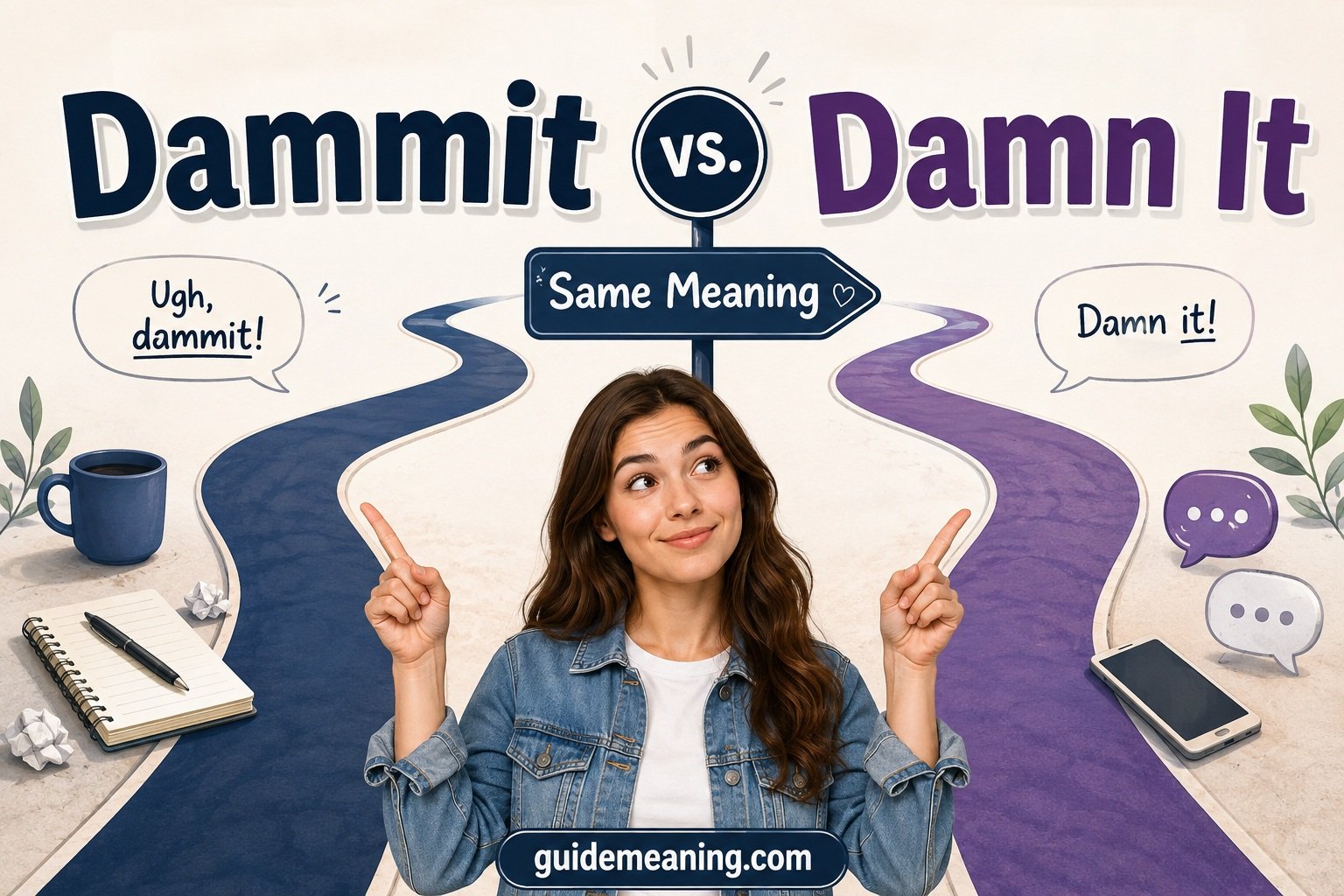

Language evolves fast, especially when emotions run the show. Few expressions capture raw frustration as perfectly as “dammit” and “damn it.”
They sound the same, feel the same, and often appear in the same heated moments — yet they’re not interchangeable.
This guide breaks down everything you need to know about the difference between dammit vs. damn it, including grammar, history, offensiveness, pronunciation, examples, and real-world usage.
Short paragraphs, clean explanations, and plenty of examples make it easy to follow along.
Let’s dive in!
Quick Answer:
Dammit vs. Damn It is mainly a difference in form, not meaning. In the United States, both express frustration, anger, irritation, or disappointment, while dammit feels more compact and conversational. Dictionaries recognize dammit as a form derived from damn it.
TL;DR:
• Damn it is the original two-word expression.
• Dammit is an established one-word form of the same expression.
• Both can express anger, frustration, irritation, or disappointment.
• Dammit often feels more conversational and emotionally immediate.
• The expression has roots in the older verb damn.
• Neither form belongs in especially formal or careful writing.
What Does Dammit Mean?
The first step is understanding what the expression actually does in conversation. Dammit usually works as an interjection, meaning it interrupts ordinary speech to express a strong feeling.
In American English, it can appear by itself or inside a sentence. Its meaning depends heavily on the situation and the speaker’s tone.
The Basic Meaning
A person might say:
“Dammit! I forgot my keys.”
Here, the speaker isn’t literally making a religious judgment about the keys. Instead, the word releases frustration.
American Heritage defines dammit as an expression of anger, irritation, contempt, or disappointment. Cambridge similarly describes it as an informal expression of anger and notes that it can also add emphasis.
Common Emotional Uses
The expression can communicate several related reactions:
• Frustration after something goes wrong
• Irritation when an unwanted event happens
• Disappointment after an expected result fails
• Anger during an argument or stressful moment
• Emphasis when the speaker feels strongly
Because context matters, the same word can sound playful, serious, dramatic, or genuinely angry.
What Does Damn It Mean?
“Damn it” is the two-word version of the expression. It generally carries the same emotional force as “dammit,” although its visual form can make the phrase feel slightly more deliberate.
The phrase can stand alone or appear before another statement. For example, someone might write, “Damn it, I knew this would happen.”
Why Two Words?
The phrase contains the verb damn followed by the pronoun it. Historically, damn had a stronger sense connected with condemnation or judgment. Over time, expressions containing the word developed many less literal uses.
Today, “damn it” is usually understood as an emotional exclamation rather than a literal statement about punishment.
Does It Always Mean Anger?
No. Although anger is common, the phrase can express other strong reactions.
Someone may say “Damn it!” after making a silly mistake. Another person might use it when disappointed by unexpected news. In fiction, the expression can even help show determination or emotional intensity.
Is Dammit One Word or Two?
This is one of the most common points of confusion. The simple answer is that dammit is one word, while damn it is two words.
Merriam-Webster lists dammit as its own interjection and gives its etymology as an alteration of “damn it.” Dictionary.com also identifies it as a contracted form of the phrase.
How the Forms Developed
Spoken language often joins neighboring words. When people say “damn it” quickly, the sounds can blend together.
Over time, that spoken form became represented in writing as dammit. Dictionary sources place the written form around 1905–1910.
A Familiar Pattern in English
English contains many shortened forms created through everyday speech. However, dammit is unusual because it became established as a dictionary word rather than remaining only a casual pronunciation.
That makes it different from simply typing words incorrectly.
Dammit vs. Damn It: What Is the Difference?
The central difference is grammatical form and style. The emotional meaning remains almost identical.
For most American readers, the easiest way to remember the distinction is this: damn it shows the original phrase, while dammit presents the expression as one informal interjection.
| Context | Damn It | Dammit | Typical Effect |
| Casual conversation | Common | Common | Emotional and direct |
| Fictional dialogue | Common | Common | Natural spoken voice |
| Text messages | Common | Very natural | Quick emotional reaction |
| Formal writing | Usually avoided | Usually avoided | Too informal |
| Strong emotional outburst | Natural | Very natural | Immediate frustration |
Tone and Appearance
“Dammit” can look more abrupt because it appears as one compact word. It visually resembles the quick sound people make when reacting emotionally.
“Damn it,” by contrast, keeps the phrase separated. That can make it look slightly more measured on the page, even though speakers may pronounce both forms almost identically.
How Did Dammit Originate?
The history begins with the word damn, not with dammit itself. The one-word form developed later from the spoken expression “damn it.”
This matters because the expression isn’t an ancient symbol with a fixed meaning. Instead, it’s an example of language changing through repeated everyday use.
The History of Damn
The English verb damn ultimately traces back through French and Latin roots connected with condemning or declaring something worthy of punishment. Its older religious sense became especially important in Christian Europe.
However, words can shift dramatically in emotional use. An expression that once carried a more literal meaning can eventually become a general exclamation.
From Phrase to Interjection
“Damn it” became an established way to express frustration. As speakers blended the phrase in rapid speech, dammit emerged as a written representation of that pronunciation.
Etymonline records dammit as a representation of the oath “damn it” and dates that form to 1908.
This development shows a familiar pattern: speech can influence spelling, especially when an expression becomes common enough.
Why Does Dammit Sound More Emotional?
There is a psychological reason the one-word form can feel stronger on the page. A compact word can visually resemble a sudden verbal outburst.
Compare these:
“Damn it. I missed the train.”
“Dammit! I missed the train.”
The words communicate nearly the same idea. However, the second version can feel faster and more spontaneous.
Emotional Release
Interjections often work differently from ordinary vocabulary. They don’t simply describe an emotion. Instead, they can signal the emotion as it happens.
Cambridge classifies dammit as an interjection and specifically connects it with anger and emphasis.
Context Changes the Force
A quiet “dammit” after dropping a pen may sound mild. A shouted “DAMMIT!” during an argument can feel much harsher.
Therefore, spelling alone doesn’t determine the emotional intensity. Voice, punctuation, setting, and relationship all matter.
How Is Dammit Used in American Culture?
In the United States, dammit is strongly connected with informal speech. It appears in everyday conversation, fictional dialogue, entertainment, humor, and online communication.
American English also has a long tradition of using mild profanity to express frustration without making a literal threat.
Everyday American Examples
You might encounter it after:
• Missing an important appointment
• Breaking something by accident
• Losing a game
• Forgetting an important detail
• Discovering an unexpected problem
• Hearing disappointing news
The word can therefore act almost like verbal punctuation. It tells the listener that something has gone wrong emotionally.
Media and Fiction
Writers frequently use dammit to make dialogue sound spontaneous. It can quickly establish frustration without requiring a long explanation.
However, writers also use it for humor. A character who repeatedly says “dammit” may become recognizable because of the habit itself.
Is Dammit Considered a Swear Word?
Yes, generally speaking, dammit is considered mild profanity or an informal swear expression in American English. However, its strength varies greatly by audience, age group, setting, and personal standards.
It isn’t usually treated with the same severity as stronger profanity. Still, it isn’t neutral language either.
Why It Can Offend Some People
The sensitivity comes partly from the historical meaning of damn. The word has religious associations involving condemnation and punishment.
For some speakers, that history still matters. For others, the word has become a mild everyday exclamation with little religious meaning.
Situation Matters
A person might casually say “dammit” among close friends. The same expression could seem inappropriate during a formal presentation or serious professional meeting.
So, the safest rule is simple: consider your audience before using it.
Does Dammit Have a Religious Meaning?
The modern word usually functions as an emotional expression rather than a literal religious statement. Still, its historical background is connected to the older meaning of damn.
This distinction helps explain why some people regard the expression as harmless while others consider it offensive.
Historical Religious Connection
The verb damn developed meanings involving condemnation. In Christian contexts, ideas about divine judgment gave the word strong religious weight.
However, modern speakers often use dammit without intending a theological statement. The expression has become largely idiomatic.
Broader Cultural Perspective
Other languages also develop emotional expressions from religious, moral, or supernatural language. The exact words and level of offense vary across cultures.
Therefore, translating dammit word-for-word doesn’t always reproduce its social force. A phrase that sounds mild in one language can sound much stronger in another.
Read More: Linchpin vs. Lynchpin: Which Spelling Is Correct? for 2026
What Does Dammit Signal Emotionally?
Words like dammit can reveal more about emotional intensity than literal meaning. The speaker usually wants to signal that something matters.
The word can therefore communicate urgency without explaining the entire situation.
Common Emotional Associations
• Frustration when plans suddenly fail
• Annoyance after repeated mistakes
• Disappointment following an unwanted result
• Anger during a heated exchange
• Determination when facing an obstacle
Sometimes it can even communicate affection or humor. For example, a fictional character might say, “Dammit, you’re impossible,” without expressing serious hostility.
Why People Use It
Swear words can provide emotional emphasis. They can also make speech sound more natural in certain social settings.
Still, emotional force depends on the speaker. One person’s mild expression may feel deeply offensive to another person.
How Is Dammit Used in Texting and Social Media?
Digital communication has made informal spellings highly visible. Because texting often imitates speech, dammit fits naturally into quick emotional messages.
For example:
“Dammit, I forgot to send the file.”
“Dammit! That was the last ticket.”
“Okay, dammit, let’s try again.”
Punctuation Changes the Feeling
Punctuation can strongly affect how the expression reads.
A period may make it feel controlled. An exclamation point makes it more forceful. Repetition can make it sound humorous, dramatic, or increasingly angry.
Digital Communication Removes Voice
Online readers can’t hear the speaker’s tone. As a result, context becomes especially important.
A message such as “Dammit 😂” may sound playful among friends. The same word without context could seem genuinely angry.
When Should You Use Damn It Instead?
“Damn it” can be useful when you want the traditional two-word form. It also works naturally when the expression appears as part of a larger sentence.
However, neither form is ideal for formal academic or professional writing.
Better Situations for Damn It
Consider the two-word form when:
• You want to preserve the original phrase
• You’re writing natural dialogue
• You want a slightly more deliberate appearance
• You need the phrase to fit a particular sentence rhythm
For formal writing, however, a neutral alternative is often better.
Instead of “Damn it, the report is late,” you could write, “Unfortunately, the report is late.”
Is Dammit the Same as Damnit?
Not exactly. Dammit is the established standard one-word spelling, while damnit appears as a variant or nonstandard spelling in different sources.
Cambridge lists damnit as a very informal variant, while Merriam-Webster and American Heritage list dammit as the established dictionary form.
Why People Write Damnit
The spelling likely reflects pronunciation. When “damn it” is spoken quickly, the final sound can make the spelling damnit seem logical.
Online writing also spreads informal variants quickly. That doesn’t mean every common spelling has equal status in edited American English.
Which Form Is Safest?
For standard American writing, dammit is the safest one-word choice. If you want the original phrase, write damn it.
“Damnit” may appear in casual communication, but it isn’t the form most readers expect in carefully edited writing.
How Has the Meaning Changed Over Time?
The expression has moved away from its older literal and religious associations. Today, most American speakers use it as an emotional exclamation.
That change reflects a broader pattern in English. Words can lose some of their original force as they become common in everyday speech.
Earlier Associations
Historically, damn had a stronger connection to judgment and condemnation. Religious language helped give the word serious emotional force.
Over time, however, damn developed many secular uses. The expression “damn it” became a general way to express frustration.
Modern Meaning
Today, dammit usually doesn’t mean that the speaker literally wishes supernatural punishment upon an object or situation.
Instead, it often means something closer to:
“I’m frustrated.”
“This is really annoying.”
“I can’t believe this happened.”
“I strongly wish this had gone differently.”
That shift is important when interpreting the expression in modern American conversation.
Common Misunderstandings About Dammit and Damn It
Because the two forms look different, people sometimes assume they have different meanings. They don’t.
Another misconception is that dammit is simply a mistake. In standard dictionaries, it has its own entry and is recognized as an interjection derived from “damn it.”
Mistake: They Have Different Meanings
They generally don’t. The difference is primarily spelling and presentation.
Mistake: Dammit Is Just Bad Spelling
It isn’t. Dammit is an established word in major dictionaries.
Mistake: Damn It Is Always More Correct
“Damn it” is the original two-word phrase, but dammit is also an accepted form.
Mistake: The Word Always Shows Serious Anger
Not necessarily. It can express mild frustration, humor, disappointment, surprise, or dramatic emphasis.
FAQs:
Is “dammit” a real word?
Yes. Major dictionaries recognize dammit as an interjection derived from “damn it.” It is informal and commonly associated with anger, irritation, contempt, or disappointment.
Is “damn it” or “dammit” correct?
Both forms are recognized. “Damn it” is the two-word phrase, while “dammit” is the established one-word form.
Is “dammit” more informal than “damn it”?
Generally, yes. The one-word spelling often feels more conversational and spontaneous, although both are informal expressions.
Is “damnit” correct?
“Damnit” appears in real usage and is listed by Cambridge as a very informal variant. However, dammit is the safer standard one-word spelling for careful American English.
Is dammit considered a bad word?
It is generally considered mild profanity. Its offensiveness depends on the audience, setting, and personal standards.
Can I use dammit in professional writing?
It’s usually better to avoid it in formal professional writing. In dialogue, creative writing, or quoted speech, it may be appropriate when the tone calls for it.
Why do people say dammit?
People usually say it to release or emphasize frustration, irritation, disappointment, or anger. In some situations, it can also add humor or dramatic emphasis.
Conclusion:
Dammit vs. Damn It isn’t really a battle between two different meanings. Both forms express strong emotion, especially frustration, irritation, disappointment, or anger. The main difference is that “damn it” preserves the original two-word phrase, while “dammit” represents the familiar spoken form as one word.
In modern American English, dammit is an established informal interjection. Its history reaches back to the older meaning of damn, but its everyday use has become much broader and less literal. Today, context, tone, punctuation, and audience matter more than the spelling alone.