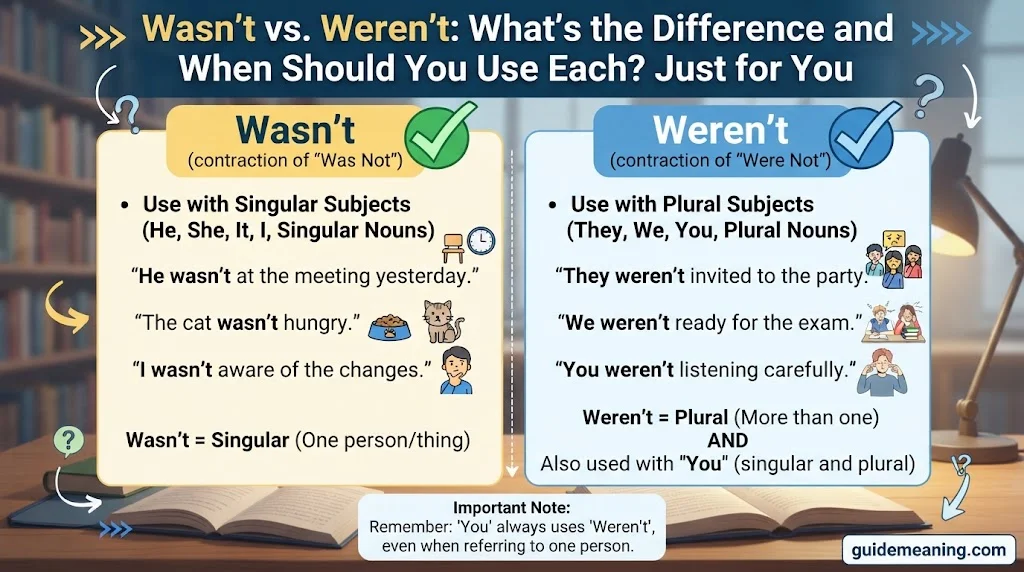

Wasn’t vs. Weren’t can seem confusing, but the right choice becomes clear when you check the subject, sentence structure, and context first. These contractions represent was not and were not, which are negative forms of the past tense of the verb to be. In most ordinary sentences, wasn’t goes with singular subjects, while weren’t goes with plural subjects. For example, “She wasn’t ready” uses wasn’t because “she” is singular. Meanwhile, “They weren’t ready” uses weren’t because “they” is plural. This simple pattern gives English learners a reliable starting point.
The subject should usually be your first checkpoint when choosing between these two forms. Singular subjects such as he, she, and it normally pair with wasn’t. Plural subjects such as we, you, and they normally pair with weren’t. The word you is especially important because English uses were with both singular and plural “you.” Therefore, you would say, “You weren’t late,” even when speaking to only one person. Once you recognize this pattern, the basic grammatical difference becomes much easier to understand.
However, real communication doesn’t always feel as neat as a grammar table. During a quick conversation, message, or everyday exchange, you may hesitate because both forms sound familiar. Spoken English can move quickly, so your attention may focus on the meaning rather than the grammatical structure. That’s when a simple habit helps. Stop for a moment, identify the subject, and then choose the appropriate negative form. This small check can prevent many common mistakes without slowing your communication for long.
Let’s dive in!
Quick Answer:
Wasn’t and weren’t are both negative past forms of be, but they normally follow different subjects.
| Form | Full Form | Common Subjects | Example |
| wasn’t | was not | I, he, she, it, singular nouns | She wasn’t ready. |
| weren’t | were not | you, we, they, plural nouns | They weren’t ready. |
The basic rule is simple:
- I wasn’t ready.
- He wasn’t home.
- She wasn’t angry.
- It wasn’t easy.
- You weren’t late.
- We weren’t prepared.
- They weren’t available.
However, hypothetical sentences create a special situation. In standard formal English, were can replace was after a singular subject when the sentence describes an unreal or hypothetical situation.
For example:
If I weren’t so busy, I would help you.
British Council grammar guidance also recognizes both was and were in many modern hypothetical constructions, although were remains especially common in formal contexts.
What Does “Wasn’t” Mean?
Wasn’t is the contraction of was not.
It is the negative form of was, which is the past form of be used with I, he, she, and it in ordinary statements.
For example:
- I wasn’t at work yesterday.
- He wasn’t feeling well.
- She wasn’t interested.
- It wasn’t my decision.
- The movie wasn’t very long.
In each sentence, the subject normally calls for was rather than were.
When Should You Use “Wasn’t”?
Use wasn’t when an ordinary past-tense sentence has one of these subjects:
- I
- he
- she
- it
- A singular noun
Consider these examples:
I wasn’t hungry after lunch.
Daniel wasn’t at the office.
The weather wasn’t pleasant.
My sister wasn’t ready.
The word after wasn’t doesn’t determine the verb. The subject does.
For instance, in “The box wasn’t on the tables,” the word tables is plural. However, the subject is box, which is singular. Therefore, wasn’t remains correct.
What Does “Weren’t” Mean?
Weren’t is the contraction of were not.
In ordinary past-tense sentences, weren’t works with you, we, they, and plural nouns.
Examples include:
- You weren’t there.
- We weren’t prepared.
- They weren’t happy.
- The students weren’t quiet.
- Those shoes weren’t expensive.
Cambridge Grammar gives the basic past-tense pattern as was with I, she, he, and it and were with you, we, and they.
Why Does “You” Use “Weren’t”?
This point often surprises English learners.
English uses were with you whether you refers to one person or several people.
So these are both correct:
You weren’t listening.
You weren’t listening.
The first sentence could address one person. The second could address several people. The verb doesn’t change.
The same rule applies to were in positive sentences:
- You were right.
- You were late.
- You were tired.
Therefore, the negative forms become:
- You weren’t right.
- You weren’t late.
- You weren’t tired.
Wasn’t vs. Weren’t: The Main Grammar Rule
The easiest way to understand wasn’t vs. weren’t is to look at the subject.
Use “wasn’t” with:
I + wasn’t
He + wasn’t
She + wasn’t
It + wasn’t
Singular noun + wasn’t
Use “weren’t” with:
You + weren’t
We + weren’t
They + weren’t
Plural noun + weren’t
Here’s the complete pattern:
| Subject | Negative Form | Example |
| I | wasn’t | I wasn’t worried. |
| You | weren’t | You weren’t worried. |
| He | wasn’t | He wasn’t worried. |
| She | wasn’t | She wasn’t worried. |
| It | wasn’t | It wasn’t difficult. |
| We | weren’t | We weren’t worried. |
| They | weren’t | They weren’t worried. |
Think of wasn’t and weren’t as two branches growing from the same verb.
BE → was/were → wasn’t/weren’t
The subject determines which branch you take.
Wasn’t vs. Weren’t With Different Subjects
A quick subject comparison can make the rule much easier to remember.
| Subject Type | Correct Choice | Example |
| I | wasn’t | I wasn’t ready. |
| Singular person | wasn’t | Maria wasn’t ready. |
| Singular thing | wasn’t | The car wasn’t ready. |
| You | weren’t | You weren’t ready. |
| We | weren’t | We weren’t ready. |
| They | weren’t | They weren’t ready. |
| Plural noun | weren’t | The cars weren’t ready. |
Notice how the noun itself doesn’t matter as much as its number.
Car is singular, so:
The car wasn’t ready.
Cars is plural, so:
The cars weren’t ready.
That tiny -s changes the subject from singular to plural. The verb follows it.
Wasn’t vs. Weren’t in Questions
Negative questions follow the same basic distinction.
Use wasn’t when the subject normally takes was.
Wasn’t he at the meeting?
Wasn’t she your teacher?
Wasn’t it expensive?
Use weren’t when the subject normally takes were.
Weren’t you listening?
Weren’t they invited?
Weren’t we supposed to leave at six?
Negative questions can express surprise, confirmation, or an expectation that something is true.
For example:
Wasn’t Sarah coming with us?
The speaker likely expected Sarah to come and wants confirmation.
Compare that with:
Weren’t the students supposed to arrive at nine?
Here, the speaker expects a group of students to have arrived.
The grammatical rule stays the same. Only the subject changes.
Wasn’t vs. Weren’t in Conditional and Hypothetical Sentences
Here’s where wasn’t vs. weren’t becomes more interesting.
English sometimes uses were with singular subjects when a sentence describes an unreal, imagined, or hypothetical situation. This traditional form is often called the past subjunctive or irrealis were.
For example:
If I weren’t busy, I would help you.
The speaker is probably busy. The sentence imagines a different situation.
Another example:
If she weren’t at work, she would join us.
The speaker is imagining a situation in which she isn’t at work.
British Council guidance explains that past-tense forms can express hypotheses about present or future situations. It also notes that were can occur after I, he, and she in these constructions.
Why Is “Were” Used With “I”?
Normally, we say:
I was tired.
But in a hypothetical statement, you may say:
If I were taller, I would play basketball.
The sentence isn’t describing an ordinary past event. It imagines a different reality.
That difference is crucial.
Compare:
I wasn’t at the party.
This describes a real past situation.
If I weren’t at the party, I would call you.
This imagines a different situation.
The same basic distinction applies to wasn’t and weren’t.
“If I Wasn’t” vs. “If I Weren’t”
Both if I wasn’t and if I weren’t occur in modern English. The best choice depends partly on the meaning, context, and level of formality.
“If I weren’t”
Weren’t traditionally marks the sentence as hypothetical or contrary to fact.
If I weren’t so tired, I’d go with you.
If I weren’t busy tomorrow, I’d join you.
If I weren’t afraid, I would try it.
This form clearly signals an imagined condition.
“If I wasn’t”
Modern English also uses wasn’t in many hypothetical constructions.
If I wasn’t clear, let me explain.
If I wasn’t available, who would handle the meeting?
If I wasn’t working tomorrow, I’d come with you.
British Council explains that modern English allows both forms in many hypothetical constructions, with were often retained as the more traditional or formal option.
So the old idea that “if I wasn’t” is always wrong doesn’t accurately describe modern English usage.
“I Wasn’t” vs. “I Weren’t”
For an ordinary past statement, I wasn’t is correct.
I wasn’t at home.
I wasn’t feeling well.
I wasn’t interested.
I wasn’t ready.
By contrast, I weren’t doesn’t work as the ordinary past form.
However, weren’t can appear with I in hypothetical constructions:
If I weren’t so busy, I’d help.
This distinction gives you a useful shortcut:
Ordinary past fact → I wasn’t
Hypothetical or unreal situation → I weren’t can be appropriate
The context matters more than simply counting singular and plural subjects.
“You Wasn’t” vs. “You Weren’t”
In standard English, use you weren’t, not you wasn’t.
Correct:
You weren’t late.
You weren’t listening.
You weren’t responsible.
Incorrect in standard English:
You wasn’t late.
You wasn’t listening.
You wasn’t responsible.
This rule applies whether you refers to one person or multiple people.
For example:
You weren’t invited.
That could mean one person wasn’t invited or an entire group wasn’t invited. The pronoun you still takes were.
Some dialects and informal varieties use forms such as you was, but standard written English uses you were.
Common Mistakes With Wasn’t and Weren’t
Using Wasn’t With Plural Subjects
Incorrect:
They wasn’t ready.
Correct:
They weren’t ready.
They is plural, so the standard form is weren’t.
Using Weren’t With Singular Subjects
Incorrect:
She weren’t available.
Correct:
She wasn’t available.
She is singular, so an ordinary past statement requires wasn’t.
Using Wasn’t With You
Incorrect:
You wasn’t paying attention.
Correct:
You weren’t paying attention.
Remember that you always takes were in standard English.
Confusing Real Past Events With Hypothetical Situations
Consider these two sentences:
I wasn’t at home.
If I weren’t at home, I would answer the phone.
The first describes a real past situation. The second imagines a condition.
That small change in meaning explains why wasn’t and weren’t can both appear with I in different contexts.
Wasn’t vs. Weren’t in Formal and Informal English
Standard grammar gives you a reliable starting point, but real English isn’t frozen in place.
In ordinary statements, the distinction remains straightforward:
- I wasn’t
- He wasn’t
- She wasn’t
- It wasn’t
- You weren’t
- We weren’t
- They weren’t
Hypothetical sentences are more flexible. Modern English commonly allows was as well as were after singular subjects in many conditional constructions. British Council materials specifically acknowledge this variation.
Still, were has an advantage when you want the hypothetical meaning to stand out clearly.
For example:
If I were you, I wouldn’t wait.
This sentence is a familiar formal construction. It unmistakably presents an imagined situation.
In casual conversation, however, you may hear:
If I was you, I wouldn’t wait.
The latter occurs in modern speech, although were remains the traditional choice and is often preferred in formal writing.
Wasn’t vs. Weren’t Examples in Everyday English
The easiest way to make the difference stick is to see it in ordinary situations.
At Work
I wasn’t in the office yesterday.
We weren’t in the office yesterday.
The manager wasn’t available.
The employees weren’t available.
At School
She wasn’t absent yesterday.
They weren’t absent yesterday.
The classroom wasn’t open.
The students weren’t ready.
With Family
My brother wasn’t home.
My brothers weren’t home.
You weren’t answering your phone.
Talking About Plans
The restaurant wasn’t open.
The restaurants weren’t open.
We weren’t expecting you.
He wasn’t expecting us.
Talking About the Weather
It wasn’t cold yesterday.
The conditions weren’t ideal.
The pattern keeps repeating. Once you spot the subject, the correct form becomes much easier to choose.
Wasn’t vs. Weren’t: A Practical Comparison
| Sentence | Correct? | Why? |
| I wasn’t tired. | Yes | I normally takes was. |
| I weren’t tired. | No in an ordinary past statement | I normally takes was. |
| You weren’t tired. | Yes | You takes were. |
| You wasn’t tired. | No in standard English | You takes were. |
| She wasn’t tired. | Yes | She is singular. |
| She weren’t tired. | No in an ordinary past statement | She normally takes was. |
| They weren’t tired. | Yes | They is plural. |
| They wasn’t tired. | No in standard English | They takes were. |
| If I weren’t busy, I’d help. | Yes | Weren’t marks a hypothetical condition. |
| If I wasn’t clear, I’ll explain. | Yes | Here, wasn’t clear can refer to an actual possibility or past statement. |
Case Study: Why Context Changes the Answer
Consider this short conversation:
Anna: Why didn’t you join us?
Ben: I wasn’t feeling well.
Here, wasn’t describes Ben’s actual past condition.
Now change the sentence:
Ben: If I weren’t feeling sick, I’d join you.
Now Ben is imagining a different situation.
The subject is still I. Yet the form changes because the sentence has changed from a straightforward past statement to a hypothetical condition.
This is one of the most important lessons in wasn’t vs. weren’t:
Grammar depends on both structure and meaning.
Subject agreement gives you the basic rule. Context explains the exceptions.
How to Remember the Difference Between Wasn’t and Weren’t
Use this simple pattern:
I / He / She / It → WASN’T
You / We / They → WEREN’T
For example:
- I wasn’t
- He wasn’t
- She wasn’t
- It wasn’t
- You weren’t
- We weren’t
- They weren’t
Then remember the special rule:
Hypothetical “were” can follow singular subjects.
If I weren’t busy…
If she weren’t here…
If he weren’t so tired…
This isn’t an ordinary subject-agreement pattern. It’s a special construction used for hypothetical or unreal situations.
Wasn’t vs. Weren’t: Quick Decision Guide
When you’re unsure, follow these steps.
First, find the subject.
Ask: Who or what wasn’t something?
Next, decide whether the sentence describes an ordinary past situation.
If yes, use the normal subject pattern.
- I/he/she/it → wasn’t
- you/we/they → weren’t
- singular noun → wasn’t
- plural noun → weren’t
Finally, check for a hypothetical meaning.
If the sentence imagines an unreal or unlikely situation, weren’t may work with a singular subject.
For example:
If I weren’t busy, I’d come.
A Simple Visual Guide
Subject
↓
I / He / She / It / singular noun
→ WASN’T
You / We / They / plural noun
→ WEREN’T
Hypothetical or unreal situation
→ WERE may be used with a singular subject
This three-step check solves most wasn’t vs. weren’t questions in seconds.
Practice: Wasn’t or Weren’t?
Fill in each blank with wasn’t or weren’t.
- I _______ ready for the meeting.
- They _______ at home.
- She _______ interested.
- You _______ late.
- The children _______ tired.
- It _______ a difficult test.
- We _______ prepared.
- The manager _______ available.
- If I _______ so busy, I’d help.
- The books _______ on the table.
Answer Key
| Sentence | Answer | Reason |
| I ___ ready. | wasn’t | I normally takes was. |
| They ___ at home. | weren’t | They is plural. |
| She ___ interested. | wasn’t | She is singular. |
| You ___ late. | weren’t | You takes were. |
| The children ___ tired. | weren’t | Children is plural. |
| It ___ difficult. | wasn’t | It takes was. |
| We ___ prepared. | weren’t | We takes were. |
| The manager ___ available. | wasn’t | Manager is singular. |
| If I ___ busy… | weren’t | The sentence is hypothetical. |
| The books ___ there. | weren’t | Books is plural. |
Wasn’t vs. Weren’t: Key Facts to Remember
Here are the rules worth keeping in your mental grammar toolbox:
- Wasn’t = was not.
- Weren’t = were not.
- Use wasn’t with I, he, she, and it in ordinary past statements.
- Use weren’t with you, we, and they.
- Use wasn’t with singular nouns.
- Use weren’t with plural nouns.
- You weren’t is correct whether you means one person or several.
- I wasn’t is correct for ordinary past statements.
- I weren’t isn’t the ordinary past form.
- Weren’t can occur with singular subjects in hypothetical or unreal constructions.
- Modern English sometimes uses was instead of were in hypothetical clauses.
- Were remains especially useful when you want to make the hypothetical meaning clear.
FAQs:
What is the difference between wasn’t and weren’t?
Wasn’t means was not, while weren’t means were not. In ordinary past-tense sentences, wasn’t usually follows singular subjects such as “he,” “she,” and “it.” Weren’t normally follows plural subjects such as “we” and “they,” as well as “you.”
Is “I wasn’t” or “I weren’t” correct?
“I wasn’t” is correct when you’re describing a real past situation. For example, “I wasn’t at home yesterday.” However, “I weren’t” can appear in certain hypothetical or subjunctive constructions, such as “If I weren’t so tired, I would go.”
Should I use wasn’t with you?
No. Standard English uses “you weren’t,” whether “you” refers to one person or several people. For example, “You weren’t late” is correct. “You wasn’t late” is considered nonstandard in formal English.
Can weren’t be used with a singular subject?
Yes, especially in hypothetical or unreal conditions. For example, “If she weren’t busy, she would come” uses weren’t with the singular subject “she.” This construction reflects the subjunctive mood rather than ordinary past-tense agreement.
Is “we wasn’t” grammatically correct?
In standard English, “we weren’t” is correct. “We” is a plural subject, so it normally takes were, including in the negative contraction weren’t. Therefore, you should write, “We weren’t ready,” rather than “We wasn’t ready.”
Which is correct: “They wasn’t” or “They weren’t”?
“They weren’t” is correct in standard English. The pronoun “they” normally takes were, so its negative form is weren’t. For example, “They weren’t available yesterday” follows standard subject-verb agreement.
How can I remember when to use wasn’t and weren’t?
Start by identifying the subject. Use wasn’t with ordinary singular subjects and weren’t with ordinary plural subjects and “you.” Then check whether the sentence expresses a hypothetical or unreal condition. With regular practice, the difference becomes much easier to recognize.
Conclusion:
Understanding wasn’t vs. weren’t becomes much simpler when you look at the subject and context together. Wasn’t normally works with singular subjects in ordinary past-tense statements, while weren’t works with plural subjects and “you.” However, hypothetical and unreal situations can use weren’t with singular subjects, so context matters too.
The best approach isn’t to memorize a mountain of grammar rules. Start with the basic pattern, notice how native speakers use these forms, and practice with realistic sentences. When you’re unsure, check the subject first and then consider whether the sentence describes a real event or a hypothetical situation. With regular practice, choosing between wasn’t and weren’t will become more natural, accurate, and automatic.