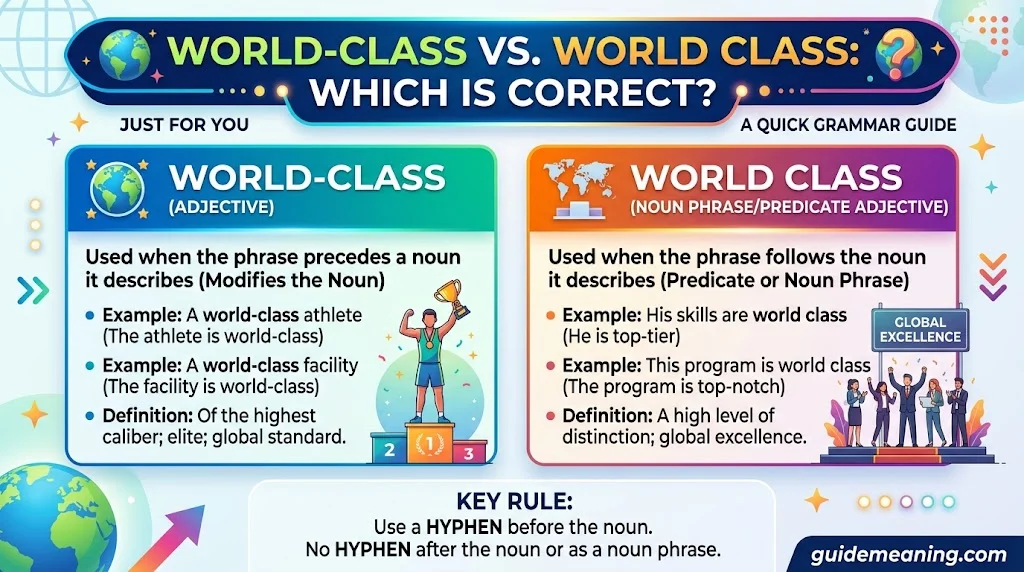

The World-Class vs. World Class difference may seem tiny, but the hyphen can affect meaning, grammar, and structure. World-class usually works as a compound adjective, while world class can function as a noun phrase. I’ve noticed that writers, learners, editors, and English learners often hesitate because both forms look almost identical. In resumes, academic papers, marketing copy, headlines, and brand slogans, selecting the correct form supports credibility, clarity, and professionalism. Strong context awareness and careful sentence setup make the intended expression easier to understand.
A plain English explanation breaks it down without fluff, vague rules, or guesswork. In professional writing, business branding, academic writing, marketing copywriting, and professional communication, world-class can describe a service or another noun directly. This follows English grammar rules, common usage patterns, stylistic consistency, and formatting rules. Meanwhile, world class may operate as a noun phrase, depending on sentence setup, word structure, and context. These choices can affect tone, audience perception, communication clarity, text interpretation, semantic shift, linguistic nuance, text formatting, and editorial context, especially when the semantic role changes.
Using practical examples and simple definitions, this guide makes the distinction clearer and helps you learn the pattern instantly. Avoid mixing them up, since errors can hurt writing accuracy, language precision, and writing quality. Good writing discipline, language learning, semantic interpretation, grammar distinction, structural difference, and text clarity strengthen communication effectiveness and writing confidence. In my experience, checking syntax, structural grammar, language rules, editorial standards, and stylistic choice helps with well-edited documents, real-world publishing, professional editing environments, and content creation. It also supports professional usage, editorial precision, tone control, and communication systems, while keeping NLP, contextually relevant wording, and writing purpose in mind.
Let’s dive in!
Quick Answer:
Use world-class when the phrase works as a compound adjective, especially when it directly modifies a noun.
- a world-class athlete
- a world-class restaurant
- world-class education
- a world-class performance
- world-class facilities
Use world class when the phrase functions as a predicate adjective after a linking verb in styles that leave the compound open.
- The athlete is world class.
- The restaurant is world class.
- Their service was world class.
Oxford specifically illustrates this distinction with “a world-class athlete” and “The team is world class.”
That said, not every style guide handles postpositive compound adjectives identically. Chicago generally favors a spare approach to hyphenation and notes that some compounds can be left open after a noun, while established dictionary forms may retain their hyphens.
| Form | Typical function | Example |
| world-class | Compound adjective before a noun | She is a world-class pianist. |
| world class | Predicate adjective after a linking verb in open-hyphenation styles | Her performance was world class. |
| worldclass | Nonstandard spelling | Avoid it in standard English. |
The safest everyday rule is simple: Use world-class before a noun. Follow your chosen style guide when it appears after a linking verb.
What Does “World-Class” Mean?
World-class is an adjective that describes something as being among the best of its kind worldwide.
It can describe skill, quality, performance, facilities, services, institutions, products, and many other things.
For example:
She is a world-class violinist.
The phrase tells you that her ability reaches an exceptionally high standard. It doesn’t necessarily mean she has officially ranked number one worldwide.
Cambridge defines the adjective as describing someone or something that is among the best of its type in the world.
Oxford uses a similar definition: something world-class is “as good as the best in the world.”
That distinction matters. Calling something world-class expresses a very high level of quality. It doesn’t automatically provide a measurable ranking.
Common Uses of World-Class
You’ll find world-class across many areas:
- world-class athlete
- world-class musician
- world-class university
- world-class hospital
- world-class restaurant
- world-class research
- world-class technology
- world-class facilities
- world-class service
- world-class performance
The phrase has broad reach because the underlying idea is simple: exceptional by global standards.
Why Is “World-Class” Hyphenated?
The hyphen joins world and class so they work together as a single compound modifier.
Consider this sentence:
The university built a world-class research center.
Here, world-class describes research center. The two words operate together as one descriptive unit.
Without the hyphen, the reader may initially process world and class as separate words. The hyphen makes their relationship immediately clear.
This is a common function of hyphens in English.
Compare:
- high-quality product
- long-term plan
- full-time employee
- well-known author
- state-of-the-art equipment
- world-class facility
In each case, the hyphen helps show that multiple words form one modifier.
Chicago’s guidance similarly emphasizes using hyphens when they prevent a possible misreading or improve comprehension.
Think of the Hyphen as a Bridge
A useful way to remember the rule is to think of the hyphen as a small bridge.
world + class → world-class
The bridge tells the reader that the two words belong together for this particular grammatical job.
That’s especially useful when the compound appears directly before a noun.
World-Class Before a Noun
When world-class directly modifies a noun, the hyphenated form is the standard choice.
Consider these examples:
She joined a world-class medical team.
The city has several world-class museums.
He delivered a world-class performance.
The company developed a world-class software platform.
In each sentence, world-class comes before the noun it describes.
The pattern looks like this:
world-class + noun
That’s the most important pattern to remember.
World-Class Athlete
The country produced a world-class athlete.
Here, world-class describes athlete. The hyphen connects the two words into a compound adjective.
World-Class Education
The university provides world-class education.
Again, the phrase describes the quality of the education.
World-Class Facilities
The hotel offers world-class facilities.
The adjective tells readers that the facilities are exceptionally high quality.
World-Class Performance
The singer delivered a world-class performance.
The phrase describes the performance rather than functioning as two independent words.
Is “World-Class” Used After a Linking Verb?
Yes. This is where the subject becomes more nuanced.
You may write:
The athlete is world class.
Oxford explicitly provides this type of construction. Its dictionary lists “The team is world class” alongside “a world-class athlete.”
Why does the form change?
The phrase no longer directly modifies a following noun. Instead, it describes the subject through a linking verb.
Compare:
She is a world-class athlete.
and:
She is world class.
In the first sentence, world-class modifies athlete.
In the second sentence, world class describes she through the linking verb is.
The underlying meaning remains closely related. The grammatical structure changes.
Examples of “World Class” After a Linking Verb
Depending on the style you follow, these open forms can work naturally:
- The team is world class.
- Their service was world class.
- Her performance was world class.
- The restaurant is world class.
- Their facilities are world class.
Oxford’s entry supports this open form in predicate position.
However, you’ll also encounter world-class after linking verbs in edited English. That isn’t surprising because dictionaries and style guides don’t always treat every compound adjective identically.
The practical lesson is more useful than pretending there is one universal rule: check the style standard you’re following and remain consistent.
World-Class vs. World Class: Side-by-Side Comparison
| Sentence | Form | Why? |
| She is a world-class athlete. | world-class | It modifies athlete before the noun. |
| They built a world-class stadium. | world-class | It modifies stadium. |
| He delivered a world-class performance. | world-class | It modifies performance. |
| The athlete is world class. | world class | Predicate use after is. |
| The performance was world class. | world class | Predicate description. |
| The restaurant is world class. | world class | Predicate adjective in an open form. |
| They opened a worldclass stadium. | worldclass | Nonstandard spelling. |
The most reliable pattern for everyday writing is therefore:
Before a noun → world-class
After a linking verb → world class may be appropriate, depending on style
Is “World Class” Ever Correct?
Yes, but it is important to describe the situation accurately.
The phrase world class can appear as an open compound in predicate position. Oxford’s dictionary provides exactly this usage.
For example:
The team is world class.
Here, world class functions as the complement of is. It isn’t placed directly before another noun.
However, you shouldn’t turn this into an absolute rule that world class is always correct after a verb. English hyphenation depends partly on established usage and editorial style.
Chicago’s current guidance explains that compound modifiers can behave differently after the noun and that some compounds retain their hyphens while others become open. It also recommends using hyphens when they improve clarity.
So if you’re writing for a particular publication, company, academic institution, or client, its style guide takes priority.
World-Class vs. World Class: Why Position Matters
Position gives you one of the easiest ways to understand this distinction.
Compare:
We hired a world-class designer.
with:
The designer is world class.
The first phrase appears before a noun. It acts as a compound modifier.
The second appears after a linking verb. It acts as a predicate description.
This pattern appears throughout English.
Compare these familiar pairs:
| Before a noun | Predicate position |
| a high-quality product | The product is high quality. |
| a long-term strategy | The strategy is long term. |
| a full-time employee | The employee works full time. |
| a first-rate service | The service is first rate. |
| a world-class team | The team is world class. |
There are exceptions to this broad pattern. That’s why style references and dictionary entries matter when a phrase has established usage.
Common World-Class Examples
Here are some natural examples you can use as models.
Business
The company provides world-class customer service.
They hired a world-class marketing team.
Education
The university has world-class research facilities.
Students receive access to world-class education.
Sports
She became a world-class swimmer.
The team has several world-class players.
Travel
The resort offers world-class dining.
Visitors can enjoy world-class attractions.
Technology
The company develops world-class cybersecurity tools.
The laboratory has world-class computing facilities.
Entertainment
The festival attracted world-class musicians.
The theater hosted a world-class performance.
Notice the recurring pattern. In every example, world-class directly describes a noun or noun phrase.
World-Class vs. Best in the World
These expressions overlap, but they aren’t identical.
World-class means exceptionally good by worldwide standards. The best in the world makes a stronger and more specific claim.
Consider:
She is a world-class tennis player.
This says she belongs among the highest level of players globally.
Now compare:
She is the best tennis player in the world.
That sentence claims she ranks above every other player.
Those are very different claims.
The first expresses an elite standard. The second asserts a specific top ranking.
This distinction matters in professional writing because world-class is often evaluative rather than numerical. If you’re making a factual claim about rankings, records, awards, or measurable performance, give the supporting evidence.
World-Class vs. World-Renowned
These expressions sound similar, but they emphasize different things.
World-class focuses on quality, ability, or performance.
World-renowned focuses on fame or recognition around the world.
Compare:
She is a world-class surgeon.
The emphasis falls on her ability and professional standard.
She is a world-renowned surgeon.
The emphasis falls more strongly on her international reputation.
Someone can be highly skilled without being famous. Likewise, someone can be famous without automatically being the best at what they do.
That’s why the two expressions aren’t perfect substitutes.
World-Class vs. International
Don’t confuse world-class with international.
International generally means involving or relating to more than one country.
World-class describes an exceptional standard.
For example:
The company has an international customer base.
This tells you where its customers are located.
Now consider:
The company offers world-class customer service.
This describes the claimed quality of that service.
A business can be international without being world-class. It can also provide world-class services without operating in dozens of countries.
The words answer different questions.
Is “World-Class” an Adjective?
Yes. World-class is a compound adjective.
It normally describes a person, thing, activity, institution, or quality.
For example:
- world-class athlete
- world-class chef
- world-class university
- world-class technology
- world-class research
- world-class service
In each example, the phrase answers a descriptive question.
What kind of athlete?
A world-class athlete.
What kind of technology?
World-class technology.
What kind of service?
World-class service.
Cambridge and Oxford both classify world-class as an adjective.
Is “Worldclass” Correct?
No. Worldclass as one closed word isn’t the standard spelling for this adjective.
Use:
a world-class athlete
Not:
a worldclass athlete
The standard dictionaries consulted list the adjective as world-class, with a hyphen.
This is an important third option to eliminate because writers sometimes wonder whether the phrase has evolved into a single word.
It hasn’t become standard in that form.
A Practical Case Study: Editing a Sentence
Suppose you write:
The hotel offers world class service.
The intended meaning is clear. However, the phrase directly modifies service, so the standard compound-adjective form is:
The hotel offers world-class service.
Now change the sentence:
The hotel’s service is world class.
Here, the phrase follows the linking verb is. Oxford’s dictionary supports this open construction.
This tiny change illustrates the central issue.
The meaning hasn’t dramatically changed. The grammatical role has.
Another Example
Original:
She is a world class musician.
Edited:
She is a world-class musician.
Why? The phrase directly modifies musician.
Now:
She is world class.
Here, world class works as the predicate description in the Oxford example pattern.
This is why simply memorizing “always add a hyphen” isn’t quite enough.
Common Mistakes With World-Class vs. World Class
Mistake: Writing “World Class” Before a Noun
❌ He is a world class athlete.
For standard compound-adjective usage, write:
✅ He is a world-class athlete.
The hyphen joins the words that jointly modify athlete.
Mistake: Writing “Worldclass”
❌ She gave a worldclass performance.
Use:
✅ She gave a world-class performance.
The closed form isn’t the standard dictionary spelling.
Mistake: Treating “World-Class” as Meaning “Number One”
Calling something world-class doesn’t automatically establish that it ranks first worldwide.
For example, a world-class restaurant can be described as exceptionally high quality without claiming it is officially the world’s number-one restaurant.
Use precise rankings when rankings actually matter.
Mistake: Assuming Every Style Guide Uses Identical Hyphenation
Hyphenation has plenty of gray areas.
Chicago’s guidance notes that some compound modifiers can be left open after a noun while certain established compounds retain their hyphens.
So don’t treat every hyphenation rule as universal law.
A Simple Decision Guide
When you’re unsure about world-class vs. world class, ask one question first:
What grammatical job is the phrase doing?
If it directly modifies a noun, use:
world-class
Examples:
- world-class athlete
- world-class hospital
- world-class product
- world-class performance
If it follows a linking verb and describes the subject, world class can be appropriate in styles that leave the compound open.
Examples:
- The athlete is world class.
- The hospital is world class.
- The performance was world class.
If you’re writing for a publication with a specific style guide, follow that guide consistently.
Quick Reference Table
| Situation | Preferred form | Example |
| Before a noun | world-class | a world-class chef |
| Compound adjective modifying a noun | world-class | world-class facilities |
| Predicate position in Oxford’s example | world class | The team is world class. |
| One-word spelling | worldclass | Avoid |
| Meaning “among the best globally” | world-class | a world-class athlete |
| Meaning “literally ranked first” | Use a precise ranking instead | the world’s No. 1 player |
FAQs:
Is it “world class” or “world-class”?
The standard compound-adjective form is world-class. Use it when the phrase directly modifies a noun, as in a world-class athlete. In predicate position, Oxford gives world class, as in The team is world class.
Is “world-class” one word or two?
It’s two words connected by a hyphen. The standard spelling is world-class, not worldclass. Cambridge and Oxford both list the adjective in this form.
Should I write “world-class athlete” or “world class athlete”?
Write world-class athlete. The compound adjective comes directly before the noun athlete.
Should I write “the team is world-class” or “the team is world class”?
Both forms appear in edited English, depending on style. Oxford specifically gives “The team is world class.”
If you’re following a house style, use its rule consistently.
Does “world-class” mean the best in the world?
Not necessarily. It means among the best or as good as the best in the world. Cambridge and Oxford use definitions along those lines.
Therefore, world-class doesn’t automatically mean number one.
Is “world-class” an adjective?
Yes. Dictionaries classify world-class as an adjective. It describes exceptionally high quality, skill, or performance.
What is the difference between world-class and world-renowned?
World-class emphasizes exceptional quality or ability. World-renowned emphasizes international fame or recognition.
A person could be world-renowned without being described as the best in their field. Conversely, an exceptionally skilled professional might have little public fame.
Conclusion:
The easiest way to remember world-class vs. world class is to look at the phrase’s grammatical position.When it directly modifies a noun, use world-class:She is a world-class athlete.They built a world-class facility.He delivered a world-class performance.When the phrase appears after a linking verb, world class is a recognized open form, particularly in the usage documented by Oxford: