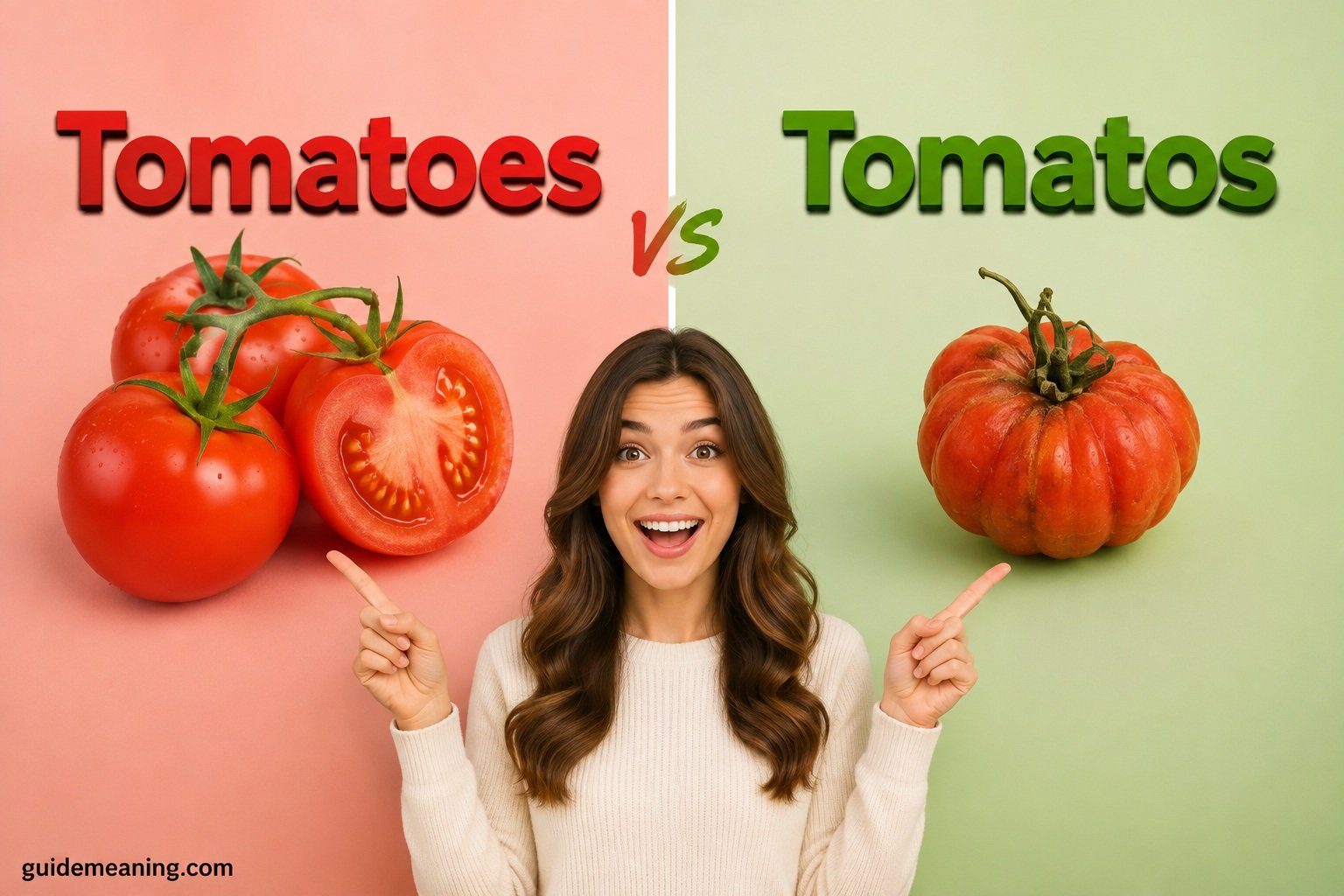

Tomatoes or Tomatos can confuse English learners, writers, and native speakers when they pause mid-sentence and wonder about the correct spelling. The right form is tomatoes, not tomatos, because the tomato changes from singular to plural by adding -es, rather than -s. This simple rule may seem less logical, but English has different spelling patterns, rules, and exceptions. From my editing experience, this common spelling mistake becomes easy once the difference is clearly explained. The -o ending often creates spelling questions, so a helpful guide can help you remember the correct plural form, avoid errors, and stop second-guess yourself.
The English language includes many words with unusual endings, making this small detail important for writing, clarity, and confidence. Whether you’re cooking, blogging, chatting online, or creating everyday sentences, choosing the right word matters. Tomato becomes tomatoes, and this form should be used properly when you want to write accurately and avoid English grammar mistakes. The singular tomato means one item, while tomatoes means more than one. Learning these plural rules helps learners, students, and professionals strengthen their English writing skills and manage similar spelling challenges with greater ease.
An important example is the possessive use of tomato’s and tomatoes’. Knowing the correct form, grammar structure, and plural endings makes these spelling choices clearer. Tomato’s can show possession for one tomato, while tomatoes’ can show possession for several tomatoes. In educational and professional material, this comprehensive understanding can improve writing quality, content, and credibility, while supporting SEO for an audience in the USA. Learning the history, using memory tricks, and reviewing real-life examples give creators, students, and writers practical insights for modern communication, including emails, documents, captions, and business writing. Words such as heirloom, cherry, farmers’ market, and produce also provide useful examples that help you learn usage knowledge through linguistic reasoning, maintain version consistency, and handle everyday situations more confidently.
Let’s dive in!
Quick Answer:
Tomatoes or Tomatos? Tomatoes is correct when you mean more than one tomato. Tomatos is an incorrect spelling in standard English.
TL;DR
• Tomato is the singular form.
• Tomatoes is the correct plural form.
• Tomatos is a common spelling mistake.
• The plural adds -es, not just -s.
• American and British English use tomatoes.
• Tomato has roots in Nahuatl and Mesoamerican food history.
What Is the Correct Plural of Tomato?
The first step is knowing the basic difference between singular and plural forms. In American English, tomato means one fruit, while tomatoes means two or more.
Merriam-Webster lists tomatoes as the plural form of tomato. It also traces the English word through Spanish to the Nahuatl word tomatl.
Tomato vs. Tomatoes
The pattern is simple:
| Form | Meaning | Example |
| tomato | One fruit | I sliced one tomato. |
| tomatoes | More than one | I sliced three tomatoes. |
| tomato’s | Belonging to one tomato | The tomato’s skin was thin. |
| tomatoes’ | Belonging to several tomatoes | The tomatoes’ colors were different. |
Because tomatoes already works as the plural, there’s no need to invent another form.
Why “Tomatos” Looks Correct
English has many nouns that form plurals by adding -s. For example, book becomes books, and car becomes cars.
Therefore, it’s understandable that someone might assume tomato becomes tomatos. However, standard English uses -es here.
Why Is “Tomatoes” Spelled With -ES?
The spelling comes from an established English plural pattern. Words ending in certain consonant-plus-o combinations often form their plural with -es.
For tomato, the result is:
tomato + es = tomatoes
This is the form recognized by standard English dictionaries.
The Easy Rule
A useful memory trick is to connect tomato with potato.
Both commonly use -es in the plural:
• tomato → tomatoes
• potato → potatoes
• hero → heroes
• echo → echoes
• torpedo → torpedoes
However, English has exceptions. Words such as photo and piano normally take -s.
So the safest approach isn’t to memorize a perfect rule for every -o word. Instead, remember the established spelling of common words.
Does the Extra E Change the Pronunciation?
No major change in meaning occurs because of the e. The spelling simply marks the accepted plural form.
Pronunciation can vary between American and British speech. Merriam-Webster notes regional differences in how tomato is pronounced, including the familiar American “tuh-MAY-toh” and “tuh-MAH-toh” varieties.
Is “Tomatos” Ever Correct?
In standard English, no. Tomatos is considered a misspelling of tomatoes.
You may still encounter it in informal posts, comments, handwritten notes, or poorly edited material. Seeing a spelling online doesn’t automatically make it an accepted English form.
Correct Examples
Correct: I bought five tomatoes.
Incorrect: I bought five tomatos.
Correct: These tomatoes are ready to eat.
Incorrect: These tomatos are ready to eat.
For schoolwork, professional writing, recipes, menus, and edited content, use tomatoes.
Why the Mistake Happens
The mistake usually comes from applying a familiar shortcut. Writers see a noun ending in -o and assume they only need to add s.
That shortcut works for some words. Unfortunately, it doesn’t work for tomato.
Tomato, Tomatoes, Tomato’s, or Tomatoes’?
These four forms can look confusing because they differ by only a few letters. However, each one performs a different grammatical job.
Understanding them can prevent several common writing mistakes.
Singular: Tomato
Use tomato when talking about one.
I need one tomato for the sandwich.
Plural: Tomatoes
Use tomatoes when talking about multiple tomatoes.
We bought six tomatoes at the market.
Singular Possessive: Tomato’s
Use tomato’s when something belongs to or is connected with one tomato.
The tomato’s skin was soft.
The apostrophe does not make the noun plural. It shows possession.
Plural Possessive: Tomatoes’
Use tomatoes’ when something belongs to multiple tomatoes.
The tomatoes’ colors ranged from green to deep red.
The apostrophe comes after the s because the noun is already plural.
Read More: Informational vs Informative: Key Differences Explained
How Do You Use Tomatoes in a Sentence?
Knowing the spelling is only part of the process. You also need to understand when the plural form belongs in a sentence.
For American readers, these examples cover many everyday situations.
In Cooking
Recipes frequently use tomatoes because they call for more than one fruit.
Add two chopped tomatoes to the pan.
The sauce needs three ripe tomatoes.
Roast the tomatoes until they soften.
In Shopping
The plural form is also common when discussing groceries.
I bought fresh tomatoes today.
These tomatoes look ripe.
The store has several varieties of tomatoes.
In Gardening
Gardeners often discuss tomatoes as a group.
We planted tomatoes in the backyard.
Our tomatoes are growing quickly.
The tomatoes need support as they become taller.
As a General Category
Sometimes tomatoes refers to the fruit generally rather than a specific number.
Tomatoes are common ingredients in American cooking.
Here, the plural represents the category as a whole.
Tomato as a Describing Word
One subtle point causes confusion for some writers. Tomato can appear before another noun as a describing word.
In these phrases, it normally stays singular.
Common Examples
• tomato sauce
• tomato soup
• tomato juice
• tomato plant
• tomato paste
• tomato salad
For example, you would normally write:
I made tomato sauce.
You wouldn’t write:
I made tomatoes sauce.
The word sauce is the main noun. Tomato tells you what kind of sauce it is.
What About “Tomato Plants”?
Here, tomato still describes the noun plants.
We planted four tomato plants.
The plants are plural, but tomato functions as a descriptor.
Tomatoes in American English
For readers in the United States, the spelling question has a clear answer. American English uses tomatoes, just like British English does.
There’s no American spelling such as tomatos. The difference between American and British English appears in words such as color/colour, but not in the plural of tomato.
Why This Matters in the USA
Tomatoes are deeply familiar in American life. They appear in salads, sandwiches, soups, sauces, gardening, farmers markets, and backyard gardens.
They also have an important place in American food history. The tomato eventually became a major commercial crop, with large-scale production developing in places such as California.
Where Did the Word “Tomato” Come From?
The spelling becomes even more interesting when you look at the word’s history. Tomato isn’t an originally English word.
Merriam-Webster traces it from an earlier form tomate, through Spanish, and ultimately to tomatl, a Nahuatl word. Its first known English use is dated to 1604.
Ancient and Mesoamerican Roots
Tomatoes originated in the Americas, with wild forms associated with South America and early cultivation connected to Mesoamerica.
Before European contact, tomatoes were already part of Indigenous food traditions. Smithsonian historical research notes their use among the Aztecs and other peoples in the region.
This history matters because the tomato’s modern identity can hide its much older American origins.
The Tomato Travels to Europe
After Spanish contact with the Americas, tomatoes traveled across the Atlantic. Europeans initially treated them with caution and curiosity.
Some people associated them with poisonous members of the nightshade family. Others valued them as unusual plants or ornamental curiosities.
Over time, however, tomatoes became important ingredients in European cooking. Italy eventually became strongly associated with tomato-based cuisine, even though the plant itself came from the Americas.
Why Were Tomatoes Once Feared?
The tomato’s history includes a surprising period of suspicion. Some Europeans believed tomatoes could be dangerous or poisonous.
The concern partly came from their relationship to other nightshade plants. Their unfamiliar appearance also contributed to uncertainty about whether they were safe to eat.
From Suspicion to Everyday Food
Over the centuries, attitudes changed dramatically. Tomatoes moved from unusual garden plants to common food ingredients.
In the United States, tomatoes eventually became part of everyday meals and commercial food products. Their journey shows how food meanings can change through culture, trade, science, and habit.
Why Is Tomato Botanically a Fruit but Often Called a Vegetable?
This question adds another layer to the tomato story. Botanically, a tomato is a fruit because it develops from a flower and contains seeds.
However, Americans commonly use it as a vegetable in cooking.
The Famous American Classification
The distinction became part of U.S. legal history in 1893. In Nix v. Hedden, the U.S. Supreme Court treated tomatoes as vegetables for tariff purposes because they were commonly served with meals rather than as dessert.
This didn’t change the botanical classification. Instead, it addressed a practical legal question.
So both statements can be true:
A tomato is botanically a fruit.
And:
A tomato is commonly treated as a vegetable in cooking.
Tomatoes and American Food Culture
Tomatoes have become strongly connected with American meals. Their bright color, fresh flavor, and versatility helped them move into countless recipes.
Today, Americans encounter tomatoes in everything from sandwiches and salads to pasta sauces and soups.
Common American Associations
| Context | Common Association | Example |
| Home cooking | Fresh ingredients | Tomato salad |
| Gardening | Summer harvest | Backyard tomatoes |
| Fast food | Sandwich toppings | Burger with tomato |
| Condiments | Familiar flavor | Ketchup |
| Italian-American food | Sauces and pasta | Tomato-based sauce |
The tomato also has a strong connection with summer gardening. For many Americans, growing tomatoes is almost a seasonal tradition.
Are Tomatoes Symbolic?
Although this is primarily a spelling question, tomatoes can also carry cultural associations. Their symbolism usually comes from their color, food use, growth, and historical journey.
The meanings aren’t fixed. Instead, they depend on context.
Common Symbolic Associations
• Red tomatoes can suggest vitality, warmth, and abundance.
• Growing tomatoes can represent patience, care, and seasonal renewal.
• Shared tomato dishes can suggest hospitality and community.
• Garden tomatoes can evoke simplicity and connection with nature.
• Their long history can symbolize cultural exchange and adaptation.
In American culture, these associations are usually everyday rather than deeply religious.
What Do Tomatoes Mean Across Cultures?
Tomatoes don’t have one universal symbolic meaning. Their cultural importance developed differently in different regions.
In Mesoamerican history, tomatoes were established food plants before Europeans arrived. Later, European societies gave them new names, uses, and associations.
A Changing Cultural Symbol
The tomato’s journey can represent cultural exchange. A plant originating in the Americas became important in cuisines around the world.
In Italy, the tomato became strongly linked with dishes such as pasta and pizza. In the United States, it became part of both fresh cooking and mass-produced foods.
This makes the tomato an interesting example of how cultural meaning develops over time.
Common Mistakes With Tomatoes
Most mistakes are easy to fix once you recognize the pattern. The biggest issue is forgetting the e before the final s.
Mistake One: “Tomatos”
Incorrect:
We bought four tomatos.
Correct:
We bought four tomatoes.
Mistake Two: “Tomato’s” for a Plural
Incorrect:
I bought three tomato’s.
Correct:
I bought three tomatoes.
An apostrophe does not normally create a plural noun.
Mistake Three: “Two Tomato”
Incorrect:
The recipe requires two tomato.
Correct:
The recipe requires two tomatoes.
When a number greater than one directly modifies the noun, use the plural.
How to Remember the Correct Spelling
A simple memory trick can make the spelling stick. Think of the word as tomato + es.
The pattern becomes:
One tomato → two tomatoes
You can also pair it with potato:
potato → potatoes
tomato → tomatoes
A Quick Memory Test
Ask yourself:
Am I talking about one or more than one?
If it’s one, use tomato.
If it’s more than one, use tomatoes.
If you’re writing the plural, remember the e.
How the Meaning and Usage Have Changed
The word tomato has changed culturally as much as the plant itself. It began with an Indigenous American name, traveled through Spanish, entered English, and became a familiar American food word.
From bizarre Plant to Everyday Word
Its pronunciation also developed regional differences. Merriam-Webster notes that several pronunciation patterns exist in English, including regional American variations.
In early European history, tomatoes could seem strange or even suspicious. Today, they’re ordinary enough to appear on grocery lists and kitchen counters.
That shift is worth remembering. Words often become familiar because the things they describe become familiar.
FAQs:
Is “tomatoes” or “tomatos” correct?
Tomatoes is the correct spelling. Tomatos is a common spelling mistake. The plural of tomato is formed by adding -es.
Why is “tomatoes” spelled with -es?
English has several spelling patterns for plural words. Because tomato ends in -o, its standard plural form is tomatoes, not tomatos.
Is “tomatos” ever correct?
No. In standard English, tomatos is considered incorrect. Use tomatoes when referring to more than one tomato.
What is the singular form of tomatoes?
The singular form is tomato. For example, “I bought one tomato” becomes “I bought several tomatoes.”
What is the difference between tomato’s and tomatoes’?
Tomato’s is the possessive form of one tomato, while tomatoes’ is the possessive form of multiple tomatoes. The apostrophe placement changes the meaning.
How can I remember the spelling of tomatoes?
A simple memory trick is to remember that tomato takes -es in its plural form: tomato → tomatoes. Think of the extra e as part of the plural ending.
Is tomatoes a common spelling mistake?
Yes. Tomatoes and tomatos are often confused because adding -s seems natural. Remembering the correct plural rule makes this spelling easier.
Conclusion:
The correct spelling is tomatoes, not tomatos. Although tomatos may look logical, standard English uses -es to form the plural: tomato → tomatoes. Knowing this simple rule can help you write with greater accuracy and confidence. Whether you’re writing emails, creating content, blogging, or using everyday English, choosing tomatoes keeps your spelling correct. Also remember the difference between tomato’s and tomatoes’ when showing possession. Once you learn these forms, this common spelling question becomes much easier to handle.