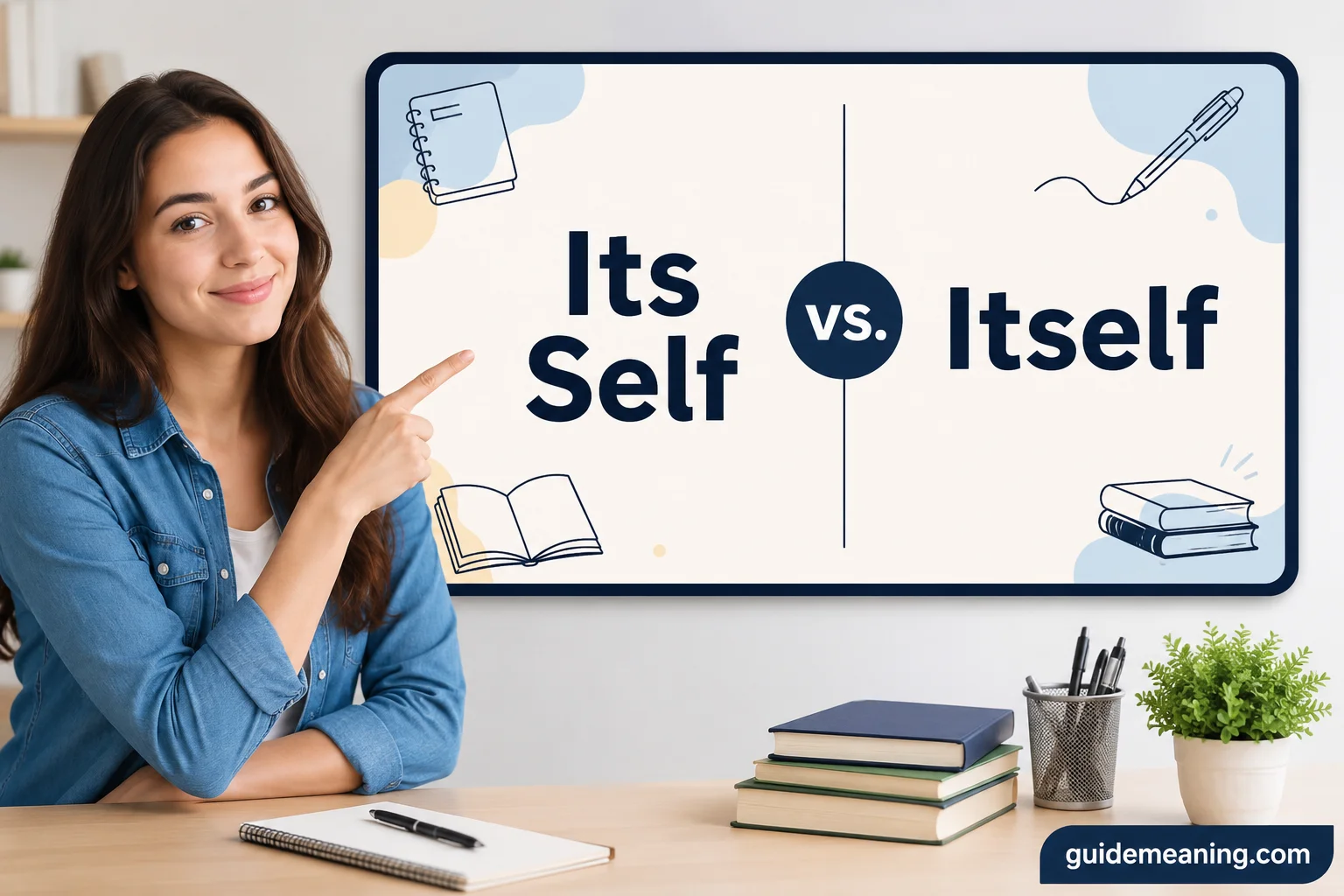

Its Self or Itself can confuse people who write online or study English grammar because the two forms look almost identical.
When learners, a student, or even writers look closer, the difference becomes clear. In English spelling, itself is the standard form and the correct form because it works as a reflexive pronoun that refers to the subject of a sentence. Like myself and yourself, it has a clear role in sentence construction, proper structure, and syntax. The form its self is generally incorrect in everyday usage, although it may appear in rare cases or special contexts. In my experience as an experienced writer, this language distinction can cause unnecessary confusion when someone may assume that its and self should work in the same way.
They aren’t interchangeable because its can show possession while self can refer to something’s own nature. Meanwhile, itself works as one complete word, so a single space or missing letter can affect spacing, meaning, clarity, and natural writing in a surprisingly big way. Professionals, editors, and teachers usually follow the accepted norm and use itself in everyday writing, formal writing, academic writing, business writing, technical writing, an email, an essay, or a professional document. This correct usage supports clear language, writing precision, writing clarity, and better communication while reducing common mistakes, mistake patterns, and writing that can wobble.
Once you learn this pattern, everything becomes easier. You can use itself correctly and confidently without second-guessing yourself every time you write. The goal is to understand the proper application of the reflexive pronoun within a sentence and its surrounding phrases. That understanding improves grammar habits, language learning, editing, and accuracy.
Let’s jump in!
Quick Answer:
Itself is the correct choice in almost all ordinary American English sentences. Use it as a reflexive or emphatic pronoun, while its self is a rare two-word construction where self functions separately as a noun.
TL;DR:
- Itself is the standard reflexive pronoun for it.
- Use itself when the subject and object refer to the same thing.
- Itself can also add emphasis to a noun or pronoun.
- Its shows possession, while it’s means it is or it has.
- Its self is possible in rare, specialized contexts.
- In normal writing, choose itself rather than its self.
What Does “Itself” Mean?
The word itself is a reflexive pronoun. It usually points back to a singular, nonhuman subject already mentioned in the sentence.
For example, consider this sentence:
The dog scratched itself.
The subject is the dog. The word itself refers back to that same dog. The dog performs the action, and the dog receives the action.
Itself as a Reflexive Pronoun
Reflexive pronouns are used when the subject and object are the same.
Common examples include:
- I → myself
- You → yourself
- He → himself
- She → herself
- It → itself
- We → ourselves
- They → themselves
Therefore, itself fills the reflexive role for it.
For example:
The machine repaired itself.
The machine is both the subject and the receiver of the action. Consequently, itself is the natural choice.
Itself as an Emphatic Pronoun
Itself can also add emphasis.
Consider:
The building itself isn’t very large.
Here, itself doesn’t receive an action. Instead, it emphasizes the building.
You could remove it:
The building isn’t very large.
The basic sentence still works. Therefore, itself is functioning mainly for emphasis.
Is “Its Self” Grammatically Correct?
In ordinary modern English, its self isn’t the normal replacement for itself. Most writers should use the single-word form.
However, the two-word construction isn’t impossible in every imaginable context. It can occur when its functions as a possessive word and self functions independently as a noun.
For example, a philosophical discussion might talk about an object’s “self” as a separate concept. Even then, writers often choose clearer wording.
Why the Difference Matters
Compare these sentences:
The robot repaired itself.
The robot repaired its self.
The first sentence clearly means the robot repaired its own body or functioning system.
The second sentence sounds unnatural because its self appears to be an attempt to create a reflexive pronoun. Standard English already has that pronoun: itself.
The Practical Rule
If you’re simply asking whether something did something to itself, use itself.
That rule handles nearly every everyday situation.
Itself vs. Its Self: The Main Difference
The easiest way to understand the difference is to look at the grammatical jobs of the words.
| Form | Function | Example | Typical Use |
| itself | Reflexive pronoun | The cat cleaned itself. | Everyday English |
| itself | Emphatic pronoun | The computer itself failed. | Adding emphasis |
| its | Possessive word | The company changed its policy. | Showing possession |
| self | Noun | The story explores the self. | Identity or philosophical ideas |
| its self | Possessive + noun | Rare discussion of an object’s self | Specialized writing |
The key distinction is simple. Itself is already a complete pronoun.
Meanwhile, its self separates two words that usually don’t need to be separated.
When Should You Use “Itself”?
Use itself when the word refers back to the subject.
This situation appears frequently in everyday American English.
After a Verb
For example:
The cat washed itself.
The computer restarted itself.
The company defended itself.
The door closed itself.
In each example, the subject and the object point to the same thing.
After a Preposition
Itself can also appear after a preposition.
For example:
The machine can operate by itself.
Here, itself means that the machine operates independently or alone.
Similarly:
The device turned off by itself.
This means no person directly turned it off.
For Emphasis
Itself can emphasize a noun.
For example:
The idea itself isn’t difficult.
The book itself explains the process.
The restaurant itself was beautiful.
In these examples, itself highlights the noun rather than acting as a direct object.
When Can “Its Self” Appear?
Although rare, its self can make sense when self is deliberately treated as a noun.
The distinction becomes clearer when you’re discussing identity, personality, consciousness, or an abstract sense of being.
Philosophical Writing
A philosophical writer might discuss an entity’s concept of self.
For example:
The theory examines the organism and its self.
Even here, the wording can feel formal or abstract. A clearer alternative might be:
The theory examines the organism and its sense of self.
That version makes the intended meaning easier to understand.
Literary or Creative Writing
Authors sometimes separate words intentionally for style or emphasis.
A writer could use its self when treating self as an independent idea. This isn’t the same as accidentally writing two words instead of the standard reflexive pronoun.
Therefore, context matters.
Specialized Discussion
Academic or theoretical writing may distinguish between an object and its conceptual identity.
However, this is unusual compared with ordinary American English. If you’re writing an email, article, school assignment, report, or everyday message, itself will almost certainly be the appropriate choice.
Why Do People Write “Its Self”?
The confusion usually comes from the structure of other reflexive pronouns.
English has:
- myself
- yourself
- himself
- herself
- ourselves
- yourselves
- themselves
So it’s understandable that someone might expect its self to follow the same pattern.
However, itself is the established form.
The Spacing Confusion
When spoken aloud, itself can sound like two separate pieces.
That can make the written form confusing, especially for English learners.
Still, the spelling is fixed in standard modern English:
itself
Not:
its self
when a reflexive pronoun is intended.
Similar Confusions
This issue is related to several other small English distinctions.
For example:
its
means possession.
it’s
means it is or it has.
itself
is the reflexive or emphatic pronoun.
Keeping these three forms separate prevents many common mistakes.
Read More: Appreciate It vs Appreciated It: The Clear Difference for 2026
Itself vs. Its vs. It’s
These three forms are easy to mix up because they look and sound similar.
However, they have different grammatical functions.
“Its”
Its shows possession.
For example:
The dog wagged its tail.
The tail belongs to the dog.
Another example is:
The company changed its name.
The name belongs to the company.
“It’s”
It’s is a contraction.
It can mean:
- it is
- it has
For example:
It’s cold today.
This means:
It is cold today.
Another example is:
It’s been a long day.
This means:
It has been a long day.
“Itself”
Itself refers back to the subject or adds emphasis.
For example:
The dog hurt itself.
Or:
The company itself announced the change.
A quick substitution test can help. If you can replace it’s with it is or it has, the apostrophe form is probably correct.
Common Mistakes With “Its Self”
Most mistakes happen when writers try to create a reflexive pronoun from its and self.
The standard form is already available.
Incorrect Reflexive Use
A common mistake looks like this:
The machine repaired its self.
The standard version is:
The machine repaired itself.
The same pattern works with many subjects.
The computer restarted itself.
The program updated itself.
The animal protected itself.
The organization introduced itself.
Confusing “Its” With “Itself”
Another mistake is using its when the sentence needs a reflexive pronoun.
For example:
The cat cleaned its.
This sentence is incomplete because its normally needs a noun after it.
Instead:
The cat cleaned itself.
The difference becomes easier when you ask what role the word plays.
How to Choose the Correct Form Quickly
You don’t need to memorize complicated grammar terminology.
Instead, ask one simple question: Does the word refer back to the subject?
If the answer is yes, itself is usually correct.
A Simple Three-Step Test
Try this quick method:
• Look for the subject of the sentence.
• Ask whether the subject receives its own action.
• If it does, choose itself.
For example:
The bird injured itself.
The bird is the subject. The bird also receives the action. Therefore, itself works.
Now consider:
The bird spread its wings.
The wings belong to the bird, but the bird isn’t doing something to itself. Therefore, its is correct.
The Replacement Test
You can also test it’s by expanding it.
If it is works, use it’s.
If it has works, use it’s.
If neither works and you need a reflexive pronoun, itself may be the answer.
Examples of “Itself” in American English
Seeing the word in different sentence patterns makes the rule easier to remember.
Everyday Examples
The baby bird found its way back by itself.
The phone turned itself off.
The cat saw itself in the mirror.
The company introduced itself to the new customers.
The door opened by itself.
The device can clean itself automatically.
Each example uses itself naturally.
Emphatic Examples
The word can also emphasize a subject.
The president’s statement itself wasn’t surprising.
The house itself was beautiful.
The question itself is easy.
The movie itself wasn’t the problem.
In these sentences, removing itself doesn’t necessarily make the sentence grammatically wrong. Instead, the word adds focus.
Does “Itself” Always Refer to a Physical Thing?
No. Itself can refer to an organization, idea, situation, system, animal, object, or other singular noun represented by it.
For example:
The company must protect itself.
The company isn’t a physical object in the usual sense. Still, it can take the pronoun itself.
Likewise:
The argument contradicts itself.
Here, itself refers to an abstract argument.
Abstract Uses
English frequently uses itself with abstract ideas.
For example:
The problem solved itself.
The situation changed itself.
The story explains itself.
These examples show why the word isn’t limited to physical objects.
The History Behind “Itself”
The modern spelling of itself developed from older forms of English that combined the pronoun it with self.
English has long used self to create reflexive and emphatic forms. Over time, these combinations became established as single words in standard usage.
From Separate Elements to Fixed Forms
Older stages of English show more variation in how such forms were written.
However, modern English generally treats reflexive pronouns as established words. That includes myself, yourself, himself, herself, and itself.
Merriam-Webster records the first known use of itself as before the 12th century. Its modern functions include both reflexive and emphatic uses.
Why Modern English Prefers One Word
Language often turns frequently used combinations into fixed forms.
That’s what happened with itself.
Today, readers expect the reflexive pronoun to appear as one word. Consequently, writing its self in a normal reflexive sentence can look like a spelling or grammar error.
Is “Its Self” Ever Better Than “Itself”?
In normal writing, almost never.
However, there is an important distinction between grammatical possibility and practical usefulness.
If you genuinely mean the self belonging to something, you may use its self in a specialized context. Yet clearer alternatives are often available.
Clearer Alternatives
Instead of:
The machine preserved its self.
You could write:
The machine preserved its identity.
Or:
The system preserved its own identity.
If you’re discussing consciousness, you might write:
The character struggles with its sense of self.
These alternatives tell readers exactly what you mean.
Why Clarity Wins
Specialized writing can sometimes require unusual constructions. However, everyday readers shouldn’t have to stop and decode a phrase.
When itself communicates the intended meaning, it’s usually the better choice.
How American English Uses “Itself” Today
In contemporary American English, itself is common across casual, professional, academic, and digital writing.
You can encounter it in conversation, emails, news writing, instructions, essays, and social media.
Everyday Communication
People commonly say:
The problem fixed itself.
It turned itself off.
The app updated itself.
The dog hurt itself.
These sentences sound completely natural to American English speakers.
Professional Writing
The same form works in formal contexts.
For example:
The organization introduced itself to the community.
Or:
The report itself provides additional information.
There is no need to replace itself with the unusual its self.
FAQs:
Is “itself” or “its self” correct?
Itself is the standard and correct form in modern English. It works as a reflexive pronoun and is normally written as one word.
Is “its self” ever correct?
Yes, but its self is extremely rare. It may appear in philosophical or highly stylistic writing when “self” functions as a separate noun.
Why do people confuse “itself” and “its self”?
The confusion comes from familiar forms such as myself and yourself. Since “its” and “self” look like separate words, some writers assume they should be written separately.
What does “itself” mean?
Itself refers back to a nonhuman singular subject. For example, “The machine turned itself off” uses itself to refer back to “the machine.”
Is “itself” a reflexive pronoun?
Yes. Itself is a reflexive pronoun used when the subject and the object refer to the same thing.
Should I use “itself” in formal writing?
Yes. Itself is appropriate for formal writing, academic writing, business writing, and professional documents. It is the normal standard form.
How can I remember whether to use “itself” or “its self”?
Remember that itself is normally one word. If you mean the reflexive pronoun, choose itself rather than its self.
Conclusion:
Itself is the correct standard form for almost every situation in modern English. Although its self can appear in rare philosophical or stylistic contexts, you should generally use itself in everyday, academic, formal, and professional writing. Understanding this small spelling difference can improve your grammar, clarity, and writing precision.