
Taken vs. Taking can seem confusing, but knowing how each verb form works helps English learners choose the right word in everyday sentences. When you use these different forms of the verb take, they can change the meaning of a sentence. A clear understanding of their nuances makes writing and speaking easier and more natural. This guide will break down the main differences with practical examples and tips that help you avoid common mistakes. Although taken and taking come from the same verb, they have different grammar roles. The key difference involves tense, function, and sentence structure, so you need to choose the correct word confidently in everyday English, formal writing, and exams.
Many learners feel confused because the words look similar, while English verbs can change their form according to time, tense, and action. Taking often describes an action happening now or happening right now, while taken can describe something completed, already finished, or acted upon. These grammar rules become easier when you learn the concept step by step through easy language and short sentences. This article explains the meanings, verb forms, tenses, passive voice, and real-life usage in simple English. The short version is straightforward: use taken when the structure requires it and use taking when the grammar calls for it.
The correct form keeps your sentences clear and prevents the wrong form from sounding incorrect. As a fluent speaker, I find that learners remember the distinction better when they connect each form with its function instead of trying to memorize isolated rules. Common slips, grammar mistakes, and common mistakes become easier to understand through examples, real examples, tables, and practice exercises. The rules help you see each one clearly, while the guide breaks down exactly how to apply them immediately. With daily English practice, you can recognize the base verb, notice the appropriate form, and speak without hesitation.
Let’s dive in!
Quick Answer:
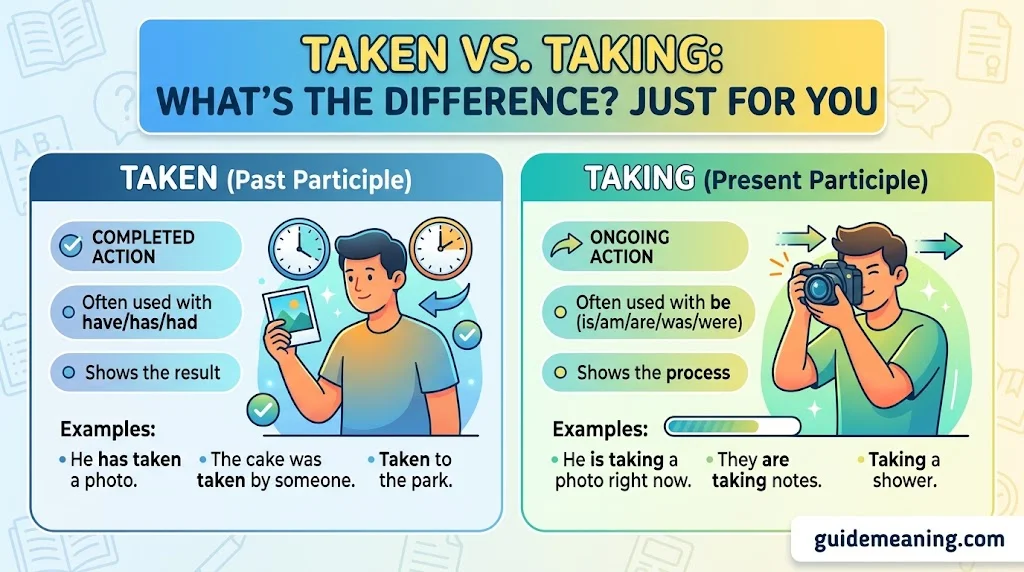
Taken is the past participle of take. It commonly appears after has, have, or had in perfect constructions. It also appears in passive constructions with forms of be.
Taking is the -ing form of take. It commonly appears with forms of be to create continuous tenses. It can also function as a gerund, which means it behaves like a noun.
| Word | Grammatical form | Common use | Example |
| take | Base form | Simple present, infinitives, commands | “I take the bus.” |
| took | Simple past | Completed past action | “I took the bus yesterday.” |
| taken | Past participle | Perfect and passive constructions | “I have taken the bus.” |
| taking | -ing form | Continuous tenses and gerunds | “I am taking the bus.” |
A simple rule can help:
Have/has/had + taken
Am/is/are/was/were + taking for an active action in progress
However, that shortcut doesn’t cover every possible construction. Grammar depends on the sentence’s meaning and structure.
What Does “Taken” Mean?
Taken is the past participle form of take. Cambridge lists took as the past tense and taken as the past participle.
Unlike took, taken usually needs another verb or grammatical structure around it. You generally can’t use it as the ordinary simple past form.
For example:
- I took the book yesterday. ✓
- I have taken the book. ✓
- I taken the book yesterday. ✗
The third sentence fails because taken isn’t the simple past form. The correct simple past form is took.
Taken as the Past Participle of “Take”
The most common use of taken appears in perfect constructions.
The basic pattern is:
has/have/had + taken
Examples include:
- She has taken the exam.
- They have taken the wrong train.
- He had taken my seat.
- We had taken enough food with us.
- I have taken several photos.
The present perfect uses have/has + past participle. The British Council explains that the present perfect connects a past action or state with the present in various ways.
Consider this example:
She has taken the medicine.
The important point isn’t simply that she took medicine sometime in the past. The sentence connects that past action to the current situation.
Now compare it with:
She took the medicine at 8 a.m.
Here, took is the simple past form. The sentence places the action at a completed point in the past.
Taken in the Passive Voice
Taken also appears in passive constructions.
For example:
- The photograph was taken yesterday.
- The documents were taken from the office.
- The patient was taken to the hospital.
- The money had been taken from the drawer.
In these sentences, the subject receives the action rather than performing it.
Compare:
- The photographer took the picture. — active
- The picture was taken by the photographer. — passive
The object in the active sentence becomes the subject in the passive sentence.
This distinction matters because “was taken” and “was taking” don’t mean the same thing.
The photographer was taking pictures.
The photographer performed an ongoing action.
The pictures were taken by the photographer.
The pictures received the action.
That small change creates a completely different grammatical relationship.
Taken in Fixed Expressions
Taken also appears in many established expressions.
Common examples include:
- taken care of
- taken seriously
- taken by surprise
- taken into account
- taken advantage of
- taken part in
- taken responsibility for
- taken away
- taken over
For example:
The manager took responsibility for the mistake.
In the perfect form:
The manager has taken responsibility for the mistake.
These expressions are worth learning as complete phrases because the meaning of take changes across different combinations. Cambridge notes that take appears in numerous fixed phrases and multi-word constructions.
What Does “Taking” Mean?
Taking is the -ing form of take. English uses this form in continuous verb constructions and as a gerund.
For example:
I am taking a break.
Here, taking forms part of the present continuous.
But consider:
Taking breaks can improve your focus.
Now taking functions as a noun-like expression. It acts as the subject of the sentence.
The spelling stays the same. The grammatical role changes.
Taking as the Present Participle
When taking appears with a form of be, it commonly describes an action in progress.
Examples include:
- I am taking a shower.
- She is taking notes.
- They are taking the train.
- He was taking photographs.
- We were taking a short break.
The pattern looks like this:
am/is/are + taking
for the present continuous, or:
was/were + taking
for the past continuous.
The action has a sense of being underway at the relevant time.
Compare:
She is taking the exam.
with:
She has taken the exam.
The first sentence presents the exam as an action in progress. The second uses the past participle and present perfect.
Taking as a Gerund
Taking can also function as a gerund.
A gerund has the form of an -ing verb but performs a noun-like role.
For example:
Taking notes helps students remember information.
Here, taking notes serves as the subject.
More examples include:
- Taking the train is convenient.
- Taking regular breaks can help you concentrate.
- She enjoys taking photographs.
- He dislikes taking unnecessary risks.
A useful test is to ask whether the -ing phrase behaves like a thing or activity in the sentence.
In:
Taking the train is cheaper.
the phrase names an activity. It isn’t describing something happening right now.
Taking to Describe an Action in Progress
The clearest use of taking appears when someone is doing something around a particular time.
Imagine a teacher walking into a classroom and seeing students with pencils in their hands.
The teacher might say:
The students are taking a test.
The action is happening now.
Later, the teacher might say:
The students have taken the test.
Now the focus shifts to the completed result or the fact that the test has occurred.
That’s the practical difference you need to notice.
Taken vs. Taking: Key Differences
The easiest way to understand taken vs. taking is to compare their grammatical jobs.
| Feature | Taken | Taking |
| Base verb | Take | Take |
| Form | Past participle | -ing form |
| Simple past? | No | No |
| Common perfect construction | Yes | No |
| Common continuous construction | No | Yes |
| Common passive construction | Yes | No |
| Can function as a gerund | No | Yes |
| Example | “She has taken the test.” | “She is taking the test.” |
The biggest trap is thinking that taken means past and taking means present.
That’s too simple.
Taken isn’t simply “the past version” of take. Took is the simple past form.
Likewise, taking isn’t a tense by itself. It is an -ing form that participates in several grammatical structures.
Cambridge’s explanation of English verb forms distinguishes the past form from the past participle and the -ing form.
When to Use “Taken”
Knowing the common patterns makes taken much easier to recognize.
After “Has,” “Have,” and “Had”
Use taken after these auxiliary verbs when forming perfect constructions.
Examples:
- She has taken the test.
- I have taken your advice.
- They have taken the wrong road.
- He had taken the money before anyone noticed.
- We had taken enough supplies for the trip.
The basic patterns are:
has + taken
have + taken
had + taken
The British Council describes the past perfect as had + past participle, which explains why had taken is correct.
For example:
By the time we arrived, they had taken the last train.
The past perfect places the taking before another past event.
In Passive Constructions
Use taken when the sentence uses take in the passive voice.
Examples:
- The photograph was taken in New York.
- The patient was taken to the emergency room.
- The documents were taken from the cabinet.
- The equipment was taken away.
Notice the difference between active and passive:
The nurse took the patient to the room.
The nurse performs the action.
The patient was taken to the room.
The patient receives the action.
In Fixed Phrases
You will also see taken in many expressions.
For example:
Her concerns should be taken seriously.
Here, taken seriously means treated as important or worthy of attention.
Another example:
Several factors must be taken into account.
This means those factors must be considered.
These expressions aren’t random combinations. They’re established patterns in English.
When to Use “Taking”
Taking becomes natural when you want to show an ongoing activity or use the action as a noun-like expression.
With Forms of “Be” for Ongoing Actions
Use taking with am, is, are, was, or were when the construction describes an ongoing active action.
Examples:
- I am taking a class.
- She is taking a break.
- They are taking the bus.
- He was taking pictures.
- We were taking notes.
The action unfolds over a period of time.
Compare:
He is taking photographs.
with:
He has taken photographs.
The first focuses on the activity. The second focuses on what has already happened.
As a Gerund
Use taking as a gerund when the activity functions like a noun.
Examples:
- Taking notes helps me remember details.
- Taking the bus saves money.
- She enjoys taking photographs.
- Taking shortcuts isn’t always wise.
The sentence isn’t necessarily saying that someone is taking something at this exact moment.
Instead, taking names an activity.
To Describe an Action in Progress
Taking is especially useful when the listener needs to picture an activity unfolding.
For example:
Maria is taking a photo of the sunset.
The action is happening around the time of speaking.
But:
Maria has taken a photo of the sunset.
The photo already exists. The action has occurred.
That difference between activity and completed result explains many real-world uses of taking and taken.
Taken vs. Taking in Different Tenses
The verb take becomes much clearer when you see all its main forms together.
| Tense or construction | Example | Form used |
| Simple present | “I take the bus.” | take |
| Present continuous | “I am taking the bus.” | taking |
| Simple past | “I took the bus.” | took |
| Present perfect | “I have taken the bus.” | taken |
| Past perfect | “I had taken the bus.” | taken |
| Passive | “The bus was taken.” | taken |
| Past continuous | “I was taking the bus.” | taking |
This table reveals something important: taken and taking aren’t competing versions of the same tense.
They belong to different grammatical structures.
The present perfect requires a past participle:
I have taken the bus.
The continuous construction uses the -ing form:
I am taking the bus.
The past perfect also requires a past participle:
I had taken the bus.
The British Council confirms that perfect constructions use the past participle after the relevant form of have.
Taken vs. Taking in Everyday Sentences
Real examples make this distinction much easier to remember.
School and Work
She is taking a class this semester.
The class is part of her current activity.
She has taken the class already.
The class has already been completed.
At work, you might say:
I am taking notes during the meeting.
Later:
I have taken notes on everything we discussed.
The first sentence focuses on the process. The second emphasizes the completed action and its present result.
Travel
Consider these two sentences:
We are taking the train to Chicago.
This describes the planned or ongoing travel arrangement.
We have taken the train several times.
This describes an experience that has occurred before.
The meaning of take itself also changes across contexts. Cambridge notes that take can describe traveling by bus, train, car, plane, and other means of transportation.
Photos and Videos
Photography offers one of the clearest examples.
He is taking a photo.
The action is happening now.
He has taken a photo.
The photo has already been captured.
He took a photo yesterday.
The action happened at a completed time in the past.
Three sentences. Three different structures.
Medicine
The same distinction works with medicine:
She is taking her medicine.
This can describe an action happening now or a current medication routine, depending on context.
She has taken her medicine.
The action has already happened.
The difference isn’t merely about whether the medicine was swallowed. The verb form tells the reader how the action relates to the surrounding time.
Common Mistakes With “Taken” and “Taking”
These errors are common because learners often translate directly from their first language.
Using “Taken” After “Is” for an Active Ongoing Action
A common mistake is:
I am taken the bus. ✗
The intended sentence is:
I am taking the bus. ✓
Why?
Because the speaker is actively performing the action. The continuous pattern requires the -ing form:
am + taking
However, “I am taken” can be grammatical in a different context.
For example:
I am taken to the office every Monday.
Here, the construction is passive. Someone else takes the speaker to the office.
So don’t automatically assume that am + taken is always wrong. The meaning determines the structure.
Using “Taking” After “Have” or “Has”
Another common mistake is:
She has taking the test. ✗
The correct form is:
She has taken the test. ✓
After has or have in the present perfect, use the past participle.
The pattern is:
has/have + past participle
Therefore:
- has taken ✓
- have taken ✓
- has taking ✗
- have taking ✗
Confusing “Took” and “Taken”
This mistake deserves special attention.
I took the book yesterday. ✓
I have taken the book. ✓
But:
I have took the book. ✗
And:
I taken the book yesterday. ✗
The reason is simple:
- took = simple past
- taken = past participle
Think of them as separate slots in the verb system.
Confusing Active and Passive Constructions
Compare these sentences:
Someone took the photograph.
Active voice tells you who performed the action.
The photograph was taken.
Passive voice focuses on what received the action.
Now compare:
Someone was taking photographs.
This describes an ongoing active action.
These constructions can look similar at first glance. Their grammatical relationships are different.
Taken vs. Taking Examples
The following examples show how the correct form depends on the surrounding grammar.
| Sentence | Correct Form | Why? |
| She is ___ a shower. | taking | Present continuous |
| She has ___ a shower. | taken | Present perfect |
| They were ___ notes. | taking | Past continuous |
| They had ___ notes. | taken | Past perfect |
| The photo was ___. | taken | Passive |
| I am ___ the train. | taking | Present continuous |
| I have ___ the train before. | taken | Present perfect |
| He ___ the package yesterday. | took | Simple past |
| ___ notes is useful. | Taking | Gerund |
| The patient was ___ to the hospital. | taken | Passive |
The surrounding words often give you the answer before you even think about meaning.
If you see has, have, or had, check whether a perfect construction needs taken.
If you see am, is, are, was, or were and the sentence describes an active ongoing action, taking is often the correct choice.
Taken vs. Taking in Questions and Negative Sentences
Questions follow the same grammatical patterns.
Questions With “Taken”
Use taken after have, has, or had in perfect questions.
Examples:
- Have you taken your keys?
- Has she taken the test?
- Had they taken the documents before you arrived?
- Have you taken any photographs?
The auxiliary verb comes before the subject, but the verb form stays the same.
Questions With “Taking”
Use taking with forms of be when the question describes an ongoing action.
Examples:
- Are you taking the train?
- Is she taking the exam today?
- Were they taking photographs?
- What are you taking with you?
The pattern changes because the tense changes.
Negative Sentences
The same rule works in negative statements.
Taken:
- I haven’t taken it.
- She hasn’t taken the medicine.
- They hadn’t taken the opportunity.
Taking:
- I’m not taking it.
- She isn’t taking the bus.
- They weren’t taking photographs.
The auxiliary verb carries much of the grammatical information.
Taken vs. Taking: A Simple Grammar Rule
When you’re unsure, look at the word immediately before the blank.
Use “Taken” After Perfect Auxiliaries
Look for:
has + taken
have + taken
had + taken
Examples:
- He has taken the book.
- They have taken the wrong road.
- She had taken the money.
Use “Taking” for Active Continuous Actions
Look for:
am + taking
is + taking
are + taking
was + taking
were + taking
Examples:
- I am taking a break.
- She is taking notes.
- They are taking the bus.
- He was taking photographs.
- We were taking a test.
But Watch the Passive Voice
Here’s where the simple rule needs a little refinement.
Was/were + taken can be completely correct when the sentence is passive:
The students were taken to the library.
The students didn’t perform the action. Someone took them there.
By contrast:
The students were taking a test.
The students performed the action.
This active-versus-passive distinction is one of the most useful things to understand about taken vs. taking.
Taken vs. Taking: How to Remember the Difference
A simple mental picture can make the distinction stick.
Think of taking as an action you can watch unfolding.
She is taking a picture.
You can imagine the camera in her hands right now.
Think of taken as a form that often points to an action already completed or an action received by something.
She has taken a picture.
The photograph now exists.
You can also use the following timeline:
Taking
Action in progress → She is taking the test.
Taken
Completed/experienced action → She has taken the test.
Took
Completed action at a definite past time → She took the test yesterday.
This three-way comparison is even more useful than memorizing taken and taking separately.
Taken vs. Taking vs. Took
Learners often understand taken vs. taking but still confuse both with took.
The four main forms of take are:
| Form | Name | Example |
| take | Base form | “I take the bus.” |
| took | Simple past | “I took the bus yesterday.” |
| taken | Past participle | “I have taken the bus.” |
| taking | -ing form | “I am taking the bus.” |
Here’s a practical comparison:
I take the bus to work.
This can describe a regular habit.
I am taking the bus today.
This describes a current or temporary situation.
I took the bus yesterday.
This refers to a completed past event.
I have taken the bus many times.
This describes past experience connected with the present.
I had taken the bus before the accident occurred.
This places one past action before another past event.
The verb doesn’t change randomly. Each form fits a particular grammatical structure.
A Real-Life Case Study: Choosing Between “Taking” and “Taken”
Imagine Sarah arrives at a train station.
She calls her friend and says:
“I’m taking the train to Boston.”
Why taking?
Because the sentence uses the present continuous construction:
am + taking
Later, after arriving, Sarah sends another message:
“I’ve taken the train to Boston many times.”
Now she uses the present perfect:
have + taken
The next day, she tells a story about the previous trip:
“I took the train yesterday.”
Now she uses the simple past.
Finally, she explains what happened before another past event:
“I had taken the train before I started driving.”
The same basic verb appears in four different forms because each sentence serves a different grammatical purpose.
That’s the real lesson. Don’t choose between taken and taking by looking at the word alone. Look at the entire sentence.
Important Facts About “Take,” “Taken,” and “Taking”
Here are several facts worth remembering:
- Take is an irregular verb.
- Took is its simple past form.
- Taken is its past participle.
- Taking is its -ing form.
- Taken commonly follows has, have, and had in perfect constructions.
- Taking commonly follows forms of be in continuous constructions.
- Taking can function as a gerund.
- Taken appears frequently in passive constructions.
- Took is the form used for ordinary simple past statements.
- Taken and taking aren’t interchangeable.
Cambridge identifies take as an irregular verb with the forms took and taken, while its grammar reference lists taking as the -ing form.
FAQs:
What is the main difference between taken and taking?
Taken and taking are different forms of the verb take. Taking usually appears in continuous structures for an action in progress. Taken is the past participle and commonly appears with forms of have or be.
Is taken a past tense of take?
Not exactly. Taken is the past participle of take, while took is its simple past form.
- I took the book yesterday.
- I have taken the book home.
When should I use taking?
Use taking when the sentence describes an action in progress or uses a gerund structure.
Examples:
- She is taking a break.
- He is taking the bus.
- Taking notes helps me remember information.
When should I use taken?
Use taken when the grammar requires the past participle of take.
Examples:
- She has taken my advice.
- The picture was taken yesterday.
- He had taken the wrong train.
Can I use taken and taking in the same sentence?
Yes. They can appear in the same sentence when they perform different grammatical functions.
Example:
“She is taking the medicine that the doctor has taken time to explain.”
The two forms depend on the structure and meaning of each clause.
Is “I am taken” the same as “I am taking”?
No. I am taking usually describes an action you are doing. I am taken uses taken as a past participle and often appears in a passive construction.
- I am taking a class.
- I am taken to the hospital.
The surrounding words determine the intended meaning.
How can I remember when to use taken or taking?
Focus on the grammar around the word rather than memorizing the forms separately. If you see am, is, or are followed by an ongoing action, taking may fit. If you see has, have, had, or a passive structure, taken may be required.
Conclusion
Understanding taken vs. taking becomes much easier once you recognize their grammatical roles. Both words come from the verb take, but they work differently in sentences.Taking commonly describes an action in progress or functions as a gerund. Taken works as a past participle and appears in perfect and passive constructions. Pay attention to the helping verbs and sentence structure around each form.With regular practice, you’ll start recognizing the correct form naturally. Instead of guessing between taken and taking, look at what the sentence is doing. That small habit can make your English clearer and more accurate.