
Froze vs Frozen can confuse English learners because both come from freeze, but they work differently in each sentence structure.
Froze is the past form, while frozen is the past participle, and this small grammar rule makes the difference much easier to understand. For example, “The water froze” describes something that happened in the past, while “The water has frozen” uses a perfect tense. These forms are used in different grammatical situations, so knowing their usage is more useful than simply memorizing the forms. This guide helps learners, students, and native speakers avoid common mistakes and use the verb correctly in speaking and writing.
The main difference becomes easier when you focus on meaning, grammar, and structure. You may hear people say both forms in everyday communication, but the wrong form can sound incorrect, especially in professional emails or academic writing. By learning the perfect tenses, real-life examples, and simple memory tricks, you can confidently explain the differences, understand the usage, and speak naturally. The verb also changes its vowels, which may seem confusing, but a complete approach makes the pattern clear and helps you remember it forever.
Let’s dive in!
Quick Answer:
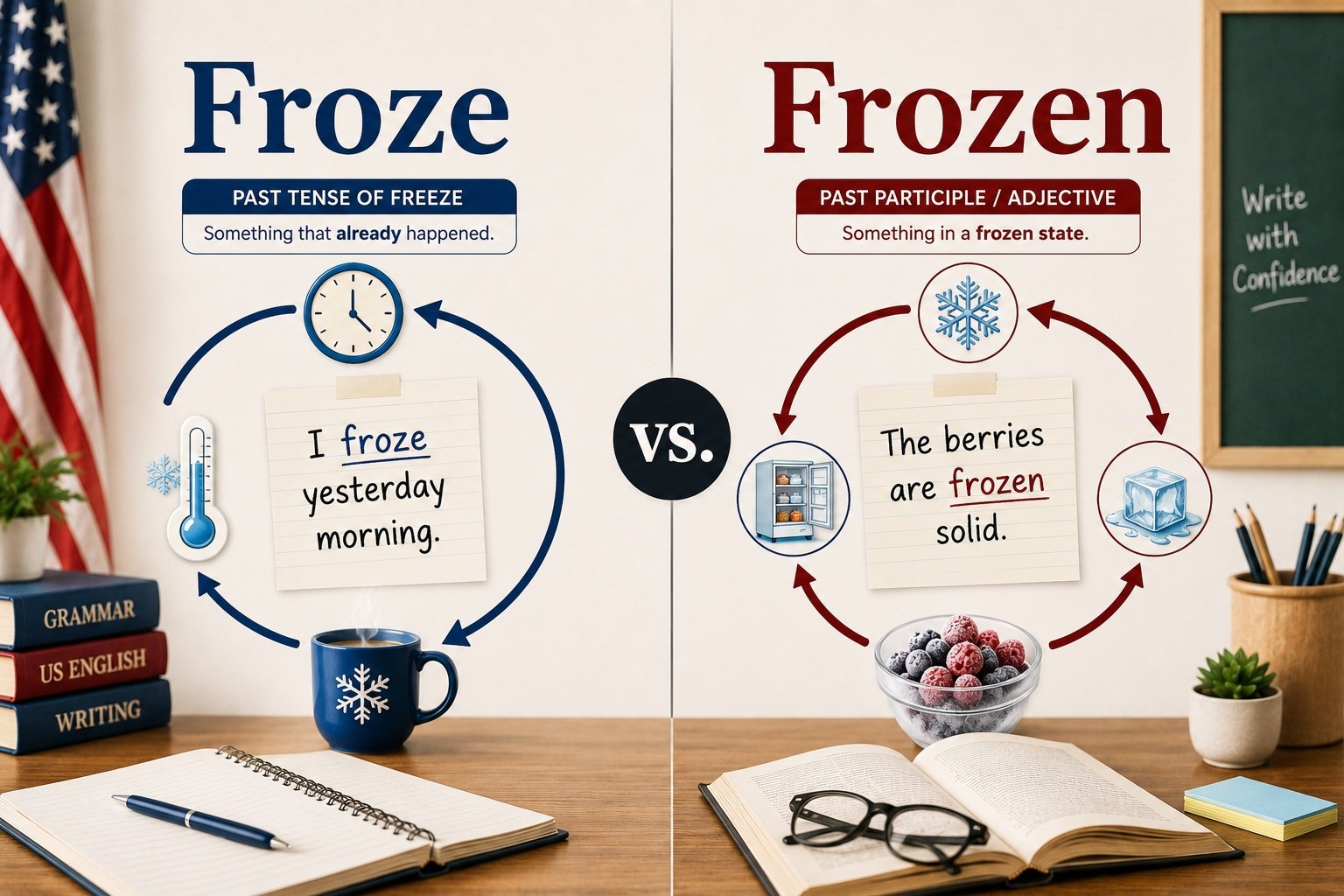
Froze vs Frozen depends on the sentence structure: froze is the simple past tense, while frozen is the past participle. Use “froze” for a completed past action and “frozen” after helping verbs such as has, have, or had, or when describing a frozen state.
TL;DR:
- Froze is the simple past form of “freeze.”
- Frozen is the past participle of “freeze.”
- Use “froze” for a completed past action.
- Use “frozen” with “has,” “have,” or “had.”
- “Frozen” can also work as an adjective.
- “Freezed” is not the standard form in American English.
What Is the Difference Between Froze and Frozen?
The basic difference is grammatical. Both words come from freeze, but they aren’t interchangeable.
Froze Means a Completed Past Action
Use froze when an action happened in the past.
For example:
- The lake froze overnight.
- My computer froze during the meeting.
- She froze when she heard the noise.
- The pipes froze during the cold snap.
Here, “froze” works as the main verb. No form of have is needed.
Frozen Has Several Uses
Frozen is the past participle. It commonly appears with helping verbs.
For example:
- The lake has frozen.
- The pipes had frozen.
- The water was frozen.
- The food has been frozen.
It can also act as an adjective:
- frozen food
- frozen lake
- frozen pipes
- frozen vegetables
That extra use is one reason learners often find “frozen” confusing.
When Should You Use Froze?
Use froze when you need the simple past tense of “freeze.”
The simple past normally describes an action that happened and finished in the past. A specific time expression often appears with it, although one isn’t required.
Simple Past Examples
Consider these sentences:
The pond froze last night.
The action happened last night. Therefore, froze is correct.
My phone froze yesterday.
Again, the event occurred in the past. The sentence doesn’t need “has,” “have,” or “had.”
You can also use froze for figurative meanings:
He froze when everyone looked at him.
Here, “froze” doesn’t mean that his body literally became ice. Instead, it means he suddenly became still because of fear, surprise, or uncertainty.
Common Uses of Froze
- Water froze during the night.
- The screen froze during the video.
- She froze in surprise.
- The roads froze after sunset.
- He froze when asked the question.
The important point is simple: froze can stand as the main past-tense verb.
When Should You Use Frozen?
Use frozen when the sentence requires the past participle.
Most often, that means another verb comes before it. Common examples include has, have, had, is, are, was, and were, depending on the construction.
Perfect Tenses
The perfect tenses use frozen rather than “froze.”
For example:
The water has frozen.
The pattern is:
has/have + frozen
For the past perfect:
The water had frozen before sunrise.
The pattern is:
had + frozen
For the future perfect:
By morning, the pond will have frozen.
The pattern is:
will have + frozen
The past participle is therefore part of a larger verb construction.
Passive Constructions
“Frozen” can also appear in passive constructions.
For example:
The food was frozen before delivery.
Here, “was” helps form the construction, so frozen is required.
Similarly:
The vegetables were frozen at the factory.
You wouldn’t normally replace “frozen” with “froze” in these constructions.
Froze vs Frozen in a Simple Grammar Table
A quick comparison can make the difference much easier to remember.
| Form | Grammatical Role | Example | Why It Works |
| Freeze | Base form | Water can freeze. | Used as the basic verb form |
| Froze | Simple past | The water froze. | Describes a completed past action |
| Frozen | Past participle | The water has frozen. | Follows a perfect-tense helper |
| Frozen | Adjective | The water is frozen. | Describes the current state |
| Freezing | Present participle | The water is freezing. | Describes an ongoing process |
The table shows why froze and frozen shouldn’t be treated as simple synonyms. Their meanings overlap, but their grammatical functions differ.
Is Frozen an Adjective?
Yes. Frozen can work as an adjective when it describes the condition of something.
Frozen as a Description
Consider:
The lake is frozen.
Here, “frozen” tells us about the lake’s condition.
You can also say:
We bought frozen vegetables.
In this sentence, “frozen” describes the vegetables.
Other common examples include:
- frozen pizza
- frozen fruit
- frozen ground
- frozen water
- frozen pipes
- frozen food
However, context can sometimes make it difficult to decide whether “frozen” is functioning as an adjective or part of a verb phrase.
For everyday writing, the important thing is recognizing that frozen is grammatically possible as both a past participle and an adjective.
Why Do People Confuse Froze and Frozen?
The confusion comes partly from the unusual way English forms this verb.
Most regular English verbs form their past tense by adding -ed. For example:
walk → walked
But freeze doesn’t follow that pattern.
Instead, it changes form:
freeze → froze → frozen
An Irregular Verb Pattern
Because “freeze” is irregular, learners can’t simply add an ending to create its past forms.
The same kind of pattern appears in other common verbs:
- speak → spoke → spoken
- break → broke → broken
- drive → drove → driven
- choose → chose → chosen
So the change from “freeze” to “froze” isn’t a mistake or spelling variation. It’s part of the established English verb system.
The Vowel Change Can Be Tricky
The spelling also changes noticeably.
Freeze contains “ee,” while froze and frozen use “o.”
That change makes the forms harder to connect at first. However, repeated exposure makes the pattern much easier to recognize.
Read More: “Me Too” vs “Me as Well” vs “I as Well”: Which One Sounds Right? 2026
The History Behind Freeze, Froze, and Frozen
The unusual forms of this verb have deep roots in the history of English.
The modern verb developed from older Germanic forms. Old English used frēosan, meaning to freeze or become frozen. Older forms included vowel changes that eventually developed into the modern forms freeze, froze, and frozen.
Why English Keeps Irregular Forms
English has changed dramatically over many centuries. However, some very common verbs kept older patterns instead of becoming regular.
That helps explain why English has forms such as:
go → went → gone
and:
sing → sang → sung
These patterns can seem unpredictable to modern learners. Historically, though, they reflect older systems of changing vowel sounds.
The modern forms have become standard through centuries of use.
The Pattern Still Matters Today
Although the history is old, the grammar hasn’t disappeared.
American English still uses:
froze = simple past
and:
frozen = past participle
Modern dictionaries and grammar references continue to recognize this distinction.
Froze vs Frozen in American English
In the United States, both forms appear frequently in everyday speech and writing.
You might hear froze when someone describes a past event:
My computer froze during class.
You might hear frozen when someone describes a current condition:
My computer is frozen.
The distinction can be especially noticeable with technology.
Weather and Nature
American speakers commonly use “froze” for weather-related events:
The lake froze in January.
Meanwhile, “frozen” often describes the resulting condition:
The lake is frozen now.
Both sentences can describe the same lake. However, they focus on different parts of the situation.
Food and Household Language
The distinction also appears in ordinary American life:
I froze the leftovers yesterday.
But:
The leftovers are frozen.
The first sentence focuses on the action. The second focuses on the resulting condition.
That difference is useful because it applies far beyond weather.
Froze vs Frozen for Technology and Emotions
The verb freeze has meanings that go beyond cold temperatures.
American English often uses it for computers, phones, games, conversations, and human reactions.
Technology
When a device stops responding, Americans often say:
My laptop froze.
This is simple past because the event happened.
But if the device remains unresponsive, someone might say:
My laptop is frozen.
Here, “frozen” describes its current condition.
Similarly:
The app has frozen again.
This uses the past participle after “has.”
Emotional Reactions
“Freeze” can also describe suddenly becoming unable to move or respond.
For example:
She froze when she saw the unexpected message.
This means she suddenly became still or uncertain.
However:
She has frozen during stressful conversations before.
The meaning is similar, but the grammar changes.
This figurative use shows how flexible the word “freeze” has become in modern American English.
Common Mistakes With Froze and Frozen
Many mistakes happen because speakers recognize both forms but use them in the wrong structure.
“I Have Froze” Is Incorrect
A common mistake is:
I have froze the food.
In standard American English, write:
I have frozen the food.
Why? Because have requires the past participle.
The pattern is:
have + frozen
“The Lake Has Froze” Is Incorrect
Another common error is:
The lake has froze.
The standard form is:
The lake has frozen.
Again, “has” requires the past participle.
“The Lake Froze” Is Correct
Without a helping verb, use the simple past:
The lake froze.
This is one of the easiest rules to remember.
“Freezed” Is Not Standard
You may occasionally hear or see freezed, especially in informal or nonstandard usage.
However, freezed isn’t the standard past-tense form in American English.
Use:
froze
for the simple past.
Use:
frozen
for the past participle.
How to Remember Froze vs Frozen
A simple memory trick can make this distinction much easier.
Remember “No Helper, Froze”
When freeze is the main verb in a completed past action, use froze.
The pipe froze.
There is no helping verb.
Remember “Helper, Frozen”
When a helping verb such as has, have, or had appears, use frozen.
The pipe has frozen.
This isn’t a perfect rule for every grammatical use because “frozen” can also be an adjective. Still, it’s an excellent starting point for learners.
Compare These Pairs
The lake froze overnight.
The lake has frozen overnight.
The first uses simple past. The second uses the present perfect.
Another pair:
My computer froze yesterday.
My computer is frozen now.
The first describes an event. The second describes a condition.
When Froze and Frozen Can Both Describe the Same Event
Sometimes the choice depends more on viewpoint than on the basic event.
Consider:
The pond froze last night.
This focuses on the event that happened last night.
Now consider:
The pond is frozen.
This focuses on the pond’s current condition.
Both statements can be true at the same time.
Event vs. State
This distinction is especially helpful:
Froze often emphasizes what happened.
Frozen often emphasizes what condition resulted.
For example:
The pipes froze during the storm.
This tells us about the event.
The pipes are frozen.
This tells us about their condition.
The difference may seem small, but it helps you choose the right form naturally.
Froze vs Frozen in Questions and Negative Sentences
The same rule applies when asking questions or creating negative statements.
Questions
For a simple past question:
Did the water freeze?
Notice that we don’t say:
Did the water froze?
The helping verb did already carries the past tense. Therefore, the main verb returns to its base form, freeze.
For a perfect construction:
Has the water frozen?
Here, “has” requires the past participle.
Negative Sentences
For simple past:
The water didn’t freeze.
Not:
The water didn’t froze.
Again, didn’t already shows the past tense.
For the present perfect:
The water hasn’t frozen.
These patterns are important because helping verbs can change which form belongs in the sentence.
How the Meaning of Freeze Extends Beyond Ice
The word “freeze” has developed several common meanings in modern English.
Its physical meaning is the most direct: something becomes solid because of cold.
However, the word can also describe sudden stillness, computer failure, or a halt in activity.
Physical Meaning
The water froze.
This means the water became solid because of low temperature.
Emotional Meaning
I froze when I heard the sound.
Here, “froze” means the person suddenly stopped moving or responding.
Technology Meaning
The screen froze.
This means the device or program stopped responding normally.
Broader Meaning
English speakers can also use “freeze” for situations that stop progressing.
For example:
The project froze after the team lost funding.
The word doesn’t literally involve ice. Instead, it communicates a sudden halt.
These meanings don’t change the grammar. The same forms still apply.
FAQs:
What is the difference between froze and frozen?
Froze is the simple past form of freeze, while frozen is the past participle. For example, “The lake froze last night,” but “The lake has frozen.”
Is froze a past tense?
Yes. Froze is the simple past tense of freeze. You can use it when talking about something that happened and finished in the past.
Is frozen a past tense?
No. Frozen is the past participle of freeze. It usually works with helping verbs such as has, have, had, or be.
Should I say “the water froze” or “the water frozen”?
Say “the water froze.” The sentence “The water frozen” is grammatically incorrect. You can say “the water has frozen” when using the present perfect tense.
Is “has froze” correct?
No, “has froze” is not standard English. The correct form is “has frozen” because has needs the past participle.
How can I remember froze vs frozen?
A simple trick is to remember: froze = past, while frozen = past participle. Think of “I froze” for a past action and “I have frozen” for a perfect tense.
Why do people confuse froze and frozen?
They’re easy to confuse because both forms come from the same verb, freeze, and they sound similar. The key is to look at the sentence structure and the helping verb being used.
Conclusion:
Understanding froze vs frozen becomes much easier once you remember their basic roles. Froze is the simple past form, while frozen is the past participle used with helping verbs and in perfect tenses. When you pay attention to the sentence structure, you’ll quickly know which form fits.