
Have You Seen vs. Did You See can confuse English learners because both expressions look similar, yet their meanings change with the time and situation. Understanding the present perfect tense and simple past tense helps you choose the right expression naturally. In my teaching experience, I’ve noticed that students sometimes feel stuck when learning English grammar rules. Clear explanations, practical examples, and spoken practice can help learners understand verb tenses and improve communication skills.
The expression have you seen describes an experience connected to the present. You can use it when asking whether something has happened ever, anytime, or lately, without specifying an exact time. For example, “Have you seen any good movies lately?” asks about someone’s experience up to now. Similarly, “Have you seen my phone?” makes sense when you’re looking for your phone and need help finding it. These expressions appear in everyday English, daily conversations, and real communication. I remember a lesson when a student pointed out a shooting star near the classroom window. That single instance helped the class understand how people observe, recall, and communicate experiences from daily life.
Let’s dive in!
Quick Answer:
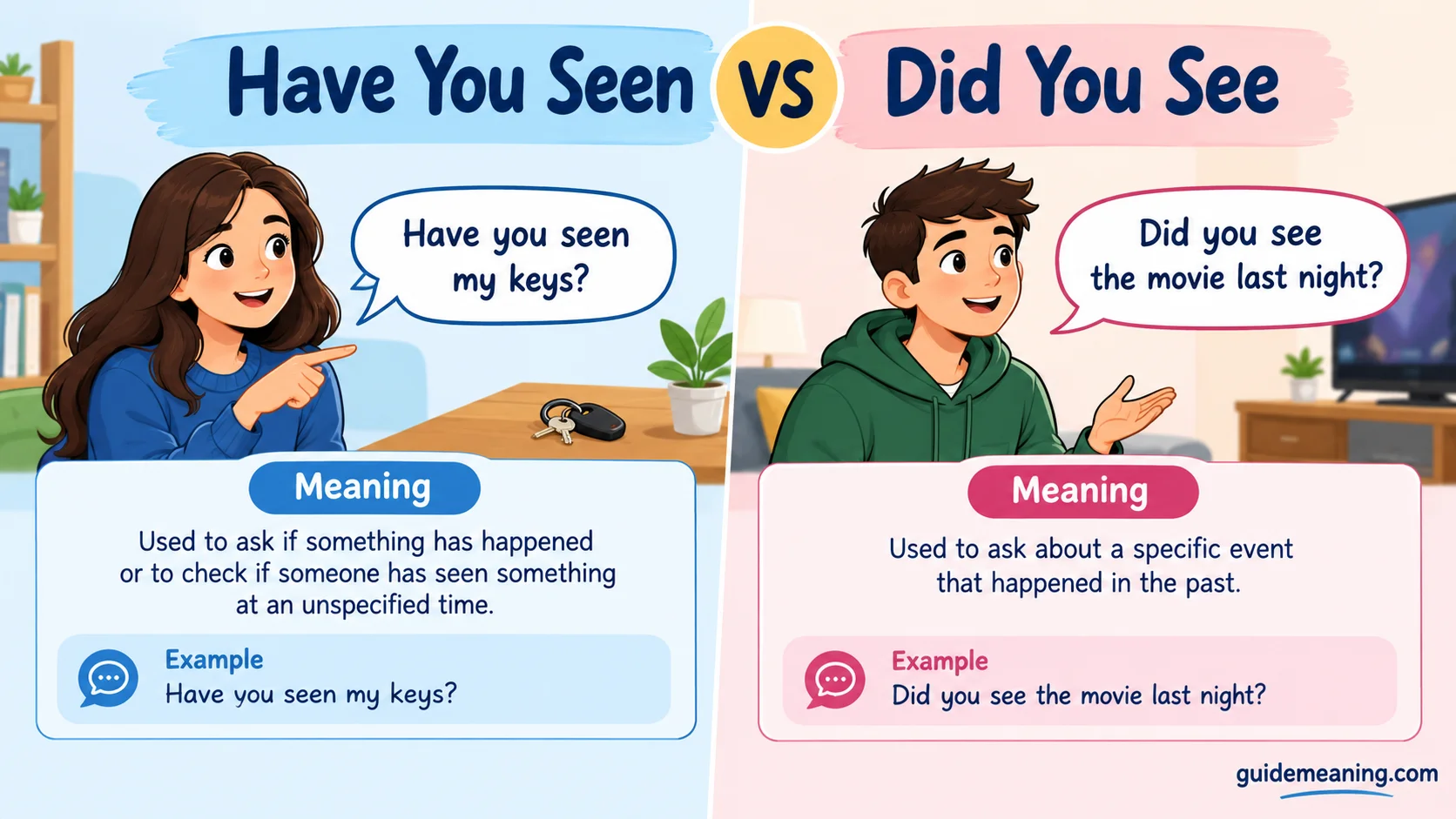
“Have you seen” is the present perfect form. Use it to ask about an experience, an event with present relevance, or something that happened within a period that continues into the present.
“Did you see” is the simple past form. Use it to ask about a completed event, particularly when the past occasion or time matters.
Examples:
- Have you seen this movie? — Have you watched it at any time before now?
- Did you see this movie last night? — Did you watch it on that particular occasion?
- Have you seen my phone? — Have you noticed or encountered my phone, and can you help me find it?
- Did you see my phone on the kitchen counter yesterday? — Did you notice it at that specific time?
Both expressions are grammatically correct. The key is to match the tense to the meaning you want to convey.
Comparison Overview
The following table highlights the main differences between “have you seen” and “did you see.”
| Feature | Have You Seen | Did You See |
| Verb tense | Present perfect | Simple past |
| Grammatical structure | Have + past participle | Did + base verb |
| Main focus | Experience or present relevance | A completed past event |
| Time reference | Often unspecified or within an ongoing period | Often a specific past occasion |
| Common time expressions | Ever, before, recently, so far | Yesterday, last night, last year, two days ago |
| Movie example | Have you seen that movie? | Did you see that movie last night? |
| Person example | Have you seen Emma today? | Did you see Emma at the party? |
| Message example | Have you seen my message? | Did you see my message yesterday? |
One important detail deserves attention: both expressions refer to something in the past. The difference isn’t simply that one describes a past action while the other doesn’t. Instead, the speaker chooses a tense based on how they frame that past event.
Main Differences Between Have You Seen vs. Did You See
Although these questions can refer to the same event, they emphasize different aspects of the experience. The present perfect connects a past experience to the present, while the simple past places an event within a completed past time frame.
Let’s examine the differences more closely.
Difference in Verb Tense
The first major difference is grammatical structure. “Have you seen” uses the present perfect tense, whereas “did you see” uses the simple past tense.
The present perfect follows this structure:
Have/Has + subject + past participle?
Examples:
- Have you seen my new laptop?
- Have they seen the latest announcement?
- Has she seen this photograph?
- Have we seen this problem before?
In these sentences, the speaker asks about an experience or an event without necessarily identifying a specific past time.
The simple past follows a different structure:
Did + subject + base form of the verb?
Examples:
- Did you see my new laptop?
- Did they see the latest announcement?
- Did she see this photograph?
- Did we see this problem before?
The simple past places the question in a past context. The speaker may have a particular occasion in mind, even when they don’t explicitly mention it.
Notice the three forms of the verb see:
| Verb Form | Word | Example |
| Base form | See | I see the bird. |
| Simple past | Saw | I saw the bird yesterday. |
| Past participle | Seen | I have seen the bird before. |
This distinction explains two common mistakes.
- Incorrect: “Did you saw the bird?”
- Correct: “Did you see the bird?”
- Incorrect: “Have you saw the bird?”
- Correct: “Have you seen the bird?”
The helping verb already establishes the grammatical structure. After did, use see. After have or has, use seen.
Difference in Time Reference
Time reference plays a major role when choosing between these expressions.
Use “have you seen” when the exact time isn’t important or when the experience connects naturally to the present. For example, “Have you seen my glasses?” asks whether someone has encountered them and may know where they are now.
Use “did you see” when you’re asking about a completed past occasion. For example, “Did you see my glasses on the desk yesterday?” focuses on a particular time and location.
Compare these examples:
- Have you seen Daniel? — You’re asking whether you’ve encountered Daniel, perhaps because you need to find him.
- Did you see Daniel yesterday? — You’re asking about an encounter during a completed past day.
- Have you seen the new advertisement? — You’re asking whether someone has viewed it.
- Did you see the advertisement during the game? — You’re asking about a specific viewing opportunity.
However, the distinction isn’t always as simple as a particular word appearing in the sentence. Context matters, too.
For instance, “Did you see the new advertisement?” can be perfectly natural without a stated time. The surrounding conversation may already establish when the advertisement appeared.
Difference in Meaning and Context
The two expressions can describe the same subject while communicating slightly different intentions.
Consider a conversation about a new television series.
Person A: Have you seen the new series?
Person B: Yes, I’ve watched the first three episodes.
Here, Person A asks whether the experience has happened at any point before now. The exact viewing time doesn’t matter.
Now consider another conversation:
Person A: Did you see the new series when it premiered on Friday?
Person B: Yes, I watched the first episode that evening.
This time, Person A asks about a particular occasion. The premiere on Friday provides the time reference.
The same distinction applies to everyday activities:
| Situation | Present Perfect | Simple Past |
| Watching a movie | Have you seen the movie? | Did you see the movie on Saturday? |
| Finding a person | Have you seen Rachel? | Did you see Rachel at lunch? |
| Checking a message | Have you seen my message? | Did you see my message this morning? |
| Noticing a change | Have you seen the new design? | Did you see the design before the meeting? |
| Witnessing an event | Have you seen anything unusual? | Did you see anything unusual last night? |
The present perfect often focuses on whether an experience exists. The simple past often focuses on whether something happened during a particular event or period.
Difference in American English Usage
In American English, both forms are widely used. Neither is automatically more natural or more correct than the other.
However, American English frequently uses the simple past with finished-time expressions.
For example:
- I saw that movie yesterday.
- Did you see the game last night?
- Have you seen that movie before?
- Have you seen the game highlights yet?
The first two examples refer to completed past occasions. The last two focus on experience or whether something has happened by the present.
British English sometimes favors the present perfect in contexts where American English commonly uses the simple past. For example, an American speaker might naturally ask, “Did you eat yet?” while a British speaker might prefer, “Have you eaten yet?”
Both patterns exist in English, and usage varies by speaker and situation.
The most useful rule is to consider the meaning rather than trying to memorize a rigid list of expressions.
What Does “Have You Seen” Mean?
“Have you seen” asks whether someone has seen, noticed, watched, or encountered something before the present moment.
It uses the present perfect tense, which connects a past action or experience to the present in some way. The speaker may care about the person’s experience, the current result, or whether an event has occurred by now.
For example:
- Have you seen my wallet?
- Have you seen the latest episode?
- Have you seen that person before?
- Have you seen the changes to the website?
Each question asks about a past experience. However, the reason for asking may differ.
When someone asks about a wallet, they may want help locating it. When they ask about a television episode, they may want to discuss its plot. When they ask about website changes, they may want to know whether the recipient has reviewed them.
When to Use “Have You Seen”
Use this expression in several common situations.
To ask about general experience
When the exact time doesn’t matter, the present perfect often sounds natural.
Example: “Have you ever seen the Northern Lights?”
The speaker wants to know whether the experience has occurred at any point in the person’s life.
To ask about something that matters now
Example: “Have you seen my keys?”
The speaker probably wants to locate the keys. The question connects a past act of seeing with a current need.
To ask about an unfinished time period
Example: “Have you seen Olivia today?”
If the day is still underway, the speaker may ask whether an encounter has happened at any point so far.
To ask whether someone has viewed something
Example: “Have you seen the email I sent you?”
The speaker wants to know whether the recipient has viewed the email, perhaps because a response or action is needed.
Examples of “Have You Seen” in Sentences
| Example | Meaning |
| Have you seen the latest episode? | Asks whether the person has watched it before now. |
| Have you seen my keys anywhere? | Asks whether the person has encountered the missing keys. |
| Have you seen Sarah today? | Asks whether an encounter has occurred during the current day. |
| Have you ever seen snow in person? | Asks about a life experience. |
| Have you seen the email I sent you? | Asks whether the recipient has viewed the email. |
| Have you seen this painting before? | Asks about previous experience with the painting. |
| Have you seen any improvements yet? | Asks whether improvements have become apparent by now. |
These examples share the same grammatical structure, but the intended meaning comes from the surrounding context.
What Does “Did You See” Mean?
“Did you see” asks whether someone saw, noticed, watched, or witnessed something during a past event or period.
It uses the simple past tense. The auxiliary verb did marks the question as past tense, so the main verb remains in its base form.
For example:
- Did you see the match last night?
- Did you see Michael at the office?
- Did you see that bird fly away?
- Did you see the message yesterday?
Each question directs attention toward a past event. The time may appear in the sentence, or the conversation may make it clear.
Imagine that you attended a concert with a friend. The next day, you might ask, “Did you see the singer’s final performance?” You’re asking about something that happened during the concert.
You wouldn’t need to use “have you seen” simply because the concert has relevance today. The simple past works naturally because you’re referring to a completed occasion.
When to Use “Did You See”
To ask about a specific past time
Example: “Did you see Mark at the meeting yesterday?”
The meeting occurred in the past, and the question concerns that particular occasion.
To ask about a completed event
Example: “Did you see the fireworks last night?”
The speaker wants to know whether the person watched the fireworks during a past event.
To ask about something someone witnessed
Example: “Did you see the accident?”
The speaker asks whether the person witnessed or noticed the accident. The surrounding circumstances usually establish when it happened.
To ask about a past viewing experience
Example: “Did you see that movie when it first came out?”
The question focuses on a particular viewing opportunity rather than simply asking whether the person has ever watched the movie.
Examples of “Did You See” in Sentences
| Example | Meaning |
| Did you see the game last night? | Asks whether the person watched the game during the previous evening. |
| Did you see Mark at the meeting yesterday? | Asks about a possible encounter at a specific meeting. |
| Did you see that car run the red light? | Asks whether the person witnessed the incident. |
| Did you see the message I sent this morning? | Asks about viewing a message during a past period. |
| Did you see the new movie when it came out? | Asks about a particular viewing occasion. |
| Did you see the storm last night? | Asks whether the person witnessed the storm. |
| Did you see what happened after the lights went out? | Asks about an event within a past sequence. |
Remember that “did you see” doesn’t require an explicit time expression. If the time is obvious from the conversation, the simple past can still be the best choice.
Have You Seen vs. Did You See: Examples Compared Side by Side
Sometimes, the easiest way to understand a grammar rule is to compare two sentences about nearly identical situations. The following examples show how the meaning changes when you switch between the present perfect and simple past.
Asking About a Movie
Have you seen that movie?
This question asks whether someone has watched the movie at any time before now. The exact date doesn’t matter.
Did you see that movie last weekend?
This question asks whether someone watched the movie during a specific weekend that has ended.
For example, if you’re recommending a movie to a friend, you might ask, “Have you seen it?” If you’re discussing what everyone watched during last weekend’s movie night, “Did you see it?” fits naturally.
Asking About a Person
Have you seen Jessica today?
This question asks whether you’ve encountered Jessica during the current day. It might come up when you’re trying to find her at work.
Did you see Jessica at the party?
This question asks whether you encountered Jessica at a particular event that has already happened.
The distinction depends on the time frame and the speaker’s focus. The first question often connects to a current situation, while the second focuses on a past occasion.
Asking About a Message
Have you seen my message?
This question asks whether the recipient has viewed the message. The speaker may be waiting for a response or wondering whether the message reached the recipient’s attention.
Did you see my message yesterday?
This question focuses on whether the recipient viewed the message yesterday. The time reference places the question in a completed past period.
Notice that seeing a message doesn’t necessarily mean reading or understanding it. The verb see can refer to noticing something, while the context determines how much attention the speaker has in mind.
Asking About an Incident
Have you seen what happened?
This question can ask whether someone has become aware of an event, perhaps through a video, report, or firsthand experience.
Did you see what happened?
This question often asks whether someone witnessed an event as it occurred.
For example, after a glass falls and breaks, someone might ask, “Did you see what happened?” The speaker wants to know whether the other person witnessed the incident.
After a news report appears online, someone might ask, “Have you seen what happened?” The focus is more likely to be whether the person knows about the event.
Asking About Life Experience
Have you ever seen a whale?
This question asks whether the experience has occurred at any point in the person’s life. The exact time doesn’t matter.
Did you see a whale on your trip?
This question asks whether the person saw a whale during a particular trip.
The word ever often appears in present perfect questions about life experience. However, American English also uses simple past questions such as “Did you ever see a whale when you lived in Alaska?” when discussing a particular past period or situation.
Have You Seen vs. Did You See With Time Expressions
Time expressions can help you choose the correct tense. However, you should consider the entire sentence rather than relying on one word alone.
Time Expressions Commonly Used With “Have You Seen”
The following expressions often appear with the present perfect:
| Time Expression | Example |
| Ever | Have you ever seen a comet? |
| Before | Have you seen this film before? |
| Recently | Have you seen Tom recently? |
| So far | Have you seen any improvements so far? |
| Yet | Have you seen the latest update yet? |
| Today | Have you seen Maria today? |
| This week | Have you seen any good movies this week? |
These expressions work well when the speaker asks about experience up to the present or a period that remains open.
For example, “Have you seen Maria today?” can be natural when the day hasn’t ended. The question asks whether an encounter has occurred so far.
Similarly, “Have you seen any good movies this week?” usually treats the week as an ongoing period.
However, time expressions don’t create absolute rules. Speakers may choose a different tense when the context or intended meaning changes.
Time Expressions Commonly Used With “Did You See”
The simple past commonly appears with expressions that identify a finished time.
| Time Expression | Example |
| Yesterday | Did you see Anna yesterday? |
| Last night | Did you see the game last night? |
| Last week | Did you see the new exhibit last week? |
| Two days ago | Did you see him two days ago? |
| In 2024 | Did you see that movie in 2024? |
| When you visited London | Did you see the Tower of London when you visited London? |
These expressions point to completed periods or particular past occasions.
In standard American English, you would generally say “Did you see him yesterday?” rather than “Have you seen him yesterday?” because yesterday identifies a finished past time.
A helpful rule is to remember that a finished time expression usually calls for the simple past when it specifies when an event happened.
Common Mistakes With Have You Seen vs. Did You See
Even fluent English speakers sometimes struggle with these expressions, particularly when they confuse the past tense with the past participle.
Here are the mistakes worth avoiding.
Saying “Did You Saw” Instead of “Did You See”
This error happens when someone adds the past-tense form of the main verb after the auxiliary did.
Incorrect: “Did you saw the accident?”
Correct: “Did you see the accident?”
The word did already marks the question as past tense. The main verb must remain in its base form.
The same rule applies to other verbs:
- Incorrect: Did you went there?
- Correct: Did you go there?
- Incorrect: Did she watched the movie?
- Correct: Did she watch the movie?
- Incorrect: Did they finished the work?
- Correct: Did they finish the work?
Once you use did, don’t change the main verb into its past-tense form.
Saying “Have You Saw” Instead of “Have You Seen”
This mistake confuses the simple past form saw with the past participle seen.
Incorrect: “Have you saw my phone?”
Correct: “Have you seen my phone?”
The present perfect requires a form of have followed by the past participle. For the verb see, that participle is seen.
Compare these examples:
- I saw the movie yesterday.
- I have seen the movie before.
- Did you see the movie?
- Have you seen the movie?
Learning these three verb forms makes it easier to avoid this mistake in questions and statements.
Using “Have You Seen” With a Finished Past Time
The present perfect usually doesn’t combine with a specific finished-time expression that identifies when an event occurred.
Incorrect in standard American English: “Have you seen him yesterday?”
Correct: “Did you see him yesterday?”
The word yesterday places the event in a completed past period. The simple past is therefore the natural choice.
Other examples include:
- Incorrect: Have you visited New York last year?
- Correct: Did you visit New York last year?
- Incorrect: Have you watched that episode last night?
- Correct: Did you watch that episode last night?
- Incorrect: Have you met Sarah two days ago?
- Correct: Did you meet Sarah two days ago?
However, the present perfect can work with a time period that continues into the present.
For example, “Have you visited New York this year?” is natural when the year is still underway.
Assuming Both Phrases Always Mean Exactly the Same Thing
Although the expressions overlap, they don’t always emphasize the same thing.
Consider these questions:
- “Have you seen the report?”
- “Did you see the report during yesterday’s meeting?”
The first asks whether the person has viewed the report. The second asks whether the person viewed it during a particular meeting.
The distinction may seem small, but it can change how the listener understands the question.
A Practical Case Study: Choosing the Right Question at Work
Imagine that you’re working on a project with a colleague named Alex. You sent Alex a report, attended a meeting, and later noticed an error in the document.
Which question should you ask in each situation?
Situation: You Need to Know Whether Alex Has Reviewed the Report
You want Alex to review the report before the next stage of the project.
Best choice: “Have you seen the report I sent you?”
Why it works: You’re asking whether Alex has viewed the report by now. The answer matters because it affects what happens next.
Situation: You Want to Know Whether Alex Opened the Report During Yesterday’s Meeting
The team discussed the report at a meeting that has already ended.
Best choice: “Did you see the report during yesterday’s meeting?”
Why it works: You’re asking about a specific completed occasion. The time and setting matter to the question.
Situation: You Want to Know Whether Alex Has Noticed a Newly Discovered Error
You found a mistake and want to check whether Alex has noticed it.
Best choice: “Have you seen the error in the report?”
Why it works: The question focuses on whether Alex has become aware of the error, which matters in the current situation.
Situation: You Want to Know Whether Alex Noticed the Error Before Sending the Report Yesterday
You’re discussing a past decision and trying to understand what happened.
Best choice: “Did you see the error before you sent the report yesterday?”
Why it works: The question refers to a specific point in a completed sequence of events.
This example shows why grammar depends on more than memorizing verb forms. The right tense helps communicate exactly what you want to know.
Is “Have You Seen” or “Did You See” More Correct?
Neither expression is inherently more correct. Both follow standard English grammar when you use them in the appropriate context.
The choice depends on your intended meaning.
Use “have you seen” when asking about experience, an event up to the present, or something relevant to the current situation.
Examples:
- Have you seen this documentary?
- Have you seen my notebook?
- Have you seen any changes recently?
Use “did you see” when asking about a completed past event or a particular occasion.
Examples:
- Did you see the documentary last night?
- Did you see my notebook on the desk yesterday?
- Did you see the changes before the meeting?
Sometimes, either form can work because context allows more than one interpretation.
For example, “Have you seen the new trailer?” asks about whether someone has watched it before now. “Did you see the new trailer?” can also be natural, especially when the trailer’s release or appearance is already understood.
The important thing is to choose the tense that matches the question you’re actually asking.
How to Choose Between Have You Seen and Did You See
If you’re unsure which expression to use, follow these practical steps.
Use “Have You Seen” When Asking About Experience
When you want to know whether someone has ever watched, noticed, or encountered something, the present perfect is often the best option.
Examples:
- Have you seen this movie?
- Have you seen the new restaurant?
- Have you seen a shooting star before?
In each case, the question focuses on whether the experience has happened, not necessarily when it occurred.
Use “Did You See” When Asking About a Specific Past Event
When you have a particular event, occasion, or finished time in mind, the simple past usually fits best.
Examples:
- Did you see this movie on Friday?
- Did you see the new restaurant when you visited Chicago?
- Did you see the shooting star last night?
Here, the questions focus on past occasions rather than general experience.
Check Whether the Time Period Has Ended
Think about the time frame you’re describing.
If you’re asking about an experience during an ongoing period, the present perfect may fit naturally.
- Have you seen James today?
- Have you watched any good shows this week?
If you’re asking about a finished period, the simple past is generally the better choice.
- Did you see James yesterday?
- Did you watch any good shows last week?
Remember that this is a useful guideline, not a rule that overrides every possible context. The speaker’s meaning and the way the conversation frames the event also matter.
FAQs:
What is the main difference between Have You Seen and Did You See?
Have you seen asks about an experience connected to the present, while did you see refers to a completed action in the past. The main difference lies in the time reference and the speaker’s intention.
When should I use Have You Seen?
Use have you seen when the exact time isn’t important or when a past experience matters now. For example, “Have you seen my keys?” works when you’re trying to find them.
When should I use Did You See?
Use did you see when asking about something that happened at a specific time in the past. For example, “Did you see the game last night?” refers to a completed past event.
Is Have You Seen present perfect tense?
Yes, have you seen uses the present perfect tense. It combines the auxiliary verb “have” with the past participle “seen” to connect a past experience with the present.
Is Did You See simple past tense?
Yes, did you see uses the simple past tense. The auxiliary verb “did” indicates the past, while “see” stays in its base form.
Can I use Have You Seen with yesterday or last night?
Usually, no. When you mention a finished time such as “yesterday” or “last night,” use the simple past. For example, say “Did you see the movie last night?” instead of “Have you seen the movie last night?”
Are Have You Seen and Did You See interchangeable?
Not always. Both expressions ask about seeing something, but they emphasize different time references. Choose have you seen for experiences connected to the present and did you see for completed past events.
Conclusion:
Understanding Have You Seen vs. Did You See becomes easier when you focus on the time and meaning behind each question. Use have you seen to ask about experiences that matter up to now. Choose did you see when referring to a finished event or a specific time in the past. For example, “Have you seen any good movies lately?” asks about recent experiences, while “Did you see that movie yesterday?” refers to a particular past event. With regular practice, clear examples, and attention to context, you can avoid common English grammar mistakes and use both expressions confidently in everyday conversations.