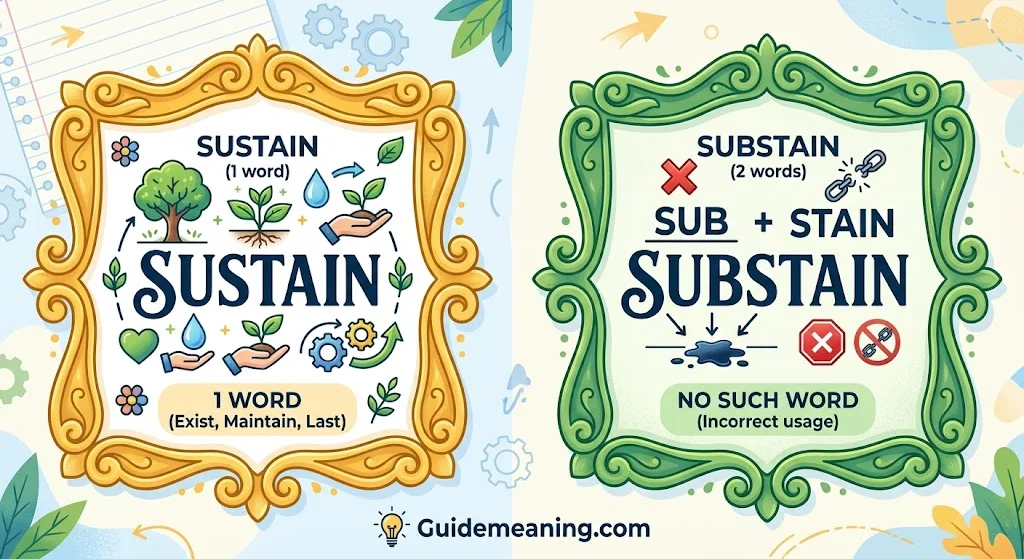

When you compare Sustain vs Substain, sustain is the correct spelling, while substain is an incorrect spelling and not a real word. This spelling confusion often affects learners because the forms look similar, but sustain is a real English verb and a widely used English word in standard English. The nonstandard spelling substain is an invalid word and false construction.
The word sustain has many applications in law, music, business, science, sustainability, and sustainable development. Its linguistic origin comes from the Latin origin word sustinere, which helps explain its word formation. Because of phonetic similarity and orthographic confusion, writers may add extra letters and create a lexical error.
Through proofreading, editing, and dictionary validation, you can improve vocabulary awareness, grammar awareness, language clarity, and writing precision. If you’re unsure, remember that sustain is the only valid word. Keeping this distinction in mind helps writers avoid mistakes in professional writing, academic writing, and everyday communication.
Quick Answer:
Sustain vs Substain has a straightforward answer: sustain is the correct standard English word. It can mean to support, maintain, continue, endure, or uphold something, while substain is not the standard English spelling for these meanings.
TL;DR:
- Sustain is the correct standard English spelling.
- Substain is normally a misspelling of sustain.
- Sustain can mean support, maintain, continue, or endure.
- The word comes through French from Latin sustinēre.
- Americans use sustain in everyday, professional, legal, and technical contexts.
- Remembering “no b” helps prevent the common spelling mistake.
What Does Sustain Mean?
Sustain is a versatile English verb with several connected meanings. At its heart, the word involves supporting something, keeping it going, or bearing something successfully.
For example, a person can sustain an effort, a building can sustain weight, and a family can be sustained by income. Someone can also sustain an injury or sustain an argument.
Common Meanings of Sustain
The exact meaning depends on the sentence.
• To keep something going over time
• To provide support or nourishment
• To withstand pressure, difficulty, or damage
• To uphold an argument, decision, or claim
• To experience something such as an injury or loss
The American Heritage Dictionary gives meanings including maintaining something, providing necessities, supporting something physically, enduring difficulty, and affirming validity.
Simple Examples
Consider these sentences:
The food helped sustain the hikers.
Here, sustain means to provide what they need to continue.
The bridge can sustain heavy traffic.
Here, it means to support or bear a load.
She sustained an injury during the game.
In this case, sustain means to experience or suffer something.
The evidence sustained his argument.
Here, it means to support or uphold the argument.
Is Substain a Word?
For standard modern English, substain is not the correct spelling of the verb sustain. If you intend to say “support,” “maintain,” “continue,” or “endure,” use sustain.
Why the Extra B Appears
The mistake probably feels logical because English contains many words beginning with sub-. Words such as subway, submarine, and substantial make the letter combination familiar.
However, sustain doesn’t come from an English construction involving the prefix sub- plus “stain.” Its history follows a different path.
There is one interesting linguistic wrinkle. An Irish-language dictionary does contain substain as an Irish verb translated as “subsist.” That doesn’t make substain a standard English spelling of sustain.
The Practical Rule
If you’re writing American English, remember this:
Use sustain.
Don’t write substain when you mean to support, maintain, or endure something.
Sustain vs Substain at a Glance
The easiest way to settle the question is to compare the forms directly.
| Word | Standard English? | Meaning | Example |
| sustain | Yes | Support or maintain | We need to sustain this effort. |
| substain | No, for this intended meaning | No standard English meaning | Avoid this spelling. |
| sustained | Yes | Past tense or past participle | The team sustained heavy losses. |
| sustaining | Yes | Present participle | The program is sustaining growth. |
The important distinction is spelling, not pronunciation or a subtle difference in meaning. There isn’t a standard English situation where you choose substain instead of sustain.
Why Do People Spell Sustain as Substain?
Spelling mistakes often happen because the brain recognizes patterns before it checks every letter. Substain looks familiar enough to pass a quick mental check.
Prefix Confusion
The biggest visual trap is probably the familiar sub- pattern.
English has many common words beginning with sub. As a result, writers may unconsciously insert b into sustain.
However, sustain has a different historical structure.
Pronunciation Can Contribute
Sustain is pronounced approximately suh-STAYN in American English. When spoken quickly, the middle sounds can be less distinct than they appear in careful spelling.
Because pronunciation doesn’t clearly announce every letter, writers sometimes reconstruct the spelling incorrectly.
Fast Typing
Typing creates another common problem. People may know the word perfectly well but add a letter automatically.
This happens especially when writing quickly, texting, drafting notes, or moving between similar words.
Where Did the Word Sustain Come From?
The history of sustain explains why there isn’t a b after the first syllable.
Latin Roots
Sustain ultimately comes from the Latin sustinēre, meaning roughly “to hold up” or “to support.” The Latin form combines elements connected with holding something up.
The word then traveled through Old French before entering Middle English.
Merriam-Webster dates the first known English use of sustain to the 13th century.
Meaning Expanded Over Time
The original idea of holding something up developed into several related meanings.
By the late 13th and early 14th centuries, the word could refer to providing necessities, supporting an effort, or keeping something going. Later meanings included enduring hardship and upholding a legal decision.
So today’s meanings aren’t random. They all connect to the basic idea of supporting or carrying something through.
How Sustain Is Used in American English
In the United States, sustain appears in many types of communication. It’s common in ordinary conversation, but it also has specialized uses.
Everyday American English
You might hear:
“Can this pace be sustained?”
Or:
“The family needs enough income to sustain itself.”
In both examples, the word expresses continuation or support.
Professional Writing
American workplaces frequently use sustain when discussing long-term performance.
Common combinations include:
• Sustain growth
• Sustain an effort
• Sustain momentum
• Sustain productivity
• Sustain a relationship
• Sustain public interest
These expressions emphasize keeping something successful or active over time.
Academic and Technical Contexts
The word also appears in scientific, engineering, environmental, and educational writing.
For example, engineers may discuss whether a structure can sustain a particular load. Researchers may discuss conditions that sustain an ecosystem.
The underlying idea remains the same: something is being supported or kept in operation.
Sustain in Law, Music, and Other Fields
One reason sustain can seem complicated is that different professions use it in specialized ways.
Legal Meaning
In American law, a judge can sustain an objection. This means the judge accepts the objection as valid.
That meaning is closely related to the broader sense of supporting or upholding something. The American Heritage Dictionary includes “affirm the validity of” among its meanings.
Music Meaning
Sustain can also function as a noun in music.
It describes the continuation of a musical note after it begins. A piano’s sustain pedal, for example, allows notes to continue sounding after the keys are released.
This musical noun developed from the same broader idea of keeping something going. Cambridge defines musical sustain as the process of making a note sound longer.
Injury and Loss
Interestingly, sustain can describe something negative.
Someone can sustain an injury, sustain damage, or sustain a loss.
That doesn’t mean the person supports the injury. Instead, it means the person experiences or suffers it.
Read More: Disoriented vs Disorientated: Which Word Is Correct? 2026
Sustain vs Maintain vs Support
Sometimes the confusion isn’t between sustain and substain. It’s between sustain and other legitimate words.
Sustain
Sustain often suggests keeping something going over a period.
The organization sustained its community program for ten years.
Maintain
Maintain usually emphasizes keeping something at an existing level or condition.
The company maintained its current staffing level.
Support
Support often emphasizes helping something succeed or preventing it from failing.
The community supported the local program.
These words overlap, but they aren’t always interchangeable.
| Word | Main Idea | Typical Focus |
| Sustain | Keep going | Continuation over time |
| Maintain | Keep as it is | Existing condition |
| Support | Help or hold up | Assistance or stability |
| Uphold | Defend or affirm | Principles, decisions, claims |
Understanding these distinctions can make your writing more precise.
Common Sentences With Sustain
Seeing the word in different contexts is one of the best ways to learn it.
Examples for Everyday Writing
Exercise can help sustain your energy throughout the day.
The volunteers worked together to sustain the program.
The shelter depends on donations to sustain its services.
The old bridge couldn’t sustain the additional weight.
Examples for Professional Writing
The company needs a stronger plan to sustain growth.
The team struggled to sustain its early momentum.
The organization hopes to sustain community interest.
Examples for Negative Experiences
He sustained a serious injury during the accident.
The building sustained significant damage during the storm.
Notice how the meaning changes slightly with context. Still, each use connects to experiencing, carrying, supporting, or continuing something.
A Simple Trick to Remember the Spelling
A good memory trick is to connect sustain with support.
Both words begin with S.
Think:
Support → Sustain
When you mean “keep something going,” choose sustain without a b.
What to Avoid
Don’t memorize a complicated spelling rule. Instead, remember the visual form:
S U S T A I N
Not:
S U B S T A I N
You can also remember the phrase:
“Sustain has no B.”
That short reminder can be surprisingly effective when proofreading.
Common Mistakes With Sustain
The extra b isn’t the only mistake people can make. Writers sometimes use the word correctly in spelling but incorrectly in grammar.
Incorrect Spelling
Incorrect: The company must substain growth.
Correct: The company must sustain growth.
Incorrect Verb Form
Incorrect: The program is sustain for another year.
Correct: The program is sustained for another year.
Confusing Sustained and Sustaining
Use sustained for a completed or ongoing condition described with the past participle.
The project sustained strong community support.
Use sustaining when the action is currently happening.
The project is sustaining strong community support.
The surrounding sentence usually makes the correct form clear.
Does Sustain Have a Positive Meaning?
Not always.
People often associate sustain with positive ideas such as stability, growth, resilience, and support. However, the word itself is neutral.
Positive Uses
Sustain can describe:
• Supporting a family
• Maintaining a successful project
• Preserving community programs
• Keeping hope or motivation alive
• Protecting long-term progress
Negative Uses
It can also describe:
• Sustaining an injury
• Sustaining financial losses
• Sustaining physical damage
• Sustaining pressure
• Sustaining hardship
Therefore, sustain doesn’t automatically mean something good. Its meaning depends on what follows it.
Sustain and Sustainability
Modern Americans also encounter sustain through words such as sustainable and sustainability.
These related terms have become especially important in discussions about environmental protection, economics, agriculture, and long-term planning.
How the Meaning Expanded
The word sustainable originally had meanings connected with something being bearable or capable of being upheld. Later, its meaning expanded toward something that could continue or be maintained.
By the modern era, sustainability became strongly connected with environmental and economic questions.
However, the basic idea remains familiar: Can something continue without failing or exhausting its support?
That connection makes sustain a useful foundation for understanding the larger family of words.
How the Meaning of Sustain Has Shifted
The history of sustain shows how English words can expand without losing their central idea.
From Physical Support
One early sense involved physically holding something up.
A structure sustains weight because it carries that weight.
To Endurance
The meaning later extended toward bearing difficulty.
A person can sustain hardship because they endure it without giving way.
To Continuation
The word also developed the sense of keeping something active or alive.
A project can sustain interest. A family can sustain itself. A tradition can sustain community identity.
To Legal Approval
In law, sustain developed the sense of affirming something as valid.
A judge can sustain an objection because the objection is accepted as legally proper.
These meanings look different at first. However, they share the same basic concept of holding something up or keeping it supported.
FAQs:
Is “sustain” the correct spelling?
Yes. Sustain is the correct and standard English spelling. It is a verb that can mean to support, maintain or continue something.
Is “substain” a correct word?
No. Substain is an incorrect spelling and isn’t recognized as a standard English word.
Why do people confuse sustain and substain?
The confusion usually comes from phonetic similarity. Since both forms look and sound somewhat similar, writers may accidentally add the letter b.
What does sustain mean?
Sustain can mean to maintain, support or keep something going. For example, “The company needs enough money to sustain its operations.”
How can I remember the spelling of sustain?
Remember that sustain has no b. Breaking the word into its parts while writing can also help you avoid adding an unnecessary letter.
Can “substain” be used in formal writing?
No. Avoid substain in academic writing, professional documents, emails and other formal contexts. Use sustain instead.
Is sustain commonly used in English?
Yes. Sustain is a common English verb used in many contexts, including business, science, law, music and everyday communication.
Conclusion:
Sustain is the correct spelling, while substain is an incorrect form. Although their similar appearance can cause spelling confusion, remembering that sustain contains no b makes the difference easy to recognize. Use sustain in your professional, academic and everyday writing for clear and accurate English.



1 thought on “Sustain vs Substain: Which Spelling Is Correct? 2026”