
Have you ever heard someone say minoot and wondered if your ears were playing tricks on you? Minoot vs. Minute is a common spelling confusion because both forms sound similar. English is packed with quirks, and small words can change a sentence’s meaning. The correct word is minute, not minoot, when you describe something tiny or insignificant. It is pronounced my-NOOT in this context, which explains why learners and native speakers alike sometimes get confused. However, minoot isn’t a real word in standard English. Understanding this difference makes the correct spelling easier to remember and helps you improve your writing and speech.
Think back to your first music class. Classical composers, including Mozart, composed minuets for symphonies and other musical works. In contrast, a minute can mean a unit of time equivalent to sixty seconds, or 1/60th of an hour. For example, 60 minutes might cover a large part of a full-length movie. These similar-sounding words differ in meaning and usage, so the context helps you choose the correct term.
The correct spelling of minute is accepted in standard English, while minoot is only a phonetic attempt to represent how the word sounds. Minute has two pronunciations and meanings: one refers to 60 seconds, and the other describes something extremely small or detailed. This spelling confusion is a common mistake, but you can avoid it by learning how to pronounce both forms correctly. This guide helps you understand the distinction, use the word effectively in everyday sentences, and avoid mixing up its meanings.
Let’s dive in!
Quick Answer:
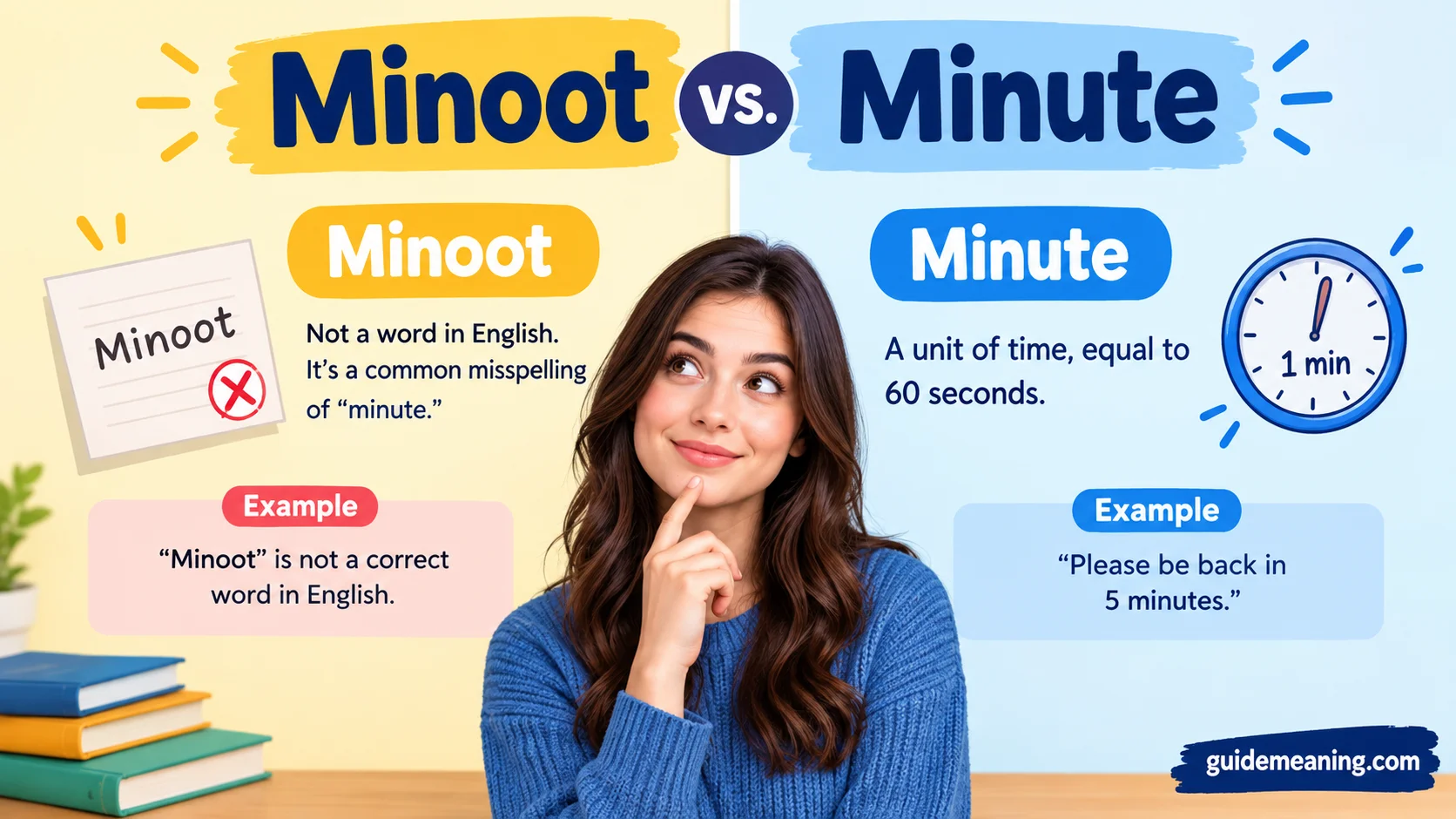
Minute is the correct standard English spelling. The spelling minoot is not the standard spelling of the English word that means either a period of time or something extremely small.
The confusion usually occurs when someone hears minute pronounced as “my-NOOT.” That pronunciation belongs to the adjective meaning extremely small, as in a minute difference. However, the word is still spelled minute, not minoot.
Here is the essential distinction:
- Minute (MIN-it): A period of 60 seconds.
- Minute (my-NOOT): Extremely small, slight, or tiny.
- Minoot: A nonstandard spelling sometimes used when someone tries to write the second pronunciation phonetically.
For example, you should write, “Wait a minute,” when asking someone to wait. You should also write, “We noticed a minute crack in the glass,” when describing a very small crack.
The spelling stays the same even though the pronunciation and meaning change.
Comparison Overview
The following table summarizes the key differences between minoot and minute and explains why the two forms cause confusion.
| Feature | Minoot | Minute |
| Standard English spelling | No | Yes |
| Meaning as a unit of time | Not standard | A period of 60 seconds |
| Meaning as an adjective | Not standard | Extremely small or slight |
| Pronunciation | An informal phonetic attempt | MIN-it or my-NOOT |
| Use in formal writing | Avoid it | Correct and appropriate |
| Example | A minoot detail | A minute detail |
The important point is that different pronunciations don’t always require different spellings. English contains many words that retain the same written form while changing their sounds or meanings.
For instance, minute can refer to time or describe something tiny. The sentence tells you which meaning the writer intends.
If you’re writing an article, sending a business email, or completing an assignment, use minute in both situations. Reserve minoot for discussions about the spelling mistake itself or for an explicitly informal, phonetic representation.
Main Differences Between Minoot vs. Minute
The biggest difference between minoot and minute is standard spelling. Minute is the accepted English word, while minoot is generally a phonetic attempt to represent one of its pronunciations.
However, understanding this spelling difference requires looking at how minute functions in a sentence. The word can act as a noun, an adjective, or a verb. Its pronunciation depends on its grammatical role and intended meaning.
Minute as a Noun
When minute refers to time, it functions as a noun. It represents one-sixtieth of an hour, which equals 60 seconds.
You probably use this meaning every day without thinking about it. You might ask a friend to wait a minute, check how many minutes remain in a meeting, or set a timer for ten minutes.
Examples:
- Please give me one minute to finish this message.
- The presentation lasted twenty minutes.
- We arrived three minutes before the movie started.
- I’ll call you in a minute.
In American English, this meaning is pronounced MIN-it. The first syllable carries the stress, and the word sounds nothing like the adjective’s pronunciation.
Minute as an Adjective
When minute describes something extremely small, it functions as an adjective. It can describe physical size, tiny quantities, subtle differences, or details that people might overlook.
For example, a minute crack in a window may be difficult to see. A minute difference between two measurements may require careful examination.
Examples:
- The scientist discovered a minute amount of residue.
- We noticed a minute scratch on the phone screen.
- The artist painted every minute detail of the building.
- There was a minute difference between the two results.
In this use, American English generally pronounces minute as my-NOOT. The final syllable receives the stress.
The Cambridge Dictionary confirms both pronunciations and distinguishes the time-related noun from the adjective meaning extremely small.
definition in the Cambridge English Dictionary
+1
Minute as a Verb
The word minute also has a less common verb form. It means to record what people say or decide during a meeting.
For example:
- The assistant will minute the committee’s decisions.
- Please minute the discussion about next year’s budget.
- The secretary minuted the meeting’s main decisions.
This verb is pronounced like the time-related noun: MIN-it.
You’ll most often encounter it in business, government, legal, and administrative settings. Although this meaning is less familiar to everyday readers, it follows the same standard spelling.
A Quick Guide to Choosing the Correct Form
Use this simple guide whenever you’re unsure which form belongs in your sentence.
| If you mean… | Write… | Example |
| Sixty seconds | Minute | Give me a minute. |
| A short period | Minute | I’ll return in a minute. |
| Extremely small | Minute | A minute speck appeared on the lens. |
| A tiny difference | Minute | We found a minute variation. |
| An official meeting record verb | Minute | Please minute the decision. |
Remember: The spelling minoot doesn’t replace minute in any of these standard uses.
Why Do People Confuse Minoot and Minute?
The confusion between minoot and minute makes sense once you consider how people learn language. Many people hear new words before they see them in print.
When someone hears the adjective minute, its pronunciation may suggest a spelling like minoot. That guess follows a reasonable instinct: write the sounds you hear. Unfortunately, English spelling doesn’t always follow pronunciation consistently.
English Spelling Doesn’t Always Match Pronunciation
English has many words whose written forms don’t provide an obvious guide to their sounds. Some words contain silent letters, while others use familiar letter combinations in unexpected ways.
Consider these examples:
| Word | Pronunciation | Common source of confusion |
| Minute | my-NOOT | The spelling doesn’t clearly suggest the long vowel sound. |
| Colonel | KER-nul | Its pronunciation differs greatly from its spelling. |
| Island | EYE-lund | The s is silent. |
| Debt | DET | The b is silent. |
| Queue | KYOO | Several letters represent a short spoken word. |
These examples illustrate why spelling by sound can cause trouble. The correct spelling often depends on learning the word as a whole.
People May Learn the Word Through Conversation
Imagine hearing a science teacher describe a minute particle. You understand that the particle is incredibly small, but you’ve never seen the word written.
You might spell it minoot because that spelling seems to match what you heard. The mistake becomes more likely if you rarely read the word in books or articles.
The same issue can occur with vocabulary learned through videos, podcasts, lectures, or casual conversations. Hearing a word correctly doesn’t automatically teach you its conventional spelling.
The Two Meanings Add Another Layer of Confusion
The problem becomes more interesting because minute has two common pronunciations. A reader who already knows the time-related noun might assume every use sounds the same.
That assumption can make the adjective seem like a different word. In reality, the written form stays unchanged while the pronunciation and meaning differ.
The solution is simple: learn both meanings together. That connection makes it easier to recognize the correct spelling in unfamiliar sentences.
How to Pronounce Minute Correctly
Correct pronunciation helps you distinguish the meanings of minute, even though it doesn’t change the spelling.
In standard American English, the noun and verb usually sound like MIN-it. The adjective meaning extremely small sounds like my-NOOT.
Pronunciation of Minute Meaning Time
When you’re talking about time, stress the first syllable.
- Pronunciation: MIN-it
- Part of speech: Usually a noun
- Meaning: Sixty seconds or a short period
- Example: “The store closes in one minute.”
The same pronunciation appears in expressions such as wait a minute, last-minute shopping, and every minute counts.
Pronunciation of Minute Meaning Tiny
When minute means extremely small, stress the second syllable.
- Pronunciation: my-NOOT
- Part of speech: Adjective
- Meaning: Extremely small or slight
- Example: “The technician found a minute flaw.”
You may encounter this pronunciation when reading scientific reports, detailed product descriptions, academic writing, or formal explanations.
Does the Pronunciation Change in American English?
The basic distinction remains the same in standard American English. Regional accents can affect individual sounds, but the difference between the two common meanings is still useful.
British English generally pronounces the adjective with an additional y sound before the long vowel. American English commonly omits that sound, producing the pronunciation represented by my-NOOT.
Neither pronunciation makes minoot the standard spelling. Pronunciation tells you how to say the word, not how to rewrite it.
Minoot vs. Minute Examples in Everyday English
Examples make the spelling rule easier to remember. The following sentences show how minute works in different contexts.
Correct Examples Using Minute for Time
Use minute when referring to 60 seconds or a short period.
- Conversation: “Give me a minute, and I’ll be ready.”
- Work: “The manager scheduled a ten-minute break.”
- Travel: “Our hotel is only five minutes from the station.”
- School: “The students had one minute to answer the question.”
- Cooking: “Let the sauce simmer for another minute.”
- Technology: “The application took a minute to load.”
Notice that the word remains minute even when it appears in a compound adjective, as in ten-minute break.
When a number and a unit form an adjective before a noun, the unit is usually singular and hyphenated. For example, write a five-minute walk, not a five-minutes walk.
Correct Examples Using Minute to Mean Small
Use minute when you want to emphasize how tiny something is.
- Science: “The sample contained a minute quantity of dust.”
- Art: “She reproduced every minute detail in the portrait.”
- Technology: “A minute crack affected the screen’s appearance.”
- Measurement: “The instruments detected a minute change in temperature.”
- Nature: “Minute insects moved across the leaf.”
- Editing: “The proofreader corrected a minute inconsistency in the report.”
In each sentence, the adjective emphasizes smallness or a fine level of detail. It doesn’t refer to a period of time.
Incorrect vs. Correct Spelling
The easiest way to catch this mistake is to compare the incorrect form with the standard version.
| Incorrect sentence | Correct sentence |
| We found a minoot crack. | We found a minute crack. |
| Wait one minoot, please. | Wait one minute, please. |
| There was a minoot difference. | There was a minute difference. |
| The report included minoot details. | The report included minute details. |
| It takes ten minoots to arrive. | It takes ten minutes to arrive. |
The final example also highlights an important point about plural forms. The plural of minute when referring to time is minutes, with an s. The adjective generally doesn’t need a plural ending because adjectives don’t change to agree with plural nouns.
For example, write minute details, not minutes details.
Minute vs. Minute: Same Spelling, Different Meaning
The word minute is a useful example of a heteronym. A heteronym is a word whose spelling stays the same while its pronunciation and meaning change.
In this case, the difference becomes clear when you compare the noun with the adjective.
| Feature | Minute (time) | Minute (small) |
| Pronunciation | MIN-it | my-NOOT |
| Part of speech | Noun | Adjective |
| Main meaning | Sixty seconds | Extremely small |
| Example | Give me a minute. | We found a minute flaw. |
| Common context | Schedules and conversations | Science, descriptions, and measurements |
Consider these two sentences:
- “The technician repaired the device in a minute.”
- “The technician discovered a minute defect.”
In the first sentence, minute describes how much time the repair took. In the second, it describes the tiny size of the defect.
Context does most of the work. You don’t need a new spelling to communicate a different meaning.
Synonyms for Minute When It Means Small
If you want to avoid repeating minute several times, you can choose a synonym that matches your sentence. However, not every synonym carries exactly the same meaning or tone.
| Synonym | Meaning or usage | Example |
| Tiny | Very small; common in everyday English | A tiny mark appeared on the wall. |
| Minuscule | Extremely small; often more formal | The machine used a minuscule amount of energy. |
| Microscopic | So small that a microscope may be needed to see it | Microscopic particles entered the sample. |
| Slight | Small in degree or amount | We noticed a slight change. |
| Miniature | A small version of something larger | She collected miniature furniture. |
| Infinitesimal | Extremely small, especially in mathematical or scientific contexts | The calculation produced an infinitesimal difference. |
| Negligible | So small or unimportant that it can be disregarded in context | The adjustment had a negligible effect. |
Choose synonyms based on meaning, not just size. For example, slight difference sounds natural, while microscopic difference suggests a difference that is exceptionally small or difficult to detect.
Likewise, negligible often emphasizes importance rather than physical size. A negligible cost might be easy to ignore even if you can see the amount clearly.
Common Mistakes to Avoid When Using Minute
A few common mistakes can make your writing less clear. Fortunately, each one has a straightforward solution.
Mistaking Pronunciation for Spelling
The most obvious error is writing minoot because the adjective sounds that way.
Incorrect: The researcher found a minoot amount of material.
Correct: The researcher found a minute amount of material.
Learn the adjective’s pronunciation alongside its standard spelling. That habit helps prevent the error from appearing in formal writing.
Assuming Both Meanings Sound Alike
Although the two forms share a spelling, they don’t share the same standard pronunciation.
Incorrect assumption: Every occurrence of minute sounds like MIN-it.
Correct understanding: The noun meaning time usually sounds like MIN-it. The adjective meaning extremely small sounds like my-NOOT.
This distinction matters when reading aloud, giving a presentation, or discussing technical information.
Confusing Minute With Minor
The words minute and minor can overlap in some contexts, but their meanings differ.
- Minute: Extremely small or fine in size or degree.
- Minor: Smaller in importance, seriousness, or rank.
For example, a minute crack is extremely small. A minor problem is relatively unimportant or not very serious.
You wouldn’t normally call a problem minute if you simply meant that it wasn’t serious. Choose the word that conveys your intended meaning.
Using the Wrong Plural Form
When minute refers to time, its ordinary plural form is minutes.
- Correct: We waited five minutes.
- Correct: The report describes minute details.
- Incorrect: The report describes minutes details.
Remember that adjectives usually remain unchanged when the nouns they describe become plural.
Every answer uses minute or its standard plural form. None requires the spelling minoot.
A Practical Case Study: Correcting Minoot in a Realistic Sentence
Imagine that a student is preparing a science report about a laboratory experiment. The student writes:
“The experiment revealed a minoot change in the color of the solution.”
The intended meaning is clear. The student wants to describe a very small color change, not a change lasting 60 seconds.
However, minoot isn’t the standard spelling. The corrected sentence reads:
“The experiment revealed a minute change in the color of the solution.”
This revision fixes the spelling without changing the meaning. It also preserves the formal tone that readers expect in a science report.
Now consider a different sentence:
“The experiment lasted one minoot.”
Here, the writer means a period of time. The correct version is “The experiment lasted one minute.”
These examples show why context matters. You can identify the intended meaning from the sentence, but the standard spelling remains the same.
FAQs:
Is minoot a real English word?
Minoot isn’t the standard spelling of the English word meaning extremely small or a period of 60 seconds. People may use it informally to represent the adjective’s pronunciation, but standard writing uses minute.
Is minute or minoot the correct spelling?
Minute is correct. Use it when referring to time or describing something extremely small. The spelling minoot is a nonstandard phonetic rendering and should generally be avoided in formal and everyday writing.
Why is minute pronounced two different ways?
English uses the same spelling for certain words with different pronunciations and meanings. The time-related noun is pronounced MIN-it, while the adjective meaning extremely small is pronounced my-NOOT in standard American English.
Does minute mean tiny?
Yes. As an adjective, minute means extremely small or slight. For example, “The inspector found a minute scratch on the surface” means the scratch was very small.
How do Americans pronounce minute when it means small?
Americans generally pronounce this adjective as my-NOOT, with stress on the second syllable. When the word means 60 seconds, the usual pronunciation is MIN-it, with stress on the first syllable.
What is the difference between minute and minor?
Minute usually emphasizes extremely small size, quantity, or detail. Minor generally describes something less important, less serious, or lower in rank. A minute scratch is tiny, while a minor problem is relatively unimportant.
Can I use minoot in formal writing?
No, not when you mean the standard English word minute. Use minute in essays, reports, professional emails, articles, and other formal documents. A phonetic spelling might appear in an informal discussion about pronunciation, but it isn’t a substitute for the standard word.
Conclusion:
The difference between minoot vs. minute comes down to standard spelling. Minute is the correct English word for both a period of 60 seconds and something extremely small. Its pronunciation changes according to its meaning, but its spelling doesn’t. Use MIN-it when discussing time and my-NOOT when describing something tiny. Remember that minoot is a nonstandard spelling, even when it seems to match the sound.