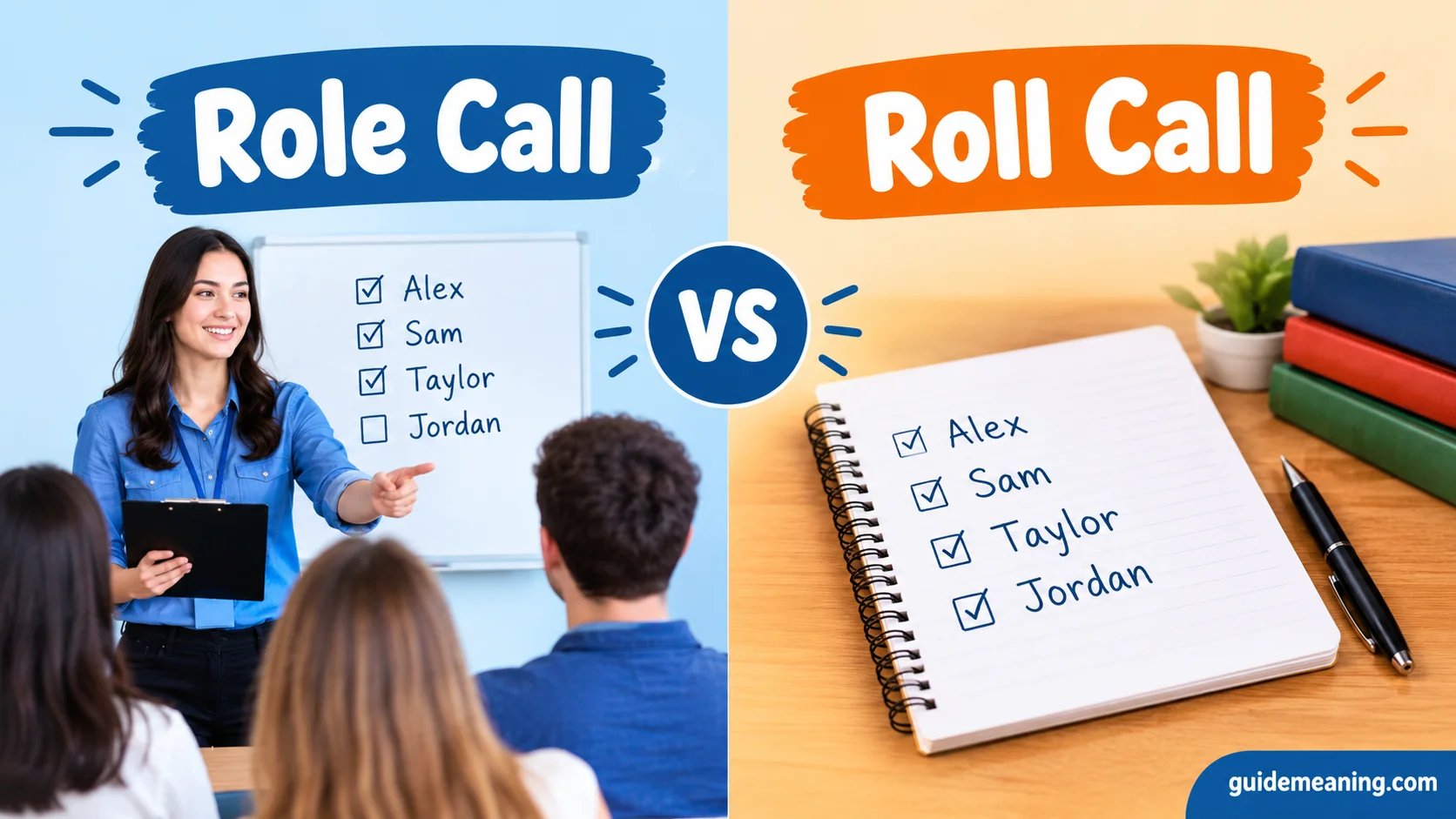

During a quiet morning in a classroom, students settle into their seats, some half-awake, others whispering softly or staring out the window. In schools and other educational settings, this familiar classroom routine is called roll call. It involves taking attendance, checking who is present, and recording names on a list. If you’re a teacher, student, or one of the participants in a meeting, knowing the correct phrase helps you avoid common mistakes in English. Role Call vs. Roll Call is a common source of confusion because both phrases sound alike, despite having different meanings. Even native speakers sometimes make these common mix-ups when writing or speaking.
The key to understanding this tricky language issue is context, word choice, and spelling. Roll call is the correct phrase for attendance checking, presence verification, and accurate attendance tracking. Teachers use it to update an attendance record or name list while supporting student accountability, discipline, and classroom management. The same attendance process takes place in workplaces, offices, corporate meetings, government assemblies, public assemblies, military camps, and online classes. Although the format may change, the purpose remains the same: confirming presence, establishing order, tracking participation, and ensuring every individual is accounted for in a shared space. These organizational procedures create a structured system for monitoring attendance and maintaining an accountability system. In educational environments and professional settings, leaders, facilitators, and record keepers rely on communication skills, language skills, and linguistic correctness. This powerful role in organizing human interaction supports group management, session management, and organizational structure while encouraging recognition, belonging, and responsibility.
The difference becomes clearer when you understand homophones, or words that sound exactly the same but mean different things. Roll refers to a list in this expression, while role means a part, character, or function someone performs, such as an actor’s part in a play or a role model’s influence. Therefore, role call is usually incorrect when discussing attendance. The role call meaning relates to a role-based meaning, while the roll call meaning has an attendance-based meaning. These semantics, language structure, and word meanings explain the meaning difference between these similar-sounding pairs. A simple trick is to connect roll with a roll of names. This error correction method helps English learners, writers, and teachers and learners improve comprehension skills, interpretation skills, and clarity in writing. When second-guessing a phrase, consider the situation, its contextual meaning, and its proper usage. Pronunciation alone cannot settle the question, so check grammar, correct spelling, language rules, and word history when needed. British usage, American usage, American English, and British English provide useful context, but the standard expression for checking attendance remains roll call. Whether you encounter it in emails, news writing, written communication, oral communication, digital platforms, or meeting gatherings, accurate spelling improves communication efficiency and supports smoother communication.
Let’s dive in!
Quick Answer:
Roll call is the correct expression when someone calls people’s names to check attendance or confirm who is present. Role call is generally a misspelling when used with this meaning.
The confusion occurs because role and roll are homophones. They have the same pronunciation in standard English but different spellings and meanings.
- Roll call: The teacher took roll call before starting the lesson.
- Role: Each student received a role in the school play.
- Role call: The teacher took role call before starting the lesson. This is incorrect when referring to attendance.
Remember this simple rule: if you’re talking about calling names from an attendance list, write roll call. If you’re talking about someone’s job, function, or character, use role.
Comparison Overview
The main difference between role call and roll call comes down to the meaning of the word you need. Although both spellings contain real English words, they don’t serve the same purpose.
| Feature | Role Call | Roll Call |
| Standard expression for attendance | No | Yes |
| Meaning of the first word | A function, position, or character | A list or register of names |
| Common usage | Usually a spelling mistake in attendance contexts | Schools, workplaces, meetings, and official proceedings |
| Pronunciation | Same as roll call | Same as role call |
| Example | Incorrect: The teacher conducted role call. | Correct: The teacher conducted roll call. |
| Appropriate alternative | Use role when discussing a function or character | Use roll call when checking attendance |
The key takeaway: Roll call is the established expression for checking attendance. Role call doesn’t normally carry that meaning in standard English.
Main Differences Between Role Call vs. Roll Call
The difference between role call vs. roll call becomes easier to understand when you examine each word separately. Role relates to what someone does or represents, while roll can refer to a list of names.
Meaning and Definition
Roll call is a procedure in which someone calls out names, usually from a list, to determine who is present. The person conducting it may record attendance, confirm participation, or establish which members are available.
For example, a teacher might read students’ names aloud at the beginning of class. Each student responds when called, allowing the teacher to identify absences.
Role, on the other hand, describes a person’s function, responsibility, or part in an activity. It can also refer to a character portrayed by an actor.
Consider these examples:
- The teacher completed roll call before the exam.
- Maria played the lead role in the school production.
- The manager explained everyone’s role in the new project.
Each sentence uses the correct word because the meaning determines the spelling.
Usage in Different Contexts
The expression roll call appears in situations where people need to confirm attendance or identify participants. Its meaning remains consistent across most settings, although the procedure can vary.
For example, a teacher might call students individually, while a meeting secretary might read the names of committee members. In both cases, the goal is to establish who is present.
The word role appears in different contexts. You might discuss someone’s role in a company, a parent’s role in a family, or an actor’s role in a movie.
Here are some practical distinctions:
- Education: Teachers conduct roll call to check which students have arrived.
- Workplaces: Supervisors may use roll call to confirm that team members are present.
- Government: Officials may use roll call to record members’ attendance or votes.
- Theater: Directors assign roles to actors rather than conducting a role call.
- Team projects: Managers explain each person’s role and responsibilities.
The setting can help you identify the intended meaning, but the word’s definition remains the deciding factor.
Grammar and Sentence Structure
Both role and roll can function as nouns, although roll also works as a verb. The expression roll call combines two nouns to form a compound noun.
In this expression, roll refers to a list or register, while call describes the act of calling names. Together, they form a term for checking attendance.
Examples include:
- The coach began the roll call at 7 a.m.
- Everyone listened carefully during the roll call.
- The committee’s roll call confirmed that enough members were present.
By comparison, role usually names a function, position, or character.
- Her role involves training new employees.
- The actor accepted a challenging role.
- Each team member understands their role.
Notice that you can replace role with words such as function or responsibility in many sentences. You can replace roll in roll call with an idea such as attendance list to understand its purpose. These substitutions offer a useful way to check your spelling.
What Does Roll Call Mean?
Roll call means calling out names from a list to determine who is present or to record participation. The person conducting it usually has a roster, register, or other list of expected participants.
During a typical roll call, the caller reads each person’s name. The person responds verbally or through another agreed method. The caller then records the response or notes any absences.
For example, a teacher might say, “Alex Johnson?” Alex answers, “Here.” The teacher marks Alex as present and continues to the next student.
Roll call can also serve purposes beyond ordinary attendance. In formal meetings, officials may call members’ names to record their presence or votes. Emergency teams may use a similar procedure to account for personnel.
Common Uses of Roll Call
Although schools provide a familiar example, roll call appears in several professional and organizational settings.
Schools and colleges
Teachers often conduct roll call at the beginning of a lesson. This helps them identify absent students and maintain accurate attendance records.
For example:
Ms. Carter took roll call before handing out the quizzes.
Workplaces
Some workplaces use roll call to confirm that employees have arrived, particularly when teams must coordinate shifts or report for duty.
For example:
The supervisor conducted roll call before the morning shift began.
Military and emergency services
Military units and emergency-response teams may use personnel checks to confirm who is present and accounted for. The precise procedure depends on the organization and situation.
For example:
The team leader completed roll call before the group departed.
Government and formal meetings
Legislative bodies and committees may call members’ names to establish attendance or record votes. A roll call vote records how individual members voted rather than merely reporting a general result.
For example:
The clerk announced the roll call vote on the proposal.
Clubs and organized activities
A club leader, camp counselor, or event coordinator might use roll call to confirm that all expected participants have arrived.
For example:
The counselor completed roll call before the hiking group left camp.
These examples demonstrate that the expression works across many settings. The shared idea is a process of calling names or recording individual responses.
What Does Role Call Mean?
Role call is not the standard expression for checking attendance. In that context, writers usually intend to write roll call but choose the wrong homophone.
The confusion makes sense because role is a common English word. It appears in discussions about jobs, relationships, responsibilities, entertainment, and social situations.
However, the fact that both words exist doesn’t make them interchangeable. Their meanings differ, even though their pronunciations match.
For example:
- Correct: The director assigned a role to every actor.
- Correct: The teacher conducted roll call.
- Incorrect for attendance: The teacher conducted role call.
Could someone intentionally write the words role call together? Yes, a writer could use them as a creative phrase, a title, or a wordplay device. A specialized organization could also define the phrase for its own purposes.
However, those possibilities don’t make role call an accepted alternative to the standard attendance expression. In ordinary writing, use roll call when you mean checking attendance.
Why People Confuse Role Call With Roll Call
Several factors make this mistake common.
- Identical pronunciation: In standard English, role and roll sound alike.
- Similar spelling: Both words contain four letters and differ only in their vowel spelling.
- Familiar vocabulary: Many people know the word role from work, school, and entertainment.
- Unfamiliar word history: Writers may not realize that roll can refer to a list of names.
- Typing errors: Spell-checkers may accept both words because each is correctly spelled on its own.
Context usually resolves the confusion. If a sentence describes someone checking names, roll call is the appropriate choice.
Role vs. Roll: Understanding the Difference
To use role call and roll call correctly, you need to understand the individual words. Both are established English words, but they refer to different things.
What Does Role Mean?
The noun role describes the function, position, or part someone has in a particular situation. It can refer to a person’s responsibilities or to a character in a performance.
For example:
- Her role as team leader includes organizing weekly meetings.
- Parents play an important role in children’s development.
- The actor prepared carefully for his role in the film.
- My role in the project involves reviewing the final draft.
In each sentence, role describes what someone does or represents.
A helpful test is to ask whether you could replace role with function, part, or responsibility. If the sentence still makes sense, role may be the correct word.
What Does Roll Mean?
The word roll has several meanings. As a noun, it can refer to a list of names, a small rounded loaf of bread, or something shaped into a cylinder.
As a verb, roll can describe turning over, moving by rotating, or forming something into a rounded shape.
Consider these examples:
- The school keeps a roll of registered students.
- She ordered a bread roll with her lunch.
- The ball began to roll down the hill.
- He rolled the paper into a tube.
The first example illustrates the meaning most closely connected to roll call. A roll can be a list or register, and calling names from that list produces a roll call.
How the Two Words Work in Real Sentences
Compare the following sentences to see how one spelling changes the meaning.
| Sentence | Correct Word | Explanation |
| The teacher checked the attendance list. | Roll | A roll can refer to a list of names. |
| She played a leading part in the movie. | Role | Role refers to an actor’s character or part. |
| The ball moved across the floor. | Roll | Roll describes movement by turning. |
| He accepted responsibility for the project. | Role | Role describes a function or responsibility. |
| The clerk called the names of the members. | Roll call | This expression describes calling names from a list. |
The important lesson is that spelling follows meaning. Don’t choose a word simply because it sounds right when spoken.
Why Is Roll Call the Correct Expression?
The expression roll call makes sense because roll has historically referred to a list or register of names. Calling names from that list became known as a roll call.
This connection between the words explains why the spelling isn’t role call. A person’s role describes their function, but it doesn’t refer to the attendance list itself.
The word roll has several historical uses involving lists and records. A roll could be a document containing names, official entries, or other information arranged for reference. The modern attendance expression preserves that older sense.
You can see the same connection in expressions such as on the electoral roll, which refers to a list of registered voters in places that use this terminology.
The distinction is straightforward:
- Roll: A list or register of names.
- Call: The act of calling out names.
- Roll call: The process of calling names to check attendance or record individual responses.
This explanation also shows why roll call isn’t simply an arbitrary spelling choice. The first word fits the purpose of the expression.
Examples of Roll Call in Sentences
Examples make the difference easier to remember because they show how the expression works in everyday writing.
Everyday Examples of Roll Call
Here are sentences you might encounter at school, work, or during organized activities.
- The teacher took roll call before beginning the lesson.
- Our coach completed roll call before practice started.
- Please remain in the room until roll call ends.
- The camp counselor conducted roll call before breakfast.
- The supervisor checked everyone’s name during roll call.
- Students answered when their names came up during roll call.
- The school office received the completed roll call sheet.
- We waited for roll call before boarding the bus.
Each example uses roll call to describe checking names or attendance.
Formal Examples of Roll Call
In formal settings, roll call can help establish attendance, accountability, or individual voting records.
- The committee secretary conducted roll call before the meeting.
- The clerk recorded each member’s response during the roll call.
- The chair requested a roll call vote on the amendment.
- The officer completed roll call before assigning duties.
- The emergency coordinator used roll call to account for team members.
- The organization updated its membership register after roll call.
These examples show that the term isn’t limited to classrooms. It also works in official and professional settings.
Examples Using Role Correctly
The following sentences demonstrate when role is appropriate.
- The manager explained my role in the new project.
- She accepted the role of team captain.
- His role in the play required extensive preparation.
- Parents have a valuable role in supporting children’s learning.
- The report examines the role of technology in education.
- Each volunteer understood their role during the event.
These sentences refer to functions, responsibilities, or characters. None describes the act of checking attendance.
Common Mistakes When Using Role Call and Roll Call
Even experienced writers can confuse homophones. Since role and roll sound identical, the wrong spelling may slip into an email, assignment, or report.
Recognizing the most common mistakes helps you catch them before publishing or sending your work.
Using Role Call for Attendance
This is the most common error. A writer uses role when the sentence refers to calling names from an attendance list.
Incorrect: The principal completed role call before the assembly.
Correct: The principal completed roll call before the assembly.
The corrected sentence uses roll because the principal is checking attendance.
Confusing a Person’s Role With Their Attendance
A person’s role and their presence are two different things. Someone can have an assigned role without being present at a particular meeting.
For example:
- Correct: The coordinator explained each person’s role.
- Correct: The coordinator checked attendance during roll call.
The first sentence describes responsibilities. The second describes an attendance procedure.
Assuming Both Spellings Are Acceptable
Some writers assume role call is an alternative spelling because it sounds the same. However, standard usage distinguishes the two expressions.
If you’re writing about attendance, use roll call. Don’t treat role call as an equally acceptable option.
Trusting Spell-Check Without Reviewing Meaning
A spell-checker might not flag role call because both words are spelled correctly individually. The problem lies in word choice rather than basic spelling.
For example, a document could contain the sentence “We began the meeting with role call.” A standard spelling checker might accept every word, even though the intended expression is roll call.
Practical tip: After running a spelling check, search your document for role call if you’ve written about attendance. Review each occurrence to confirm that the wording matches your intended meaning.
Case Studies: Choosing the Correct Expression
These short scenarios illustrate how the distinction works in realistic situations.
Case Study: A Teacher Checking Attendance
Imagine a teacher who begins every morning by reading students’ names from the class register.
The teacher asks each student to respond when called. Then the teacher records absences in the attendance system.
The correct expression is roll call because the teacher calls names from a list.
Correct sentence: “Mrs. Adams took roll call before teaching the first lesson.”
Writing role call would incorrectly substitute the word for a function or character.
Case Study: A Manager Assigning Responsibilities
Now imagine a manager preparing a team for a new project. She explains who will handle research, who will review the budget, and who will communicate with clients.
This situation involves people’s responsibilities rather than attendance.
The correct word is role.
Correct sentence: “The manager explained each employee’s role before the project began.”
If the manager later checks which employees attended the planning meeting, that separate activity could involve roll call.
Case Study: A Committee Recording Votes
A committee must vote on a proposed policy. The secretary calls each member’s name and records whether that member votes for or against the proposal.
In this context, the secretary conducts a roll call vote.
The term describes a voting procedure that records individual responses. It isn’t simply another way to describe assigning committee members their roles.
These scenarios reveal a useful principle: identify the action or meaning first, then choose the word that expresses it.
Roll Call vs. Attendance: Are They the Same?
Although people sometimes use roll call and attendance in similar situations, the terms don’t mean exactly the same thing.
Roll call describes a procedure for checking who is present. Attendance refers more broadly to the fact or record of someone’s presence at an event, class, workplace, or meeting.
For example, a teacher might conduct roll call at the beginning of class. The teacher then uses the responses to update the attendance record.
| Term | Meaning | Example |
| Roll call | Calling names to check presence | The teacher conducted roll call. |
| Attendance | The state or record of being present | Her attendance improved this semester. |
| Attendance sheet | A document used to record presence | Please sign the attendance sheet. |
| Register | A list or official record | The teacher updated the class register. |
The terms overlap, but you shouldn’t automatically substitute one for another.
For instance, saying “The school monitors attendance” sounds natural when discussing attendance policies. Saying “The school conducts roll call” describes a particular way the school checks who is present.
How to Remember the Correct Spelling
You don’t need to memorize complicated grammar rules to distinguish role call from roll call. A simple connection between spelling and meaning will usually do the trick.
Use the List-of-Names Trick
Remember that roll can mean a list or register of names. When someone calls names from that list, the procedure is called roll call.
Think of it this way:
- Roll = list of names
- Call = calling those names
- Roll call = checking attendance
This memory trick connects both words to the expression’s purpose.
Connect Role With Responsibility
The word role describes what someone does or the part they play in a situation.
For example, a teacher has a role in education, an actor plays a role in a movie, and a manager has a role in a company.
Whenever you’re discussing someone’s function or responsibility, role is likely the word you need.
Ask Yourself One Simple Question
Before writing the expression, ask yourself: “Am I checking who is present or describing what someone does?”
- If you’re checking who is present, write roll call.
- If you’re describing someone’s function, use role.
- If you’re describing something that turns or rotates, roll may be the appropriate word.
This quick check works in emails, essays, meeting notes, and professional reports.
FAQs:
Is it role call or roll call?
Roll call is correct when referring to checking attendance by calling names. Role call is generally a spelling mistake in this context because role refers to a function, position, or character.
Why is roll call spelled with roll?
The word roll can refer to a list or register of names. Since roll call involves calling names from that list, the spelling reflects the expression’s historical meaning.
Is role call ever correct?
It can appear intentionally as creative wordplay, a title, or a phrase with a specially defined meaning. However, role call isn’t the standard expression for checking attendance. Use roll call for that purpose.
What does roll call mean?
Roll call is a procedure in which someone calls out names to determine who is present or to record individual responses. Teachers, supervisors, committee secretaries, and other officials may conduct roll call.
What is the difference between role and roll?
Role refers to a function, responsibility, position, or character. Roll can refer to a list of names, a rounded object, or the action of turning over. The intended meaning determines which spelling you should use.
Is roll call one word or two?
Roll call is written as two words. The expression functions as a compound noun, as in “The teacher conducted roll call before class.” When it modifies another noun, it can also appear in phrases such as roll-call vote.
What is another word for roll call?
Depending on the situation, alternatives include attendance check, name check, and attendance check-in. In some settings, calling the register or checking the roster may also fit. However, these expressions aren’t interchangeable in every context.
Conclusion:
The difference between role call vs. roll call is simple once you understand what each word means. Role describes a person’s function or character, while roll can refer to a list of names. When someone calls names to check attendance, the correct expression is roll call. You’ll encounter it in classrooms, workplaces, government meetings, and organized activities.
Remember the connection between a roll of names and the act of calling those names. That small detail makes the spelling easier to recall. Before you finish your next email, assignment, or report, check the meaning behind the word. If you’re talking about attendance, choose roll call every time.