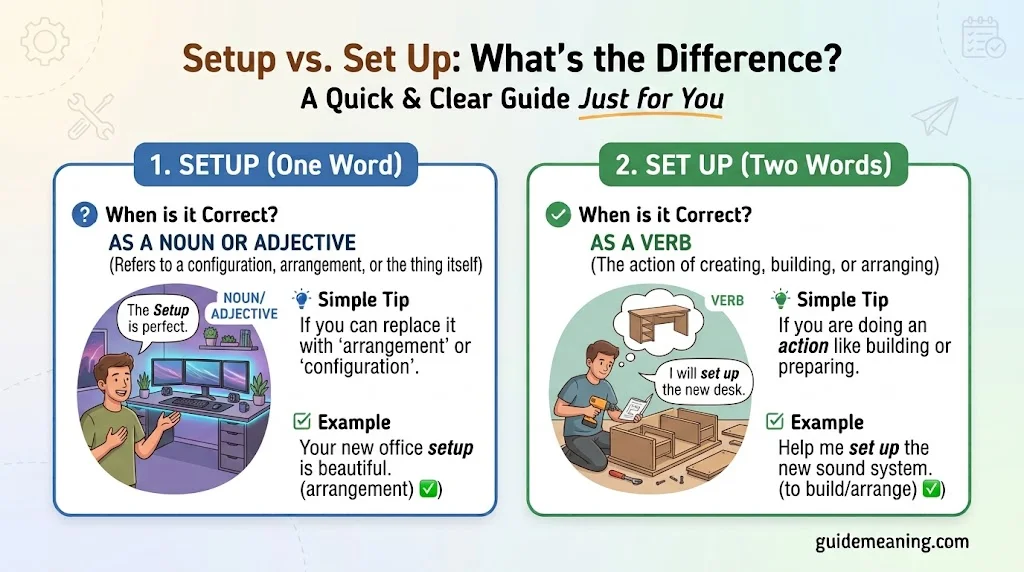

Setup vs. Set Up becomes easier when you see how a noun names a thing, while the verb set up describes an action in everyday writing.
When I explain this distinction, I usually compare these two forms to siblings with similar faces but different jobs. They may sound identical when spoken, but their grammar roles are different. Setup works as a noun or adjective, describing a thing, arrangement, configuration, or description, while set up works as a verb phrase showing an action. You can set up an account, arranges, prepares, installs, or starts something, while a setup describes what you see afterward. The set-up form is also found as a hyphenated form in some usage, although American English often favors setup as the noun. British English may show some variation. This simple rule is a useful quick takeaway for writing, emails, conversations, proposals, blog posts, and academic writing.
The good news is that you do not need vague advice or fluff to write better. A practical guide with plain English, clear explanations, sentence examples, case studies, and memory tricks can help the distinction stick. If you have seen or typed both forms and second-guessed yourself at first glance, remember the core rule: the form with a space usually signals an action, while the closed form names the resulting arrangement or configuration. Once you use the forms in the same way consistently, the correct choice becomes easier to recognize, and you can hesitate less when choosing between setup and set up.
Let’s dive in!
Quick Answer:
Setup is generally a noun that refers to an arrangement, configuration, situation, or collection of equipment.
Set up is a phrasal verb meaning to arrange, prepare, establish, install, or create something.
| Word | Grammar | Basic meaning | Example |
| setup | Noun | An arrangement or configuration | “I like your desk setup.” |
| set up | Phrasal verb | To arrange or prepare something | “I need to set up my desk.” |
| set-up | Noun in some usage | An arrangement or deceptive situation | “It was a set-up.” |
Cambridge Dictionary defines setup as a noun for an arrangement or situation and also records its use for equipment or organizational arrangements.
Meanwhile, set up functions as a phrasal verb. It can mean preparing something for use, establishing something, arranging an event, or creating a particular situation.
The easiest rule is this:
If you’re naming the arrangement, use “setup.” If you’re describing the action, use “set up.”
What Does “Setup” Mean?
Setup is usually a noun. It describes the way things are arranged, organized, or configured.
Think of it as the finished arrangement rather than the action that created it.
For example:
Her home office setup is comfortable and practical.
Here, setup refers to the desk, chair, monitor, lighting, computer, and other elements considered together.
You could also say:
The camera setup took up most of the table.
The word doesn’t describe someone arranging the camera. Instead, it names the arrangement itself.
Cambridge Dictionary lists setup as a noun meaning an arrangement that allows something to happen. It also uses the word for a particular situation and for an arrangement of equipment.
Setup as a Noun
As a noun, setup commonly refers to:
- An arrangement of equipment
- A configuration of technology
- The organization of a workplace
- The structure of a system
- The way something operates
- A particular situation or arrangement
- A deceptive situation designed to trick someone
Consider these examples:
- My gaming setup includes two monitors.
- The studio setup looks professional.
- We changed the office setup.
- The new setup makes the process easier.
- The laboratory setup requires several instruments.
In each sentence, setup names something.
That’s the key grammatical clue.
“Setup” in Technology and Computing
Technology provides some of the clearest examples of the distinction.
You might talk about a computer setup, gaming setup, office setup, or camera setup. In each case, setup describes the configuration or arrangement.
For example:
- My computer setup includes a laptop and an external monitor.
- His gaming setup has a mechanical keyboard.
- The studio setup needs better lighting.
- Our network setup is fairly simple.
Technology also uses setup in compounds such as setup wizard. Cambridge Dictionary defines a setup wizard as software that guides users through configuring another program or system.
Notice the difference:
The setup wizard is easy to use.
Here, setup helps form a noun phrase.
Now compare:
I need to set up the software.
This time, set up expresses the action.
What Does “Set Up” Mean?
Set up is a phrasal verb made from the verb set and the particle up.
Unlike setup, it describes an action.
Depending on context, set up can mean:
- Arrange something
- Prepare something
- Install something
- Configure something
- Establish something
- Create an organization or system
- Arrange an appointment or meeting
- Prepare someone for something
- Trick or frame someone
Cambridge Dictionary specifically lists meanings involving preparation, establishment, arrangement, and deception.
Set Up Means “Arrange”
When you physically arrange something, set up often means getting it ready for use.
For example:
Please set up the chairs before the guests arrive.
You aren’t naming the chairs’ arrangement. You’re describing the action of arranging them.
More examples include:
- We need to set up the tables.
- They set up the equipment before the presentation.
- She set up the room for the meeting.
- I’ll set up the projector.
Set Up Means “Install or Configure”
Technology makes this meaning particularly common.
You can set up:
- A computer
- A phone
- A printer
- A software program
- An account
- A network
- A camera
- A smart device
For example:
I need to set up my new laptop.
Here, set up could involve connecting devices, configuring settings, installing software, and completing initial steps.
Cambridge gives set up the meaning of preparing something for use, including putting different parts together.
Set Up Means “Establish”
The phrase also works when you create or establish something more abstract.
For example:
- They set up a new company.
- She set up a charitable organization.
- The school set up a new program.
- We set up a system for tracking expenses.
- They set up a fund for the project.
In these examples, you’re not physically placing objects somewhere. You’re creating or establishing something.
Cambridge specifically includes establishing companies, organizations, systems, and ways of working among the meanings of set up.
Setup vs. Set Up: The Main Difference
The most important distinction comes down to grammar.
Setup functions as a noun. Set up functions as a verb.
Consider this pair:
The setup looks complicated.
We need to set up the equipment.
The first sentence answers “What arrangement?”
The second answers “What action needs to happen?”
That difference is small on the page but important in grammar.
A Simple Way to Remember the Difference
Use this mental test:
Can you replace the word with “arrangement” or “configuration”?
If yes, setup will usually work.
I like your setup.
You could say:
I like your arrangement.
Now ask whether the sentence describes an action.
I need to set up my computer.
You could replace set up with configure or prepare:
I need to configure my computer.
That tells you you’re dealing with the verb set up.
Setup vs. Set Up Examples
The fastest way to understand the distinction is to place the forms side by side.
| Setup | Set Up |
| My setup is simple. | I need to set up my computer. |
| The office setup works well. | We need to set up the office. |
| Her gaming setup is impressive. | She wants to set up a gaming system. |
| The camera setup looks professional. | They will set up the cameras. |
| The meeting setup was unusual. | We need to set up a meeting. |
| The new setup saves time. | The team will set up a new system. |
The pattern is remarkably consistent.
Setup names the arrangement. Set up describes creating the arrangement.
Common Mistakes With Setup and Set Up
These two forms cause several predictable mistakes. Most happen because writers treat the expression as one grammatical unit in every situation.
Mistake: “I Need to Setup My Computer”
This is one of the most common errors.
Incorrect:
I need to setup my computer.
Correct:
I need to set up my computer.
Why?
Because set up acts as the verb. You are describing the action of configuring the computer.
However, you could write:
My computer setup is almost complete.
Now setup works because it functions as a noun.
Mistake: “I Like Your Set Up”
When you’re using the word as a noun, modern US English generally uses setup as one word.
Less appropriate in standard US usage:
I like your set up.
Preferred:
I like your setup.
The noun refers to the arrangement itself.
Mistake: Confusing the Action With the Result
This is perhaps the most useful distinction to remember.
Imagine someone assembling a home recording studio.
While they’re working:
They are setting up the studio.
Once everything is ready:
The studio setup looks excellent.
The first sentence focuses on the action.
The second focuses on the resulting arrangement.
That’s the grammatical dividing line.
Setup vs. Set Up in Different Contexts
The same distinction appears across many everyday situations.
Technology
Setup:
My computer setup has three monitors.
Set up:
I need to set up the new monitor.
Gaming
Setup:
His gaming setup takes up half the desk.
Set up:
He wants to set up a new gaming station.
Office Work
Setup:
The office setup encourages collaboration.
Set up:
The manager will set up the new office.
Events
Setup:
The event setup looked professional.
Set up:
The staff arrived early to set up the event.
Meetings
Setup:
The meeting setup allowed everyone to see the screen.
Set up:
I’ll set up the meeting for Friday.
Online Accounts
Setup:
The account setup took only a few minutes.
Set up:
I need to set up an account.
These examples show why context matters more than pronunciation.
Set Up in Different Tenses
Another reason set up can confuse learners is that the verb set has unusual forms.
Unlike many regular verbs, set keeps the same form in the present, past, and past participle.
| Verb form | Example |
| set up | I set up the computer every morning. |
| sets up | She sets up the equipment. |
| setting up | They are setting up the room. |
| set up | He set up the account yesterday. |
| has set up | She has set up a new system. |
Notice something important: set up remains two words when it functions as the verb.
For example:
He set up the meeting yesterday.
The past tense doesn’t turn it into setup.
Likewise:
She has set up the account.
The phrase remains set up.
How to Use “Set Up” With Pronouns
Set up is a separable phrasal verb in common constructions. That means the object can appear between set and up.
For example:
Set up the computer.
You can also say:
Set the computer up.
Both structures can work with a noun object.
However, pronouns normally go between the verb and particle:
Set it up.
Not:
Set up it.
This distinction becomes especially useful in everyday speech.
Compare:
- Set up the printer.
- Set the printer up.
- Set it up.
The final example demonstrates the usual placement of a pronoun with this phrasal verb.
Setup vs. Set Up: What About “Set-Up”?
The hyphenated form set-up deserves attention because you may encounter it in dictionaries, British English, business writing, or particular editorial styles.
Cambridge records set-up as a noun meaning an arrangement and also as a noun for a situation in which someone is tricked.
However, setup is also an established noun form, especially in US English.
For example:
The office setup is efficient.
You may also encounter:
The office set-up is efficient.
The important point isn’t that one spelling exists and the other doesn’t. Usage varies by regional convention and style.
For US English, setup is the straightforward one-word noun in common modern usage.
The verb remains two words:
We need to set up the office.
So don’t use the hyphen simply because you see set-up elsewhere.
Is “Setup” One Word or Two?
The answer depends on its grammatical function.
When setup acts as a noun, write it as one word in standard US usage:
The setup is ready.
When set up acts as a verb, write it as two words:
We need to set up the equipment.
This creates a useful noun-versus-verb pattern:
The setup is complete.
We set up the system yesterday.
The first sentence names the configuration. The second describes the work involved in creating it.
Setup vs. Set Up in Real-World Writing
Consider a small business owner preparing a new office.
At first, she might say:
I’m going to set up my new office.
She’s describing an upcoming action.
After several hours of work, she might say:
My office setup is finally complete.
Now she’s talking about the resulting arrangement.
Later, she could write:
The new setup makes it easier to work.
If she changes the arrangement again, she might say:
I need to set up another monitor.
This miniature case study demonstrates the distinction better than an isolated grammar rule.
Another Example: A Conference
Imagine an event team preparing a conference room.
Before the event:
The staff needs to set up the room.
During preparation:
They’re setting up the microphones and chairs.
Afterward:
The room setup looks excellent.
The spelling follows the grammatical function at every stage.
A Practical Rule for Choosing the Right Form
When you’re unsure, look at the word’s job in the sentence.
Use setup when:
- You’re naming an arrangement.
- You’re talking about a configuration.
- You’re describing equipment collectively.
- You’re discussing how something is organized.
- You’re referring to a particular situation.
- You can substitute arrangement or configuration.
Examples:
- The setup is convenient.
- I changed my desk setup.
- The camera setup needs improvement.
Use set up when:
- You’re describing an action.
- You’re arranging something.
- You’re preparing something for use.
- You’re installing or configuring something.
- You’re establishing an organization or system.
- You’re arranging a meeting or appointment.
Examples:
- Set up the equipment.
- She set up an account.
- They set up a meeting.
A Quick Grammar Test
Here’s a simple trick worth remembering.
Replace setup with arrangement.
The setup looks professional.
Becomes:
The arrangement looks professional.
The sentence still works. That’s a strong sign that setup is the right choice.
Now replace set up with arrange.
We need to set up the room.
Becomes:
We need to arrange the room.
Again, the sentence still works.
This isn’t an absolute rule for every meaning, but it works extremely well for everyday usage.
Setup vs. Set Up: Key Facts
- Setup is primarily a noun in US English.
- Set up is a phrasal verb.
- Setup can describe an arrangement or configuration.
- Set up can mean arrange, prepare, install, establish, or create.
- Setup appears as one word in common US noun usage.
- Set up remains two words when used as a verb.
- Setting up is the present participle form.
- Sets up is the third-person singular present form.
- Set up can be used in the simple past because set has the same past form.
- Set-up also exists as a noun in some dictionaries and style conventions.
FAQs:
Is “setup” one word or two?
Setup is usually one word when it functions as a noun or adjective. For example, “The computer setup is simple.” When you need the verb, use set up: “I will set up the computer.”
Is “set up” a verb?
Yes. Set up is a verb phrase that means to arrange, prepare, install, establish, or organize something. For example, “We need to set up the meeting room.”
Is “setup” a noun?
Yes. Setup is commonly used as a noun to describe an arrangement, configuration, or way something is organized. For example, “Your new office setup looks great.”
Can “setup” be an adjective?
Yes. Setup can work as an adjective when it describes another noun. For example, “We bought a new setup guide.” However, the exact form can depend on the sentence and style.
What is the difference between “setup” and “set up”?
The main difference is grammatical. Setup usually refers to a thing or arrangement, while set up describes an action. Think of it this way: you set up something, and the resulting arrangement is the setup.
Is “set-up” correct?
Set-up can appear as a hyphenated form in some styles and contexts. However, setup is widely used as the noun, while set up is the standard verb form in modern American English.
How can I remember “setup vs. set up”?
Use a simple memory trick: if you can replace the word with arrangement or configuration, setup is likely correct. If you are describing something you need to do, use set up.
Conclusion:
Understanding Setup vs. Set Up becomes much easier once you focus on their grammatical roles. Setup usually names a thing, arrangement, or configuration, while set up describes an action. For example, you can set up a new computer, and the final setup can be exactly what you need. Remembering this simple difference will help you write more clearly and avoid a common mistake in emails, conversations, and formal writing.