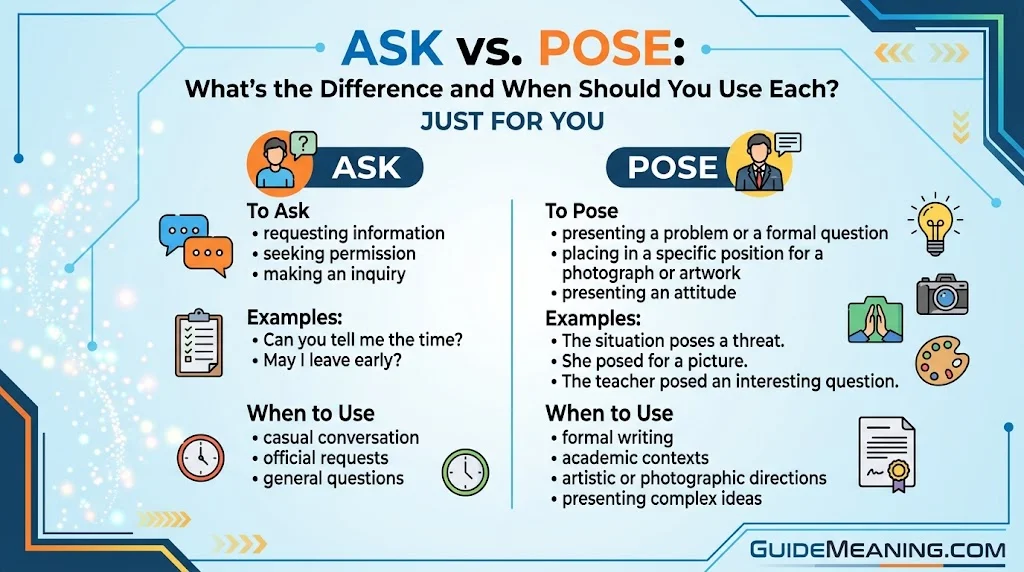

The difference in Ask vs. Pose becomes clearer when you compare tone, purpose, and context in everyday and professional communication with care. When ask and pose are similar verbs, their usage can still differ in tone, communication style, and purpose. In my teaching experience, I have found that learners understand the nuances more easily when they compare daily conversation, everyday conversation, and professional settings. Ask works naturally for simple interaction, direct questions, requests, information, and an action request, while pose is more common when presenting or introducing a question in formal, academic, or analytical contexts.
Understanding ask meaning and pose meaning helps learners choose the right word that fits best according to the situation, context, and purpose. The difference can sometimes feel like a split-second decision, especially when the words seem interchangeable. Writers may find themselves paused and wondering which word to use, even when the basic meaning is clear. However, the choice can drastically change how a sentence may sound, making it sharp or slightly off. A useful guide breaks it down clearly, without fluff, vague rules, or unnecessary academic fog, helping you learn without confusion. You need to know the intent, formality, and expression behind a question. In natural speech, ask often feels direct and conversational, while pose can introduce a topic presentation, idea, or thought that invites deeper discussion.
These words relate to different purposes, although they can perform the same job in certain contexts. The thin line becomes easier to recognize through daily learning practice, everyday life, and professional communication. Paying attention to the devil in the details can dramatically improve your English usage. Instead of guessing, knowing the rules can help you make the right choice instantly and apply it confidently when asking or posing questions. Using the terms interchangeably is not always awkward or inappropriate, but the wrong choice may affect the tone and communication of your message. Ask or Pose a Question is therefore more than a simple vocabulary choice because words, information, action, topic, and presentation can work together in real communication and writing.
Let’s dive in!
Quick Answer:
Ask and pose can both mean putting a question to someone. The main difference lies in purpose, context, and tone.
- Ask usually means requesting information, an answer, clarification, or a response.
- Pose means presenting or putting forward a question for consideration, discussion, or thought.
- Ask is much more common in everyday conversation.
- Pose often sounds more formal, deliberate, or analytical.
- Ask works naturally with people and direct requests.
- Pose also works with abstract subjects such as problems, challenges, threats, and risks.
For example:
“I want to ask you a question.”
This sounds natural in almost any ordinary conversation.
“The findings pose an important question about the reliability of the method.”
Here, the question isn’t simply directed at one person. The findings themselves introduce an issue worth considering.
| Feature | Ask | Pose |
| Basic meaning | Request information or an answer | Put forward a question or issue |
| Everyday use | Very common | Less common |
| Formal writing | Common | Very common |
| Academic writing | Common | Common |
| Directly addressing someone | Natural | Possible, but more formal |
| Requests for information | Yes | Usually no |
| Questions for discussion | Yes | Especially natural |
| Problems | Not normally | Yes |
| Challenges | Not normally | Yes |
| Threats | Not normally | Yes |
| Risks | Not normally | Yes |
What Does “Ask” Mean?
Ask is one of the most flexible verbs in English. At its core, it means requesting information, an answer, an action, permission, or something else from another person.
When you ask a question, you generally want someone to respond.
For example:
- “Can I ask you a question?”
- “She asked me where I lived.”
- “He asked about the meeting.”
- “I asked for more information.”
- “They asked whether the store was open.”
- “The student asked the teacher for help.”
The verb also works far beyond questions. You can ask for help, ask permission, ask someone to leave, or ask for directions.
That broad usefulness makes ask the natural choice in ordinary English.
Common Uses of “Ask”
You can use ask in several important patterns.
Ask Someone a Question
This is perhaps the most familiar structure.
“I asked Sarah a question.”
The person receiving the question appears directly after ask.
You can also say:
“I asked Sarah about the new project.”
Here, about introduces the subject of the question.
Ask for Something
When you want someone to provide something, use ask for.
“He asked for a glass of water.”
“She asked for additional information.”
“The customer asked for a refund.”
Notice that these sentences don’t involve questions in the narrow sense. Ask can describe a request as well.
Ask Someone to Do Something
You can also use ask + person + to + verb.
“I asked him to call me later.”
“She asked her assistant to send the report.”
This construction is another reason ask is much broader than pose.
Ask About Something
Use ask about when you want information concerning a particular subject.
“I asked about the price.”
“They asked about the new policy.”
This pattern is extremely common in everyday speech.
What Does “Pose” Mean?
The verb pose has several meanings. In the context of questions, it means to put forward or present a question for consideration.
Cambridge Dictionary lists this as a formal use of pose. It also defines pose in other contexts as causing a problem or difficulty, adopting a position for a photograph, or pretending to be someone else.
For this article, the question-related meaning matters most.
Consider:
“The professor posed a difficult question.”
The professor certainly asked a question. However, posed emphasizes the act of putting that question before students as something they should think about.
That subtle shift makes pose especially useful in academic, professional, analytical, and formal contexts.
Common Uses of “Pose”
The most useful collocations include:
- pose a question
- pose a problem
- pose a challenge
- pose a threat
- pose a risk
- pose an issue
- pose a dilemma
This wider range is important.
You can say:
“The new technology poses a serious risk.”
You can’t naturally replace poses with asks:
❌ “The new technology asks a serious risk.”
That sentence doesn’t work because pose has a broader meaning than simply asking a question.
Ask vs. Pose: The Main Difference
The easiest way to understand ask vs. pose is to focus on what happens after the verb.
With ask, someone usually seeks an answer.
With pose, someone usually presents an issue for consideration.
Think of it this way:
Ask → “I want an answer.”
Pose → “Here is an issue worth considering.”
This isn’t an absolute rule. English doesn’t always divide words into neat little boxes. In many contexts, the two verbs overlap.
For example:
“The researcher asked an important question.”
“The researcher posed an important question.”
Both sentences are grammatically correct.
The second version simply gives the question a slightly more formal or deliberate feel.
Ask Is Broader and More Direct
Ask works when you directly seek information.
Imagine you’re at a restaurant:
“Can I ask what today’s special is?”
Nobody would normally say:
“Can I pose what today’s special is?”
That sounds unnatural because you’re simply requesting information.
Similarly:
“I asked my manager about the deadline.”
This sentence describes a straightforward interaction.
Pose Suggests Presentation
Pose becomes especially useful when the question itself is the subject of discussion.
Consider:
“The discovery poses an interesting question.”
The discovery isn’t literally speaking to someone. Instead, it creates an issue that researchers need to consider.
That’s a major difference.
The question can exist as an intellectual problem even when nobody expects an immediate verbal answer.
“Ask a Question” vs. “Pose a Question”
Both expressions are correct.
The distinction comes from how you frame the question.
Ask a Question
Ask a question is neutral and highly versatile.
You might use it with:
- friends
- teachers
- coworkers
- customer-service agents
- interviewers
- doctors
- family members
- strangers
Examples:
“May I ask a question?”
“I need to ask you something.”
“The reporter asked several questions.”
“Students asked questions after the lecture.”
These sentences sound natural because they describe direct communication.
Pose a Question
Pose a question sounds more deliberate.
Examples:
“The speaker posed a challenging question.”
“The article poses an important question about privacy.”
“The researchers posed several questions for future studies.”
“The professor posed a question to the class.”
Here, the question often functions as part of a broader discussion.
It may invite reflection rather than demand an immediate answer.
Are “Ask” and “Pose” Grammatically Interchangeable?
Sometimes, yes.
However, grammatical correctness doesn’t guarantee identical meaning or tone.
Compare these sentences:
“The interviewer asked a difficult question.”
“The interviewer posed a difficult question.”
Both work.
The first focuses more directly on the interviewer’s action. The second gives the question a slightly more deliberate or formal presentation.
Now consider:
“The study asks an important question about climate modeling.”
“The study poses an important question about climate modeling.”
Again, both can work. Pose may feel more natural when the study itself introduces an issue rather than literally speaking to someone.
A useful distinction is that ask often centers on the interaction, while pose can center on the question itself.
Ask vs. Pose in Different Contexts
Context can make the choice surprisingly easy.
Everyday Conversation
Use ask.
“Can I ask you something?”
“I asked him where he bought it.”
“She asked whether we were ready.”
Using pose in these situations can sound unnecessarily formal.
For instance:
“I need to pose a question about dinner.”
There’s nothing grammatically impossible about that sentence. It simply sounds more ceremonious than the situation requires.
Academic Writing
Both verbs can work in academic writing.
However, pose frequently appears when researchers introduce questions, problems, or theoretical issues.
“The findings pose several questions for future research.”
“The study poses an important question about causation.”
Academic writing often deals with questions that don’t have immediate answers. That makes pose particularly useful.
Still, don’t assume ask is wrong in academic writing.
“The researchers asked participants whether they agreed.”
Here, ask is exactly right because the researchers actually requested responses from participants.
Business Writing
Business writing uses both verbs.
Use ask when describing a direct request:
“I asked the client about the revised deadline.”
Use pose when describing an issue:
“The proposed change poses a significant challenge for smaller teams.”
That distinction is more useful than simply labeling one word “informal” and the other “formal.”
Interviews
Ask usually sounds natural when describing an interviewer’s interaction with a person.
“The reporter asked the mayor about the decision.”
You can also use pose:
“The reporter posed a difficult question.”
The second sentence emphasizes the nature of the question rather than the simple act of requesting information.
Debates and Discussions
Pose often fits well when a speaker introduces an issue for consideration.
“The speaker posed an important question about personal responsibility.”
Meanwhile, ask works naturally when someone directly requests an answer:
“The moderator asked the candidates whether they supported the proposal.”
The difference becomes clearer when you focus on the target of the action.
Ask vs. Pose: Common Collocations
Collocations are words that naturally appear together. Learning them can make your English sound far more natural.
Common Collocations With “Ask”
- ask a question
- ask someone
- ask for help
- ask for information
- ask permission
- ask about something
- ask whether
- ask why
- ask how
- ask when
- ask someone to do something
Common Collocations With “Pose”
- pose a question
- pose a problem
- pose a challenge
- pose a threat
- pose a risk
- pose a dilemma
- pose an issue
- pose difficulties
These patterns reveal an important point: pose isn’t simply a fancy replacement for ask.
Its meaning extends beyond questions.
Can You Use “Pose” for Every Question?
No.
Although pose a question is correct, that doesn’t mean you should replace every occurrence of ask with pose.
Consider this conversation:
“I need to ask my brother where he parked the car.”
Changing it to:
“I need to pose my brother where he parked the car.”
is incorrect.
You could say:
“I need to pose a question to my brother about where he parked the car.”
That sentence is grammatical, but it sounds much more formal than the original.
The problem isn’t grammar. It’s natural usage.
Why “Ask” Works Better Here
The speaker wants information from a specific person.
That’s a straightforward request.
Ask handles that job perfectly.
By contrast, pose often frames the question as an object of consideration:
“The incident poses questions about how the system failed.”
Nobody is necessarily waiting for one person to answer. The incident has created issues that deserve examination.
Can You Use “Ask” Instead of “Pose”?
Often, yes.
For example:
“The report poses several questions about the policy.”
You could write:
“The report asks several questions about the policy.”
The second sentence isn’t necessarily wrong. However, poses can better communicate that the report raises issues for readers or researchers to examine.
Similarly:
“The new evidence poses an important question.”
could become:
“The new evidence asks an important question.”
The latter is understandable. The former is often more idiomatic when an object, discovery, or situation creates an intellectual question.
Ask vs. Pose: Real-World Examples
The following examples show how context changes the choice.
| Situation | Natural Example | Why |
| Talking to a friend | “Can I ask you something?” | Direct conversation |
| Customer service | “I want to ask about my order.” | Request for information |
| Interview | “The reporter asked about the decision.” | Direct inquiry |
| Research | “The study poses an important question.” | Issue for analysis |
| Academic discussion | “The professor posed a difficult question.” | Deliberate presentation |
| Business report | “The change poses a significant challenge.” | Creates difficulty |
| Public speech | “The speaker posed a question to the audience.” | Invites reflection |
| Risk assessment | “The defect poses a safety risk.” | Causes or creates danger |
Ask vs. Pose: Case Studies
Case Study: A Student in Class
Imagine a student doesn’t understand a mathematical concept.
The student says:
“Can I ask a question?”
That’s the natural choice.
The student wants the teacher to provide information.
Now imagine the teacher wants the class to think about a difficult concept:
“The professor posed a question about whether the formula would still work under different conditions.”
Here, pose works because the teacher deliberately presents an issue for consideration.
Case Study: A Research Paper
Consider these two sentences:
“The researchers asked participants whether they trusted the system.”
This is a direct request for information. Ask is ideal.
Now compare:
“The findings pose an important question about whether the system can be trusted.”
The findings don’t literally question someone. Instead, they raise an issue for researchers to examine.
That’s where pose shines.
Case Study: A Business Report
Suppose a company introduces a complicated new process.
You might write:
“The manager asked the team whether they could meet the deadline.”
That’s direct communication.
But:
“The new process poses a significant challenge for the operations team.”
Here, pose means create or present a difficulty.
Cambridge Dictionary also gives pose this “cause a problem or difficulty” meaning.
The distinction isn’t merely about formality. The verbs perform different grammatical jobs.
Ask vs. Pose: Common Mistakes
Mistake: Using “Pose” to Sound More Intelligent
Some writers assume formal vocabulary automatically improves writing.
It doesn’t.
Compare:
“I would like to pose a question regarding tomorrow’s lunch.”
with:
“Can I ask about tomorrow’s lunch?”
The first sentence sounds unnecessarily grand for an ordinary situation.
Good writing matches the word to the situation.
Mistake: Assuming “Ask” Is Too Informal for Academic Writing
This misconception causes unnecessary problems.
Academic writers absolutely can use ask.
For example:
“The researchers asked participants to complete the survey.”
Using pose here would change the meaning.
You wouldn’t normally write:
“The researchers posed participants to complete the survey.”
That structure doesn’t work.
Mistake: Treating “Pose” as a Direct Synonym for “Ask”
The verbs overlap when followed by question, but their broader meanings differ.
You can:
- ask for help
- ask permission
- ask someone to leave
- ask about prices
You can:
- pose a threat
- pose a risk
- pose a challenge
- pose a problem
This is why learning the words separately is more useful than memorizing “ask = pose.”
Ask vs. Pose in Formal and Informal English
Formality helps explain the difference, but it doesn’t tell the whole story.
Ask can appear in highly formal writing.
“The committee asked whether the proposal met the requirements.”
Likewise, pose can appear in spoken English.
“Let me pose a question.”
So the difference isn’t a strict formal-versus-informal rule.
Instead, consider these three factors:
- Who is communicating?
- Who receives the question?
- What is the purpose of the question?
If one person directly seeks information from another, ask usually fits.
If someone presents an issue for reflection, analysis, or discussion, pose often fits better.
“Pose a Question” Does Not Always Mean No Answer Is Expected
It’s tempting to create a hard rule:
Ask = expects an answer
Pose = doesn’t expect an answer
That shortcut can help beginners, but it isn’t completely accurate.
Someone can pose a question and expect an answer.
For example:
“The professor posed a question to the class.”
The professor may absolutely expect students to answer.
Likewise, someone can ask a rhetorical question without expecting an answer.
“Who wouldn’t want a better solution?”
So the distinction isn’t about whether an answer is guaranteed.
The more reliable difference concerns how the question is framed.
Ask emphasizes inquiry or a request for information.
Pose emphasizes presenting the question as something to consider.
Other Useful Alternatives to “Ask” and “Pose”
English gives you several related verbs. Each has its own shade of meaning.
Raise a Question
Raise a question means to bring an issue or doubt to attention.
“The results raise questions about the reliability of the test.”
This is particularly common in analytical writing.
Put a Question to Someone
This means to direct a question toward someone.
“The journalist put the question to the minister.”
It can sound formal or deliberate.
Submit a Question
This usually means formally sending a question for consideration.
“Readers can submit questions before the webinar.”
Bring Up a Question
This is more conversational.
“She brought up an interesting question during the meeting.”
Present a Question
This emphasizes putting a question before an audience.
“The speaker presented a question for the panel to consider.”
These alternatives shouldn’t be treated as perfect synonyms. Each one changes the emphasis slightly.
How to Choose Between Ask and Pose
When you’re stuck, use this simple decision process.
Use “Ask” When:
- You want information.
- You want clarification.
- You need an answer from someone.
- You’re making a request.
- You’re speaking naturally in conversation.
- You’re describing a direct interaction.
Examples:
“Ask your teacher for help.”
“I asked him about the price.”
“She asked whether we were ready.”
Use “Pose” When:
- You’re presenting a question for consideration.
- You’re introducing an intellectual issue.
- You’re discussing research.
- You’re writing analytically.
- You’re describing a challenge or problem.
- You’re emphasizing the question itself.
Examples:
“The study poses an important question.”
“The proposal poses a serious challenge.”
“The discovery poses new questions for researchers.”
A Simple Memory Trick
Here’s an easy way to remember the difference:
Ask someone. Pose something.
This isn’t a rigid grammar rule. It’s a useful mental shortcut.
You ask someone for information:
“I asked Maria about the schedule.”
You pose a question for consideration:
“The article poses a question about the future of education.”
You can also pose a problem, threat, risk, or challenge:
“The outdated equipment poses a safety risk.”
That wider pattern makes pose easier to recognize.
Ask vs. Pose: Quick Comparison
| If you mean… | Use |
| Request information | Ask |
| Request help | Ask |
| Request permission | Ask |
| Ask someone directly | Ask |
| Introduce a question for discussion | Pose |
| Present a thought-provoking question | Pose |
| Introduce a research question | Pose |
| Present a problem | Pose |
| Create a challenge | Pose |
| Create a threat | Pose |
| Create a risk | Pose |
Final Rules to Remember
The difference between ask vs. pose becomes much easier once you stop treating them as exact synonyms.
Remember these points:
- Ask is the broader and more common verb.
- Ask works especially well for direct questions and requests.
- Pose means to put forward a question for consideration.
- Pose often carries a more deliberate or analytical tone.
- Pose works with more than questions.
- You can pose a problem, challenge, threat, risk, or dilemma.
- Both ask a question and pose a question are grammatically correct.
- Ask isn’t wrong simply because the writing is academic.
- Pose isn’t automatically better because it sounds formal.
- Context should determine your choice.
FAQs:
What is the difference between ask and pose?
Ask is common for direct questions, requests, and everyday communication. Pose is more formal and often introduces a question, issue, or idea for discussion.
Is it correct to say ask a question?
Yes. Ask a question is the most common and natural expression in everyday English. For example, “May I ask a question?”
Is pose a question grammatically correct?
Yes. Pose a question is grammatically correct. It is especially common in formal, academic, professional, and analytical writing.
Can ask and pose be used interchangeably?
Sometimes, but not always. Both can refer to putting a question forward, but ask usually sounds more direct and conversational, while pose often sounds more formal.
When should I use ask?
Use ask for everyday questions, personal requests, information requests, and ordinary conversations. For example, “I asked my teacher for help.”
When should I use pose?
Use pose when you want to present a question, issue, problem, or idea for consideration. For example, “The study poses an important question about education.”
Which sounds more formal, ask or pose?
Pose generally has a more formal tone than ask. However, the appropriate choice depends on the context, audience, and purpose of the sentence.
Conclusion:
Ask vs. Pose is mainly a difference in tone, purpose, and context. Ask is the natural choice for everyday questions, requests, and direct communication. Pose is useful when introducing a question, idea, problem, or topic in formal, academic, or professional settings. Understanding this distinction helps you choose the word that fits your sentence naturally and makes your English sound clearer and more precise.