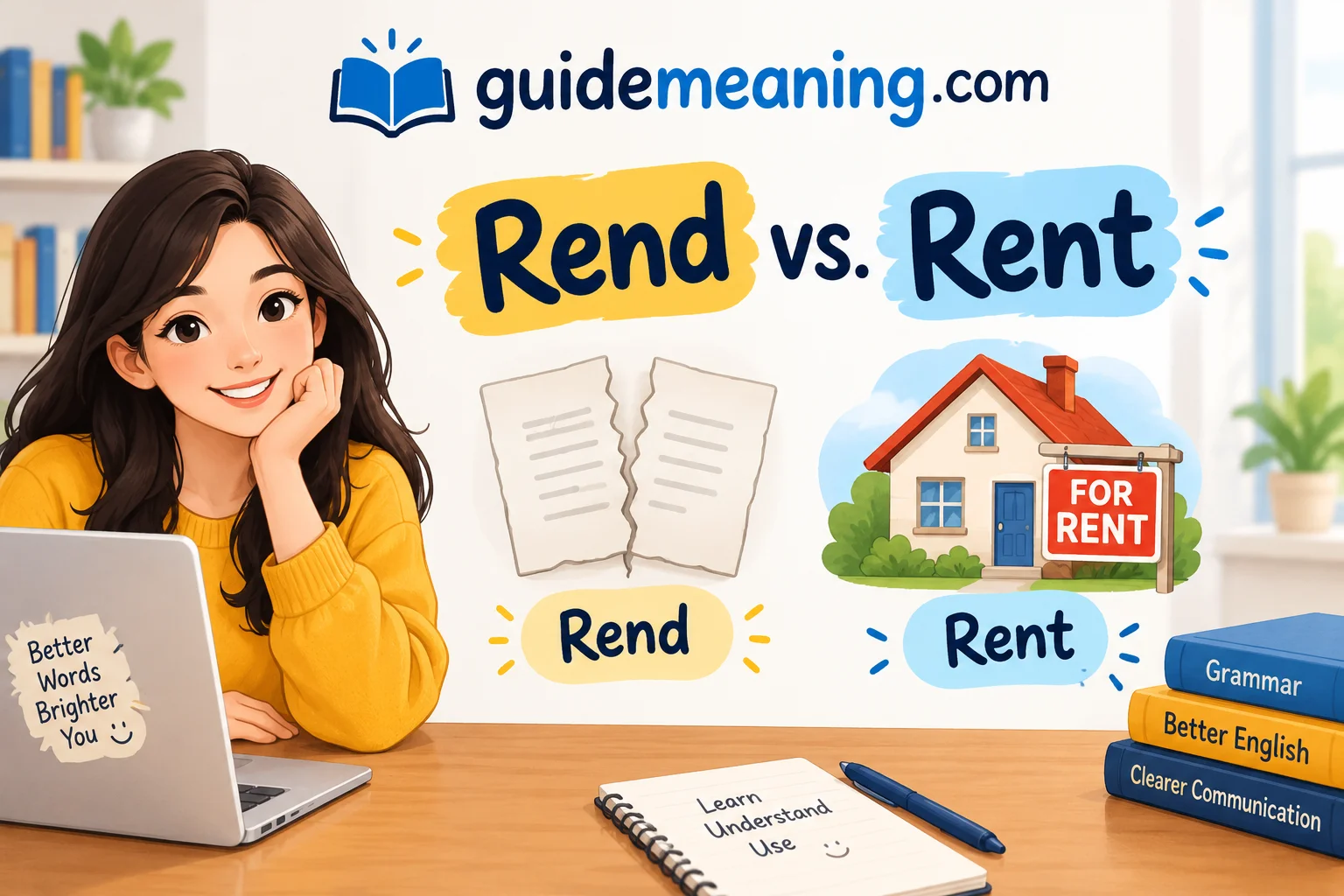

At first glance, rend and rent seem similar, yet their historical roots create an unusual overlap that makes their difference feel tricky. In Rend vs. Rent, context helps you understand why these words don’t mean the same thing. When you’re using a word incorrectly, you can change the whole message of a sentence. As a guide, I find that clear, conversational, real examples work better than memorizing isolated explanations. Simple memory tricks, tables, and case studies make the distinction easy to remember. In everyday English, rend refers to tearing something apart, while rent connects with property, money, and payment.
The word rent also has an important role in grammar because it serves as the past tense and participle form of the verb rend. At the same time, rent works as a separate word for payment involving property. Someone might sign a lease or leasing agreement, start paying, and get paid regularly over time. This dual role creates a common problem for learners because the spelling looks identical. You may wonder, hesitate, or struggle when choosing the correct form. The key concept becomes clearer when you consider the different meaning depending on the context. A careful comparison can help students make the right choice. One useful rule works well: when the sentence involves ownership, something that belongs to someone, or property-related payment, rent is generally the intended choice.
From my experience working with learners, I’ve seen this confusion many times. People may hesitate while typing, pause mid thought, and become unsure when they notice the two forms. A practical approach is to understand the meaning, meanings, and usage through practical practice. Writers, speakers, and native users can all benefit from noticing how each word behaves in a sentence. An article can provide better and clearer explanations, while useful tips can explain the distinction and differences. Keep the physical and emotional senses of rend in mind, then connect rent with its financial sense or grammatical past form. This confusing pair becomes easier to see, and that reduces a common mistake while making you more confident in writing, language, usage, and application. You can eventually remember which form fits the context every time.
Let’s dive in!
Quick Answer:
Rend means to tear, split, or break something apart forcefully. It is generally considered literary or old-fashioned in modern English.
Rent usually means the money paid to use property or something owned by another person. As a verb, it means to pay for or provide something for temporary use.
However, rent is also the past tense and past participle of rend.
| Word | Meaning | Example |
| rend | Tear or split apart violently | The force could rend the metal apart. |
| rent | Pay for temporary use | They rent an apartment downtown. |
| rent | Past tense of rend | The blast rent the wall apart. |
| rented | Past tense of modern rent | She rented a car yesterday. |
| rending | -ing form of rend | The machine was rending the material. |
| renting | -ing form of modern rent | They are renting a house. |
The easiest memory rule is:
Rend means tear. Rent usually means pay to use something.
There’s one exception worth remembering: rent can mean “tore” when it comes from the verb rend.
What Does “Rend” Mean?
Rend is a verb that means to tear or break something apart with force or violence.
The word often creates a stronger image than ordinary verbs such as tear or rip. If you say that someone rent a piece of cloth, the wording suggests forceful separation. In literary writing, rend can also describe emotional or figurative division.
For example:
- The powerful beast tried to rend the rope apart.
- The storm threatened to rend the sails.
- The tragedy seemed to rend the family apart.
- A terrible scream rent the silence.
Modern dictionaries generally mark rend as literary, dated, or old use. That doesn’t make it incorrect. It simply means you’ll encounter it much more often in literature, formal writing, historical prose, and established expressions than in ordinary conversation.
If someone casually says, “I need to rend this paper,” most speakers would probably choose tear instead. Tear is the everyday word. Rend carries a more dramatic tone.
The Core Meaning of Rend
Think of rend as a forceful version of tear apart.
| Word | General idea | Typical tone |
| tear | Pull something apart | Everyday |
| rip | Tear quickly or roughly | Everyday/informal |
| split | Divide into parts | Neutral |
| sever | Cut or separate completely | Formal |
| rend | Tear apart violently or forcefully | Literary/formal |
The difference isn’t always about the physical action itself. Rend often adds intensity.
Compare these sentences:
She tore the letter in half.
She rent the letter in two.
Both communicate separation. The second sounds considerably more literary and dramatic.
How “Rend” Is Used in Modern English
Although rend isn’t common in everyday speech, it remains useful in certain contexts.
Physical Tearing
The most direct use describes something being pulled or broken apart.
- The machine could rend thick sheets of metal.
- The animal’s claws seemed capable of rending the hide.
- The force of the collision rent the damaged structure apart.
In these examples, the object experiences a strong physical separation.
Figurative Separation
English also uses rend figuratively.
A country can be rent in two by conflict. A community can be rent apart by disagreement. A person’s heart can be rent by grief.
Here, nothing necessarily gets physically torn. The word describes a severe emotional, social, or political division.
For example:
The conflict rent the community in two.
The community isn’t literally being ripped like a sheet of paper. Instead, deep disagreement has divided it.
“Rend the Air”
One particularly recognizable literary construction is rend the air.
When a sound rends the air, it means the sound is extremely loud, sharp, or piercing.
For example:
A piercing cry rent the air.
This construction gives the sound a physical force. The cry is presented almost as if it cuts through the surrounding atmosphere.
That’s one reason rend remains useful in expressive writing. It can turn an ordinary action into a vivid image.
What Does “Rent” Mean?
Unlike rend, the everyday word rent is extremely common.
As a noun, rent usually means money paid regularly for the use of property or another item. As a verb, rent can mean to pay for temporary use or to allow someone else to use something in exchange for payment.
For example:
- Our rent is due on the first of every month.
- They rent an apartment near the university.
- We rented a car for the weekend.
- The owner rents the house to students.
This meaning has nothing to do with tearing.
Rent as a Noun
When rent functions as a noun, it refers to the payment itself.
Consider these examples:
- The rent increased this year.
- She couldn’t afford the rent.
- They pay rent every month.
- The landlord collected the rent on Friday.
You can also use related expressions such as:
- pay the rent
- monthly rent
- annual rent
- high rent
- low rent
- rent payment
- for rent
For example:
The apartment is for rent.
Here, for rent means the apartment is available for someone to use in exchange for payment.
Rent as a Verb
As a verb, rent has several closely related uses.
You can rent something from someone:
We rented a house from a local owner.
You can rent something to someone:
The owner rents the apartment to students.
You can also rent something out:
They rent out their guesthouse during the summer.
The person paying for use and the person receiving payment can therefore both be involved in the verb rent.
That distinction can matter in longer sentences, especially when the subject and object change.
Rend vs. Rent: The Main Difference
The biggest difference is meaning.
Rend concerns tearing, splitting, or violent separation. Rent usually concerns payment or temporary use.
| Feature | Rend | Rent |
| Main meaning | Tear or break apart | Pay for or provide temporary use |
| Common today? | Less common | Very common |
| Typical style | Literary or formal | Everyday |
| Part of speech | Verb | Noun and verb |
| Past tense | rent | rented |
| Past participle | rent | rented |
| -ing form | rending | renting |
| Example | The force may rend the material. | We rent the equipment. |
The most important detail appears in the tense forms.
Rend → rent → rent
but
Rent → rented → rented
Those two verb patterns belong to different meanings.
Is “Rent” the Past Tense of “Rend”?
Yes.
This is one of the most important facts in the rend vs. rent discussion.
The verb rend is irregular. Its past tense is rent, and its past participle is also rent.
The basic forms are:
| Verb form | Word |
| Base form | rend |
| Third-person singular | rends |
| Past tense | rent |
| Past participle | rent |
| Present participle | rending |
So you can write:
- The machine rends the material.
- The machine rent the material.
- The machine had rent the material.
- The machine was rending the material.
The form rented does not normally represent the past tense of rend. Rented belongs to the modern rental verb.
Why This Creates Confusion
Consider these two sentences:
They rented a house.
The explosion rent the wall.
The first sentence concerns payment and temporary use.
The second sentence uses rent as the past tense of rend. It means that the explosion tore the wall apart.
The spelling looks identical. The meanings are worlds apart.
Context does the heavy lifting.
Read More: “What It Looks Like” vs. “How It Looks”: Grammar, and Correct Usage for 2026
Rend vs. Rent Verb Forms
The easiest way to avoid mistakes is to compare the two verb systems directly.
| Meaning | Present | Past | Past Participle | -ing Form |
| Tear apart | rend | rent | rent | rending |
| Pay/provide temporary use | rent | rented | rented | renting |
This table reveals the key difference immediately.
If you’re talking about tearing, use:
rend → rent → rent → rending
If you’re talking about paying for use, use:
rent → rented → rented → renting
Examples of the Two Patterns
Tearing meaning:
- The force may rend the structure.
- The force rent the structure.
- The force had rent the structure.
- The force was rending the structure.
Rental meaning:
- They rent the apartment.
- They rented the apartment.
- They have rented the apartment.
- They are renting the apartment.
Notice the difference between rending and renting. The single letter combination can change the entire meaning of the sentence.
Rend vs. Rent Examples
Examples make this distinction much easier to see.
Examples Where “Rend” Is Correct
The creature could rend the heavy fabric with ease.
Here, rend means tear violently.
The storm threatened to rend the sail.
The sentence describes forceful physical damage.
Grief seemed to rend her heart.
This is figurative. The grief causes intense emotional pain.
The conflict threatened to rend the nation apart.
Again, the division is figurative rather than physical.
Examples Where “Rent” Means Payment
We rent an apartment near the city center.
Here, rent means pay to use a home.
She rented a car for three days.
The sentence describes temporary use in exchange for payment.
They rent office space to small businesses.
Here, the owner provides the space in exchange for payment.
The family has rented the house for five years.
This is the modern rental meaning. The correct participle is rented, not rent.
Examples Where “Rent” Means “Tore”
Now consider the less familiar use:
The explosion rent the wall apart.
Here, rent means tore.
The scream rent the silence.
The scream violently interrupted the silence.
The war rent the country in two.
The sentence uses rent figuratively to describe severe division.
The fabric was rent by the sudden force.
This construction uses rent as the past participle of rend.
A Simple Rend vs. Rent Comparison
The context usually tells you which meaning you’re dealing with.
| Sentence | Meaning of “rent” |
| I pay rent every month. | Payment |
| We rent a car. | Pay to use |
| She rented an apartment. | Paid to use |
| The storm rent the sail. | Tore apart |
| The blast rent the wall. | Tore apart |
| The conflict rent the country in two. | Divided severely |
Notice something important: the word itself doesn’t always tell you its meaning.
The surrounding words do.
If you see apartment, landlord, payment, monthly, car, or lease, the rental meaning is probably intended.
If you see tear, apart, silence, heart, war, storm, or in two, the literary rend/rent meaning may be intended.
Rend vs. Rent in Modern English
Frequency matters when choosing a word.
Rent belongs to ordinary modern vocabulary. People use it every day when discussing homes, apartments, cars, equipment, and payments.
Rend, on the other hand, has a much narrower stylistic range. Dictionaries identify its tearing sense as literary, dated, or old-fashioned.
That doesn’t mean you should avoid it completely. In the right context, rend can be more precise or expressive than tear.
For example:
The argument tore the family apart.
This sounds natural and conversational.
The argument rent the family apart.
This sounds more dramatic and literary.
Neither sentence has to be wrong. The better choice depends on the tone you want.
When to Use “Tear” Instead of “Rend”
For everyday writing, tear will usually sound more natural.
Use tear when you’re describing ordinary actions:
- tearing paper
- tearing a shirt
- tearing a page
- tearing a photograph
- tearing a package open
Use rend when the context calls for stronger or more literary language.
That’s an important writing lesson: a word can be grammatically correct yet stylistically unusual.
Rend vs. Rent: Common Mistakes
Mistake: Treating “Rend” and “Rent” as Synonyms
They aren’t interchangeable.
You wouldn’t normally write:
I rend an apartment.
If you mean that you pay to live in an apartment, use rent:
I rent an apartment.
Likewise, if you mean something was violently torn apart, rend may be the appropriate base form.
Mistake: Assuming Every “Rent” Means Payment
This mistake can cause confusion when reading older or literary texts.
Consider:
The thunderous sound rent the air.
Nobody is paying for anything. Here, rent means tore or broke through violently.
The sentence uses the past tense of rend.
Mistake: Using “Rented” as the Past of “Rend”
This is another common trap.
The correct forms are:
- rend → rent
- rent → rented
So:
The force rent the barrier.
not:
The force rented the barrier.
The second sentence would normally suggest a completely different meaning.
Mistake: Confusing “Rending” and “Renting”
These words look similar, but they come from different meanings.
Rending means tearing.
The rending sound echoed through the building.
Renting means paying for or providing temporary use.
They are renting the building.
One letter changes the form because the underlying verbs are different.
Rend vs. Rent: A Practical Case Study
Imagine you’re editing a historical novel.
The manuscript contains this sentence:
The cannonball rent the wooden gate.
At first glance, rent might look like a mistake. Perhaps the writer intended rented. But that would change the meaning completely.
The intended meaning is that the cannonball tore the gate apart.
Therefore:
rent = past tense of rend = tore
Now consider another sentence:
The soldiers rented horses before leaving the village.
Here, rented has the ordinary modern meaning. The soldiers paid to use the horses.
What the Context Tells You
| Sentence | Correct interpretation |
| The cannonball rent the gate. | The cannonball tore the gate. |
| The soldiers rented horses. | The soldiers paid to use horses. |
| The storm rent the sails. | The storm tore the sails. |
| The travelers rented a boat. | The travelers paid to use a boat. |
The spelling may look confusing at first. The surrounding context usually removes the ambiguity.
Rend vs. Rent Memory Trick
A simple memory trick can make this distinction stick.
Think “Rend = Rip”
Both rend and rip describe forceful separation.
Rend = rip apart
Then associate rent with the familiar rental meaning:
Rent = pay to use
Finally, remember the irregular past tense:
Rend → rent = tear → tore
So the complete memory pattern becomes:
Rend = tear
Rent = pay to use
Rent = tore, when it is the past tense of rend
This three-part rule handles nearly every situation you’ll encounter.
Rend vs. Rent Synonyms
Understanding related words can sharpen the distinction.
Synonyms for Rend
Depending on the context, possible alternatives include:
- tear
- rip
- split
- sever
- sunder
- break apart
- shred
These words aren’t perfect substitutes in every sentence. Rend often carries a stronger or more literary sense of forceful separation.
Words Related to Rent
For the rental meaning, useful related words include:
- lease
- rental
- tenant
- landlord
- hire
- rent out
- rental property
- rent payment
For example:
The tenant pays rent to the landlord.
The relationship is completely different from:
The explosion rent the metal apart.
The first sentence belongs to the world of property and payment. The second belongs to the world of destruction and separation.
Rend vs. Rent: Quick Grammar Guide
When you’re unsure which form to choose, ask yourself what the sentence actually means.
If You Mean “Tear Apart”
Use:
- rend for the present form
- rent for the past
- rent for the past participle
- rending for the -ing form
Examples:
- The force may rend the material.
- The force rent the material.
- The material had been rent apart.
- The machine was rending the material.
If You Mean “Pay to Use”
Use:
- rent for the present
- rented for the past
- rented for the past participle
- renting for the -ing form
Examples:
- We rent a house.
- We rented a house.
- We have rented a house.
- We are renting a house.
That distinction is the heart of the entire rend vs. rent question.
FAQs:
What is the difference between rend and rent?
Rend means to tear, split, or pull something apart forcefully. Rent usually means payment for using property. However, rent is also the past tense and past participle of rend.
Is rend a verb?
Yes. Rend is a verb that means to tear something apart. For example, “The storm may rend the fabric.”
Is rent the past tense of rend?
Yes. Rent can be the past tense and past participle of rend. For example, “The cloth was rent in two.”
Does rent always refer to money?
No. Rent can refer to money paid for property, but it can also function as a form of the verb rend. The context tells you which meaning applies.
How can I remember rend vs. rent?
Connect rend with the action of tearing something apart. Then remember that rent can describe that same action in the past. When rent relates to property or payment, it has its separate everyday meaning.
Can rend be used figuratively?
Yes. Rend can describe emotional or dramatic actions in literature. For example, writers may use it to describe a heart being torn by grief.
Why do learners confuse rend and rent?
The words have similar spelling, and rent has two grammatical roles. It can refer to property payment or act as the past form of rend. That overlap often causes confusion.
Conclusion:
Rend and rent look similar, but their meanings depend heavily on context. Rend generally describes tearing or splitting something apart, while rent commonly refers to money paid for property. Remember that rent can also be the past tense and past participle of rend. Once you notice the surrounding words and the intended meaning, choosing the correct form becomes much easier.




1 thought on “Rend vs. Rent: What’s the Difference? 2026”