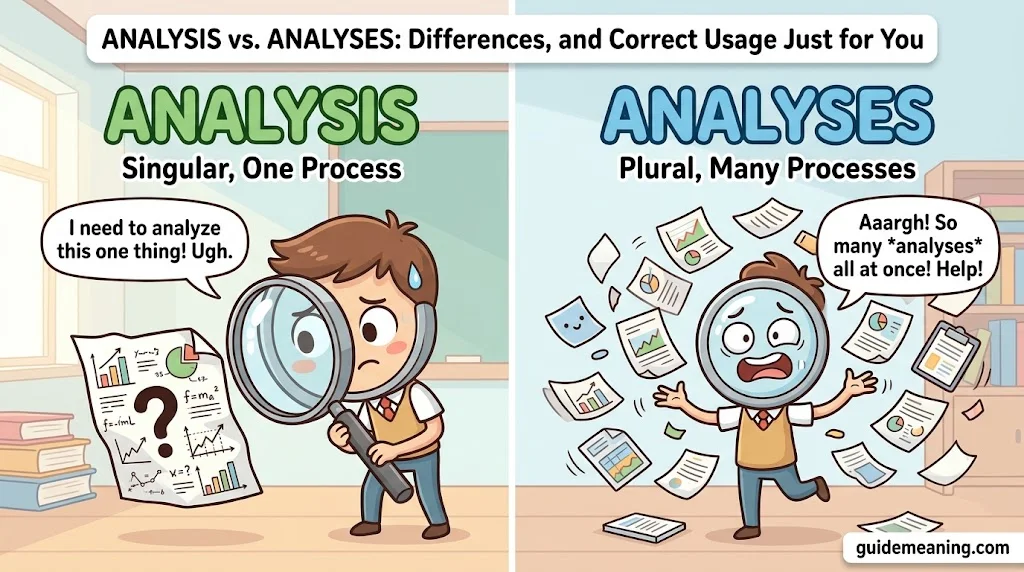

Analysis vs. Analyses can help you understand which form fits your sentence when these words confuse millions of learners. Although analysis and analyses look similar, they aren’t interchangeable. The easiest way to remove the guesswork is to understand the grammatical job of each form. Analysis is singular, while analyses is plural. In academic, professional, and everyday contexts, analysis means one study, examination, or detailed review. Analyses means more than one such breakdowns. This difference helps you use each form confidently in essays, reports, research papers, business writing, and everyday communication.
The plural form creates confusion because English borrows these terms from Greek, where plurals don’t follow normal English rules. The English pattern isn’t analysises, which is incorrect. A helpful rule and memory trick is to connect analysis with a single process and analyses with multiple reviews. The same root word has different purposes, so your sentence construction should show what you mean. When you analyze an object, person, or field of study, your analysis can discover, explain, quantify, or reveal something. When researchers analyze separate topics, their analyses can produce different outcomes.
Pronunciation can keep you aware of the difference, too. Analysis has a different final syllable from analyses, giving you a useful pronunciation cue during real academic usage when reading aloud. Analyze is used in the US, while analyse is preferred outside the US, especially in British English. In British usage, analyses may also work as a verb. Understanding the word origin, ise spelling, American usage, and British usage makes the pattern easier to recognize. You can break something down to understand it, inspect it closely, and know exactly when to use each form without second-guessing yourself.
Let’s dive in!
Quick Answer:
Analysis is singular. Analyses is plural.
- Analysis = one detailed examination, interpretation, or evaluation.
- Analyses = two or more detailed examinations, interpretations, or evaluations.
For example:
- The analysis of the survey was thorough.
- The analyses of the survey results revealed several patterns.
The key difference is simply one versus more than one.
| Word | Number | Meaning | Example |
| Analysis | Singular | One examination or evaluation | The analysis was useful. |
| Analyses | Plural | Multiple examinations or evaluations | The analyses were useful. |
Cambridge Dictionary lists analysis as a noun meaning the process of examining something in detail and gives analyses as its plural form.
One important point often causes confusion: analyses isn’t pronounced like “analysis” with an extra syllable. The ending changes in both spelling and sound.
What Does “Analysis” Mean?
Analysis means a detailed examination of something to understand it better.
You might analyze data, a problem, a financial report, a scientific sample, a literary work, or a political situation. In each case, the goal involves looking closely at information and drawing conclusions from it.
Cambridge defines analysis as the act of studying or examining something in detail to discover or understand more about it. It can also refer to the opinion or judgment formed after that examination.
For example:
The analysis of the sales data revealed a sharp increase in online purchases.
Here, analysis refers to one examination of the sales data.
The word can also describe a scientific examination:
The chemical analysis revealed a high concentration of copper.
It can even refer to an interpretation:
Her analysis of the novel focused on its treatment of identity.
So, analysis has a broad range of uses. What connects them is the idea of examining something carefully to gain understanding.
Analysis as a Singular Noun
When you use analysis as a countable singular noun, it normally refers to one particular examination or interpretation.
Common phrases include:
- an analysis
- the analysis
- this analysis
- one analysis
- a detailed analysis
- a statistical analysis
- a financial analysis
- a literary analysis
- a chemical analysis
Consider these examples:
- The researcher completed an analysis of the results.
- This analysis supports the original hypothesis.
- The financial analysis identified several risks.
- Her analysis of the poem was persuasive.
- We need a more detailed analysis before making a decision.
Notice the word an in “an analysis.” That’s an easy clue that the noun is singular.
You can also use analysis as an uncountable noun when discussing the activity or process generally:
The issue requires careful analysis.
Here, the sentence doesn’t necessarily identify one separate, countable analysis. It refers to the process of examining the issue carefully.
What Does “Analyses” Mean?
Analyses is the plural form of analysis.
It refers to multiple examinations, interpretations, or evaluations.
For example:
The researchers compared several analyses of the same dataset.
The sentence discusses more than one analysis. Therefore, analyses is required.
Another example:
The three analyses produced similar results.
The word three immediately tells you that the noun must be plural.
Cambridge specifically identifies analyses as the plural of analysis and provides examples from academic and research contexts.
Analyses as a Plural Noun
You can use analyses when you’re talking about multiple separate examinations.
Common phrases include:
- several analyses
- multiple analyses
- different analyses
- two analyses
- three analyses
- the analyses
- these analyses
- various analyses
- further analyses
For example:
- The researchers conducted several analyses.
- These analyses produced different results.
- The report compares three separate analyses.
- Further analyses may reveal additional patterns.
- The scientists reviewed multiple analyses before reaching a conclusion.
The Cambridge English Corpus includes examples where researchers refer to multiple analyses performed separately or under different conditions.
Analysis vs. Analyses: Key Differences
The easiest way to understand analysis vs. analyses is to treat them like other singular and plural pairs.
Think:
one analysis → several analyses
The spelling changes from -sis to -ses, and the pronunciation changes as well.
| Feature | Analysis | Analyses |
| Number | Singular | Plural |
| Refers to | One examination | Multiple examinations |
| Spelling | analysis | analyses |
| Pronunciation | /əˈnæl.ə.sɪs/ | /əˈnæl.ə.siːz/ |
| Example | One analysis was completed. | Several analyses were completed. |
| Determiner | an analysis | several analyses |
| Verb | analysis is | analyses are |
Cambridge gives the US pronunciations as /əˈnæl.ə.sɪs/ for analysis and /əˈnæl.ə.siːz/ for analyses.
The practical rule is wonderfully simple:
One = analysis. More than one = analyses.
That’s the rule worth remembering.
Analysis vs. Analyses Examples
Seeing the two words side by side makes the difference much easier to recognize.
Examples With “Analysis”
Use analysis when you’re referring to one examination.
- The analysis was completed yesterday.
- Her analysis of the problem was accurate.
- The company requested an analysis of its expenses.
- This analysis explains the unexpected results.
- The financial analysis identified several weaknesses.
- A detailed analysis is necessary before approval.
- The analysis of the survey took several hours.
Each sentence describes one particular analysis.
Examples With “Analyses”
Use analyses when you mean multiple examinations.
- The analyses were completed by different researchers.
- Several analyses produced similar conclusions.
- The researchers compared two analyses of the same dataset.
- These analyses reveal important differences.
- The report includes three separate analyses.
- Further analyses are required before publication.
- The scientists reviewed previous analyses of the samples.
Here, words such as several, two, three, these, and previous help signal plurality.
Side-by-Side Examples
| Singular | Plural |
| The analysis is complete. | The analyses are complete. |
| I reviewed one analysis. | I reviewed three analyses. |
| Her analysis was detailed. | Her analyses were detailed. |
| This analysis supports the claim. | These analyses support the claim. |
| The analysis produced a result. | The analyses produced several results. |
Notice another important pattern.
With singular analysis, use singular verbs when the noun acts as the subject:
The analysis is convincing.
With plural analyses, use plural verbs:
The analyses are convincing.
That’s ordinary subject-verb agreement. The unusual spelling doesn’t change that basic grammar rule.
Analysis and Analyses in Different Contexts
The singular-plural distinction works the same way across different fields. The subject changes, but the grammar doesn’t.
Academic Writing
Academic writers frequently use both analysis and analyses.
Suppose a student examines one novel:
Her analysis of the novel focuses on social class.
That’s one interpretation.
Now imagine a paper comparing several interpretations:
The study examines competing analyses of the novel.
That’s multiple interpretations.
Academic writing often uses analyses because researchers may examine the same question through different methods, variables, samples, or theoretical approaches.
For example:
The researchers conducted separate analyses for each age group.
The word separate makes the plurality clear.
Data and Statistics
Data analysis provides another useful example.
A researcher might perform one statistical examination:
The analysis showed a strong relationship between the variables.
However, the same researcher might perform several statistical tests:
Additional analyses showed that the relationship remained significant across different groups.
In research writing, analyses can refer to distinct statistical procedures or examinations. It doesn’t necessarily mean the researchers examined completely unrelated subjects.
For example, one dataset could produce several analyses:
- Analysis of age differences
- Analysis of income differences
- Analysis of regional differences
- Analysis of customer behavior
Those are multiple analytical examinations of related information.
Business and Finance
Businesses use analysis constantly.
A company might conduct:
a market analysis
That’s one examination of a market.
It might also conduct:
several analyses of customer behavior, pricing, and competitors.
Now the plural form makes sense.
For example:
The company’s financial analysis revealed rising operating costs.
But:
Its analyses of pricing, demand, and customer retention produced different findings.
The number of examinations determines the noun form.
Literature and Textual Analysis
Literary criticism often relies on analysis.
For one interpretation:
The essay provides a detailed analysis of the poem.
For multiple interpretations:
The book compares several analyses of the poem.
You could also discuss several critics:
The researchers examined different analyses offered by contemporary critics.
Again, the distinction has nothing to do with how complicated the examination is. It concerns how many analyses exist.
Scientific Writing
Science provides some of the clearest examples.
A laboratory might perform one chemical examination:
The chemical analysis confirmed the presence of copper.
A research team might perform several examinations:
Additional analyses confirmed the initial findings.
The plural form becomes especially common when researchers repeat tests, examine different samples, or use multiple analytical methods.
How to Pronounce “Analysis” and “Analyses”
The spelling difference becomes much easier once you hear the pronunciation difference.
Analysis is pronounced:
/əˈnæl.ə.sɪs/
Analyses is pronounced:
/əˈnæl.ə.siːz/
Cambridge lists these pronunciations for both British and American English, with minor notation differences depending on the dictionary’s presentation.
The final sound changes noticeably:
- analysis ends with a “sis” sound.
- analyses ends with a “seez” sound.
So you might hear:
analysis → uh-NAL-uh-sis
analyses → uh-NAL-uh-seez
The stress stays near the beginning, while the ending changes.
That’s useful because pronunciation can help you remember which form you’re looking at.
Why Is the Plural of “Analysis” “Analyses”?
English usually forms plurals by adding -s or -es.
For example:
- book → books
- class → classes
- report → reports
Naturally, you might expect:
analysis → analysises
But English doesn’t work that way here.
Analysis comes from Greek through later forms of the language, and it belongs to a group of words whose plural forms preserve an older -is → -es pattern. Dictionary.com traces the word to Greek through New Latin and explains its historical formation.
That’s why we get:
- analysis → analyses
- thesis → theses
- hypothesis → hypotheses
- crisis → crises
- axis → axes
Scribbr also identifies analyses as an irregular plural and explains that English retains this Greek-derived plural pattern.
Why “Analysises” Is Incorrect
A common mistake involves adding a regular plural ending to the entire word:
❌ analysises
✔ analyses
The incorrect version feels logical because English often forms plurals by adding -s or -es. However, analysis belongs to a group of irregular nouns that change their endings instead.
Think of it as a transformation rather than an addition:
analysis → analyses
The ending doesn’t simply receive another letter. The -is changes to -es.
Common Mistakes With Analysis and Analyses
The distinction looks simple, yet several errors appear frequently.
Using “Analyses” for One Analysis
Consider:
❌ The analyses was completed yesterday.
This sentence uses the plural noun with a singular verb.
The correct version is:
✔ The analysis was completed yesterday.
If you’re discussing one examination, use analysis.
Treating “Analysis” as the Plural
Another common mistake looks like this:
❌ The researchers conducted three analysis.
The number three tells you that the noun must be plural.
Correct:
✔ The researchers conducted three analyses.
The same pattern applies to other quantities:
- two analyses
- several analyses
- many analyses
- multiple analyses
- numerous analyses
Using the Wrong Verb
The singular and plural forms require matching verbs.
Incorrect:
❌ The analyses is complete.
Correct:
✔ The analyses are complete.
Likewise:
✔ The analysis is complete.
A useful shortcut is:
analysis → is
analyses → are
This isn’t an absolute rule for every sentence because verbs depend on the larger grammatical structure. However, it works perfectly when the noun acts as the subject.
Writing “Analysises”
This is simply not the standard plural form.
❌ analysises
✔ analyses
The correct plural changes the ending instead of adding another plural suffix.
Analysis vs. Analyses in a Sentence
Both forms can appear in several grammatical positions.
As the Subject
Analysis:
The analysis revealed a major error.
Analyses:
The analyses revealed several major errors.
The noun controls the number of the sentence’s subject.
As the Object
Analysis:
The manager requested an analysis of the report.
Analyses:
The manager requested several analyses of the report.
The same singular-plural distinction remains intact.
After a Preposition
You can also use either word after prepositions:
The team discussed the analysis during the meeting.
The team discussed the analyses during the meeting.
The preposition doesn’t change the noun’s number.
With Possessives
You may also see constructions such as:
The analyst’s analysis was detailed.
For multiple analyses:
The analysts’ analyses covered different areas.
Here, both the possessive noun and the main noun can change depending on number.
Analysis vs. Analyses vs. Analyze
Another source of confusion is the verb analyze.
These words belong to the same word family, but they perform different grammatical jobs.
| Word | Part of Speech | Function | Example |
| Analysis | Noun | One examination | The analysis was useful. |
| Analyses | Noun | Multiple examinations | The analyses were useful. |
| Analyze | Verb | Examine something | Researchers analyze the data. |
| Analyzed | Verb | Examined something | Researchers analyzed the data. |
| Analyzing | Verb | Examining something | They are analyzing the data. |
| Analytical | Adjective | Related to analysis | She has strong analytical skills. |
In US English, the verb is spelled analyze.
For example:
Researchers analyze customer behavior.
Don’t confuse that verb with analyses, which functions as the plural noun.
There’s an especially interesting spelling issue here. In US English:
- he analyzes
- the analyses
The words look similar, but they aren’t interchangeable.
For example:
She analyzes the data carefully.
Here, analyzes is a verb.
The analyses were carefully documented.
Here, analyses is a plural noun.
Scribbr specifically notes this US English distinction between the plural noun analyses and the third-person singular verb analyzes.
Related Word Forms
Understanding the whole word family can make these forms easier to remember.
Analysis
A singular noun:
The analysis was thorough.
Analyses
A plural noun:
The analyses were thorough.
Analyze
The base verb:
Researchers analyze the results.
Analyzed
The past tense or past participle:
Researchers analyzed the results.
Analyzing
The present participle:
Researchers are analyzing the results.
Analytical
An adjective describing something connected with analysis:
The report demonstrates strong analytical thinking.
These forms share the same basic idea: examining something closely to understand it.
Analysis vs. Analyses: A Practical Case Study
Imagine a marketing team studying a company’s declining sales.
First, the team examines overall sales performance.
The analysis of annual sales revealed a decline.
That’s one analysis.
Next, the team examines three separate areas:
- Customer demographics
- Regional performance
- Product categories
The report might say:
The analyses of customer demographics, regional performance, and product categories revealed different causes of the decline.
Now analyses is correct because the team performed multiple examinations.
The distinction doesn’t depend on the size of the report. A 20-page report can contain one analysis, while a two-page report could contain several analyses.
That’s an important point.
Length doesn’t determine the noun. Number does.
A Simple Way to Remember Analysis vs. Analyses
When you’re unsure, ask yourself one question:
How many examinations am I talking about?
If the answer is one, use:
analysis
If the answer is two or more, use:
analyses
You can turn that into a quick mental formula:
1 → analysis
2+ → analyses
For example:
- one analysis
- two analyses
- five analyses
- several analyses
- multiple analyses
Never write:
- ❌ two analysis
- ❌ several analysis
- ❌ three analysises
Instead, use:
- ✔ two analyses
- ✔ several analyses
- ✔ three analyses
Quick Comparison: Analysis vs. Analyses
| If You Mean… | Use… | Example |
| One examination | analysis | The analysis is complete. |
| More than one examination | analyses | The analyses are complete. |
| One detailed evaluation | analysis | We need an analysis of the costs. |
| Multiple evaluations | analyses | We compared several analyses. |
| The act of examining | analyze | Researchers analyze the data. |
| Past examination | analyzed | Researchers analyzed the data. |
| Related to careful examination | analytical | She has analytical skills. |
This table captures the central distinction without requiring a complicated grammar rule.
FAQs:
What is the difference between analysis and analyses?
Analysis is the singular form, while analyses is the plural form. Use analysis for one examination or detailed review and analyses for two or more.
Is analyses the plural of analysis?
Yes. Analyses is the correct plural of analysis. The plural isn’t analysises, which is incorrect.
Should I say analysis or analyses?
It depends on the number. Say analysis when discussing one study, review, or examination. Use analyses when referring to multiple studies or reviews.
Is analysis singular or plural?
Analysis is singular. For example, “The analysis shows a clear trend.” Its plural form is analyses.
Is analyses a verb or a noun?
Analyses can be a noun or a verb, depending on the sentence. As a noun, it means multiple examinations. In British English, analyses can also function as a verb meaning “examines” or “studies.”
How do you pronounce analysis and analyses?
Analysis is commonly pronounced with an ending like “uh-sis,” while analyses ends like “uh-seez.” The different final sounds can help you tell them apart when speaking.
Is analyse the American spelling?
No. Analyze is the standard American spelling. Analyse is commonly preferred in British English and some other varieties of English.
Conclusion
Understanding analysis vs. analyses is easier once you remember one simple rule: analysis is singular, while analyses is plural. Use analysis for one study, examination, or detailed review. Use analyses when you’re talking about multiple studies or reviews. Also remember that analysises is incorrect. Once you understand the number, pronunciation, spelling differences, and sentence context, choosing the right form becomes much more natural.