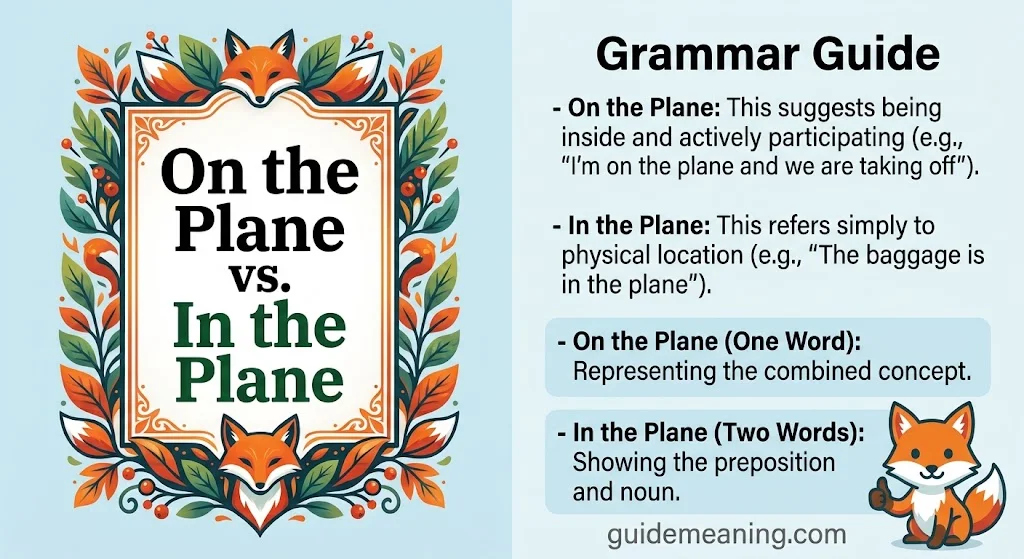

For learners, writers, and advanced English speakers, On the Plane or In the Plane can be a confusing phrase choice when selecting the right prepositions. For an airplane or plane, on the plane is the usual choice because English treats it as general transport. Although passengers are physically inside and inside an airplane, this idiomatic pattern isn’t always logical. Native speakers follow this real usage naturally. From my experience teaching English grammar, I find that this pattern-based rule helps learners sound more confident, fluent, and accurate. A simple grammar guide shows that on often means aboard transport while in can describe a particular location, space, or enclosure. This distinction helps you determine the correct and appropriate phrase without stopped mid-sentence, wondering, or hesitating about what to say.
In the plane isn’t always wrong because the specific context can change the meaning. It can describe being physically within the aircraft, especially when focusing on a smaller enclosure or a particular part of it. These aviation-specific exceptions show why context, spatial understanding, and movement context matter. The exact difference becomes easier to understand through examples, historical insights, historical usage, usage patterns, and grammar structures. In travel, aviation, everyday speech, and formal writing, on the plane remains the more natural choice in most situations. However, by plane refers to the method of travel rather than a passenger’s location of something. Knowing this distinction improves clarity, accuracy, communication, reader comprehension, and sentence structure while reducing Common ESL mistakes.
A practical cheat sheet can help you use each phrase correctly and keep your English natural. Whether you’re writing an email, discussing travel, or working in aviation, regular practice with context clues strengthens your writing and speaking skills. This understanding supports English language learning, professional English skills, and real communication. It also helps you interpret meaning, understand the prepositional phrase, improve communication precision, and choose a correct phrase that sounds natural. The standard usage rules generally favor on the plane for ordinary transport, while in the plane has a more limited role based on specific context. Once you understand the phrase choice, you can use anywhere the right form with greater clarity.
Quick Answer:
“On the Plane” or “In the Plane” can both be correct, but “on the plane” is the normal choice for passengers and travel. Use “in the plane” when emphasizing something physically inside the aircraft.
TL;DR:
- “On the plane” is the usual choice for passengers traveling.
- “In the plane” emphasizes the aircraft’s interior.
- “On a plane” means an unspecified aircraft.
- “On the plane” usually means a specific aircraft.
- “By plane” describes the method of transportation.
- “Aboard the plane” is a more formal alternative to “on the plane.”
What Does “On the Plane” Mean?
The phrase on the plane normally means that someone is aboard an aircraft. In American English, it’s the natural expression for ordinary travel situations.
The Everyday Meaning
When someone says, “I’m on the plane,” they usually mean they’ve boarded and are traveling.
For example:
- “I’m on the plane now.”
- “She’s on the plane to Chicago.”
- “We met on the plane.”
- “He fell asleep on the plane.”
Here, the focus isn’t the physical walls surrounding the passenger. Instead, the aircraft is viewed as a means of transportation.
Why “On” Sounds Natural
English commonly uses on with transportation such as planes, buses, trains, and ships.
You can say:
- “I’m on the bus.”
- “She’s on the train.”
- “They’re on the ferry.”
- “He’s on the plane.”
The same pattern helps explain why “I’m on the plane” sounds natural to American English speakers.
What Does “In the Plane” Mean?
In the plane focuses more directly on physical location inside the aircraft. It’s correct, but it usually has a narrower purpose.
Focusing on the Interior
Use in the plane when the aircraft is being treated as an enclosed space.
For example:
- “The air in the plane was very dry.”
- “There was smoke in the plane.”
- “The equipment in the plane was damaged.”
- “The temperature in the plane was unusually high.”
These sentences focus on something existing within the aircraft.
When “In” Becomes More Natural
“In” can also work when you contrast the inside with the outside.
For example:
“The passengers were in the plane while their families waited outside.”
The contrast makes in sound completely natural.
The important point is that “in” isn’t grammatically forbidden. It simply creates a different emphasis.
“On the Plane” vs. “In the Plane”: The Main Difference
The easiest way to understand the distinction is to think about travel versus interior space.
A Simple Rule
Use on when you’re talking about being aboard or traveling.
Use in when you’re describing something inside the aircraft.
| Expression | Main Focus | Example |
| On the plane | Being aboard or traveling | “I’m on the plane now.” |
| In the plane | Physical interior | “The lights in the plane are bright.” |
| By plane | Method of travel | “We traveled by plane.” |
| Aboard the plane | Being aboard, formal tone | “All passengers were aboard the plane.” |
This distinction isn’t about whether passengers are literally inside. They obviously are.
Instead, English uses established patterns for transportation. That’s why physical logic alone doesn’t always predict the correct preposition.
Why Do We Say “On the Plane” Instead of “In the Plane”?
This question causes confusion because on can seem to suggest a surface. However, prepositions have many meanings beyond physical position.
“On” Can Describe Transportation
English uses on to describe traveling aboard several types of transportation.
For example:
- “on the bus”
- “on the train”
- “on the subway”
- “on the ferry”
- “on the ship”
- “on the plane”
The meaning is closer to aboard than “on top of.”
Therefore, “I’m on the plane” doesn’t mean you’re sitting on the airplane’s roof.
It means you’re aboard the aircraft.
English Prepositions Aren’t Always Literal
Consider the difference between these expressions:
“I’m on the train.”
“I’m in the car.”
Both speakers are physically inside their vehicles. Yet English traditionally uses different prepositions.
That’s because language follows established usage as well as physical meaning.
When Should You Use “On the Plane”?
For everyday American English, on the plane should usually be your first choice when discussing air travel.
Talking About Passengers
Use it when describing where passengers are.
Examples include:
- “Are you on the plane yet?”
- “My parents are on the plane.”
- “Everyone is already on the plane.”
- “There were 150 people on the plane.”
These sentences describe passengers as occupants of transportation.
Talking About Activities During Travel
It’s also natural when describing things you do during a flight.
For example:
- “I watched a movie on the plane.”
- “She read a book on the plane.”
- “We ate dinner on the plane.”
- “He worked on the plane.”
Here, on the plane identifies the setting for the travel experience.
Talking About Lost Items
This expression is especially common when discussing belongings left behind.
For example:
“I think I left my headphones on the plane.”
That sentence sounds completely natural because the headphones were left aboard the aircraft.
When Should You Use “In the Plane”?
Use in the plane when you want to emphasize the aircraft’s interior or something located inside it.
Describing Conditions
“In” works especially well for conditions within the aircraft.
For example:
“The air in the plane felt unusually warm.”
The focus is on the air inside the aircraft.
Likewise:
“The lighting in the plane was very dim.”
The sentence describes the interior environment.
Describing Objects Inside
You can also use in for physical objects.
For example:
“There’s medical equipment in the plane.”
“The bags are still in the plane.”
“A small device was found in the plane.”
In these examples, the speaker is locating something inside the aircraft.
Emphasizing Inside Versus Outside
“In” becomes particularly useful when the outside location matters.
For example:
“The crew was in the plane while technicians worked outside.”
The inside-versus-outside contrast makes in the natural choice.
“On a Plane” vs. “On the Plane”
The difference between a and the creates another important distinction.
“On a Plane”
Use on a plane when you mean an unspecified aircraft.
For example:
“I met an interesting person on a plane.”
The listener doesn’t know which aircraft you mean.
Another example is:
“She once lost her passport on a plane.”
The particular plane isn’t identified.
“On the Plane”
Use on the plane when the aircraft is specific or already understood.
For example:
“I’m on the plane we booked yesterday.”
The listener knows which plane or flight you mean.
Compare these:
“I met him on a plane.”
This refers to an unspecified aircraft.
“I met him on the plane.”
This suggests a specific aircraft already known from context.
Read More: Drove vs Driven: The Simple Difference Explained for 2026
“In a Plane” vs. “In the Plane”
The same article rule applies to in a plane and in the plane.
Unspecified Aircraft
Use in a plane when the aircraft isn’t specific.
For example:
“I once experienced severe turbulence in a plane.”
You’re talking about an aircraft in general.
Specific Aircraft
Use in the plane when both speakers can identify the aircraft.
For example:
“There was a problem in the plane we inspected.”
The phrase refers to a particular aircraft.
Therefore, remember that two separate grammar choices are involved:
- On vs. in changes the relationship to the aircraft.
- A vs. the changes whether the aircraft is specific.
Keeping these issues separate makes the grammar much easier.
“On the Plane” vs. “By Plane”
These phrases may look similar, but they answer different questions.
“On the Plane” Describes Location
If someone asks:
“Where are you?”
You can answer:
“I’m on the plane.”
The phrase tells us where you are.
“By Plane” Describes Transportation
If someone asks:
“How did you get there?”
You can answer:
“I traveled by plane.”
Here, by plane describes the method of transportation.
You can also say:
“We flew there by plane.”
However, “We traveled on the plane” focuses more on the aircraft you used.
“On the Plane” vs. “Aboard the Plane”
Aboard the plane has almost the same basic meaning as on the plane.
Everyday American English
In casual conversation, on the plane is usually more natural.
For example:
“I’m on the plane. I’ll call you after we land.”
That sounds relaxed and conversational.
A More Formal Alternative
Aboard the plane can sound more formal or official.
For example:
“All passengers must be aboard the plane before departure.”
You may see this wording in announcements, reports, or formal descriptions.
Both expressions communicate the idea of being aboard the aircraft.
How “On the Plane” Fits Other Transportation Phrases
Looking at other vehicles makes the pattern easier to remember. American English uses different prepositions depending on the type and conventional treatment of transportation.
Common Transportation Patterns
Here are some useful examples:
- “on the plane”
- “on the bus”
- “on the train”
- “on the subway”
- “on the ferry”
- “on the ship”
- “in the car”
- “in the taxi”
Notice that the rule isn’t simply about whether a vehicle has walls.
Instead, English has conventional expressions that speakers learn through regular use.
Getting On and Getting In
The same pattern appears with verbs.
You normally say:
“We got on the plane.”
You also say:
“We got on the train.”
But with a car, you usually say:
“We got in the car.”
This is one reason learners often find transportation prepositions frustrating. English follows patterns that aren’t always perfectly logical.
Common Mistakes With “On” and “In”
Many mistakes happen because learners apply the literal meanings of prepositions too strictly.
Mistake: “I’m in the plane” for Normal Travel
“I’m in the plane” isn’t necessarily grammatically wrong.
However, if you’re simply telling a friend that you’ve boarded your flight, “I’m on the plane” sounds more natural.
Mistake: Assuming “In the Plane” Is Always Wrong
That’s also incorrect.
Consider:
“The temperature in the plane was uncomfortable.”
Here, in is completely natural.
Therefore, don’t treat “in the plane” as an error. Consider the context first.
Mistake: Confusing “By Plane” and “On the Plane”
These expressions don’t mean the same thing.
“We traveled by plane.”
This describes how you traveled.
“We spent six hours on the plane.”
This describes where you spent the time.
How Context Changes the Meaning
Small changes in context can make either preposition sound appropriate.
Passenger Context
“Where’s Daniel?”
“He’s on the plane.”
This is the normal travel expression.
Interior Context
“Where is the technician?”
“He’s in the plane.”
Here, the physical location may be more important than the travel experience.
Environmental Context
“The air in the plane was dry.”
The speaker is describing the aircraft’s interior.
Travel Experience
“We watched three movies on the plane.”
The speaker is describing an activity during the journey.
This is why memorizing one absolute rule can cause problems. The intended meaning matters.
Why “In the Plane” Can Sometimes Sound Unnatural
The phrase may sound unusual when the speaker is simply describing ordinary air travel.
For example:
“I’m in the plane flying to Denver.”
This is understandable, but many American English speakers would naturally say:
“I’m on the plane flying to Denver.”
The second version treats the aircraft as transportation.
The Same Idea Appears Elsewhere
You wouldn’t normally say:
“I’m in the train.”
You’d say:
“I’m on the train.”
Likewise:
“I’m on the bus.”
So when the subject is a passenger traveling, on is usually the safer choice.
A Simple Memory Trick
If you want one easy rule, think aboard versus inside.
Use “On” for the Journey
Think:
On = aboard
Examples:
- “I’m on the plane.”
- “She’s on the train.”
- “They’re on the bus.”
- “We’re on the ferry.”
The transportation experience is the main focus.
Use “In” for the Interior
Think:
In = inside
Examples:
- “The air in the plane is dry.”
- “There’s equipment in the plane.”
- “Someone is working in the plane.”
- “The seats in the plane are comfortable.”
The physical interior receives more attention.
This isn’t an absolute mathematical rule. Still, it’s a useful guide for everyday American English.
FAQs:
Is “on the plane” or “in the plane” correct?
On the plane is the standard and more natural phrase when you mean that someone is traveling as a passenger. For example, “I’m on the plane now.”
Why do we say “on the plane” if we are physically inside it?
English uses on for many forms of transport, including planes, buses, trains, and ships. The phrase describes being aboard the vehicle rather than simply being inside a space.
When should I use “in the plane”?
Use in the plane when the context focuses on being physically inside the aircraft or a particular enclosed area. For example, “There was a strange smell in the plane.”
Is “in an airplane” grammatically correct?
Yes. In an airplane is grammatically correct when you want to emphasize the physical interior of the aircraft. However, on an airplane is usually more natural when discussing air travel.
What is the difference between “on the plane” and “by plane”?
On the plane describes your location or position during a flight. By plane describes the method of transportation. For example, “She is on the plane” and “She traveled by plane.”
Do native English speakers usually say “on the plane”?
Yes. On the plane is the normal expression for passengers traveling by air. Native speakers generally use it instinctively because it follows common English transportation patterns.
Is “on the plane” used in formal English?
Yes. On the plane works in both everyday speech and formal writing. You can use it in conversations, emails, travel information, and professional communication.
Conclusion:
Choosing between on the plane and in the plane becomes easier when you focus on context. In most situations involving air travel, on the plane is the natural and standard choice. In the plane can also be correct when you specifically emphasize the aircraft’s interior or a particular enclosed space. Understanding this small difference can improve your grammar, clarity, and confidence in everyday English.




1 thought on “On the Plane or In the Plane? Clear Grammar Guide for 2026”