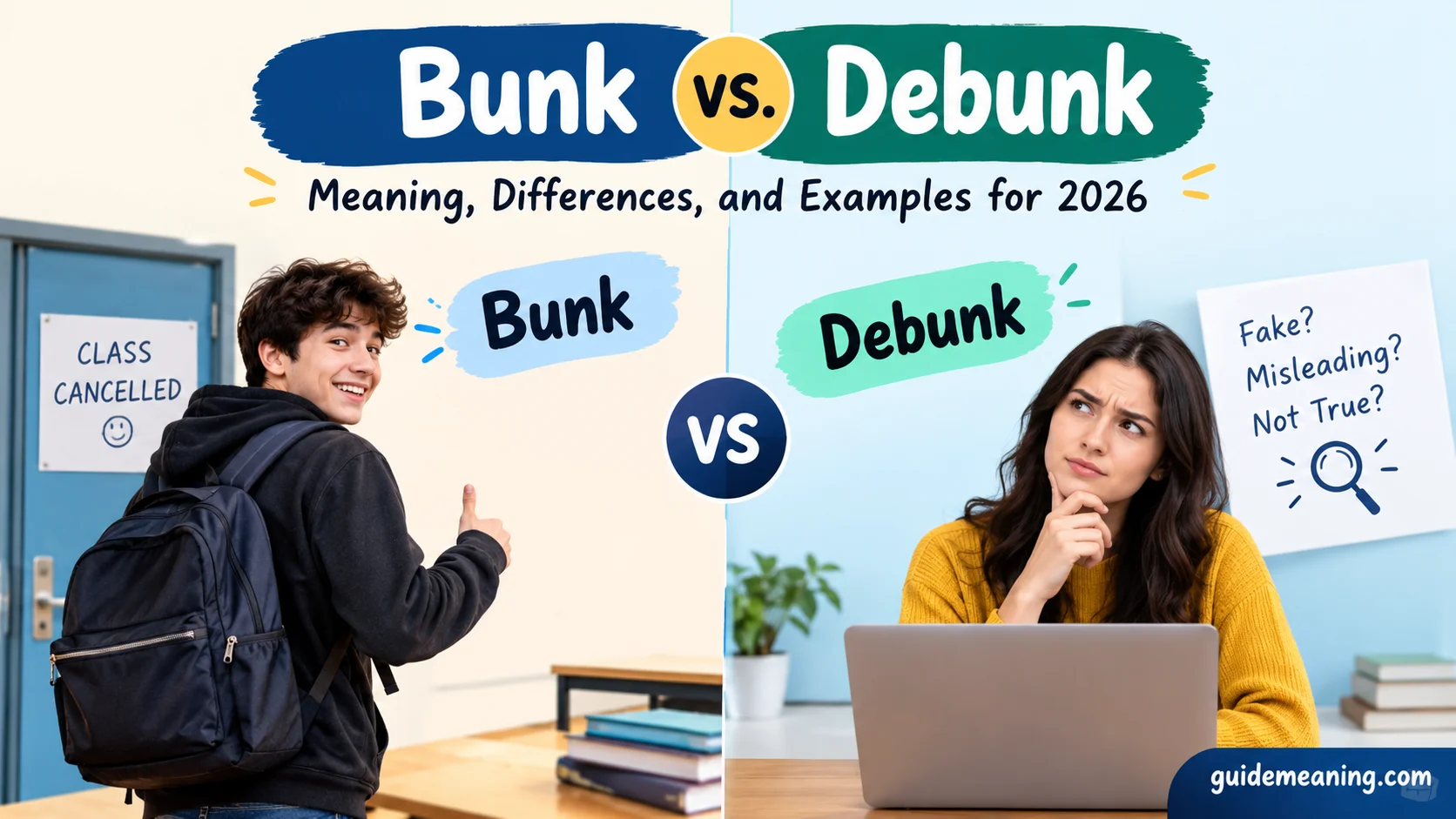

Bunk vs. Debunk explains how similar-looking words have different meanings, uses, and goals in everyday English, communication, and writing.
Bunk and debunk may look similar, but their meanings differ depending on context. Bunk is a noun that describes nonsense, foolishness, unsupported ideas, baseless rumors, and false information lacking evidence or credibility. It can also mean a narrow bed or a bed in a bunk bed. In the United States, it may be a mass noun for nonsense or a verb meaning to room with another person. The word is a shortened version of bunkum, which has the same meaning. As a side note, buncombe is another spelling connected to a politician’s speech about Buncombe, North Carolina. Outside the United States, the phrase do a bunk means to hastily leave or escape. These examples show why contextual meaning, definitions, and correct usage matter when choosing words.
Debunk, by contrast, is a verb meaning to prove false, expose falsehoods, challenge misleading information, and disprove claims through facts, logic, careful analysis, and reliable evidence. While bunk may dismiss facts or describe pure bunk, debunking aims to clarify, uncover, and correct misunderstandings. For example, calling the flat Earth theory bunk expresses skepticism about its validity, while a scientist may debunk it using scientific evidence. Similarly, the belief that eating carrots improves night vision is a common myth that researchers can investigate through scientific research. The noun forms include debunker and debunkery. The word stems from bunk, and debunk appeared in a work of fiction as a term for removing bunk from topics or thoughts. Understanding this semantic distinction helps people understand the difference between spreading falsehood and exposing false claims. From my experience with everyday language, recognizing these different lives and different goals makes it easier to choose the right word and communicate with greater accuracy.
In today’s world, saturated with information, news, headlines, social media, and casual opinions, this common comparison has both academic value and practical value. Misinformation, fake news, unverified content, misleading talk, social-media claims, and misleading-information can spread quickly when users confidently state false claims or repeat them without checking facts. This makes fact checking, fact-checking, truth verification, and logical reasoning essential critical thinking skills for effective daily communication. Journalists, researchers, and educators often debunk myths to improve public understanding and help readers distinguish truth from falsehood. Exploring these meanings, uses, concepts, interpretation, and usage builds awareness, strengthens understanding of science and communication-skills, and helps people process ideas more effectively and think clearly. Learning these words also improves vocabulary, grammar, word choice, and writing skills in social media posts, news reports, essays, and everyday conversations. When a claim has a lack of evidence, calling it bunk describes its weakness; when someone investigates that claim and presents proof, debunking provides a method for factual correction.
Let’s dive in!
Quick Answer:
What Do Bunk and Debunk Mean?
In American English, bunk means nonsense or something considered untrue, while debunk means to expose a false or misleading claim. More broadly, the words distinguish a questionable statement from the process of examining and challenging it.
TL;DR
- Bunk is an informal noun meaning nonsense or foolish talk.
- Debunk is a verb meaning to expose a false or misleading claim.
- Both words have roots in American English.
- Bunk can also mean a narrow bed or sleeping place.
- Debunking requires evidence, not simply disagreement or personal opinion.
What Does Bunk Mean?
Bunk is an informal American English word that commonly means nonsense, empty talk, or a claim someone considers false. It can express doubt, frustration, or disbelief without requiring a detailed explanation.
For example, imagine a friend claims that drinking a special drink guarantees perfect grades. You might reply, “That sounds like bunk.”
Common Meanings of Bunk
The word has several meanings, so context matters:
- Nonsense: An idea or statement considered foolish or untrue.
- Empty talk: Words that sound impressive but lack substance.
- Sleeping place: A narrow bed, often found in camps, ships, or shared rooms.
- Bunk bed: A bed arrangement where one sleeping space sits above another.
The nonsense meaning is especially common in informal American conversation. However, the sleeping-place meaning remains familiar in everyday life.
Examples of Bunk in Sentences
- That advertisement is complete bunk.
- His explanation sounded like bunk to everyone.
- The campers stored their bags beside their bunks.
- She climbed into the top bunk before bedtime.
Notice how the surrounding words clarify the intended meaning. In the first two examples, bunk expresses disbelief. In the final two, it refers to sleeping arrangements.
What Does Debunk Mean?
Debunk is a verb that means to expose a false claim, challenge a misconception, or reveal that something isn’t as convincing as it first appeared. Unlike bunk, it describes an action rather than simply naming something as nonsense.
For example, a researcher might examine a popular health claim and find no reliable evidence supporting it. The researcher could then debunk that claim by explaining the findings.
Common Uses of Debunk
People use debunk in several everyday and professional settings:
- Science: Researchers challenge unsupported explanations through evidence.
- Journalism: Reporters investigate rumors and misleading public statements.
- Education: Teachers correct misconceptions about history or nature.
- Social media: Fact-checkers examine viral claims before sharing corrections.
However, debunking isn’t simply calling someone wrong. A convincing debunking explains the evidence and shows why a claim doesn’t hold up.
Examples of Debunk in Sentences
- Scientists debunked the popular myth.
- The documentary aims to debunk common misconceptions.
- Reporters debunked the rumor with verified records.
- Her research helped debunk the misleading advertisement.
These examples show how debunk changes with tense. You can write debunk, debunks, debunked, or debunking depending on the sentence.
Bunk vs. Debunk: Key Differences
The main difference is grammatical and practical. Bunk usually identifies something as nonsense, while debunk describes the process of exposing a claim as false.
Comparison Table
| Feature | Bunk | Debunk |
| Part of speech | Usually a noun | Verb |
| Main meaning | Nonsense or empty talk | To expose a false or misleading claim |
| Purpose | Expresses a judgment | Describes an investigative action |
| Tone | Informal and often dismissive | Neutral, explanatory, or critical |
| Common settings | Conversations and casual opinions | Research, journalism, education, and fact-checking |
| Example | “That story is bunk.” | “The reporter debunked the story.” |
How to Remember the Difference
A simple trick makes the distinction easy: bunk is the claim being dismissed; debunk is the action taken to expose it.
Compare these sentences:
- “The rumor is bunk.”
- “The investigation debunked the rumor.”
The first sentence gives an opinion about the rumor. The second describes an investigation that challenged it.
Importantly, the words aren’t interchangeable. Saying “The investigation bunked the rumor” would be incorrect in standard contemporary English when you mean exposed it as false.
The Historical Origins of Bunk and Debunk
The history of these words offers a glimpse into American political culture. Unlike many English expressions inherited from ancient languages, the nonsense meaning of bunk has a relatively recent and distinctly American origin.
How Bunkum Became Bunk
The story begins in the early nineteenth century, during debates in the United States Congress. Representative Felix Walker represented Buncombe County, North Carolina, and reportedly delivered a speech that frustrated his fellow lawmakers.
According to the familiar historical account, Walker explained that he was speaking for his constituents rather than addressing his colleagues. His remark helped inspire bunkum, a term for speech delivered mainly for show or political effect.
Over time, speakers shortened bunkum to bunk. The word eventually became a general expression for nonsense, empty talk, and claims lacking credibility.
When Debunk Entered English
The verb debunk appeared in American English in 1923. American writer William Woodward popularized it through his book Bunk, which explored the exposure of illusions and misleading beliefs.
The prefix de- suggests removal or reversal in many English words. In debunk, it conveys the idea of stripping away nonsense to reveal what remains.
This origin explains why the two words look so similar. It also explains their close connection to skepticism, truth, and the challenge of misleading claims.
How Bunk and Debunk Are Used in American Culture
American English often uses short, memorable words to challenge exaggerated claims. Bunk and debunk fit this tradition, especially in political debate, news coverage, entertainment, and everyday conversation.
Political Speech and Public Debate
The political origin of bunkum gives the word a lasting connection to empty promises and public performance. Today, an American might call a politician’s speech bunk when it sounds impressive but offers little substance.
However, the word expresses the speaker’s judgment. Calling a promise bunk doesn’t automatically prove that the promise is false.
Debunk carries a different emphasis. A reporter might review public records to test a politician’s claim and publish the findings.
Science, News, and Online Discussions
Debunking has become especially useful in conversations about misinformation. Viral posts, misleading headlines, and popular myths often prompt people to ask whether evidence supports a claim.
For American readers, these words can help distinguish between an opinion and an investigation. Still, reliable conclusions depend on evidence rather than the confidence of the person speaking.
Everyday American Examples
| Context | Example | Intended Meaning |
| Casual conversation | “That excuse is bunk.” | The excuse sounds unconvincing. |
| Political discussion | “The campaign promise was bunk.” | The speaker considers the promise empty or false. |
| Scientific reporting | “Researchers debunked the claim.” | Evidence challenged the claim’s accuracy. |
| Social media | “This post debunks a viral rumor.” | The post presents evidence against the rumor. |
| Travel or camping | “My bunk is near the window.” | The speaker means a sleeping place. |
These examples show why context matters. The same spelling can refer to nonsense or a bed, while debunk consistently describes an action involving a claim or belief.
The Emotional and Psychological Associations of Bunk and Debunk
Although these words aren’t traditional symbols, they carry emotional associations. Their use can signal skepticism, frustration, curiosity, or confidence in evidence.
What Bunk Communicates
Calling something bunk often expresses immediate disbelief. It can also show impatience with explanations that seem dishonest, exaggerated, or poorly supported.
For example, someone might call a misleading advertisement bunk after noticing exaggerated promises. The word delivers a quick judgment without requiring a long argument.
However, that bluntness can sound dismissive. A listener may feel insulted if you label their carefully held belief as nonsense.
What Debunk Communicates
Debunk often suggests investigation and a willingness to question accepted ideas. It can signal curiosity, critical thinking, and an interest in separating reliable information from misleading claims.
Nevertheless, the word doesn’t guarantee that an investigation is accurate. A person can claim to debunk something while relying on weak evidence or ignoring important details.
The strongest approach combines open-mindedness with careful testing. Instead of assuming a claim is bunk, examine the evidence before deciding whether it deserves that label.
Bunk vs. Debunk in Social Media and Modern Communication
Digital communication has made these words useful in discussions about rumors and questionable information. On American social platforms, people frequently encounter claims that demand quick reactions, corrections, or further investigation.
Social Media Posts and Viral Claims
Someone might comment “That’s bunk” beneath a post they consider misleading. Another person might create a video explaining how to debunk the claim with documents, experiments, or verified information.
These responses serve different purposes. One expresses disbelief, while the other promises an explanation supported by evidence.
Videos, Podcasts, and Educational Content
Creators often use debunk in titles about myths, rumors, unusual beliefs, or misleading product claims. The word tells viewers to expect an examination rather than simple agreement.
However, dramatic presentation doesn’t replace reliable research. A persuasive video may still overlook evidence that challenges its conclusion.
Using the Words in Online Writing
Choose the word that matches your intended message:
- Write “This claim is bunk” when expressing a negative judgment.
- Write “This article debunks the claim” when describing an investigation.
- Write “The rumor turned out to be bunk” when describing a conclusion.
- Write “The report attempts to debunk the rumor” when discussing an investigative effort.
These patterns keep your writing clear. They also prevent you from treating the two words as interchangeable.
Common Misunderstandings About Bunk and Debunk
Because the words share a root, readers sometimes assume they work in similar ways. Their relationship is real, but their grammatical roles and meanings remain distinct.
Does Debunk Mean to Make Something Nonsense?
No. Debunk means to expose a claim as false, misleading, or less convincing than people believe. It doesn’t mean creating nonsense or making a statement foolish.
For example, a journalist might debunk a rumor by checking official records. The journalist isn’t creating the rumor; they’re investigating its accuracy.
Does Calling Something Bunk Prove It’s False?
No. Calling a statement bunk expresses a judgment, not proof. A claim might be wrong, exaggerated, poorly explained, or simply unpopular with the speaker.
By contrast, a strong debunking presents reasons and evidence for rejecting a claim. Even then, readers should examine the quality of that evidence.
Can Bunk Be a Verb?
The word bunk has several verb uses, including sleeping somewhere and, in some varieties of English, skipping school or leaving unexpectedly. However, it isn’t the standard verb for exposing false information.
For that meaning, use debunk. For example, write “The researcher debunked the rumor,” rather than “The researcher bunked the rumor.”
Bunk vs. Debunk in Formal and Informal Writing
The best choice depends on your audience and the situation. Both words appear in American English, but they create different tones.
When to Use Bunk
Bunk works well in casual conversations, opinion pieces, and informal writing. Its direct tone makes it useful when someone wants to dismiss an idea quickly.
For example, “The sales pitch was bunk” sounds conversational and critical. In a formal report, however, “The sales pitch contained unsupported claims” may communicate the point more precisely.
When to Use Debunk
Debunk suits discussions about research, fact-checking, public claims, and education. It works in everyday speech as well as more formal writing.
Consider these examples:
- Informal: “Let’s debunk that internet myth.”
- Academic: “The study challenges and debunks the earlier explanation.”
- Journalistic: “The investigation debunked the circulating rumor.”
- Educational: “The lesson debunks several common misconceptions.”
However, don’t use debunk merely because you disagree with an argument. The word suggests that evidence or analysis has exposed a problem with the claim.
How the Meanings Have Changed Over Time
The history of these words shows how language grows through political events and changing public attitudes. Their modern meanings developed through different stages rather than appearing together.
From Political Rhetoric to Everyday Speech
In the early nineteenth century, bunkum described empty or insincere political speech. As the shorter form bunk spread, its meaning expanded to include nonsense more generally.
Eventually, people could use bunk to dismiss a rumor, an argument, or an exaggerated sales pitch. The word no longer needed a political setting to make sense.
From Nonsense to Investigation
When debunk emerged in 1923, it gave English speakers a concise way to describe exposing falsehoods and illusions. Over time, the word became useful in scientific discussions, journalism, education, and public debate.
Today, debunking often involves checking claims against reliable evidence. Digital media has made this role especially visible, although the underlying idea remains straightforward.
Why Both Words Still Matter
Bunk remains useful because people often need a short expression of disbelief. Debunk remains useful because explaining why a claim fails requires more than dismissing it.
Together, the words capture two familiar responses to questionable information: rejecting it and investigating it. The distinction remains relevant whenever people encounter rumors, exaggerated promises, or disputed explanations.
FAQs:
What is the main difference between bunk and debunk?
Bunk means nonsense or information that lacks credibility. Debunk is a verb that means proving a false claim wrong through evidence, facts, or logical reasoning.
Is bunk a noun or a verb?
Bunk can function as both a noun and a verb. As a noun, it means nonsense or a narrow bed. As a verb, particularly in the United States, it can mean sharing a room with another person.
Is debunk a noun or a verb?
Debunk is a verb that means exposing false beliefs, challenging misinformation, or disproving unsupported claims. Related nouns include debunker, a person who exposes false claims, and debunking, the process of doing so.
What does bunk mean in everyday English?
In everyday English, bunk usually means nonsense or an idea that lacks credibility. For example, someone might call an unsupported rumor bunk when they believe it has no factual basis.
How do you use debunk in a sentence?
You can use debunk when someone investigates a claim and shows why it’s false. For example: “The researchers used scientific evidence to debunk the popular myth.”
Can bunk and debunk be used interchangeably?
No, bunk and debunk have different meanings. Bunk describes nonsense or refers to a bed, while debunk means exposing falsehoods. Using one in place of the other can change the meaning of your sentence.
Why is debunking important in the digital world?
Debunking helps people identify misinformation, question misleading claims, and distinguish facts from falsehoods. It’s especially useful when evaluating social media posts, fake news, online rumors, and unverified content.
Conclusion:
Understanding Bunk vs. Debunk helps you choose the right word in everyday English. Bunk refers to nonsense, foolishness, or information that lacks reliable evidence. Debunk means exposing false claims through facts, research, and logical reasoning. Although the words share a common origin, they serve different purposes. Using them correctly improves your vocabulary, communication, critical thinking, and writing skills. If you’re discussing myths, checking social media posts, or evaluating news reports, knowing the difference helps you separate unsupported claims from evidence-based explanations.