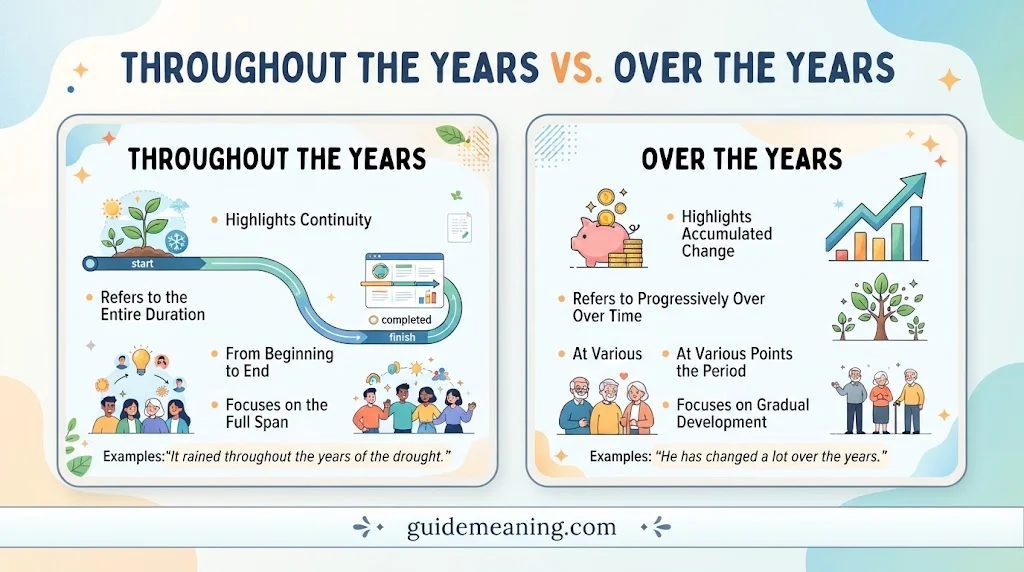

Throughout the Years vs. Over the Years explains how English language choices shape meaning, tone, clarity, and time in real writing today. As language evolves, phrases from conversations, movies, speeches, and books can carry different meanings, tones, and uses. Throughout the Years and Over the Years may look identical, but they tell a different story about time. Throughout the years often shows continuity, a continuous span, or a steady presence, while over the years often suggests change, development, progress, evolution, or gradual change across a number of years.
These differences may seem small, but they can affect tone, clarity, emotional weight, and the right expression that fits your message. From my teaching view, I have seen writers, students, professionals, and native speakers wonder whether these phrases are interchangeable. Their patterns, meaning, context, and emphasis help you understand which phrase fits. A simple, practical way to learn the difference is through real examples, comparisons, and a clear usage distinction. This guide breaks the point down so you can choose the right one without thinking twice. For Americans, both forms appear in real writing, everyday conversation, storytelling, and descriptive writing, where phrase choice helps readers understand the intended meaning in seconds.
One big confusion comes from throughout versus through out. In modern English, throughout is the correct form when it works as a compound word, while through out as separate words is not the normal standard usage for this meaning. This spelling distinction follows a grammar rule, usage rule, word formation, orthography, and morphology. A spelling error can become a common mistake and cause frequent confusion during proofreading, editing, academic writing, and professional writing. When we compare the two main phrases, throughout the years works as a time expression and temporal reference, while over the years provides another time reference for something happening across a duration or extended timeframe.
Let’s dive in!
Quick Answer:
Throughout the years means during the whole period of years being discussed. It often emphasizes continuity, persistence, repetition, or something remaining present across the period.
Over the years means during the course of several years. It often works naturally when describing gradual changes, development, experiences, or things that accumulate with time.
| Expression | Main emphasis | Typical use | Example |
| Throughout the years | The whole period | Continuity, persistence, repeated events | She remained dedicated throughout the years. |
| Over the years | The passage of time | Change, development, growth, experience | Her skills improved over the years. |
There is plenty of overlap. In some sentences, either expression works without creating a major difference in meaning.
A useful rule of thumb is simple:
Throughout looks across the entire period. Over often looks at what happened during that period.
That isn’t an absolute grammar rule. Context still decides which expression sounds most natural.
What Does “Throughout the Years” Mean?
Throughout the years refers to the whole span of years under discussion. The word throughout carries the idea of something extending across an entire period rather than focusing on one particular point within it.
Cambridge gives throughout the meaning of “during the whole period of time.” Collins similarly explains that when something happens throughout a period, it happens during the whole of that period.
Consider:
Throughout the years, her family continued the tradition.
The sentence doesn’t focus on one particular year. Instead, it presents the tradition as something that continued across the period.
This makes throughout the years especially useful when you want to highlight:
- Continuity
- Persistence
- Repeated events
- Long-lasting qualities
- Ongoing relationships
- Traditions
- Consistent behavior
- Something that remained true
However, don’t assume that throughout means something literally stayed unchanged. An activity can continue throughout a period even while details change.
For example:
Throughout the years, the company introduced several new products.
The products changed. The important point is that product development happened across the period.
Examples of “Throughout the Years”
Here are several natural examples:
- Throughout the years, she remained loyal to her friends.
- The tradition continued throughout the years.
- Throughout the years, the museum attracted visitors from around the world.
- He supported his family throughout the years.
- Throughout the years, the organization faced many challenges.
- Their friendship survived throughout the years.
Notice that these sentences don’t all describe something perfectly static. The phrase simply places the action or situation across the entire time span.
What Does “Over the Years” Mean?
Over the years means during the course of several years. It frequently appears when the writer wants to discuss change, development, progress, experience, or accumulation.
For example:
Her writing improved over the years.
The focus is on the movement from one stage to another. Her writing wasn’t simply present during those years. It developed during them.
That’s why over the years commonly appears with verbs such as:
- changed
- developed
- improved
- increased
- decreased
- evolved
- grew
- learned
- developed
- expanded
- accumulated
- adapted
Consider another example:
The town has changed dramatically over the years.
Here, the phrase works naturally because the sentence describes a transformation that occurred during a period of years.
Examples of “Over the Years”
- Technology has changed rapidly over the years.
- She became more confident over the years.
- The company expanded over the years.
- He gained valuable experience over the years.
- Their priorities changed over the years.
- The neighborhood has grown considerably over the years.
Still, over the years does not automatically mean change. It can simply describe something that happened during a period.
For example:
I’ve collected hundreds of photographs over the years.
The collection may have grown gradually, but the phrase itself doesn’t grammatically require change. It establishes the period during which the collecting happened.
Throughout the Years vs. Over the Years: The Key Difference
The easiest way to understand Throughout the Years vs. Over the Years is to imagine a timeline.
Throughout the Years
Beginning → Middle → End
The expression draws attention to the whole stretch.
Over the Years
Beginning → changes → development → later stage
The expression often draws attention to what happened during the passage of time.
This gives the two expressions slightly different flavors.
| Example | Main idea |
| They remained friends throughout the years. | Their friendship continued across the period. |
| They became closer over the years. | Their relationship developed gradually. |
| The tradition continued throughout the years. | The tradition persisted during the period. |
| The tradition changed over the years. | The tradition developed or shifted with time. |
| She remained committed throughout the years. | Her commitment continued. |
| She became more experienced over the years. | Her experience increased gradually. |
This is why replacing one phrase with the other can sometimes change the emphasis even when both sentences remain grammatically possible.
Can “Throughout the Years” and “Over the Years” Be Used Interchangeably?
Sometimes, yes.
English doesn’t always create a hard grammatical boundary between these expressions. In many contexts, both can describe something occurring during a long period.
For example:
I’ve collected many books throughout the years.
I’ve collected many books over the years.
Both sentences are understandable and grammatical. The second sounds more natural in many everyday contexts because over the years commonly describes experiences and accumulation.
However, context can make one expression more precise.
Compare:
Throughout the years, she remained committed to the project.
This emphasizes continued commitment across the period.
Now compare:
Over the years, she developed a new approach to the project.
This emphasizes development.
So rather than memorizing “throughout = correct” and “over = incorrect,” focus on the meaning you want to convey.
Throughout vs. Over: The Grammar Behind the Expressions
The difference becomes clearer when you look at the prepositions themselves.
How “Throughout” Works
Throughout can function as a preposition or adverb. When it refers to time, it means during the whole period. Cambridge gives examples such as throughout the day and throughout the performance.
Examples include:
- throughout the day
- throughout the week
- throughout the month
- throughout the year
- throughout the decade
- throughout the years
The important idea is coverage of the whole period.
How “Over” Works
Over can also introduce a period of time:
- over the years
- over the past decade
- over the weekend
- over the last few months
- over a period of time
With over the years, the phrase commonly frames the years as a period during which something occurs.
For example:
The business grew over the years.
The phrase gives us the time frame for the growth.
“Throughout the Years” vs. “Throughout the Year”
The singular and plural forms create an important distinction.
Throughout the year
This refers to one year as a complete period.
The store offers discounts throughout the year.
The discounts occur during the year rather than being limited to one season.
Throughout the years
This refers to multiple years or an extended span of years.
The tradition has continued throughout the years.
Here, the speaker is referring to several years.
The distinction is straightforward:
| Phrase | Time span | Example |
| Throughout the year | One year | The park remains open throughout the year. |
| Throughout the years | Multiple years | The park has changed throughout the years. |
“Over the Years” vs. “Over the Year”
The same issue appears with over the years and over the year.
Over the years normally refers to multiple years:
The company has grown over the years.
Over the year can refer to changes or events occurring during one year:
Sales increased steadily over the year.
The second sentence might describe movement from the beginning of a particular year to its end.
So don’t automatically add or remove the or change the singular to plural. The form depends on the time period you actually mean.
Read More: HMJ Meaning in Text: What Does HMJ Mean in a Text ? for 2026
Throughout the Years vs. Over the Years in Different Contexts
Context often provides the clearest answer.
Relationships
Use throughout the years when emphasizing continued support or connection:
They supported each other throughout the years.
Use over the years when emphasizing how the relationship developed:
Their friendship became stronger over the years.
One highlights endurance. The other highlights development.
Personal Growth
Over the years works especially well when discussing personal development:
She became more confident over the years.
The sentence describes a gradual change.
However:
Throughout the years, she remained curious and eager to learn.
Here, curiosity is presented as an enduring quality.
Business
Business writing frequently uses over the years when discussing expansion, performance, or development:
The company expanded into several new markets over the years.
Meanwhile, throughout the years can emphasize continuity:
Throughout the years, the company maintained its commitment to customer service.
Technology
Technology is naturally associated with change, so over the years often fits well:
Smartphones have become more powerful over the years.
The sentence describes development.
However:
Throughout the years, technology has played an important role in communication.
Here, the emphasis falls on its continuing presence.
History
Both expressions can work in historical writing.
Throughout the years, the community preserved its cultural traditions.
Over the years, the community changed as new generations arrived.
The first emphasizes preservation. The second emphasizes historical development.
Common Mistakes to Avoid
Treating One Phrase as Always Correct
A common mistake is believing that throughout the years must describe something unchanged while over the years must describe something changing.
That’s too rigid.
The meanings overlap. The surrounding verb and context matter just as much as the time expression.
Assuming “Throughout” Means Absolutely Unchanged
Throughout means across the whole period. It doesn’t necessarily mean that every detail stayed identical.
Throughout the years, the company introduced new services.
The company changed. The activity simply occurred across the years.
Using “Over the Years” Only for Change
Although over the years often works beautifully with change, it can also describe accumulated experiences or activities:
I’ve met many interesting people over the years.
The phrase establishes when those experiences occurred.
Confusing “For Years” With “Throughout the Years”
These expressions aren’t identical.
For years emphasizes duration:
She lived there for years.
Throughout the years emphasizes something happening or existing across the whole period:
She maintained contact with her old friends throughout the years.
Think of it this way:
- For years → How long?
- Throughout the years → Across which entire period?
Throughout the Years vs. For Years
This distinction is especially useful for English learners.
| Expression | Main focus | Example |
| For years | Length of time | He worked there for years. |
| Throughout the years | Whole span of the period | He remained dedicated throughout the years. |
You can even use both ideas in related sentences:
She worked there for years and remained close to her coworkers throughout the years that followed.
The first phrase measures duration. The second emphasizes continuity across a defined period.
Over the Years vs. For Years
Now consider:
He studied photography for years.
This tells us how long he studied.
Compare:
He developed his photography skills over the years.
This tells us about development during that period.
The difference isn’t absolute, but the emphasis changes.
For years is primarily about duration.
Over the years commonly provides the time frame for experiences, changes, or development.
Throughout the Years vs. Through the Years
Another phrase worth knowing is through the years.
It is also grammatical and can overlap with throughout the years.
Compare:
Throughout the years, she remained devoted to her work.
Through the years, she remained devoted to her work.
Both can communicate continued devotion across a span of years.
Through the years can sound slightly more concise and reflective. Throughout the years more explicitly carries the sense of covering the entire period.
The choice often comes down to context, rhythm, and personal style rather than a strict grammar rule.
Common Sentence Patterns
Learning useful patterns can make these expressions much easier to use naturally.
Patterns With “Throughout the Years”
Throughout the years, + subject + continued/remained/has + past participle
Examples:
- Throughout the years, she remained supportive.
- Throughout the years, the tradition continued.
- Throughout the years, they maintained their friendship.
You can also place the phrase at the end:
- They remained close throughout the years.
- The tradition continued throughout the years.
Patterns With “Over the Years”
Over the years, + subject + changed/developed/grew/improved
Examples:
- Over the years, his confidence improved.
- Over the years, the company expanded.
- Over the years, technology evolved rapidly.
The phrase also works naturally at the end:
- His confidence improved over the years.
- The company expanded over the years.
Real-World Comparison: Same Topic, Different Emphasis
One of the easiest ways to understand Throughout the Years vs. Over the Years is to compare pairs.
Friendship
Throughout the years, they supported each other.
Focus: continued support.
Over the years, their friendship became stronger.
Focus: development.
Career
Throughout the years, she remained dedicated to teaching.
Focus: lasting dedication.
Over the years, she developed new teaching methods.
Focus: professional development.
Business
Throughout the years, the company maintained its original values.
Focus: continuity.
Over the years, the company expanded internationally.
Focus: growth.
Personal Experience
Throughout the years, he continued writing in his journal.
Focus: repeated or ongoing activity.
Over the years, his writing style changed considerably.
Focus: gradual transformation.
A Simple Decision Test
When you’re unsure which expression to choose, ask yourself one question.
Are you emphasizing the whole period?
If yes, throughout the years may fit naturally.
Throughout the years, she remained committed to the cause.
Are you emphasizing what happened during the period?
If yes, over the years may be a natural choice.
Over the years, she gained more experience.
There’s an important caveat, though: these aren’t rigid rules. English speakers use both expressions in overlapping contexts.
The best choice depends on the meaning, rhythm, and surrounding words.
Mini Case Study: One Sentence, Two Perspectives
Imagine a teacher who has worked at the same school for twenty years.
You could write:
Throughout the years, the teacher remained passionate about education.
This sentence emphasizes the teacher’s continuing passion.
Now change the sentence:
Over the years, the teacher developed new approaches to education.
The teacher’s career is now viewed as a process of development.
Both sentences describe the same twenty-year period. They simply point the reader toward different aspects of that period.
That’s the heart of the distinction.
Is “Throughout the Years” Grammatically Correct?
Yes. “Throughout the years” is grammatically correct.
The structure is:
throughout + the + plural noun
Examples include:
- throughout the years
- throughout the decades
- throughout the centuries
- throughout the seasons
When used with time, throughout means during the whole period. This meaning is established in major English dictionaries such as Cambridge and Collins.
For example:
Throughout the years, the family preserved the tradition.
The sentence is grammatically sound.
Is “Over the Years” Grammatically Correct?
Yes. “Over the years” is also grammatically correct and extremely common.
It functions as a time expression that tells the reader when something happened.
Examples:
- She learned a great deal over the years.
- The city changed over the years.
- They built a successful business over the years.
- He gained confidence over the years.
It can appear at the beginning or end of a sentence:
Over the years, the project became more ambitious.
The project became more ambitious over the years.
Both structures are natural.
Which Expression Should You Use?
Don’t choose based on the idea that one phrase is universally superior. Instead, choose according to the emphasis you want.
Use “Throughout the Years” When:
- You want to emphasize the whole period.
- Something continued across that period.
- You want to highlight persistence or endurance.
- An action occurred repeatedly during the period.
- A quality remained present.
- You’re writing a reflective or slightly formal sentence.
Use “Over the Years” When:
- You describe gradual development.
- Something changed with time.
- A skill improved.
- A business expanded.
- An opinion evolved.
- Experiences accumulated.
- You want a natural, general expression for a period of years.
Quick Memory Trick
Think of throughout as a highlighter running across the entire timeline.
Think of over as an arrow moving through time.
That simple mental picture can help you choose the expression without memorizing a complicated grammar rule.
FAQs:
Is “throughout the years” correct English?
Yes. “Throughout the years” is correct English. It refers to something occurring or existing during the whole period of years being discussed.
What does “over the years” mean?
“Over the years” means during the course of several years. It frequently appears when discussing changes, development, experiences, or gradual progress.
Are “throughout the years” and “over the years” interchangeable?
Sometimes. Both can refer to events occurring during a period of years. However, throughout the years often emphasizes the entire span, while over the years frequently emphasizes what happened during that span.
Which phrase should I use for gradual change?
“Over the years” is usually a natural choice for gradual change.
For example:
Her confidence increased over the years.
The phrase works well because the sentence describes development.
Which phrase should I use for something that continued?
“Throughout the years” can emphasize continued presence or activity across the entire period.
For example:
Throughout the years, they remained close friends.
Is “through the years” correct?
Yes. “Through the years” is also a standard expression. It can overlap in meaning with “throughout the years,” although the shorter form may sound more concise or reflective in some contexts.
Is “over the years” more natural than “throughout the years”?
There isn’t a universal rule that makes one correct and the other incorrect. “Over the years” is widely used in everyday English and works especially well for change, development, and accumulated experience. “Throughout the years” is also correct and can better emphasize the whole period or continuity.
Conclusion:
Throughout the years and over the years are both useful expressions for talking about time, but they can create different meanings and tones. Throughout the years generally focuses on continuity, persistence, or something that remains present across an entire period. Over the years often draws attention to change, development, progress, or gradual shifts as time passes.
The spelling point is also important. Throughout is written as one word when it means during an entire period. Once you understand this distinction, you can choose between these phrases with greater confidence and make your writing clearer, more natural, and more precise.




1 thought on “Throughout the Years vs. Over the Years: Meaning, Difference, and Correct Usage for 2026”