
How Can I vs. How I Can becomes easier to understand when you recognize how word order affects meaning, clarity, and grammatical accuracy in English.
This confusion happens often because learners hesitate between similar question patterns. For example, “How can I ask questions?” is a direct question, while “I wonder how I can ask questions” contains an indirect question. Although the vocabulary looks similar, the word order changes. A small mistake can affect professionalism and confidence. Understanding interrogative sentences, statement formation, and sentence formation helps native speakers and beginners improve their English. Some learners experience hesitation and linguistic uncertainty when dealing with syntactic variation, especially the inversion pattern, auxiliary verb placement, and subject-verb order. A misplaced auxiliary can create grammar confusion, but a clear sentence structure helps readers distinguish an interrogative form from a declarative form.
When I explain these language rules, I tell students that understanding patterns is more useful than memorizing isolated examples. Compare “When can I leave?” with “I know when I can leave.” The same principle applies to other question patterns involving when, I, and can. These examples show how question structure depends on whether you’re asking questions or making a statement. A focused mastering grammar guide can include case studies, quotes, tables, and examples when they add value. The learning objective is to build communication skills, effective expression, and confidence in speech and writing.
With smart vocabulary choice, contextual usage, and practice mastering question forms, readers can improve their practical usage, clarity, professionalism, and confidence. This structural difference, supported by syntax rules and core English grammar concepts, reduces confusion between forms. As readers feel more able, they continue mastering these patterns through repeated practice and time. The result is better reader outcomes, less misunderstanding of word order, and stronger language mastery across overall grammatical structure and everyday English.
Quick Answer: How Can I vs. How I Can
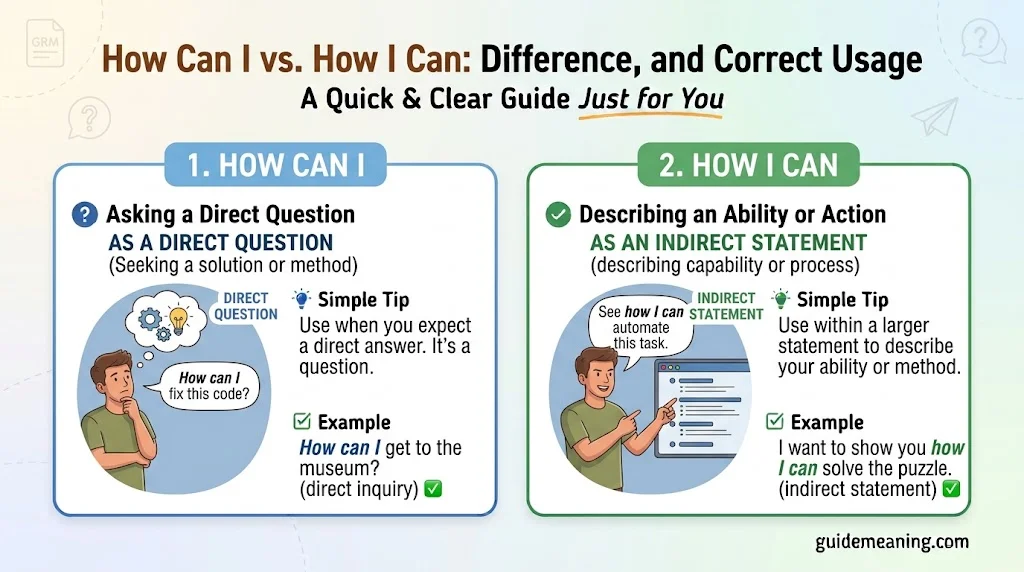
“How can I” is the standard word order for direct questions. “How I can” is generally used in indirect questions and statements that explain how something is possible or can be done.
| Phrase | Main use | Example |
| How can I | Direct questions | How can I reset my password? |
| How I can | Indirect questions | Can you explain how I can reset my password? |
| How can I | Asking about possible actions | How can I help you? |
| How I can | Explaining an ability or method | I know how I can help you. |
The easiest way to remember the difference is to look at the sentence structure.
- Direct question: How + can + subject + base verb?
- Indirect question: Introductory words + how + subject + can + base verb.
For example:
- Correct: How can I solve this problem?
- Correct: I wonder how I can solve this problem.
- Incorrect in standard English: I wonder how can I solve this problem.
The last example uses direct-question word order inside an indirect question. In standard English, the embedded question normally follows the subject-before-verb pattern.
What Does “How Can I” Mean?
The phrase “how can I” asks about the way, method, or possibility of doing something. You use it when you want another person to explain a process, offer help, or suggest a solution.
The word how asks about a method or manner. The modal verb can expresses ability, possibility, or permission. Finally, I identifies the person who wants to perform the action.
Consider this example:
“How can I learn English faster?”
You’re asking for practical ways to improve your English skills. The question invites advice, instructions, or possible solutions.
According to Cambridge Dictionary’s explanation of can, this modal verb commonly expresses ability, permission, and possibility. These meanings explain why the phrase appears in so many everyday questions.
Cambridge Dictionary
+1
Examples of “How Can I” in Sentences
Here are examples showing how the phrase works in different situations.
| Example sentence | Purpose |
| How can I improve my pronunciation? | Asking for advice |
| How can I open this locked door? | Asking for a method |
| How can I help you today? | Offering assistance |
| How can I access my account? | Asking about a process |
| How can I join the meeting? | Asking about possibility |
| How can I get permission to leave early? | Asking about permission |
| How can I make this recipe healthier? | Seeking a practical solution |
| How can I contact the support team? | Asking for instructions |
Notice that every example follows the same basic pattern. The question begins with how, followed by can, then the subject I, and finally the base form of the main verb.
For instance, “How can I write better?” is correct because can comes before I. The main verb write stays in its base form.
You don’t need to add do after can. The modal verb already helps form the question.
- Correct: How can I fix this?
- Incorrect: How do I can fix this?
The second sentence combines two different question structures. In standard English, use either How can I fix this? or How do I fix this?
When Should You Use “How Can I”?
Use “how can I” when you want to ask a direct question about an action or outcome. It works well in conversations, customer service requests, interviews, and professional emails.
For example, imagine that you’ve forgotten your account password. You might ask a support agent:
How can I reset my password?
The question is direct, clear, and easy to understand.
You can also use the phrase when offering help or exploring possibilities. A manager might ask, “How can I support your team?” A student might ask, “How can I prepare for the exam?”
Here are three common situations where this phrase fits naturally:
- Asking for instructions: How can I submit my application?
- Seeking advice: How can I become a better writer?
- Exploring possibilities: How can I finish this project by Friday?
In each case, you’re asking the listener to explain what you can do or how you might accomplish something.
What Does “How I Can” Mean?
The phrase “how I can” describes a method, ability, or possible action within a larger sentence. Instead of using direct-question word order, it follows the usual subject-before-verb pattern.
Compare these two sentences:
- Direct question: How can I solve this problem?
- Statement: I know how I can solve this problem.
Both sentences discuss solving a problem. However, the first asks for information directly, while the second states that the speaker knows a possible solution.
The difference comes from the grammatical role of the phrase. In the first example, how can I solve this problem forms a direct question. In the second, how I can solve this problem forms an embedded question within the larger statement.
An embedded question contains a question word but doesn’t use the usual subject–auxiliary inversion of a direct question. The British Council’s guide to question words explains this distinction with examples of direct and indirect questions.
LearnEnglish Teens
+1
Examples of “How I Can” in Sentences
The following examples demonstrate how how I can works in statements and indirect questions.
| Example sentence | Purpose |
| I know how I can improve my writing. | Explaining knowledge |
| I’m trying to understand how I can fix this error. | Describing an effort |
| She asked how I can help her team. | Reporting a question |
| I want to discover how I can save money. | Expressing a goal |
| Can you explain how I can apply? | Asking an indirect question |
| I’m considering how I can organize my schedule. | Describing a plan |
| Please show me how I can use this tool. | Requesting instructions |
| I wonder how I can make this process easier. | Expressing uncertainty |
Some examples may require a different tense depending on the intended meaning. For instance, “She asked how I could help her team” often sounds more natural when reporting a past conversation. However, can may remain appropriate when the ability or situation still applies.
The important point is that I comes before can when the phrase forms an embedded question with this subject and modal verb.
When Should You Use “How I Can”?
Use “how I can” when the phrase appears after an introductory expression or forms part of a statement. It’s especially useful when explaining what you know, want to learn, or are trying to accomplish.
Common introductory expressions include:
- I know: I know how I can improve the results.
- I wonder: I wonder how I can contact the organizer.
- I want to know: I want to know how I can register.
- Can you tell me: Can you tell me how I can get there?
- I’m learning: I’m learning how I can manage my time better.
- I need to understand: I need to understand how I can prevent this issue.
The phrase also helps you ask polite questions. Instead of asking someone directly, “How can I access the files?” you could say, “Could you explain how I can access the files?”
The second version sounds more like a request for assistance. It’s often a good choice when speaking with a customer service representative, colleague, teacher, or someone you don’t know well.
However, remember that how I can doesn’t always indicate a question. It can also appear in ordinary statements that describe an action or method.
For example, “This guide explains how I can organize my finances” is a statement. It tells readers what the guide explains rather than asking them a question.
Key Differences Between “How Can I” and “How I Can”
The main difference between “how can I” and “how I can” is word order. Direct questions usually place the modal verb before the subject, while embedded questions generally keep the subject before the modal verb.
Although the two phrases often communicate similar ideas, you can’t freely swap them in every sentence.
| Feature | How can I | How I can |
| Word order | How + can + I | How + I + can |
| Typical function | Direct question | Embedded question or statement |
| Main purpose | Asking directly | Explaining or referring to a method |
| Example | How can I improve? | I know how I can improve. |
| Question mark | Usually used for direct questions | Depends on the full sentence |
| Common context | Direct requests and questions | Explanations, reports, and indirect questions |
Compare These Sentence Pairs
Pair one: Asking for advice
- Direct question: How can I save more money?
- Embedded question: I want to learn how I can save more money.
The first sentence asks someone for suggestions. The second explains what the speaker wants to learn.
Pair two: Requesting instructions
- Direct question: How can I install this application?
- Indirect question: Could you tell me how I can install this application?
Both sentences request instructions. The second wraps the question in a polite request, making it useful in professional or unfamiliar settings.
Pair three: Expressing uncertainty
- Direct question: How can I finish this task today?
- Statement: I’m not sure how I can finish this task today.
The first asks about possible ways to complete the task. The second expresses uncertainty about those possibilities.
These comparisons reveal a simple rule: look at the complete sentence, not just the phrase itself. The surrounding words determine which word order fits.
Grammar Rules for “How Can I” vs. “How I Can”
Understanding the grammar behind these expressions makes the difference easier to remember. English follows different word-order patterns for direct questions and embedded questions.
Subject–Auxiliary Inversion in Direct Questions
In a direct question, English usually places an auxiliary verb or modal verb before the subject. This pattern is known as subject–auxiliary inversion.
With can, the structure looks like this:
How + can + subject + base verb + remaining information?
For example:
- How can I learn faster?
- How can I fix this computer?
- How can I reach the airport?
- How can I improve my presentation?
The modal verb can appears before the subject I. The main verb follows I in its base form.
This rule also applies when the subject changes.
| Subject | Correct question |
| I | How can I help? |
| You | How can you tell? |
| He | How can he know? |
| She | How can she improve? |
| We | How can we prepare? |
| They | How can they participate? |
One useful detail: can doesn’t change according to the subject. You say “How can she help?” rather than “How cans she help?”
Normal Word Order in Indirect Questions
Embedded questions generally follow statement word order. The subject comes before the modal verb, even when the larger sentence is itself a question.
The usual pattern is:
Introductory phrase + how + subject + modal verb + base verb
Examples include:
- I understand how I can improve.
- Can you explain how I can improve?
- Do you know how I can improve?
- I’d like to learn how I can improve.
Notice something important about the second and third examples. Both sentences are direct questions, so they end with question marks. Yet the embedded part still uses how I can improve, not how can I improve.
The outer question determines the punctuation and overall sentence type. The embedded question follows its own grammatical pattern.
This distinction is one of the most common sources of confusion for English learners. They see a question mark at the end and assume every verb must follow direct-question word order. That’s not how embedded questions work.
Punctuation and Sentence Structure
Punctuation depends on the complete sentence rather than the phrase alone.
A direct question generally ends with a question mark:
- How can I change my username?
- How can I contact the office?
A statement containing an embedded question generally ends with a period:
- I know how I can change my username.
- I need to find out how I can contact the office.
However, an embedded question inside a larger direct question still takes a question mark at the end:
- Could you tell me how I can change my username?
- Do you know how I can contact the office?
The embedded phrase doesn’t need its own question mark. The punctuation belongs to the complete sentence.
LearnEnglish
Common Mistakes to Avoid
Even confident English speakers sometimes mix up these phrases. Fortunately, most errors become easy to spot once you recognize the difference between direct and embedded questions.
Using “How I Can” for a Direct Question
When asking a direct question, place can before I.
- Incorrect: How I can change my password?
- Correct: How can I change my password?
The first version lacks the standard word order for a direct question. The second follows the usual inversion pattern.
Using “How Can I” Inside an Embedded Question
An embedded question usually follows statement word order, even when the full sentence is a question.
- Incorrect: Can you tell me how can I change my password?
- Correct: Can you tell me how I can change my password?
The opening phrase, “Can you tell me,” already forms the direct question. The words following how make up the embedded question, so they don’t need inversion.
Assuming One Phrase Is Always Wrong
Neither expression is inherently incorrect. The problem arises when you use the wrong structure for the sentence.
Compare these examples:
- Correct: How can I contact the manager?
- Correct: I need to know how I can contact the manager.
Both sentences are grammatical because each follows the appropriate word order.
Using Incorrect Punctuation
Another common mistake involves adding a question mark to a statement.
- Incorrect: I know how I can solve this problem?
- Correct: I know how I can solve this problem.
If you’re asking a direct question, use a question mark. If you’re making a statement, use a period unless the sentence calls for different punctuation.
“How Can I” vs. “How I Can” in Everyday Examples
These phrases appear in conversations, emails, workplace discussions, and academic writing. Understanding their differences helps you communicate clearly across different situations.
In Casual Conversations
In everyday speech, direct questions often sound natural when you want an immediate answer.
For example:
Alex: How can I get to the train station?
Jordan: Walk straight for two blocks, then turn left.
Now consider an indirect question:
Alex: Do you know how I can get to the train station?
Jordan: Yes. Walk straight for two blocks, then turn left.
Both conversations sound natural. The second begins with a request for information, while the first asks directly for directions.
In Emails and Professional Writing
Professional communication often benefits from indirect questions because they can sound more courteous.
Compare these two requests:
- Direct: How can I access the shared folder?
- Polite: Could you explain how I can access the shared folder?
The direct version is clear and perfectly acceptable. The second version frames the question as a request for assistance.
Here’s another example you could use at work:
Hi Morgan,
Could you please explain how I can access the latest project files? I’ve tried the shared link but haven’t been able to open it.
Thanks for your help.
The embedded question fits naturally into the polite request. It also helps you explain the problem without sounding abrupt.
In Academic and Formal Writing
Academic writing often uses embedded questions when discussing research methods, possible explanations, or areas for further investigation.
For example:
- Direct question: How can researchers measure this effect?
- Formal statement: This study examines how researchers can measure this effect.
The first sentence asks a question. The second describes the study’s purpose.
Similarly, a student might write, “The assignment explains how I can evaluate the available evidence.” Here, how I can introduces the method the student intends to use.
Choose the structure that matches your purpose. Direct questions work well when seeking an answer, while embedded questions help integrate a question into a larger idea.
A Practical Case Study: Choosing the Correct Phrase
Imagine that Maya wants to improve her writing skills. She decides to ask her teacher for advice, then explains her learning goal in an assignment.
First, she writes:
“How I can improve my writing?”
Her teacher points out that the sentence asks a direct question. Maya should write:
“How can I improve my writing?”
Later, Maya writes in her assignment:
“I want to understand how can I improve my writing.”
This sentence also needs a correction. Although the complete sentence expresses a desire to learn, the phrase after understand is an embedded question.
The correct version is:
“I want to understand how I can improve my writing.”
Maya’s two corrections reveal the same grammatical principle. The word order depends on the role the phrase plays in the complete sentence.
| Maya’s sentence | Correct version | Reason |
| How I can improve my writing? | How can I improve my writing? | Direct questions use inversion. |
| I want to understand how can I improve my writing. | I want to understand how I can improve my writing. | Embedded questions use statement word order. |
The lesson: Don’t decide which phrase to use by memorizing isolated words. Examine the complete sentence and identify whether you’re asking directly or embedding a question.
FAQs:
Is “How Can I” Grammatically Correct?
Yes, “how can I” is grammatically correct when you ask a direct question about an action, method, or possibility.
For example, “How can I improve my English?” follows the standard question structure. The modal verb can comes before the subject I.
Is “How I Can” Grammatically Correct?
Yes, “how I can” is correct when it appears in an embedded question or statement.
For example, “I want to learn how I can improve my English” is grammatically correct. However, “How I can improve my English?” isn’t the standard form for a direct question.
Should I Say “How Can I Do This” or “How I Can Do This”?
Both expressions are correct in the right context.
Use “How can I do this?” when asking a direct question. Use “how I can do this” when embedding the question in another sentence, as in “Please explain how I can do this.”
Is “Can You Tell Me How Can I” Correct?
No. In standard English, “Can you tell me how I can” is the correct structure for this type of indirect question.
For example:
- Incorrect: Can you tell me how can I apply?
- Correct: Can you tell me how I can apply?
The main question already uses inversion. The embedded question follows normal statement word order.
Is “Can You Tell Me How I Can” Correct?
Yes, it’s correct when followed by a suitable verb or phrase.
For example, “Can you tell me how I can apply for the position?” is a natural, polite question. You can use it in emails, conversations, and professional requests.
Why Does “Can” Come Before “I” in Direct Questions?
English usually places modal verbs before subjects when forming direct questions. This pattern is called subject–auxiliary inversion.
For example, the statement “I can help” becomes the question “Can I help?” Adding how creates “How can I help?”
Can “How I Can” Start a Sentence?
Yes, “how I can” can begin a sentence when it introduces a statement or serves another grammatical function.
For example, “How I can improve my writing depends on how regularly I practice” is a grammatical statement. Here, the opening phrase isn’t a direct question.
However, if you want to ask directly, use “How can I improve my writing?”
Conclusion:
The difference between “How can I” and “How I can” comes down to sentence structure. Both phrases are grammatically correct, but they serve different purposes.Use “how can I” when asking a direct question, such as “How can I solve this problem?” The modal verb can comes before the subject I.Use “how I can” when embedding a question within a larger sentence. For example, “I want to know how I can solve this problem” follows normal statement word order.