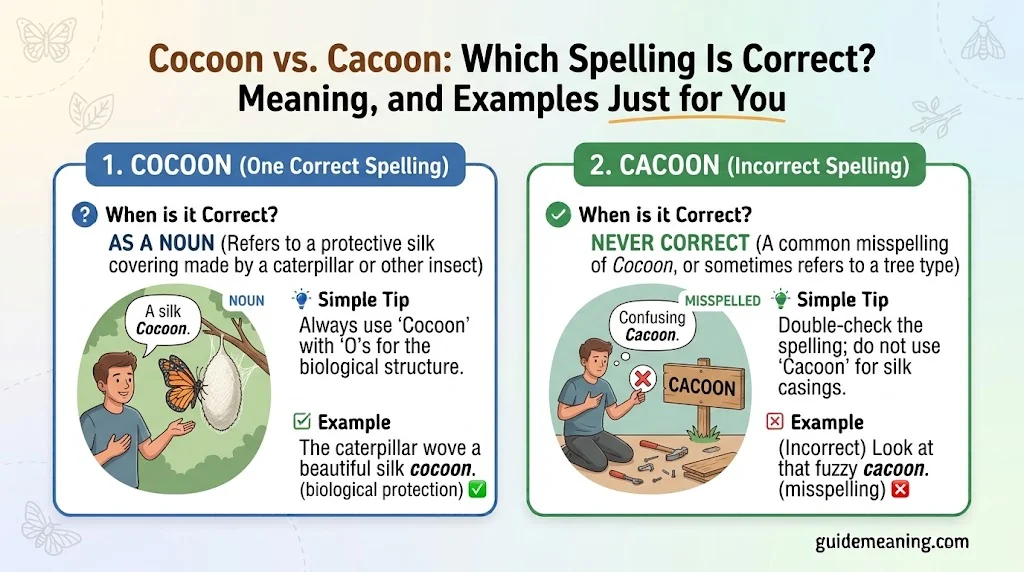

Cocoon vs. Cacoon explains why similar-looking words can confuse writers, students, and English learners when choosing the correct spelling for their writing. Have you ever typed “cacoon or cocoon” into a search box and wondered which spelling is correct? The standard English spelling is cocoon, which describes a protective covering associated with certain insects. A caterpillar may form a silky case or protective enclosure before becoming a butterfly. In science, biology, and nature, this process relates to metamorphosis, transformation, and the insect lifecycle. Understanding the context and meaning of these terms makes their difference easier to remember.
The word cocoon functions as a noun describing a protective structure. It also works as a verb meaning to envelop or protect someone or something from the outside world. This broader meaning appears in everyday language when someone seeks a safe, comfortable environment. By contrast, cacoon is generally considered a common misspelling of the insect-related term. However, it may appear in specialized botanical contexts, including names associated with certain tropical plants, seeds, or a large tropical bean linked to the West Indies. These uses connect with botany, agriculture, and legume terminology. Remember that a cocoon, pupa, and chrysalis describe different structures or stages in insect development.
From my experience reviewing spelling mistakes, this small distinction can affect clarity, accuracy, and credibility. Whether you’re writing school essays, online posts, or blogs, the wrong spelling may distract readers and change how they interpret your message. A useful guide combines clear explanations, visuals, examples, tables, and real-world references to build confidence in English writing. For better understanding, use cocoon when discussing the insect’s protective covering, and check the context when you encounter cacoon. Practical strategies and memory tricks can help learners avoid common errors, improve writing accuracy, and strengthen communication. Once you understand the correct meaning and usage, remembering the spelling becomes much simpler.
Let’s dive in!
Quick Answer: Cocoon vs. Cacoon
Cocoon is the standard spelling for an insect’s protective covering and a figurative sense of shelter or comfort. Cacoon is a rare botanical word referring to a large, beanlike seed produced by certain tropical vines. Records this specialized meaning.
Here’s the difference at a glance:
- Cocoon: A protective covering spun by certain insect larvae; also a sheltered or comfortable space.
- Cacoon: A rare botanical term for a large seed associated with a tropical vine.
- Correct everyday usage: Choose cocoon when discussing insects, protection, warmth, or isolation.
- Specialized usage: Use cacoon when the botanical meaning specifically applies.
Example: The moth formed a cocoon before emerging as an adult.
Botanical example: The naturalist recorded a cacoon seed during a study of tropical plants.
The easiest rule is simple: if you’re not discussing the specialized botanical term, you probably need cocoon.
Cocoon vs. Cacoon: Key Differences at a Glance
Although these words share similar spellings, they serve different purposes. The following table summarizes their meanings and common contexts.
| Feature | Cocoon | Cacoon |
| Standard meaning | A protective covering made by certain insect larvae | A large, beanlike seed associated with a tropical vine |
| Everyday usage | Common | Rare |
| Biological context | Insect development and metamorphosis | Plant seeds and botanical identification |
| Figurative meaning | A comfortable, sheltered, or secluded environment | No widely established everyday figurative meaning |
| Part of speech | Noun and verb | Primarily a noun |
| Common example | The caterpillar spun a cocoon. | The botanist identified a cacoon seed. |
| Recommended usage | Ordinary writing and conversation | Specialized botanical discussions |
The most important distinction concerns context. Cocoon belongs naturally in everyday conversations, educational writing, and descriptions of comfort. Cacoon belongs in a much narrower botanical context.
If you’re writing a school assignment about moths, describing a cozy bedroom, or discussing personal isolation, use cocoon. If you’re identifying a particular tropical seed, check a reliable botanical reference before choosing cacoon.
What Does Cocoon Mean?
The word cocoon has both a literal biological meaning and a figurative meaning. It can describe a physical structure that protects an insect or an environment that makes someone feel safe.
Cocoon as a Noun
In biology, a cocoon is a protective covering produced by certain insect larvae. Many moth caterpillars create cocoons from silk before entering the pupal stage of development.
Inside this covering, the insect undergoes important changes as it develops toward adulthood. The cocoon can provide physical protection from environmental conditions and some potential threats.
However, not every insect creates a cocoon. Many butterfly species form a chrysalis without spinning a separate silken covering. Although people sometimes use these terms interchangeably, they describe different structures.
Consider these examples:
- The silkworm spun a delicate cocoon around itself.
- We found a small cocoon attached to a garden branch.
- The moth emerged after completing its development inside the cocoon.
- The biology class examined several cocoons under a microscope.
Each sentence uses cocoon to describe a physical structure associated with insect development.
Cocoon in Figurative Language
Outside biology, cocoon often describes a place or situation that offers comfort, privacy, or protection. This figurative meaning draws on the idea of being enclosed in something safe.
For example, imagine returning home after a stressful week. You turn off your phone, make a warm drink, and settle beneath a soft blanket. You might describe your peaceful surroundings as a personal cocoon.
Writers also use the word to describe emotional security. A child might feel protected in a loving home, while someone recovering from a difficult experience may prefer a quiet, familiar environment.
Here are several natural examples:
- She created a cozy cocoon with blankets and pillows.
- His apartment became a peaceful cocoon away from city noise.
- After a hectic week, I wanted to retreat into my own cocoon.
- The quiet library offered a cocoon of concentration and calm.
In each case, the word suggests shelter or separation from the outside world. It doesn’t imply that a person is literally enclosed in a biological covering.
Cocoon as a Verb
Cocoon can also function as a verb. It means to surround, shelter, wrap, or isolate someone or something in a protective environment.
The verb often appears with reflexive pronouns, such as myself, yourself, or herself. These constructions emphasize that someone is creating a comfortable space for themselves.
For example:
- She cocooned herself in a thick blanket.
- He cocooned himself in his home office while finishing the project.
- Soft lighting and warm furniture cocooned the guests in comfort.
The word also appears in forms such as cocoons, cocooned, and cocooning.
| Form | Example |
| Base form | I cocoon myself in blankets during winter. |
| Third-person singular | She cocoons herself in a quiet room. |
| Past tense | He cocooned himself at home yesterday. |
| Present participle | They are cocooning during the rainy weekend. |
Notice that the spelling remains consistent across these forms. The double o stays in place, making cocoon easy to recognize once you learn it.
What Does Cacoon Mean?
Unlike cocoon, the word cacoon has a specialized meaning connected with plants. It refers to a large, beanlike seed associated with certain tropical climbing vines.
According to, the term describes the large bean of a tropical climber identified in its entry as Entada scandens. The seed has historically been used to make objects such as purses, spoons, and small containers.
The word also appears in historical dictionary entries describing seeds used for decorative and practical purposes. Some modern references associate the name with Entada rheedei, a tropical woody vine. Botanical naming can vary between sources, so scientific identification should be checked carefully.
The Botanical Meaning of Cacoon
A cacoon seed is not an insect covering. It is a plant seed, which makes the distinction between the two words especially important.
Some species of Entada produce large, durable seeds. Their tough seed coats can help them withstand conditions that would damage more delicate seeds. Certain seeds can travel through water, which explains why some are known as sea beans.
Historically, people have used large tropical seeds for crafts and decorative objects. Depending on the plant and regional tradition, seeds may become beads, ornaments, or other small items.
Keep these facts in mind:
- Plant connection: Cacoon is associated with particular tropical climbing plants.
- Seed structure: The term refers to a large, beanlike seed rather than a silky insect covering.
- Specialized usage: The word appears mainly in botanical, historical, or regional contexts.
- Limited everyday relevance: Most ordinary writing does not require this term.
Because botanical names and common names can differ by region, don’t assume every large tropical seed is a cacoon. Confirm the plant’s identity before using the word in scientific or educational writing.
Is Cacoon a Misspelling of Cocoon?
The answer depends on what you mean.
If you’re describing a moth’s protective covering, cacoon is a spelling error. The correct word is cocoon. The same rule applies when you’re describing a comfortable environment or using the word as a verb.
However, cacoon is a legitimate word in a narrow botanical sense. Calling it universally incorrect would ignore its documented meaning.
Compare these examples:
- Incorrect: The caterpillar spun a cacoon.
- Correct: The caterpillar spun a cocoon.
- Specialized usage: The botanist documented a cacoon seed.
The distinction is straightforward once you identify the subject. Insect development calls for cocoon, while a specific botanical reference may call for cacoon.
Cocoon vs. Cacoon: Examples in Sentences
Examples make the difference easier to remember. They also show how the surrounding words reveal which spelling belongs in a sentence.
Correct Examples of Cocoon
Use cocoon when describing insect development, shelter, or a protective environment.
- The moth spun a cocoon beneath the tree branch.
- A delicate cocoon hung from the underside of a leaf.
- The students learned how a silkworm produces silk for its cocoon.
- She curled up in a blanket cocoon during the storm.
- He needed a quiet cocoon after several demanding days at work.
- Warm curtains and soft lighting transformed the room into a cocoon.
- The young insect remained inside its cocoon during development.
- She cocooned herself in a sweater while reading by the window.
These examples cover both literal and figurative meanings. The first group concerns insects, while the later examples describe comfort and shelter.
Correct Examples of Cacoon
Use cacoon only when the botanical meaning fits the subject.
- The researcher consulted a historical dictionary entry for the word cacoon.
- The botanist recorded a cacoon seed during the field study.
- The museum displayed a collection of tropical seeds, including a specimen labeled cacoon.
- The writer checked a botanical reference before using the term in the report.
These sentences illustrate possible contexts rather than document specific historical events. For factual reports, verify the specimen, plant species, and terminology against the relevant source.
Incorrect Usage to Avoid
A single misplaced vowel can change the accuracy of your sentence. Here are common errors and their corrections.
| Incorrect sentence | Correct sentence | Reason |
| The moth built a cacoon. | The moth built a cocoon. | The sentence refers to an insect covering. |
| I wrapped myself in a cacoon of blankets. | I wrapped myself in a cocoon of blankets. | The word has a figurative meaning. |
| She cocooned herself in a warm cacoon. | She cocooned herself in a warm cocoon. | Both uses refer to comfort and shelter. |
| The caterpillar left its cacoon. | The caterpillar left its cocoon. | The context involves insect development. |
The best way to avoid these mistakes is to identify the meaning before checking the spelling. Context often makes the correct choice obvious.
Why Do People Confuse Cocoon and Cacoon?
The confusion is understandable. Both words have six letters, end in -coon, and look similar at a glance. When people remember a word mainly by its sound, they may substitute the wrong vowel.
Similar Pronunciation
The first syllable of cocoon is usually unstressed. In many English accents, its vowel sounds like a short, relaxed sound rather than a clearly pronounced letter name.
That can make the spelling less obvious to someone who hasn’t seen the word written frequently. However, pronunciation alone cannot tell you whether the first vowel should be an o or an a.
When in doubt, look up the word rather than relying on how it sounds. A dictionary check takes only a moment and prevents repeated mistakes.
English Spelling Isn’t Always Predictable
English spelling reflects several historical influences, including older pronunciations and borrowed words. As a result, similar sounds don’t always correspond to the same letters.
Consider balloon, saloon, and cocoon. Each word ends in the same familiar letter sequence, but its opening letters differ.
The comparison doesn’t establish a universal spelling rule. Instead, it shows why memorizing a word’s written form is often more reliable than guessing from pronunciation.
Typing Errors and Autocorrect
Fast typing can also introduce spelling mistakes. If you type cacoon while writing quickly, your spell checker may catch it, but you shouldn’t assume every tool will flag it consistently.
Voice typing can introduce another complication. Speech recognition software sometimes selects a word that sounds similar to the intended term, especially when the surrounding sentence offers little context.
To reduce these errors:
- Read the sentence again before publishing.
- Use a trusted dictionary for unfamiliar words.
- Check whether the spelling matches the intended meaning.
- Review automatic corrections instead of accepting them blindly.
- Pay extra attention to specialized terms in academic or professional writing.
A reliable proofreading habit catches more than spelling mistakes. It also helps you identify sentences where the chosen word doesn’t fit the context.
How to Remember the Correct Spelling of Cocoon
You don’t need a complicated grammar rule to remember cocoon. A simple visual association can help you recall the spelling whenever the word comes up.
Remember the Double O
The standard spelling is C-O-C-O-O-N. Notice the two consecutive o’s in the second syllable.
Picture the word printed on a biology worksheet beside an illustration of a moth. Connecting the written form with a familiar image makes the spelling easier to remember.
Connect the Word With Its Meaning
Think of a moth inside a protective cocoon. The image reinforces both the spelling and the meaning.
You can extend the association to figurative uses. A warm blanket, a quiet bedroom, or a comfortable reading nook can all suggest a personal cocoon.
Check the Context Before Choosing
Ask yourself one question: Am I talking about an insect covering, a sheltered environment, or a botanical seed?
- If the answer is an insect covering, use cocoon.
- If the answer is comfort or protection, use cocoon.
- If the answer is a specialized tropical seed, verify whether cacoon is the appropriate term.
This method works because it connects spelling to meaning rather than treating letters as an isolated memory test.
Use a Simple Memory Sentence
Try this sentence: A moth rests in a cocoon, while a cacoon is a botanical term.
It isn’t a scientific definition of every related plant species. It’s simply a reminder that the two spellings serve different purposes.
Cocoon vs. Cacoon: Common Mistakes to Avoid
Even experienced writers can confuse similar-looking words. The following mistakes are worth watching for when editing an article, school assignment, or professional document.
Treating Cacoon as an Alternative Spelling
Don’t use cacoon as a casual alternative to cocoon. Although the botanical term exists, it doesn’t replace the standard spelling in everyday contexts.
For example, a sentence about a moth should use cocoon. A sentence about a specific seed may require cacoon, provided a reliable reference supports that identification.
Assuming Cacoon Has No Legitimate Meaning
Some spelling guides dismiss cacoon as a simple typo. That explanation is incomplete because historical and modern dictionary sources record a botanical meaning.
This doesn’t mean you should use the word freely. Its specialized meaning matters only when the subject genuinely calls for it.
Confusing a Cocoon With a Chrysalis
A cocoon and a chrysalis are related to insect development, but they aren’t identical.
A cocoon is a protective covering that certain insects spin around themselves. A chrysalis is the pupal stage of a butterfly, often visible without a separate silken covering.
For example, many moth caterpillars spin cocoons, while butterflies generally form chrysalides. The exact structures vary by species, so avoid treating every insect’s development as identical.
Forgetting That Cocoon Can Be a Verb
Some writers recognize cocoon only as a noun. However, the word can also describe the act of sheltering or surrounding someone.
Compare these sentences:
- Noun: The baby moth remained inside its cocoon.
- Verb: She cocooned herself in a soft blanket.
Both uses are correct because the word’s role depends on the sentence.
Relying Only on Spell-Check Tools
Spell-check software can be useful, but it doesn’t replace an understanding of meaning. A tool may miss an error or fail to distinguish a rare term from an incorrectly chosen word.
When a word pair causes confusion, consult a dictionary and read the complete sentence. That extra step improves both spelling accuracy and clarity.
Real-World Case Study: Choosing Between Cocoon and Cacoon
Imagine a teacher preparing a worksheet about the life cycle of a moth. The worksheet says, “The caterpillar spins a cacoon before becoming an adult.”
Although students might understand the sentence, the spelling is incorrect for the intended meaning. The teacher should replace cacoon with cocoon to keep the lesson accurate.
Now consider a different situation. A museum curator prepares a display about tropical seeds and discovers a historical reference to the word cacoon. In this context, the curator shouldn’t automatically change it to cocoon. Instead, the curator should check the botanical source and confirm the specimen’s identity.
These two examples highlight an important lesson: correct spelling depends on both the word’s accepted form and its intended meaning.
What These Examples Teach Us
- Identify the subject: Determine whether you’re discussing insects, personal comfort, or plant seeds.
- Check the definition: Consult a reputable dictionary when a word has an unfamiliar meaning.
- Preserve specialized terminology: Don’t replace a legitimate technical term simply because another word looks more familiar.
- Proofread for context: A sentence can look grammatically correct while using the wrong word.
This approach helps writers avoid mistakes without oversimplifying the English language.
FAQs:
Is Cocoon or Cacoon Correct?
Cocoon is correct when referring to an insect’s protective covering or a figurative space that offers comfort and shelter. Cacoon is a rare botanical term associated with a large seed from a tropical vine. Choose the spelling that matches your intended meaning.
Is Cacoon a Real Word?
Yes, cacoon is a real but uncommon English word. Dictionaries record it as a botanical term for a large, beanlike seed associated with certain tropical climbing plants. However, it isn’t a standard alternative spelling of cocoon.
What Does Cocoon Mean?
A cocoon is a protective covering spun by certain insect larvae during development. The word can also describe a comfortable, sheltered environment. For example, someone might call a quiet bedroom their personal cocoon after a tiring day.
What Does Cacoon Mean in Botany?
In botanical terminology, cacoon refers to a large seed associated with certain tropical vines. Historical references describe its use in making small objects, including purses and containers. Because common plant names can vary, consult a reliable botanical source before identifying a particular seed as a cacoon.
How Do You Spell Cocoon Correctly?
The correct spelling is C-O-C-O-O-N. Remember the two consecutive o’s in the second syllable. If you’re describing a moth’s protective covering or a comfortable retreat, use cocoon rather than cacoon.
Are Cocoon and Chrysalis the Same Thing?
No, although both terms relate to insect development. A cocoon is a protective covering spun by certain insects, while a chrysalis is the pupal stage of a butterfly. Many moths form cocoons, but butterflies generally develop in chrysalides without spinning a separate cocoon.
Can You Use Cocoon as a Verb?
Yes. Cocoon can function as a verb meaning to shelter, surround, or wrap someone in a protective environment. For example, you might say, “She cocooned herself in a blanket while reading.” The related forms include cocoons, cocooned, and cocooning.
Conclusion:
The difference between cocoon vs. cacoon becomes clear once you understand their meanings. Cocoon is the standard word for the protective covering made by certain insects. It also describes a comfortable, sheltered space and can function as a verb.Cacoon, meanwhile, has a rare botanical meaning connected with the seeds of certain tropical climbing plants. Although you probably won’t need it in everyday writing, recognizing its specialized use prevents an oversimplified spelling rule.When you’re unsure, focus on the subject of your sentence. If you’re discussing moths, insect development, warmth, or personal comfort, choose cocoon. Reserve cacoon for situations where a reliable botanical reference confirms that it’s the appropriate term.