
If So vs. If Yes helps English learners understand how these expressions connect earlier ideas with later responses in different situations.
The main difference between if so and if yes depends on their meaning, context, and purpose. In English grammar, “if so” is a flexible phrase that refers back to a previous question, statement, or condition. It means “if that is the case” or “if that is true.” However, “if yes” has a more limited use because it focuses on a positive answer. These conditional expressions influence sentence structure, sentence flow, and tone. Understanding these subtle differences helps you choose the right expression instead of treating both phrases as identical or fully interchangeable.
In everyday conversations, emails, formal writing, and professional communication, native speakers often prefer “if so” because it creates smoother sentence connections. For example, “Are you interested in the course? If so, please register today” refers back to the earlier question and introduces a condition. On the other hand, “Did you complete the payment? If yes, upload the receipt” gives a direct instruction and expects a clear answer. You may also see these phrases in forms, surveys, questionnaires, and instructional writing. A question about joining a party inside provides another practical example. A definitive yes may lead to “if yes,” while “if so” can refer to the wider situation. These grammar tips explain if so usage and if yes explanation. They also show how word choice, context clues, and expression choice make your writing clearer in formal language, casual forms, professional settings, and informal conversations. When a longer phrase mentioned earlier needs a shorter reference, “if so” can replace it. Meanwhile, “if yes” works when the intended response is specifically affirmative.
A practical way to remember the central distinction is to check what comes after a question and what you want to express. If you refer to a previous situation or a statement connected to a condition, “if so” usually fits. If you answer a direct yes-or-no question, “if yes” may be clearer. In my experience, real-life situations help English learners understand these differences and reduce confusion and misunderstandings. Practising both expressions can strengthen your writing skills, speaking skills, spoken English, English writing, English speaking, email writing, and daily communication skills. Regular language learning, language development, language improvement, and language mastery help you communicate more naturally. As you keep developing and mastering language, you can craft clear, persuasive, and authentic messages that resonate with your audience. This practical approach improves overall fluency and communication confidence while helping you create precise, effective, and meaningful messages with greater clarity. Using these phrases properly makes your writing and speaking more grammatically correct and helps you handle questions, answers, and instructions in everyday communication with fewer awkward writing choices and less unnecessary repetition.
Let’s dive in!
Quick Answer
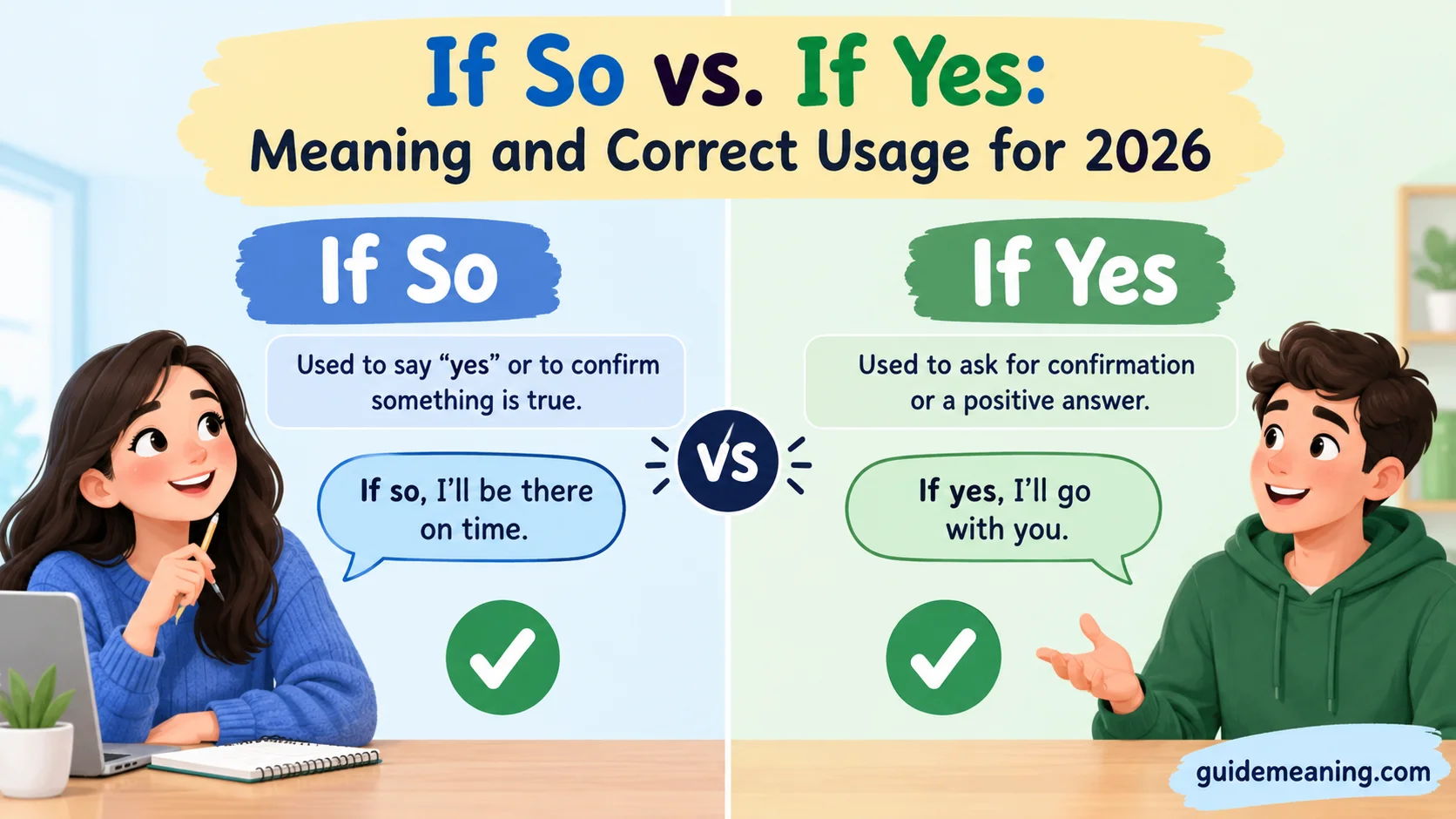
“If so” is generally the more natural and widely used expression in American English. It means “if that is the case,” while “if yes” means “if the answer is yes.” Use “if so” to refer to a previously mentioned situation and “if yes” when explicitly referring to an affirmative answer.
TL;DR
- If so means “if that is the case.”
- If yes means “if the answer is yes.”
- “If so” usually sounds smoother in everyday American English.
- “If yes” can emphasize an explicit yes-or-no answer.
- Both expressions introduce a condition and depend on context.
- In formal writing, choose the phrase that makes your meaning clearest.
What Does “If So” Mean?
“If so” means “if that is true,” “if that is the case,” or “if the situation is as described.” It refers to information mentioned earlier, so you don’t need to repeat the entire idea. This makes the phrase useful in conversations, emails, and formal writing.
How to Use “If So”
Use “if so” when the next sentence depends on a previously stated fact, possibility, or condition.
For example:
- Are you feeling better? If so, you can return to work.
- The store may close early. If so, we should leave now.
- Did you receive my message? If so, please reply today.
- She might already know the answer. If so, there’s no need to explain it again.
- Is everyone ready? If so, let’s begin.
Notice how “if so” connects the next action to the earlier information. It doesn’t necessarily mean someone said the word “yes.”
Why “If So” Sounds Natural
English speakers often use short expressions to avoid repeating information. Here, “so” stands for the idea already mentioned.
Compare these sentences:
Repetitive: Are you available tomorrow? If you are available tomorrow, we can meet.
Natural: Are you available tomorrow? If so, we can meet.
Both sentences communicate the same idea. However, the second sounds smoother and more concise.
What Does “If Yes” Mean?
“If yes” means “if the answer is yes.” It refers directly to an affirmative response rather than broadly referring to a situation. You’ll often see it in forms, surveys, instructions, and other settings that require a clear yes-or-no answer.
How to Use “If Yes”
Use “if yes” when a question expects an explicit answer and the next step depends on that answer.
For example:
- Do you have any allergies? If yes, list them below.
- Have you completed the application? If yes, click Submit.
- Do you need additional assistance? If yes, contact our support team.
- Have you worked for this company before? If yes, provide your employment dates.
- Is this your first visit? If yes, complete the registration form.
In these examples, “if yes” connects an affirmative answer to a specific instruction. That makes it especially useful in structured communication.
Where “If Yes” Appears Most Often
You might encounter this expression in several everyday situations.
- Online forms: If yes, enter your account information.
- Surveys: If yes, select your preferred option.
- Job applications: If yes, provide your previous position.
- Instruction manuals: If yes, continue to the next step.
- Customer support: If yes, describe the problem below.
Although “if yes” is grammatically acceptable, it can sound stiff in casual conversation. Therefore, “if so” often works better when you’re speaking naturally.
What Is the Difference Between “If So” and “If Yes”?
The main difference is what each phrase refers to. “If so” points back to an earlier idea or situation, while “if yes” points specifically to an affirmative answer. Both can follow yes-or-no questions, but their tone and emphasis differ.
| Feature | If So | If Yes |
| Basic meaning | If that is the case | If the answer is yes |
| Main purpose | Refers back to an idea or condition | Refers to an affirmative response |
| Everyday conversation | Usually sounds natural | Can sound overly formal |
| Forms and surveys | Works in many contexts | Often suits direct instructions |
| Previous statement required | Usually needs clear context | Needs a clear yes-or-no context |
| Use after a possibility | Often natural | Usually awkward |
Compare the Phrases Side by Side
Consider this question:
Are you available tomorrow?
- If so, let’s schedule a meeting. This sounds natural and conversational.
- If yes, select an available time. This sounds appropriate for a scheduling form.
Both sentences are understandable. However, the first focuses on availability, while the second emphasizes the respondent’s affirmative answer.
Now consider a statement instead of a question:
The office might close early today.
- If so, we’ll work from home. This is natural because the phrase refers to the possible closure.
- If yes, we’ll work from home. This sounds awkward because nobody has asked a yes-or-no question.
That distinction provides a reliable starting point when choosing between the expressions.
When Should You Use “If So” or “If Yes”?
The best choice depends on your audience, purpose, and sentence structure. In American English, “if so” is usually the safer option for ordinary writing, while “if yes” works well for direct instructions.
Use “If So” for Everyday Communication
Choose “if so” when you want your writing to sound clear, relaxed, and natural.
For example:
- Are you free this weekend? If so, let’s grab lunch.
- Did the package arrive? If so, please bring it inside.
- The meeting may start earlier. If so, I’ll let everyone know.
- Your password might have expired. If so, reset it before signing in.
The phrase also works after statements that describe possibilities. You don’t need to ask a question first.
Use “If Yes” for Direct Instructions
Choose “if yes” when readers must answer a question before following an instruction.
For example:
- Have you read the agreement? If yes, click Continue.
- Do you need a receipt? If yes, select the box below.
- Are you applying for the first time? If yes, complete Section A.
In these cases, the phrase makes the decision process easy to follow. It also fits interfaces where users select “Yes” or “No.”
Can You Use Both After the Same Question?
Yes, sometimes. The difference often concerns emphasis rather than strict grammatical correctness.
For example:
Question: Have you finished your report?
- If so, send it to your manager.
- If yes, select the completed option on the form.
Both can be correct, but each fits a different context. The first sounds like ordinary workplace communication, while the second sounds more procedural.
“If So” vs. “If Yes” in American and British English
American and British English generally follow the same usage pattern for these phrases. Neither expression belongs exclusively to one variety of English. Instead, the choice depends on the situation and the tone.
Usage in American English
In the United States, “if so” appears naturally in conversations, workplace emails, news writing, and everyday explanations.
For example:
“Are you joining us for dinner? If so, I’ll save you a seat.”
Meanwhile, “if yes” commonly appears in forms and step-by-step instructions.
“Have you registered? If yes, proceed to the next page.”
Usage in British English
British English follows the same basic distinction.
For example:
“Have you finished the assignment? If so, send it to your tutor.”
Likewise, a British questionnaire might say:
“Do you require assistance? If yes, complete this section.”
Therefore, you don’t need to learn separate rules for American and British English. Focus on meaning and context instead.
Common Mistakes When Using “If So” and “If Yes”
These expressions are easy to confuse because both introduce conditions. However, a few common mistakes can make your writing sound unnatural or unclear.
Using “If Yes” After a Statement
Incorrect or awkward: The office may close early. If yes, we’ll leave at three.
Better: The office may close early. If so, we’ll leave at three.
The first sentence describes a possibility rather than asking a direct question. Therefore, “if so” provides the more natural connection.
Using “If So” Without Clear Context
Unclear: If so, please contact me.
Better: Did you receive the documents? If so, please contact me.
The first version leaves readers wondering what “so” refers to. Add the earlier statement or question to make the condition clear.
Confusing “If Yes” With “Whether”
Incorrect: I don’t know if yes she will attend.
Better: I don’t know whether she will attend.
You can also write, “I don’t know if she will attend.” Here, “if” introduces an indirect yes-or-no question. However, “if yes” doesn’t work as a substitute for that grammatical structure.
Assuming “If Yes” Is Always Wrong
“If yes” isn’t grammatically incorrect simply because it’s less common in casual speech. It works well when the affirmative answer itself matters.
For example: “Do you need a parking permit? If yes, submit your application today.”
The key is choosing language that fits the task rather than treating one phrase as universally correct.
Punctuation and Sentence Structure
Both expressions follow ordinary punctuation rules. When either phrase begins a sentence, place a comma after it.
Correct Punctuation Examples
- If so, we can continue with the next step.
- If yes, enter your details below.
- We can continue and, if so, finish before noon.
- Please select an option and, if yes, provide additional information.
When a phrase appears inside a sentence, punctuation depends on the surrounding structure. You don’t need special punctuation rules just because the phrase contains “so” or “yes.”
Can You Use Them in Formal Writing?
Yes. Both expressions are acceptable in formal writing when used appropriately.
However, “if so” often works better in reports, business emails, and professional explanations because it refers naturally to an earlier statement. “If yes” is especially useful in questionnaires, instructions, and decision-based documents.
For maximum clarity, make sure readers can identify the condition or question being referenced.
FAQs:
What is the main difference between “if so” and “if yes”?
“If so” refers to a previous statement, situation, or condition. “If yes” specifically refers to an affirmative answer. Both expressions can connect ideas, but their meanings depend on context.
Is “if so” grammatically correct?
Yes, “if so” is grammatically correct and widely used in everyday and formal English. It means “if that is the case” or “if that is true.”
Is “if yes” grammatically correct?
Yes, “if yes” is grammatically correct, especially when referring to a direct yes-or-no question. For example, “Did you submit the form? If yes, please wait for confirmation.”
Which expression is more common in everyday English?
“If so” often sounds more natural because it refers to an earlier statement or situation. However, “if yes” works well when you want to emphasize a positive answer.
Can I use “if so” and “if yes” interchangeably?
Not always. “If so” can refer to a broader situation, while “if yes” specifically points to an affirmative response. Choosing the right expression helps make your meaning clear.
Should I use “if so” in formal writing?
Yes, “if so” works well in professional emails, reports, instructions, and other formal writing. It connects ideas smoothly without repeating an entire statement.
Can I use “if yes” in emails and questionnaires?
Yes, “if yes” is useful in emails, surveys, forms, and questionnaires that require a clear positive response. For example, “Are you available on Monday? If yes, please confirm your attendance.”
Conclusion:
Understanding If So vs. If Yes helps you choose the right expression for different situations. Use “if so” when referring to a previous statement, situation, or condition. Choose “if yes” when you specifically mean that the answer to a yes-or-no question is positive.
Both expressions are grammatically correct, but they serve slightly different purposes. By considering the context and your intended meaning, you can write clearer sentences, communicate more naturally, and avoid unnecessary repetition in everyday conversations, emails, and professional writing.