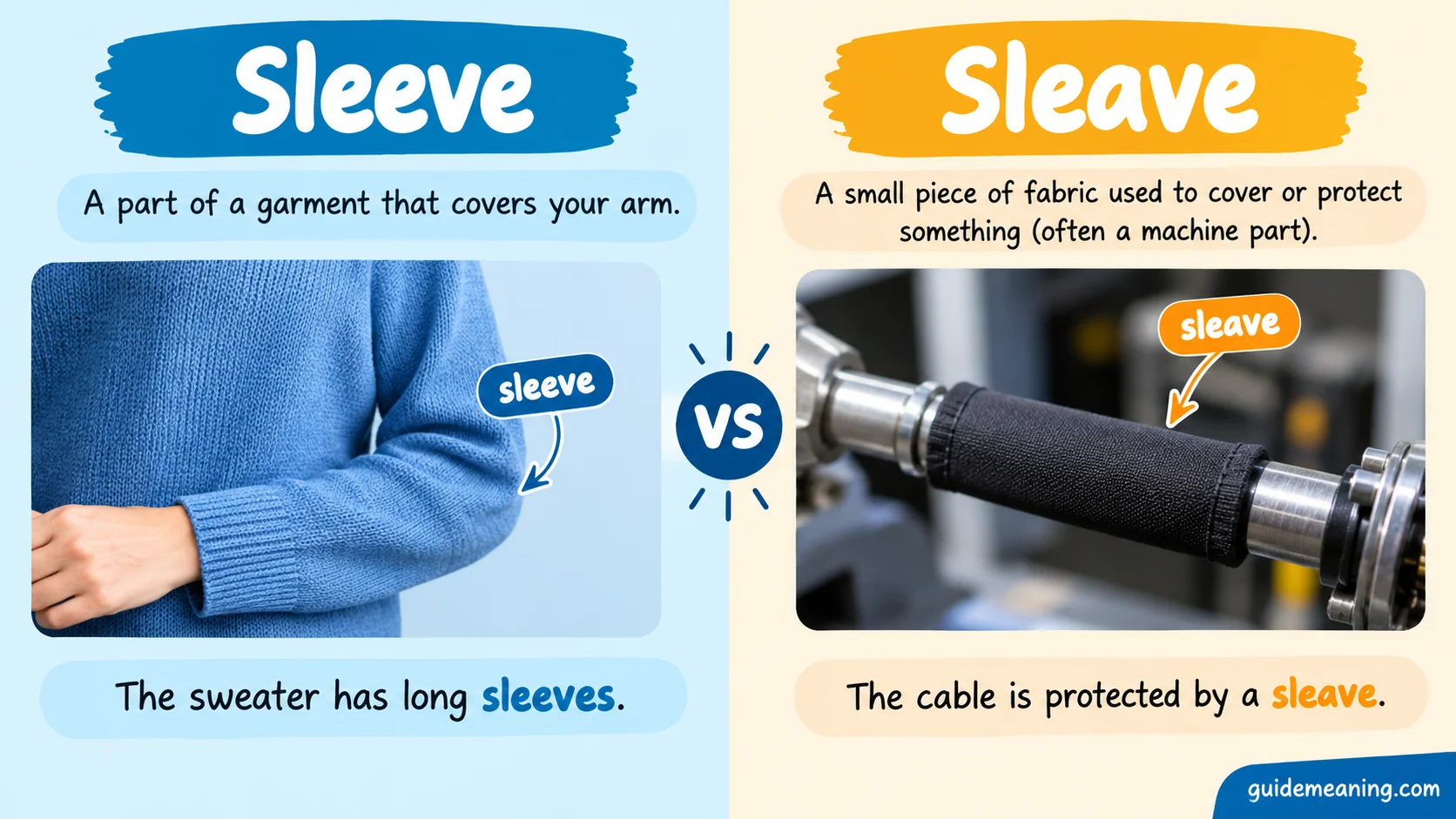

Sleeve vs. Sleave can be confusing when two similar-looking words sound alike, but only one fits everyday clothing contexts correctly.
Imagine typing a quick message to a friend about buying a new jacket online. You write, “I love the long sleaves on this coat.” A few minutes later, autocorrect underlines the word, and you pause. This tiny detail can confuse English learners and native speakers because sleeve and sleave look almost identical. Their pronunciation may sound the same, but their meanings, spellings, and histories differ. Recognizing this spelling difference helps you choose the right word confidently.
In everyday English, sleeve is the correct spelling for the part of a shirt, jacket, coat, dress, or other garment that covers the arm. It is widely used in clothing, engineering, sports, and other contexts. For example, “short sleeve shirt” is correct, while “short sleave shirt” contains a spelling error. Spell-checkers may miss this mistake because sleave is a real English word, although it is not interchangeable with sleeve. Historically, sleave referred to silk, thread, or loosely twisted material in textile contexts. Today, it is an extremely rare, archaic literary term found mainly in old literary language, historical references, and famous works such as those by Shakespeare. In nearly every modern situation, sleeve is the straightforward choice. Understanding the distinction helps writers avoid common spelling mistakes, improve communication, and write with confidence.
Let’s dive in!
Quick Answer:
In American English, sleeve is the correct spelling for clothing, protective coverings, and related uses. Sleave is a rare, historical word associated with silk fibers and tangled threads, not a standard alternative for a garment.
TL;DR
- Sleeve means the part of clothing that covers the arm.
- Sleave refers mainly to fine, untwisted, or tangled silk threads.
- Both words have historical roots, but their meanings differ.
- American and British English both use sleeve for clothing.
- Use sleeves as the regular plural of sleeve.
- Shakespeare’s writing helped preserve the older word sleave in literature.
What Does Sleeve Mean?
A sleeve is the part of a garment that covers some or all of an arm. Its design can vary depending on the clothing, fashion trend, season, or intended activity.
In everyday American English, the word also describes tube-shaped protective coverings. These coverings may protect objects from dust, scratches, heat, or other forms of damage.
Common Uses of Sleeve
The word appears in many everyday situations, including:
- Clothing, such as shirts, sweaters, coats, and dresses.
- Protective covers for laptops, books, and vinyl records.
- Insulating or protective tubes around electrical cables.
- Mechanical parts designed to fit over rods or other components.
- Figurative expressions involving hidden plans, resources, or advantages.
For example, you might say, “My jacket sleeve is too long.” Similarly, “I bought a protective sleeve for my laptop” uses the same word for a different purpose.
Common Sleeve Types
Sleeves come in different styles and serve different functions. For clothing, their names often describe length, shape, or construction.
- Short sleeve: Covers the upper part of the arm.
- Long sleeve: Usually extends toward the wrist.
- Sleeveless: Describes clothing designed without sleeves.
- Rolled-up sleeve: A sleeve folded back for comfort or convenience.
- Bell sleeve: A sleeve that widens toward its opening.
These variations don’t change the spelling. Whether you’re describing a fitted shirt or a flowing dress, sleeve remains the correct word.
What Does Sleave Mean?
Sleave is an uncommon English word connected with silk fibers and thread. Dictionaries record it as a noun and, in historical usage, as a verb related to separating fibers.
Unlike sleeve, it isn’t the word you want when describing clothing. Its use today is largely limited to historical writing, specialized textile discussions, and literary references.
Historical Meaning of Sleave
Historically, sleave could describe silk that had not been twisted into a finished thread. It could also refer to fine fibers or material that had become tangled.
The related verb to sleave meant to separate or divide threads into individual strands. These meanings reflect older textile work, when preparing and handling fibers required considerable manual skill.
Sleave in Literature
One of the best-known appearances of the word occurs in William Shakespeare’s Macbeth. In Act 2, Scene 2, Macbeth describes sleep as something that “knits up the ravell’d sleave of care.”
The image compares sleep to untangling a complicated bundle of thread. In this passage, sleave helps express how rest can ease the mental strain of daily life.
However, the word is unusual in modern conversation. Most American readers encounter it through Shakespeare or historical dictionaries rather than everyday writing.
Sleeve vs. Sleave: Key Differences
The main difference between these words is their meaning, not simply their spelling. Although they look nearly identical, they serve different purposes in English.
Comparison Table
| Feature | Sleeve | Sleave |
| Main meaning | Part of a garment covering the arm | Fine, untwisted, or tangled silk thread |
| Modern usage | Very common | Rare or historical |
| Clothing context | Correct | Incorrect in ordinary usage |
| Historical connection | Garments and protective coverings | Textile fibers and tangled thread |
| Example | She rolled up her sleeve. | The old passage describes tangled sleave. |
| Word forms | Sleeves, sleeved, sleeveless | Sleaved, sleaving, in historical usage |
Which Word Should You Choose?
Use sleeve whenever you’re discussing clothing or a protective covering. Choose sleave only when the context specifically calls for its uncommon textile meaning.
For example, “The shirt has a torn sleeve” is correct. Writing “The shirt has a torn sleave” would be a spelling error in ordinary modern English.
Why Do People Confuse Sleeve and Sleave?
These words are easy to mix up because they differ by only one letter. Their similar appearance and pronunciation can make the wrong spelling seem reasonable.
Similar Sounds, Different Spellings
In many American English accents, both words are pronounced like “sleev.” As a result, hearing the word aloud usually won’t tell you which spelling belongs in a sentence.
English often represents similar sounds with different letter combinations. For example, green and great use the same vowel letters but have different vowel sounds.
With sleeve and sleave, the problem works differently: the spellings look different, but the words can sound alike. Therefore, meaning and context provide the most reliable clues.
How to Remember the Correct Spelling
Try connecting sleeve with familiar clothing words and phrases. This simple habit makes the standard spelling easier to remember.
- A shirt has sleeves.
- A jacket has sleeves.
- A laptop can have a protective sleeve.
- A sleeveless dress has no sleeves.
Remember that sleave belongs to a much narrower historical vocabulary. Unless you’re discussing old textile terminology, sleeve is almost certainly the word you need.
Is Sleeve or Sleave Correct in American English?
For everyday American English, sleeve is correct when you mean a garment part or protective covering. The word appears in clothing catalogs, school assignments, product descriptions, and ordinary conversation.
However, saying that sleave is not a word at all would be inaccurate. Established dictionaries recognize it, although its uses are rare, specialized, or old-fashioned.
American vs. British English
There is no standard American-British spelling difference for the clothing term. Both varieties use sleeve and its regular plural, sleeves.
The historical word sleave has appeared in both varieties of English dictionaries. Its pronunciation and precise description may vary between references, but it isn’t a regional alternative for a shirt sleeve.
Everyday Examples
Consider these sentences:
- American English: “I prefer long-sleeve shirts in winter.”
- British English: “The coat has a loose sleeve.”
- American English: “Keep the vinyl record inside its sleeve.”
- Historical usage: “The poem uses sleave to describe tangled silk.”
Notice that the ordinary examples all use sleeve. The historical example uses sleave for its specialized meaning.
Historical Origins of Sleeve and Sleave
Although the two words look related, their recorded histories point toward different meanings. Understanding those histories explains why neither spelling should automatically replace the other.
Where the Word Sleeve Comes From
Sleeve has a long history in English. Dictionaries trace it through Middle English to Old English forms that referred to the arm-covering part of a garment.
Its meaning fits the basic purpose of clothing: covering and protecting the body. Over time, the word also developed broader uses for objects shaped like tubes or coverings.
For instance, modern English uses sleeve for protective cases and mechanical components. These meanings grew from the idea of something that fits around another object.
Where the Word Sleave Comes From
Sleave has a separate historical path connected with dividing or separating fibers. Its recorded origins reach back to Old English forms associated with splitting or separating material.
The word later became associated with fine silk, loose fibers, and tangled threads. These meanings made it useful in textile descriptions and figurative literary language.
However, its everyday relevance declined as the specialized term became less familiar. Today, readers are much more likely to see sleeve in daily life.
How Sleeve Is Used in American Culture
In the United States, sleeves are part of everyday clothing, workwear, uniforms, and personal style. Their appearance can communicate practical needs or fashion preferences, although no single meaning applies to every person.
Clothing and Personal Expression
Sleeve styles often influence how an outfit looks and feels. A long sleeve may provide warmth, while a sleeveless design can feel more suitable for hot weather.
In American workplaces, uniforms and dress codes sometimes specify sleeve length or coverage. However, these expectations vary by employer, occupation, and setting.
Figurative Expressions in American English
The word sleeve also appears in familiar expressions that have nothing to do with clothing.
- Roll up your sleeves: Prepare to work hard or tackle a task.
- Have something up your sleeve: Keep a plan or surprise hidden.
- Wear your heart on your sleeve: Show your feelings openly.
- Laugh up your sleeve: Find something amusing without openly showing it.
These expressions make sleeve useful in both literal and figurative writing. By contrast, sleave doesn’t normally appear in these expressions.
Sleeve in Fashion, Technology, and Everyday Life
The meaning of sleeve extends beyond shirts and jackets. In modern American English, it can describe protective products and components across several industries.
Fashion and Accessories
Fashion designers use sleeve length, shape, and material to change a garment’s appearance. For example, puff sleeves can create a fuller silhouette, while fitted sleeves produce a more streamlined look.
Sleeve design also affects comfort and movement. Athletic clothing, winter coats, and formal wear may use different constructions to meet different needs.
Technology and Protective Covers
Outside fashion, sleeves often protect valuable or delicate objects. Their function depends on the material and the item they cover.
Examples include:
- Laptop sleeves that help protect computers during transport.
- Record sleeves that hold vinyl albums.
- Cable sleeves that organize or protect wires.
- Book sleeves that help prevent scratches and surface damage.
These uses all follow the same basic idea. A sleeve fits around something to provide coverage, organization, or protection.
Does Sleeve Have a Symbolic Meaning?
A sleeve doesn’t have one universal symbolic meaning. However, clothing and the expressions built around sleeves can carry personal, social, or cultural associations.
Personal Style and Identity
In the United States, clothing often helps people express their tastes and identities. Sleeve length, fabric, and design can contribute to that expression.
For example, a person might choose a long-sleeve shirt for comfort, modesty, warmth, or personal preference. Someone else might choose short sleeves for convenience or a relaxed look.
These choices don’t automatically reveal a person’s beliefs or personality. Context matters, and the wearer may have a practical reason for choosing a particular design.
Figurative Meaning
Expressions involving sleeves can carry stronger symbolic associations than the garment itself.
“Wear your heart on your sleeve” suggests openness and emotional honesty. Meanwhile, “have something up your sleeve” suggests secrecy, preparation, or a hidden advantage.
These meanings come from established English expressions rather than a universal spiritual tradition. Therefore, it’s best to interpret them through their wording and context.
Common Mistakes When Using Sleeve and Sleave
The most frequent mistake is writing sleave when describing clothing. Because both spellings are legitimate words, a basic spelling checker may not always identify the intended meaning.
Incorrect and Correct Examples
| Incorrect or Unclear | Correct Version | Explanation |
| My shirt has a short sleave. | My shirt has a short sleeve. | Clothing requires sleeve. |
| She rolled up her sleaves. | She rolled up her sleeves. | The plural is sleeves. |
| I bought a laptop sleave. | I bought a laptop sleeve. | A protective cover is a sleeve. |
| The dress is sleaveless. | The dress is sleeveless. | The standard adjective is sleeveless. |
| He wore a long sleave shirt. | He wore a long-sleeve shirt. | The clothing term uses sleeve. |
Watch Out for Related Forms
Remember that sleeve has several common forms. The correct choice depends on the sentence.
- Sleeves: The regular plural noun.
- Sleeved: An adjective describing something fitted with sleeves.
- Sleeveless: An adjective describing clothing without sleeves.
- Sleeving: The act of fitting or covering something with a sleeve, depending on context.
For example, “The dress is sleeveless” is correct. Writing “sleaveless” would be a spelling mistake.
How the Meanings of Sleeve and Sleave Have Changed
The history of these words shows how vocabulary changes as everyday practices change. One remains common because its meaning applies to clothing and many modern objects, while the other survives mainly in specialized contexts.
From Traditional Textiles to Modern English
Historically, textile work required words for different fibers, threads, and methods of preparation. Sleave served a purpose in that vocabulary, particularly when describing loose or tangled silk.
As language changed, many specialized textile terms became less familiar to general readers. Nevertheless, older words can remain in dictionaries and literature long after their everyday use declines.
Why Sleeve Remains Common
The word sleeve continues to describe familiar clothing features and protective coverings. Its figurative expressions also keep it active in conversation, books, and media.
By contrast, sleave has fewer everyday applications. Its survival in literary passages and historical references doesn’t make it an alternative spelling for clothing.
This is a useful reminder that a word can be genuine without being appropriate for every context.
FAQs:
Is it sleeve or sleave?
Sleeve is correct when referring to the part of a garment that covers your arm. Sleave is a rare historical word with a different meaning.
What does sleeve mean?
A sleeve is the part of a shirt, jacket, coat, or dress that covers all or part of your arm. For example, “My shirt has long sleeves.”
Is sleave a real English word?
Yes, sleave is a real English word. It historically referred to silk, thread, or loosely twisted material, but it is rarely used in modern English.
Why do people confuse sleeve and sleave?
People confuse these words because their spellings differ by only one letter, and their pronunciation can sound similar. However, their meanings and common usage are different.
Is it short sleeve or short sleave?
Short sleeve is correct. For example, “I bought a short-sleeve shirt.” The spelling “short sleave” is incorrect when referring to clothing.
Does sleave appear in literature?
Yes, sleave appears in historical and literary contexts, including works associated with Shakespeare. Its use is uncommon today, so most readers will rarely encounter it.
How can I remember the correct spelling of sleeve?
Connect sleeve with clothing, such as a shirt sleeve or jacket sleeve. When writing about something that covers your arm, choose sleeve, not sleave.
Conclusion:
The difference between sleeve vs. sleave comes down to their meanings and everyday usage. Sleeve is the correct word for the part of a shirt, jacket, coat, or dress that covers your arm. Sleave, however, is a rare historical word associated with silk, thread, and loosely twisted material. You may encounter it in older literary texts, but it is uncommon in modern English.
To avoid spelling mistakes, remember to use sleeve when writing about clothing. Although both words look and sound similar, they are not interchangeable. Understanding their meanings helps you write clearly and confidently.