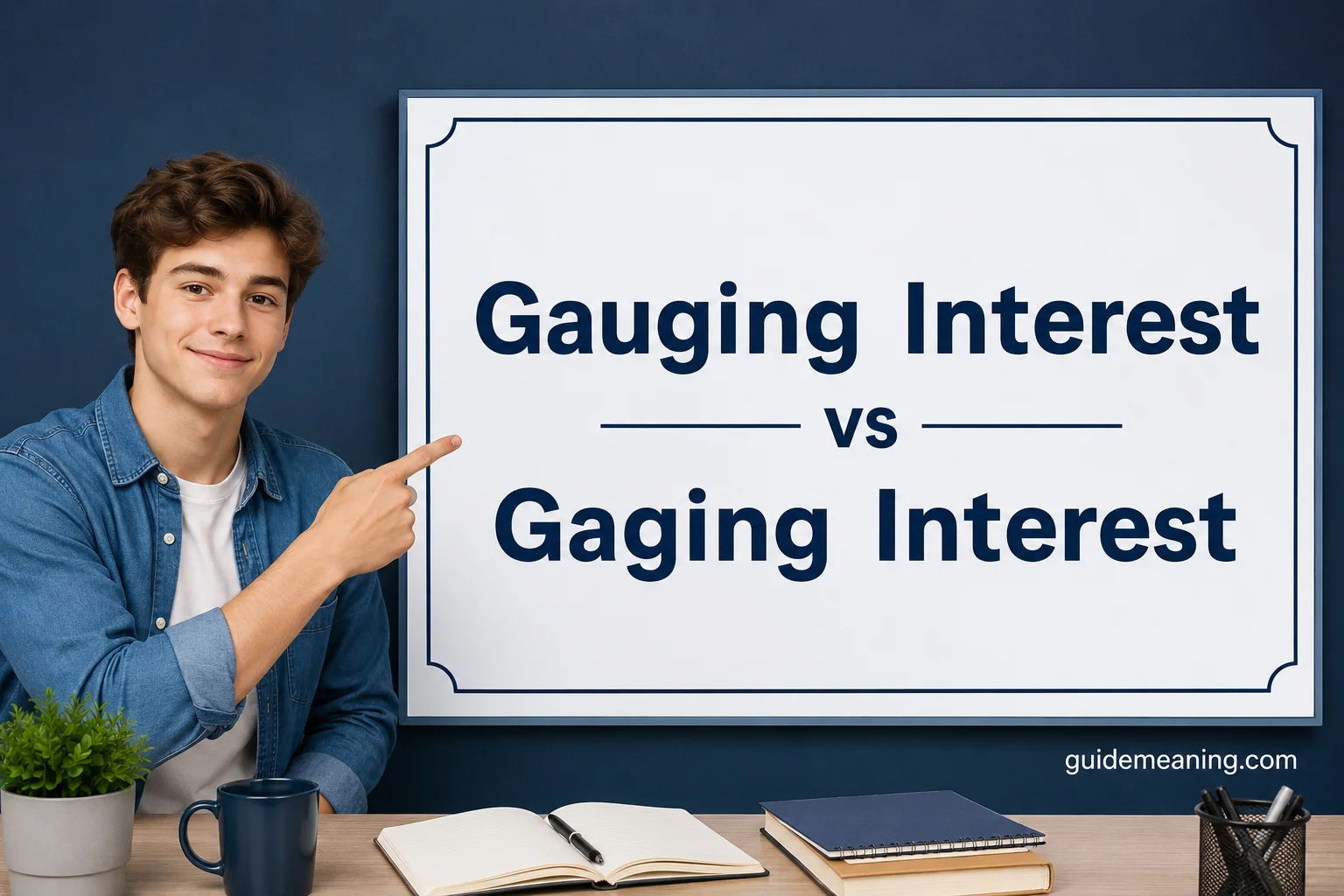

The difference between Gauging Interest vs Gaging Interest is mainly a matter of spelling, usage, and modern US English preference.
Gauging interest is the more common and preferred expression, while gaging interest is a less common variant that may cause a mix-up for beginners. The verb gauge means to assess, estimate, or determine something. When you add -ing, it becomes gauging, which can look unusual because the spelling changes from gauge to gauging. Although gage exists as an alternate spelling, gauging remains the clearer choice in most professional writing, academic settings, and everyday English.
In business, marketing, and professional writing, gauging interest means finding out how interested people are in something. You might use the phrase when discussing a new product, business idea, event, service, proposal, email, or campaign. For example, a company may send a survey to start market research and gauge how many customers want a new service. Choosing gauging interest usually improves clarity, accuracy, readability, and effective communication. While gaging interest isn’t impossible to encounter, it looks less familiar to many readers and isn’t the best choice for most formal writing.
To avoid confusion, remember that gauge is the standard form you’ll usually want when writing about measuring or assessing interest. Understanding the definitions, grammar, historical-context, and usage makes the spelling easier to remember. Style guides, editorial-standards, and regular writing-skills can also improve language-precision, context-awareness, and textual-clarity. Whether you’re writing for business, academic contexts, or casual contexts, choose gauging interest when you mean assessing someone’s level of interest. With a few easy tips and practical examples, you’ll feel more confident using the word correctly.
Let’s jump in!
Quick Answer:
Gauging Interest vs Gaging Interest comes down mainly to spelling preference. Gauging interest is the standard and strongly preferred form in modern American English, while gaging interest reflects a less common variant of gauge.
TL;DR:
- Gauging interest is the preferred spelling in general American English.
- Gaging interest is a recognized but uncommon spelling variant.
- Both forms refer to assessing or estimating someone’s interest.
- Gauge has been the dominant general spelling for centuries.
- The phrase is common in business, events, surveys, and everyday conversation.
- Use gauging interest when you want the safest modern choice.
What Does “Gauging Interest” Mean?
The phrase describes an attempt to determine how interested someone is. The “measurement” isn’t usually physical, though the underlying idea comes from measurement.
Simple Meaning
When you’re gauging interest, you’re trying to assess people’s reactions, opinions, or enthusiasm.
For example:
We’re gauging interest in a new weekend workshop.
This means the organizers want to know whether people would actually like to attend.
The phrase can apply to individuals, groups, customers, employees, readers, voters, students, or potential participants.
Common Examples
You might hear the phrase in situations such as:
- A company asking customers about a possible new product.
- A teacher asking students about an optional class.
- An event organizer checking potential attendance.
- A writer asking readers whether they’d enjoy a new topic.
- A community group considering a proposed activity.
In each case, the goal is similar: find out how much interest exists before taking the next step.
Is “Gauging Interest” or “Gaging Interest” Correct?
For most American English writing, gauging interest is the better choice. It follows the standard spelling of the verb gauge.
The Preferred Form
The standard pattern is:
gauge → gauging
So you would write:
We are gauging interest in the proposal.
You could also write:
The team is gauging customer interest.
This spelling looks familiar to most readers and fits ordinary professional writing.
The Less Common Form
Gaging comes from the alternative spelling gage.
Therefore, the relationship is technically understandable:
gage → gaging
However, gage is much less common in general writing. Merriam-Webster lists it as a variant of gauge, while noting that gauge is by far the preferred general form.
For that reason, gaging interest may look unusual or even like a spelling mistake to many American readers.
Why Is “Gauging” Spelled With a U?
The unusual-looking spelling comes from the long history of the word gauge. English spelling wasn’t always standardized, so older forms of the word appeared in several spellings.
The History of Gauge
The noun gauge dates back to the 15th century. It developed through French forms associated with measurement and standards.
Over time, English settled around gauge as the dominant spelling.
However, gage survived as an alternative form. Both spellings can therefore be traced through the history of English.
Why the U Stayed
The “u” isn’t added because the word is pronounced differently. Gauge and gage have the same pronunciation in ordinary American English.
Instead, the difference is historical spelling.
English contains many words whose spelling preserves older forms. In this case, gauge became the established everyday spelling, while gage remained a less common alternative.
What Is the Difference Between Gauge and Gage?
The two words can overlap, but their usage patterns aren’t identical. Understanding this distinction makes the spelling question much easier.
Gauge as a Verb
Gauge means to measure, estimate, judge, or assess something.
For example:
She gauged his reaction carefully.
Here, she assessed his reaction rather than physically measuring it.
Similarly:
We need to gauge public interest first.
The meaning is to estimate or assess that interest.
Gage as a Variant
Gage can function as a variant spelling of gauge. It isn’t simply an invented mistake.
However, its use is much more limited in ordinary modern writing. It can appear in specialized or technical contexts and in historical or established terminology.
That distinction matters because a word can be legitimate without being the most natural choice everywhere.
How Did “Gauge” Become the Standard Spelling?
The history of gauge helps explain why both spellings still exist. It also shows why modern writers generally favor one form.
Early English Usage
The word entered English centuries ago through French. During that period, spelling was far less fixed than it is today.
Consequently, several forms could appear in written records.
The spelling gauge eventually gained greater prominence. By the late 19th century, it had become the preferred form for most general uses.
The Simplified Spelling Movement
In the early 20th century, spelling reformers in the United States promoted simpler spellings. One proposed change was replacing gauge with gage.
The change never became the general standard.
Instead, gauge continued to dominate everyday English, while gage survived as an alternative.
This history explains why gaging isn’t completely mysterious. It reflects a real spelling tradition, even though it isn’t the form most modern writers choose.
Why Do People Confuse “Gauging” and “Gaging”?
The confusion is understandable because the two forms sound exactly alike. The difference appears only in writing.
Pronunciation Creates the Problem
When spoken aloud, these phrases are effectively indistinguishable:
gauging interest
and
gaging interest
Both use the same basic pronunciation.
Therefore, someone may hear the phrase many times before ever seeing it written. When they finally type it, the spelling can feel uncertain.
The Word “Gauge” Looks Unusual
The spelling gauge isn’t especially intuitive for many learners.
The combination of letters can make writers wonder whether the “u” should disappear before -ing.
With many English verbs ending in silent e, the final letter disappears:
make → making
hope → hoping
But gauge is different. Its established spelling remains:
gauge → gauging
That’s why the word can feel inconsistent at first glance.
Read More: There Have Been or There Has Been: Which Is Correct? 2026
Is “Gaging Interest” Ever Acceptable?
Yes, but that doesn’t make it the preferred choice. Gaging is a recognized variant connected with gage, although it is uncommon in general modern usage.
Variant Does Not Mean Preferred
English dictionaries sometimes record multiple spellings. That doesn’t mean every spelling is equally useful in every situation.
For everyday American writing, the distinction is roughly this:
| Form | Status | Best General Use | Example |
| gauging | Standard, preferred | Everyday and professional writing | We are gauging interest. |
| gaging | Less common variant | Specialized or variant usage | We are gaging interest. |
| gauge | Standard verb | General English | We need to gauge interest. |
| gage | Less common variant | Limited or specialized contexts | The instrument uses a gage. |
So, while gaging has a linguistic basis, gauging is the safer choice for most readers.
When Should You Avoid the Variant?
Choose gauging when you’re writing:
- A business email
- A school assignment
- A professional report
- A website article
- A survey announcement
- A proposal or presentation
- General correspondence
The familiar spelling reduces the chance that readers will stop and question your word choice.
Is “Gauging Interest” Common in American English?
Yes. The phrase is widely used because it offers a concise way to describe assessing people’s interest.
Common American Contexts
In the United States, you may encounter the phrase in business, education, community planning, entertainment, and everyday conversation.
For example:
We’re gauging interest before scheduling another session.
Or:
The publisher is gauging reader interest in the topic.
The expression works because “interest” is something that can be estimated even though it can’t normally be measured with a physical instrument.
Formal and Informal Use
The phrase works in both formal and casual settings.
A manager might say:
We’re gauging employee interest in the program.
A friend might say:
I’m just gauging interest before I make plans.
The meaning stays essentially the same.
What Are Better Alternatives to “Gauging Interest”?
Sometimes another phrase may sound more natural. The best alternative depends on exactly what you’re trying to discover.
Common Alternatives
You can use:
- Assessing interest when emphasizing careful evaluation.
- Measuring interest when discussing a more concrete result.
- Checking interest for casual communication.
- Testing interest when exploring an early idea.
- Evaluating demand when potential purchases matter.
- Seeking feedback when opinions matter more than participation.
For example, a casual message could say:
I’m checking interest before booking the venue.
A professional report might instead say:
We are assessing interest among potential participants.
Both communicate the same broad idea.
What Does “Gauging Interest” Mean in Business?
In business, gauging interest usually means testing whether customers, employees, investors, or other groups are receptive to an idea.
Before a Product Launch
A company may ask potential customers whether they’d consider buying a product.
The company isn’t necessarily making a final decision yet. Instead, it’s gathering information before committing resources.
Before an Event
An organizer might post a question asking who would attend a proposed event.
The number and quality of responses can help the organizer decide whether planning should continue.
Before a New Project
A workplace might ask employees whether they’d participate in a new program.
This gives decision-makers an early sense of enthusiasm without treating informal feedback as a final commitment.
How Is “Gauging Interest” Used in Everyday Conversation?
The phrase isn’t limited to business language. Americans often use it casually when they want to test someone’s reaction.
Casual Examples
Consider these sentences:
I’m gauging interest in a movie night.
We’re gauging interest before ordering the shirts.
She’s gauging interest before starting the club.
I’m just gauging interest, so there’s no commitment yet.
The last example highlights an important feature of the phrase. Gauging interest often suggests exploration rather than a final decision.
Why That Nuance Matters
Someone who says they’re gauging interest usually hasn’t committed to the plan.
Instead, they’re asking:
Would people actually want this?
That makes the phrase useful when plans are still uncertain.
Common Mistakes With “Gauging Interest”
Most mistakes involve spelling or misunderstanding the phrase’s meaning. Fortunately, they’re easy to avoid.
Mistake: Writing “Gaging” Automatically
Because gage exists as a word, writers may assume gaging is equally common.
It isn’t.
For general American English, gauging is the clearer and more familiar form.
Mistake: Treating It as Physical Measurement
You don’t need a literal measuring device to gauge interest.
The phrase uses measurement as a metaphor. You’re estimating the level of enthusiasm through questions, reactions, behavior, or other evidence.
Mistake: Assuming Interest Means Commitment
Someone can express interest without making a firm commitment.
Therefore, gauging interest usually tells you about potential enthusiasm, not guaranteed participation.
Gauging Interest vs Measuring Interest
These phrases are close, but they can carry slightly different shades of meaning.
Gauging Interest
Gauging often suggests an estimate or judgment.
For example:
We’re gauging interest in the new class.
The organizers may be looking at comments, questions, sign-ups, or general reactions.
Measuring Interest
Measuring can sound more precise.
For example:
The survey measured interest among 2,000 respondents.
Here, the writer may be describing a structured research process.
Still, the two expressions frequently overlap in everyday language. The difference usually depends on how formal or precise the situation is.
Does “Gauging Interest” Sound Professional?
Yes. Gauging interest is completely appropriate in professional American English.
Professional Examples
You could write:
We’re currently gauging interest in the proposed training program.
Or:
Before moving forward, we’d like to gauge interest among our customers.
These sentences sound natural and professional.
However, extremely formal documents may use alternatives such as assessing demand, evaluating responses, or determining interest levels.
The choice depends on your audience and the tone you want.
How Has the Meaning Shifted Over Time?
The basic idea behind gauge has remained surprisingly stable. What changed most was the range of situations in which people use it.
From Physical Measurement to Judgment
Historically, a gauge could refer to a measurement, standard, or measuring instrument.
Over time, gauge developed a broader figurative meaning. People began using it for judging things that aren’t easily measured.
For example, someone could gauge:
- A person’s mood
- Public reaction
- Political sentiment
- Customer demand
- The seriousness of a situation
- Someone’s level of interest
Today, that figurative use is extremely ordinary.
Why the Modern Phrase Feels Natural
When Americans say they’re gauging interest, they’re using the old idea of measurement in a flexible way.
The interest itself isn’t placed on a scale. Instead, the person estimates its strength through available clues.
That metaphor has become so common that most speakers don’t think of it as figurative.
Why “Gauging Interest” Is the Safest Choice
If you’re unsure which spelling to use, the answer is simple. Write gauging interest.
A Practical Rule
Remember this pattern:
gauge → gauging
Then use it consistently.
If you’re writing for a general American audience, this choice will look familiar, natural, and professional.
Quick Memory Trick
Think of the phrase as keeping the original spelling:
GAUGE + ING = GAUGING
Don’t try to rebuild the word from pronunciation. The written form is the part you need to remember.
FAQs:
1. Is “gauging interest” correct?
Yes. Gauging interest is the standard and more common spelling in modern US English. It means assessing or estimating how interested people are in something.
2. Is “gaging interest” grammatically correct?
Gaging interest can appear as a variant spelling because gage is an alternative form of gauge. However, it’s much less common, so gauging interest is usually the better choice.
3. What does “gauging interest” mean?
Gauging interest means finding out how interested someone is in a product, idea, event, service, or proposal. For example, a business might survey customers to gauge their interest in a new product.
4. Why is “gauging” spelled with “u”?
The verb gauge keeps its standard spelling when forming gauging. The e is removed before adding -ing, giving you gauging rather than gaugeing.
5. Should I use “gauging interest” in professional writing?
Yes. Gauging interest is the preferred choice for professional writing, emails, business documents, academic work, and marketing content because most readers recognize it immediately.
6. What is the difference between “gage” and “gauge”?
Gauge is the standard spelling for the verb meaning to measure, assess, or estimate. Gage is an accepted variant in some contexts, but gauge is far more common in general US English.
7. Which one should I use: “gauging interest” or “gaging interest”?
Use gauging interest in most situations. It’s more familiar, clearer, and widely preferred in modern writing, especially when you want to maintain professional clarity and accuracy.
Conclusion:
Gauging interest is the best choice for most writers. Although gaging interest exists as a less common variant, gauging is more familiar and natural in modern US English. When you need to describe assessing, estimating, or determining how interested people are, choose gauging interest for clear and effective communication.



1 thought on “Gauging Interest vs Gaging Interest: Which Is Correct? for 2026”