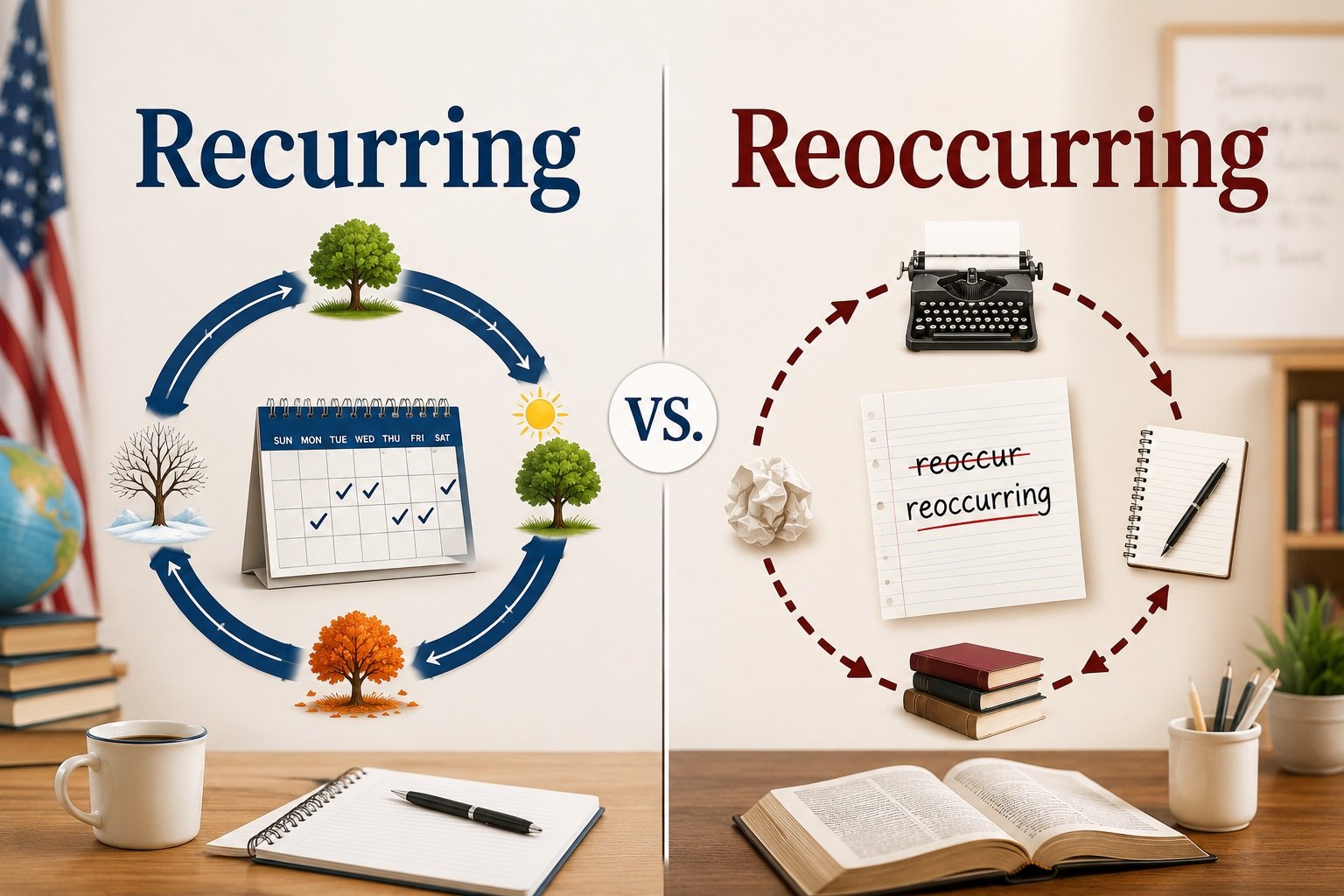

Recurring vs. Reoccurring explains a small but important difference in English, where two words look and sound similar yet follow different meanings. Recurring usually follows a regular schedule, a predictable pattern, or an established cycle, while reoccurring describes something that occurs again without a clear pattern. This distinction is surprisingly common in professional writing, email writing, report writing, and online writing, where writers, professionals, and students often face confusion because the terms seem interchangeable at first glance. Although both terms exist and dictionaries recognize them, recurring remains the widely accepted and standard form in most situations.
A quick example makes the idea easier to understand. A recurring meeting every Monday at 10 AM, recurring payments, a recurring schedule, or a monthly subscription all follow a regular, periodic, and established pattern. By contrast, an unusual problem or a reoccurring issue may appear again after a fix, but without a continuing schedule. This key difference affects word choice, because selecting the correct word improves trust, trustworthiness, and clear communication. During editing, many people search documents, emails, reports, and online content to avoid a small spelling mistake that can completely change the intended meaning.
The broader usage of these terms connects with grammar, language, recurrence, occurrence, and reoccurrence. Recurring is commonly used for events that happen repeatedly and follow a known pattern, while reoccurring is generally used when something simply returns. Many people misuse these terms because they sound alike, but a deep dive into the sentence usually reveals the best choice. If an event follows a regular schedule, recurring is the right answer; if it simply shows up again, reoccurring may fit better. This simple approach helps make everyday writing, professional communication, and online content more accurate and natural.
Let’s dive in!
Quick Answer:
Recurring vs. reoccurring usually differs in emphasis: recurring suggests something happens repeatedly or regularly, while reoccurring simply means it happens again. In the USA, recurring is generally the better choice for established patterns, schedules, and repeated events.
TL;DR:
• Recurring usually suggests repeated or regular events.
• Reoccurring usually means something happens again.
• Recurring often describes schedules, patterns, and repeated experiences.
• Reoccurring can describe an event that returns unexpectedly.
• Both words are legitimate and sometimes overlap in meaning.
• Context matters more than a strict either-or rule.
What Does Recurring Mean?
The word recurring comes from the verb recur. It describes something that happens again, especially when repetition forms a pattern.
For American readers, the word often carries a sense of continuity. Something recurring doesn’t merely return once. Instead, it tends to keep appearing.
Common Meaning of Recurring
Consider these examples:
• A recurring meeting happens on a repeated schedule.
• A recurring payment happens repeatedly over time.
• A recurring dream returns to someone’s thoughts.
• A recurring problem appears again and again.
• A recurring theme keeps appearing in a story.
The important idea is repetition. The repetition may be regular, but it doesn’t always have to follow an exact schedule.
Is Recurring Always Regular?
No. A recurring event can happen repeatedly without following a strict timetable.
For example, “recurring headaches” describes something that returns over time. It doesn’t necessarily mean the experience happens every Monday at 9 a.m.
Therefore, recurring is broader than “scheduled.” Its central idea is repeated return.
What Does Reoccurring Mean?
Reoccurring comes from the verb reoccur. It means that something occurs again.
The word can emphasize another occurrence rather than a long-running pattern. Therefore, it can fit situations where something happened before and then happened again.
The Main Idea Behind Reoccurring
Imagine a town experiences flooding after many years without a major flood. The flooding has happened again, so calling it reoccurring can make sense.
However, if flooding happens every spring, recurring usually sounds more natural.
That distinction gives writers a useful shortcut:
Recurring = repeated pattern.
Reoccurring = happening again.
Still, these meanings overlap considerably in everyday American English.
Is Reoccurring a Real Word?
Yes. Reoccurring is a recognized word formed from reoccur. Merriam-Webster lists reoccurring as the present participle of reoccur, while its thesaurus connects the word with recurring.
However, some style resources have traditionally preferred recurring. That preference can make reoccurring look unusual, but it doesn’t make the word automatically incorrect.
Recurring vs. Reoccurring: What’s the Difference?
The easiest way to understand the difference is to focus on repetition versus another occurrence.
Both words can mean that something happens again. However, recurring more strongly suggests repetition, while reoccurring can simply point to another occurrence.
Side-by-Side Comparison
| Context | Recurring | Reoccurring | Best Choice |
| Weekly meeting | Regular repeated event | Possible but less natural | Recurring |
| Repeated dream | Returning experience | Possible | Recurring |
| Problem happening again | Repeated issue | Another occurrence | Either |
| Unexpected second incident | Less specific | Another occurrence | Reoccurring |
| Monthly payment | Repeated schedule | Awkward in many contexts | Recurring |
The distinction is useful, but it shouldn’t become a rigid rule.
For example, “a reoccurring problem” is understandable and widely used. However, “a recurring problem” more clearly suggests a problem that keeps returning.
When Should You Use Recurring?
Use recurring when you want to highlight repetition, continuation, or an established pattern.
This makes the word especially useful for schedules and situations that return over time.
Common Examples
• The company has a recurring staff meeting every Friday.
• She keeps having the same recurring dream.
• The software has a recurring technical issue.
• Customers receive recurring monthly charges.
• The character becomes a recurring figure in the series.
In each example, repetition is important. The reader expects the event, issue, or person to appear again.
Recurring in Everyday American English
In the United States, recurring is especially common in business, technology, entertainment, and ordinary conversation.
You’ll often see phrases such as “recurring payment,” “recurring event,” and “recurring character.” The word works well because it clearly communicates an ongoing pattern.
When Should You Use Reoccurring?
Use reoccurring when the main point is that something has happened again.
It can work particularly well when the event isn’t clearly regular or predictable.
Common Examples
• The problem was reoccurring after the repair.
• The error kept reoccurring during testing.
• The same issue is reoccurring in several departments.
• The incident was reoccurring despite earlier changes.
However, many of these sentences can also use recurring.
That’s why context matters. If you want to emphasize a repeated pattern, recurring often sounds smoother. If you simply mean “occurring again,” reoccurring can work.
Recurring vs. Reoccurring in American English
American English generally accepts both forms, but usage preferences can differ by context.
Modern dictionaries recognize reoccur and reoccurring. At the same time, many writers still favor recur and recurring because they are more established in common usage.
Why Recurring Often Sounds More Natural
The word recurring is deeply familiar in everyday American phrases.
Think about expressions such as recurring expenses, recurring meetings, recurring dreams, and recurring characters. These combinations are immediately clear to most readers.
By contrast, reoccurring can sometimes feel more deliberate. Writers may choose it when they want to stress that something occurred another time.
Does Reoccurring Sound Wrong?
Not necessarily.
A word can be less common without being wrong. In this case, major dictionaries recognize reoccur and its forms.
The safest choice depends on what you mean. When describing a continuing pattern, recurring is usually clearer.
Recurring vs. Reoccurring Examples
Examples make this distinction much easier to recognize.
Examples With Recurring
The team holds a recurring meeting every Monday.
The meeting happens regularly, so recurring fits naturally.
She has a recurring dream about returning to school.
The dream repeatedly returns, making recurring a strong choice.
The business faces recurring costs each month.
The costs form an ongoing pattern.
Examples With Reoccurring
The same error was reoccurring after the update.
Here, the emphasis is on the error happening again.
The flooding was reoccurring after several years.
The word can emphasize another occurrence rather than a fixed schedule.
The issue began reoccurring after the system changed.
The problem returned after previously appearing.
Examples Where Both Can Work
Some sentences accept either word without a major change in meaning.
The problem is recurring.
The problem is reoccurring.
The first version more strongly suggests a continuing pattern. The second simply emphasizes that the problem has happened again.
Read More: A MA or An MA? The Correct Grammar Explained for 2026
Recurring and Reoccurring in Different Contexts
The best word can change depending on the situation.
For American readers, context often gives more useful guidance than memorizing a strict rule.
Business and Work
Recurring is usually the natural choice for scheduled or repeated business activities.
For example, a company may have recurring meetings, recurring expenses, or recurring tasks.
Technology
Both words appear in technical writing. However, recurring often works better when describing repeated errors or system behavior.
For example, “a recurring software issue” suggests the problem keeps returning.
Entertainment
The phrase recurring character is especially established. It describes a character who returns across multiple episodes or installments.
Using “reoccurring character” may be understandable, but it sounds less conventional.
Personal Experiences
Both words can describe experiences that return.
However, “recurring dream” is much more natural than “reoccurring dream” when describing a repeated dream pattern.
The History of Recur and Reoccur
The distinction becomes clearer when you look at the words behind them.
Roots of Recur
Recur comes from Latin roots associated with running back or returning. Over time, English developed the word with the meaning of happening again or returning.
Its history helps explain why recurring naturally suggests return and repetition.
The Rise of Reoccur
Reoccur developed later in English. Merriam-Webster gives 1734 as its first known use.
The construction combines re- with occur, creating the straightforward idea of occurring again.
This explains why the two words look so similar. They share the basic idea of something returning or happening again.
Why Are These Words So Often Confused?
The confusion is understandable because the words share several features.
Both contain the idea of another occurrence. Both can function as adjectives or verb forms. Both can describe events that happen more than once.
Similar Spelling
The visual difference is only a few letters.
Recurring comes from recur.
Reoccurring comes from reoccur.
Because reoccur looks like a natural combination of “re-” and “occur,” many writers instinctively choose it.
Overlapping Meanings
The bigger problem is that the meanings overlap.
A recurring event is happening again. A reoccurring event is also happening again.
The difference is usually one of emphasis rather than a completely different definition.
Is Recurring More Correct Than Reoccurring?
There isn’t a universal rule saying that reoccurring is always wrong.
Instead, recurring is often the more natural and established choice when repetition or regularity matters.
Why Some Writers Avoid Reoccurring
Some style guides and usage references have historically discouraged reoccurring. They often recommend the simpler and more established recurring.
That advice reflects style preference, not necessarily a claim that the word cannot exist.
What Modern Dictionaries Show
Current dictionary evidence supports the existence of reoccur and reoccurring. Merriam-Webster defines reoccur as happening another time and identifies reoccurring as its present participle.
Therefore, writers don’t need to treat the word as automatically incorrect.
Common Mistakes With Recurring and Reoccurring
Most mistakes happen when writers choose a word without considering the intended pattern.
Mistake: Treating Them as Completely Different
The words aren’t opposites.
They overlap in meaning, and either may work in some sentences.
Mistake: Assuming Reoccurring Is Always Wrong
That belief is too strong. Reoccurring is a recognized English form.
However, a recognized word may still be less natural in certain contexts.
Mistake: Using Reoccurring for Regular Events
If something happens every week, month, or year, recurring usually communicates the idea better.
For example, “recurring annual event” clearly describes a repeated tradition.
Mistake: Thinking Recurring Requires a Fixed Schedule
It doesn’t.
A recurring problem can return unpredictably. The key idea is repeated appearance, not perfect timing.
How to Remember the Difference
A simple memory trick can make the choice easier.
Think “Pattern” for Recurring
When something forms a pattern, think recurring.
A recurring event keeps coming back. A recurring problem keeps appearing. A recurring dream keeps returning.
Think “Again” for Reoccurring
When you mainly mean “it happened again,” think reoccurring.
This doesn’t mean the event must happen only twice. It simply puts more attention on another occurrence rather than a regular pattern.
A Simple Test
Ask yourself one question:
“Am I emphasizing repetition, or am I emphasizing another occurrence?”
If the answer is repetition or an ongoing pattern, choose recurring.
If the answer is simply another occurrence, reoccurring may fit.
Does the Meaning Change Over Time?
Language changes gradually, and these words show that process clearly.
Older usage preferences sometimes treated reoccur with suspicion. However, modern dictionary evidence recognizes the form, and contemporary writing uses both words.
Modern Usage
Today, the distinction remains useful but flexible.
Recurring continues to dominate many familiar phrases. Reoccurring remains a valid alternative when writers want to emphasize another occurrence.
Why Context Still Matters
Language isn’t a mathematical formula.
A word can be grammatically acceptable yet sound unusual in a particular sentence. That’s why natural usage matters alongside dictionary definitions.
For most general American writing, recurring is the safer choice when you mean something that keeps happening.
FAQs:
What is the difference between recurring and reoccurring?
Recurring usually describes something that happens again on a regular or predictable pattern. Reoccurring generally means something happens again, without necessarily following a regular pattern.
Is recurring or reoccurring more common?
Recurring is more common in everyday and professional English. It’s the preferred choice when you’re describing something that happens regularly.
Is reoccurring grammatically correct?
Yes. Reoccurring is a valid word. However, it’s less common than recurring, so the context should guide your choice.
Is a recurring meeting correct?
Yes. A meeting held every Monday, every month, or on another fixed schedule is a recurring meeting because it follows a predictable pattern.
Should I say recurring problem or reoccurring problem?
Both can work, but they can suggest slightly different ideas. Recurring problem usually suggests a problem that keeps happening, while reoccurring problem can emphasize that the problem has happened again.
Can recurring and reoccurring be used interchangeably?
Sometimes, especially when the only idea is that something happens again. However, they aren’t always interchangeable because recurring often suggests repetition or a regular pattern.
Which word should I use in professional writing?
In most professional situations, recurring is the safer choice, especially for recurring expenses, recurring meetings, recurring payments, and regular schedules.
Conclusion:
Recurring and reoccurring both describe something happening again, but the difference becomes clearer when you consider the pattern. Use recurring for something that happens regularly, repeatedly, or according to a schedule. Use reoccurring when something simply happens again without a predictable pattern.
When you’re unsure, look at the context rather than relying only on how the words sound. In most professional writing, recurring will be the more natural and widely accepted choice.