
Copula Verbs vs. Auxiliary Verbs explains how one word can perform different jobs in English sentences, helping learners understand grammar and meaning.
When speaking or writing a sentence, a small word can make a big difference. Say the sentence out loud, “She is happy,” and compare it with “She is reading a book.” The word is appears in both examples, but it behaves differently. In the first sentence, it helps describe identity or a state, holding meaning together as an essential part of the sentence. In the second, it helps support an action. Have you ever wondered why the same word can perform different jobs? This distinction between copula verbs and auxiliary verbs can be fascinating but confusing for English learners. Understanding these differences helps you interpret sentences, construct meaning, express yourself clearly, and improve written communication and spoken communication.
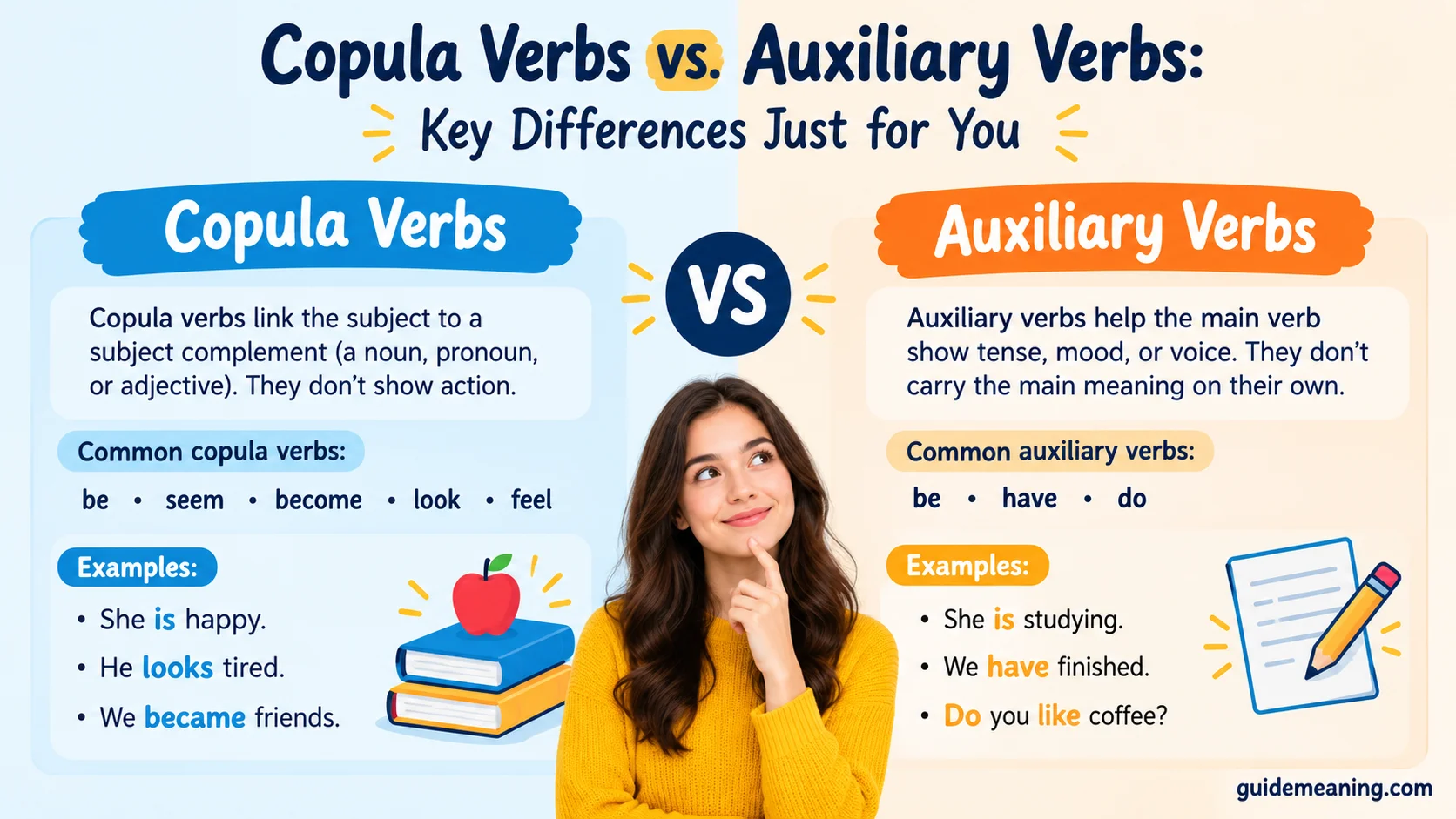
Copula verbs, also known as linking verbs, connect a subject with a complement, predicate, or additional information. They describe identity, condition, quality, appearance, feelings, or a state of being. Common forms include am, are, was, were, be, being, and been. Depending on the context, verbs such as appear, become, feel, get, grow, look, prove, remain, seem, smell, sound, stay, taste, and turn can also function as copulas. These verbs express a state or transformation rather than a direct action. Their linking function helps explain what a subject is or seems to be. For example, “She seems tired” connects the subject with a description. Copulas can serve as main verbs and perform the main grammatical function in main clauses and subordinate clauses. Learning their definition, verb usage, and grammatical roles makes this grammatical distinction easier to recognize.
Auxiliary verbs, also called helping verbs, have the opposite role because they support other verbs to express tense, form questions and negatives, or communicate other meanings. For example, in “She is reading,” is acts as an auxiliary verb because it helps form the continuous tense with the main verb reading. Unlike a copula, an auxiliary helps another verb instead of connecting a subject to a description. This difference shows how verb function changes with sentence structure. Although the English language is a complex language with different types of verbs, clear explanations and relatable examples offer practical insights into English grammar. Exploring these concepts in depth builds a strong understanding and intuitive understanding of what they are, how they function, and why they matter. These essential grammatical tools help shape English structure and sentence meaning. Understanding the auxiliary function, copula function, main verb function, auxiliary verb function, and copula verb function improves sentence construction, clause structure, and language learning. It also makes verb classification, language rules, independent verbs, action verbs, state of being verbs, predicate complement, subject complement, copula forms, and auxiliary forms easier to recognize. With practice, learners can identify grammatical concepts beneath the surface and use each verb type properly.
Let’s dive in!
Quick Answer:
Copula verbs vs. auxiliary verbs: A copula verb connects the subject to information that describes or identifies it, while an auxiliary verb helps a main verb express tense, aspect, voice, or other grammatical meaning. For example, is is a copula in “She is happy” but an auxiliary in “She is running.”
TL;DR
- Copula verbs connect subjects with descriptions, identities, or states.
- Auxiliary verbs help main verbs express tense, aspect, voice, or modality.
- The verb be can function as either type.
- Common copulas include be, seem, and become.
- Common auxiliaries include be, have, do, and modal verbs.
- The verb’s function in a sentence determines its grammatical category.
What Are Copula Verbs?
Copula verbs, also called linking verbs, connect a subject to a word or phrase that identifies, describes, or explains it. Instead of showing an action performed by the subject, they link the subject with information about its condition or identity.
For example, consider the sentence “The room is quiet.” The verb is connects the room with the description quiet. It doesn’t tell us that the room performs an action.
Common Examples of Copula Verbs
The most familiar copula is a form of be. However, several other verbs can perform the same function.
- Be: She is confident.
- Seem: The answer seems correct.
- Become: He became a teacher.
- Remain: The door remained open.
- Appear: The situation appears serious.
- Feel: I feel tired.
- Look: You look happy.
- Sound: That sounds reasonable.
Some verbs, such as feel, look, and sound, can also describe actions or experiences. Their grammatical role depends on how they’re used.
How Copula Verbs Work
A copula usually links the subject to a subject complement. This complement may be an adjective, a noun, or another phrase that describes or identifies the subject.
Examples:
- My brother is an engineer.
- The flowers smell wonderful.
- Her idea seems practical.
- The weather became colder.
In each sentence, the bold phrase supplies information about the subject. The copula connects that information to the subject rather than acting as a typical action verb.
What Are Auxiliary Verbs?
Auxiliary verbs are helping verbs. They work with a main verb to express grammatical information, such as tense, ongoing action, completed action, passive voice, or possibility.
For example, in “They are playing soccer,” the verb are helps the main verb playing express an ongoing activity. Here, are is an auxiliary rather than a copula.
Common Auxiliary Verbs
English has three primary auxiliary verbs and a group of modal auxiliaries.
- Be: She is working.
- Have: They have arrived.
- Do: Do you understand?
- Can: We can swim.
- Could: He could help.
- Will: I will call.
- Should: You should rest.
- Might: It might rain.
The verbs be, have, and do are often called primary auxiliaries. Words such as can, will, should, and might are called modal auxiliaries because they express ideas like ability, possibility, obligation, and willingness.
How Auxiliary Verbs Work
Auxiliary verbs usually appear alongside a main verb or verb phrase. Together, they help communicate when an event happens, whether it continues, or how the speaker views it.
Consider these examples:
- She is studying for her exam.
- We have finished our homework.
- They do not agree with the decision.
- You should check the instructions.
- The package was delivered yesterday.
The helping verbs support different grammatical structures. They don’t simply describe the subject, as copulas typically do.
Copula Verbs vs. Auxiliary Verbs: Key Differences
The biggest difference between these verb types is their function. Copulas connect subjects to descriptions or identities, while auxiliaries help build grammatical structures.
For American English learners, recognizing that distinction makes sentence construction, editing, and reading comprehension easier.
Comparison Table
| Feature | Copula Verbs | Auxiliary Verbs |
| Main function | Link a subject to a complement | Help form verb phrases |
| Common examples | Is, seem, become, remain | Be, have, do, can, will |
| Typical structure | Subject + copula + complement | Subject + auxiliary + main verb |
| Example | The soup tastes delicious. | The soup is cooking. |
| Main purpose | Describe a state or identity | Express tense, aspect, voice, or modality |
| Can the same word serve both roles? | Yes | Yes |
The Simplest Way to Remember
Think of a copula as a link between a subject and its description. An auxiliary, however, helps another verb express a grammatical meaning.
Compare these sentences:
- Copula: The children are happy.
- Auxiliary: The children are laughing.
- Copula: He has a new car.
- Auxiliary: He has purchased a new car.
Notice that are links children with happy in the first example. In the second, it helps the main verb laughing express an ongoing activity.
Similarly, has is the main verb in the third sentence. In the fourth, it helps form the present perfect construction has purchased.
Can the Same Verb Be Both Copular and Auxiliary?
Yes. Several English verbs can perform different grammatical functions, depending on their sentence context. The verb be provides the clearest example, although have and do also have different uses.
The Different Roles of “Be”
Consider these examples:
- Copula: My sister is a nurse.
- Auxiliary: My sister is working.
- Copula: The weather was pleasant.
- Auxiliary: The weather was changing.
In the copula examples, is and was connect the subjects to descriptions or identities. In the auxiliary examples, they help the main verbs working and changing express ongoing activities.
Other Verbs With Multiple Functions
The verbs have and do can also act as main verbs or auxiliaries.
- Main verb: I have two brothers.
- Auxiliary: I have visited Chicago.
- Main verb: They do their homework.
- Auxiliary: They do understand the problem.
Here, have expresses possession in the first sentence but helps form a perfect construction in the second. Likewise, do expresses an activity in the third and adds emphasis in the fourth.
What Is the Difference Between Copula Verbs and Linking Verbs?
Copula verbs and linking verbs are generally treated as the same category in English grammar. Both connect a subject with information that identifies or describes it.
This distinction matters because some grammar resources use different labels for the same function.
Are All Linking Verbs Copulas?
In traditional English grammar, copula and linking verb usually refer to the same basic idea. Common examples include be, seem, become, and remain.
For example:
- The sky looks cloudy.
- Her explanation seems reasonable.
- The room became silent.
- The milk smells sour.
Each verb links the subject to a quality or condition. However, verbs such as look and smell can also describe actions, so context remains important.
Why Do Grammar Resources Use Different Terms?
The word copula is more common in formal linguistics, while linking verb often appears in school grammar lessons. Both terms help explain how a sentence connects a subject with its description.
For most everyday writing and learning, you can treat them as equivalent. The more important skill is recognizing what the verb does in context.
Types of Auxiliary Verbs in English
Auxiliary verbs do more than help express actions. They allow speakers to form questions, negatives, ongoing actions, completed events, and statements about possibility or necessity.
American English uses primary auxiliaries and modal auxiliaries for these purposes.
Primary Auxiliary Verbs
The three primary auxiliaries are be, have, and do. Each serves several important grammatical functions.
- Be: She is reading a book.
- Have: They have completed the project.
- Do: Did you call your friend?
The auxiliary be helps form continuous and passive constructions. The auxiliary have helps form perfect constructions, while do supports questions, negatives, and emphasis in many sentences.
Modal Auxiliary Verbs
Modal auxiliaries express meanings such as ability, permission, possibility, intention, and obligation.
Common examples include:
- Can: I can drive.
- May: You may leave early.
- Might: We might visit tomorrow.
- Must: Everyone must follow the rules.
- Should: You should drink some water.
- Will: She will arrive soon.
- Would: I would help if I could.
- Could: He could solve the puzzle.
Unlike ordinary verbs, modal auxiliaries generally don’t change form to match the subject. For example, we say she can, not she cans.
How Copula Verbs Work in American English
Copula verbs appear throughout everyday American conversation. They help people describe emotions, introduce themselves, identify objects, and explain changing conditions.
Because these verbs are so common, speakers often use them without thinking about their grammatical role.
Describing People and Feelings
Copulas are especially useful when talking about personal qualities, emotions, or temporary conditions.
Examples include:
- I’m excited about the trip.
- He seems nervous today.
- My parents are proud of me.
- The children became restless.
These sentences focus on a person’s state or a change in condition. They don’t require a separate action verb to express their central meaning.
Identifying Things and Explaining Conditions
Copulas also help speakers identify objects and describe situations.
For example, an American might say, “This is my favorite restaurant,” or “The roads are slippery.” In both sentences, the copula connects the subject with information about it.
These simple structures are essential in conversations, classroom discussions, business writing, and everyday explanations.
How Auxiliary Verbs Work in American English
Auxiliary verbs help American English speakers communicate time, possibility, obligation, and the structure of an event. They also play an important role in questions and negative statements.
Their use often becomes clearer when you compare statements with questions or negatives.
Forming Questions and Negative Sentences
Auxiliaries frequently help create questions and negatives.
- Statement: You like coffee.
- Question: Do you like coffee?
- Negative: You don’t like coffee.
- Statement: She has finished.
- Question: Has she finished?
- Negative: She hasn’t finished.
Notice that the auxiliary’s position or form changes the sentence structure. This flexibility helps English speakers ask questions and express disagreement without changing the central action.
However, the verb be usually forms questions by moving before the subject. For example, “She is ready” becomes “Is she ready?” rather than “Does she be ready?”
Expressing Time and Possibility
Auxiliaries also help speakers explain when something happens and how certain they feel about it.
Consider these examples:
- We are waiting outside.
- She has already eaten.
- The documents were signed yesterday.
- They might arrive late.
- I will finish the assignment tonight.
Each auxiliary contributes a different grammatical meaning. Together with the main verb, it helps readers understand the timing, status, or likelihood of an event.
Common Mistakes With Copula and Auxiliary Verbs
Many learners confuse these categories because the same words can appear in both roles. Fortunately, a few practical checks can help you avoid common mistakes.
Mistake: Assuming “Be” Is Always a Copula
The verb be doesn’t always function as a copula.
Incorrect classification: “He is sleeping” uses is as a copula.
Correct classification: In “He is sleeping,” is is an auxiliary because it helps form the continuous verb phrase.
By contrast, is is a copula in “He is sleepy” because it links the subject to the adjective sleepy.
Mistake: Assuming Every Verb Before a Noun Is a Copula
A noun doesn’t automatically make a nearby verb a copula. You must examine the relationship between the subject, verb, and following phrase.
Compare these sentences:
- She became a manager.
- She hired a manager.
In the first sentence, became links she to her new role. In the second, hired describes an action involving an object.
Mistake: Using “Do” With the Verb “Be”
English speakers generally don’t use auxiliary do to form questions or negatives with be.
Incorrect: Does she be happy?
Correct: Is she happy?
Similarly, “He isn’t ready” is standard, rather than “He doesn’t be ready.” These patterns are useful to remember when writing questions and negative sentences.
How to Identify Copula and Auxiliary Verbs in a Sentence
The easiest way to identify these verbs is to examine their function. Don’t rely only on the word itself, because a single verb can perform different jobs.
Follow These Simple Steps
Use this quick process when analyzing an unfamiliar sentence.
- Find the verb you’re trying to classify.
- Check whether it links the subject to a description or identity.
- Look for another verb that it helps form.
- Check whether it expresses tense, aspect, voice, or modality.
- Read the entire sentence to confirm the verb’s function.
For example, consider “The baby is quiet.” The word is links baby with the description quiet, making it a copula.
Now consider “The baby is crying.” Here, is helps the main verb crying express an ongoing activity, making it an auxiliary.
Practice With These Examples
Try identifying the bold verb in each sentence.
| Sentence | Verb | Correct Classification |
| The coffee smells fresh. | Smells | Copula |
| We have finished dinner. | Have | Auxiliary |
| The building became taller. | Became | Copula |
| Does your brother drive? | Does | Auxiliary |
| The students are prepared. | Are | Copula |
| The students are preparing. | Are | Auxiliary |
The last two examples highlight the key lesson. Even when the same verb appears in similar sentences, its grammatical function can change.
FAQs:
What is the main difference between copula verbs and auxiliary verbs?
Copula verbs connect a subject to information that describes it, such as a condition or quality. Auxiliary verbs help other verbs express tense, questions, negatives, or other meanings.
Is the verb “is” a copula verb or an auxiliary verb?
The verb “is” can be both. In “She is happy,” it is a copula because it links the subject to a description. In “She is reading,” it is an auxiliary because it helps form the continuous tense.
What are some common examples of copula verbs?
Common copula verbs include am, is, are, was, were, be, being, and been. Depending on the sentence, verbs such as seem, become, feel, look, and remain can also function as copulas.
What are the most common auxiliary verbs?
The most common auxiliary verbs are be, do, and have, including their forms. Modal auxiliary verbs include can, could, may, might, must, shall, should, will, and would.
Can a copula verb stand alone as the main verb?
Yes. A copula can serve as the main verb of a sentence. For example, in “The room is quiet,” the verb “is” connects the subject “the room” with the description “quiet.”
Can the same verb function as both a copula and an auxiliary?
Yes. The verb “be” can perform either role, depending on its use. In “They are ready,” “are” is a copula. In “They are working,” “are” is an auxiliary that helps form the continuous tense.
How can I identify copula and auxiliary verbs in a sentence?
First, check what the verb does. If it connects the subject to a description or identity, it is likely a copula. If it helps another verb form a tense or express a grammatical meaning, it is an auxiliary. Always consider the full sentence because the same verb can perform different functions.
Conclusion:
Understanding Copula Verbs vs. Auxiliary Verbs makes English grammar easier to use and understand. Copula verbs connect subjects with descriptions, conditions, or identities, while auxiliary verbs help other verbs express tense and other grammatical meanings.Remember the examples “She is happy” and “She is reading.” In the first sentence, “is” links the subject to a description. In the second, it helps the main verb “reading.” Learning to recognize these different functions will help you build clearer sentences, improve your writing, and communicate more confidently.