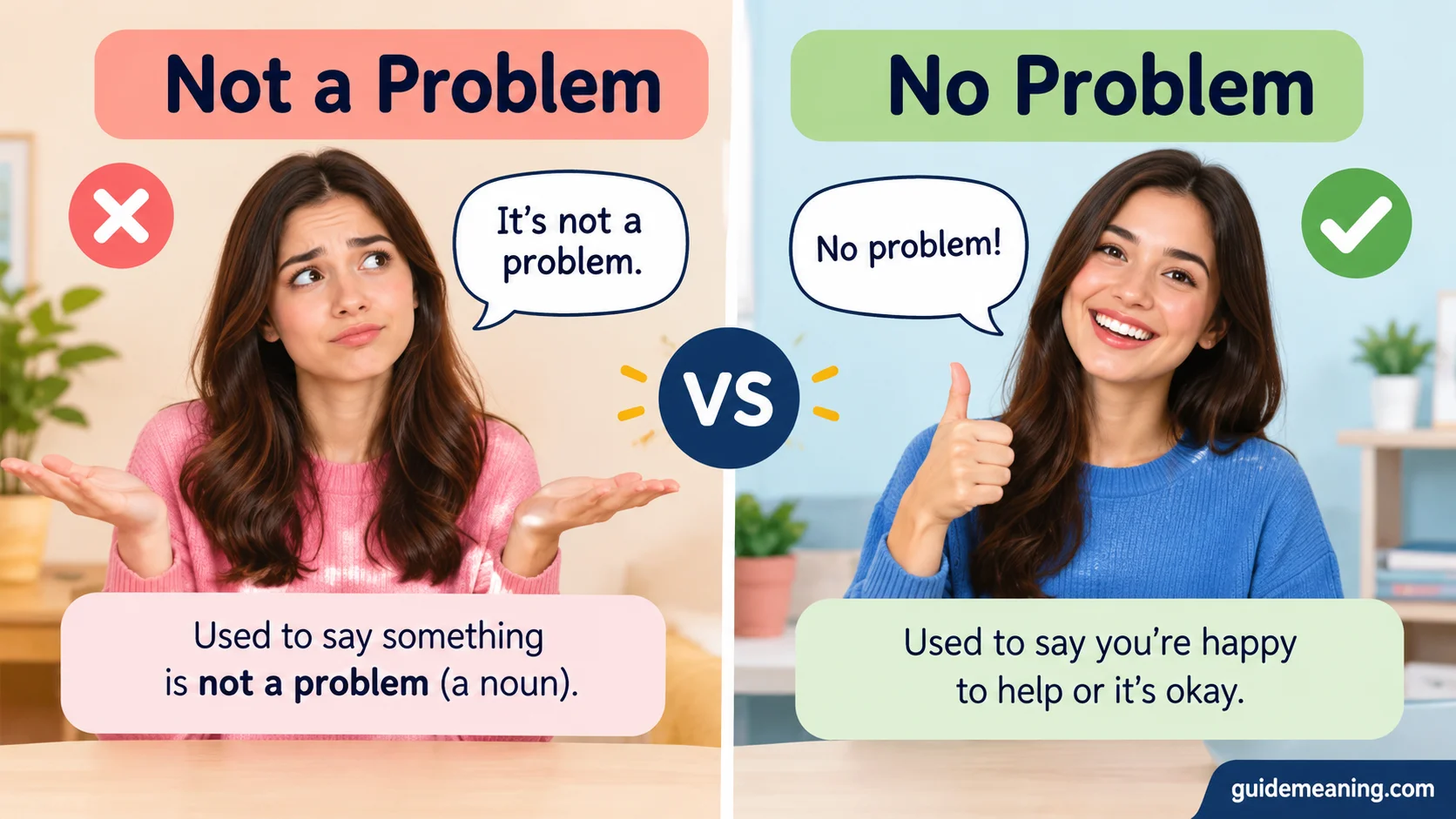

Not a Problem vs. No Problem: Both sound polite, but tone and context shape how people understand these everyday replies. At first glance, these phrases seem identical because they share the same basic meaning. However, subtle differences in tone, purpose, and context can influence overall communication. English speakers use these quick responses when replying to thanks, requests, and apologies. Both expressions sound friendly and natural, so people often consider them interchangeable. Still, formality and social context can change how a simple response feels. For example, “not a problem” often offers neutral reassurance, while “no problem” may sound more casual and warm. Understanding these meanings helps English learners choose expressions that fit different situations and communicate clearly.
In my personal experience, listeners sometimes react differently to the same words because of delivery, eye contact, and a sincere response. A smile and genuine gratitude can create positive impressions, while a rushed or careless reply may sound automatic or dismissive. Style experts and workplace trainers emphasize careful wording because professional settings and customer-facing environments may require polished responses. In casual settings, a quickly given reply usually feels natural and appropriate. However, choosing the wrong phrase can create unintended implications or awkward misunderstandings. These nuances affect professionalism and show why speakers should be thoughtful and careful at work and in everyday life. Although popularity trends may vary, both phrases remain useful alternatives in daily conversations.
To understand the exact effect of each phrase, consider its similar conversational purpose before choosing the right expression. Not a Problem vs. No Problem is not a strict choice between right and wrong. The best expression depends on your tone, situation, and intended message. A professional setting may call for a formal or confident reply, while everyday replies can remain relaxed and effortless. These wording choices matter because even a short reply can affect the mood of conversations. Helpful examples and tables can explain the difference and make the best choice easier to identify. Some people believe simple articles such as “a,” “an,” and “the” don’t change anything, but these words can completely change a sentence. English learners can explore these details to find out how to use both phrases effectively in social and workplace situations.
Let’s dive in!
Quick Answer:
“Not a problem” vs. “no problem” comes down to emphasis and context. In American English, “no problem” is a common casual response to thanks or a request, while “not a problem” often reassures someone that a situation or task isn’t difficult or troublesome. Both are correct and widely understood.
TL;DR
- “No problem” is a natural, casual response to thanks.
- “Not a problem” often emphasizes that something isn’t an issue.
- Both expressions can accept requests and reassure other people.
- Neither phrase is automatically more polite or professional.
- Your tone, relationship, and situation influence how each sounds.
What Does “Not a Problem” Mean?
“Not a problem” means something isn’t difficult, inconvenient, or unacceptable. People often use it to reassure someone who worries about asking for help or creating extra work.
Common Uses of “Not a Problem”
The phrase works in several everyday situations:
- Accepting a request: “Could you send me the file? Not a problem.”
- Reassuring someone: “Sorry I’m late.” “That’s not a problem.”
- Offering help: “I can take care of that. It’s not a problem.”
- Dismissing a concern: “Will the change affect your plans?” “No, it’s not a problem.”
In each example, the speaker suggests that the situation won’t cause trouble. However, the full sentence often sounds more natural than the shortened response.
What Does It Communicate?
The expression can communicate willingness, reassurance, and acceptance. For example, “That’s not a problem” directly addresses a concern instead of simply accepting a request.
However, the phrase doesn’t always mean a task requires zero effort. You might spend an hour helping someone and still say, “It’s not a problem,” because you were happy to help.
What Does “No Problem” Mean?
“No problem” is an informal expression that means something is acceptable or can be done without trouble. In American English, it’s especially common when responding to thanks, requests, or apologies.
Common Uses of “No Problem”
You’ll hear this expression in many everyday exchanges:
- Responding to thanks: “Thanks for picking me up!” “No problem!”
- Accepting a request: “Can you watch my bag?” “No problem.”
- Responding to an apology: “Sorry about the delay.” “No problem.”
- Agreeing to a small favor: “Could you grab me a coffee?” “No problem.”
The phrase keeps conversations moving without requiring a long response. Consequently, it feels natural among friends, family members, coworkers, and service staff.
Why Is It So Common?
One reason is its simplicity. Instead of explaining that a favor caused little inconvenience, you can communicate the same general idea in two words.
Additionally, “no problem” works in both speech and informal writing. It’s easy to say, quick to type, and widely understood across the United States.
What Is the Difference Between “Not a Problem” and “No Problem”?
Both expressions communicate acceptance or reassurance, but their grammatical structures differ. Their conversational meanings overlap so much that the situation often matters more than the exact wording.
A Side-by-Side Comparison
| Feature | Not a Problem | No Problem |
| Basic meaning | Something isn’t an issue | Nothing is wrong or troublesome |
| Common response | Reassuring someone about a concern | Responding to thanks or a request |
| Tone | Neutral and reassuring | Casual and friendly |
| Workplace use | Useful when explaining a situation | Natural in everyday team conversations |
| Text messages | Works well in complete sentences | Common in short replies |
| Correctness | Standard English | Standard English |
These differences are tendencies, not strict rules. For example, both phrases can respond naturally to a request for help.
Examples That Show the Difference
Consider these two conversations:
Example A
“I’m sorry I asked you to stay late.”
“That’s not a problem. I was happy to help.”
Here, the longer expression reassures the other person about a specific concern.
Example B
“Thanks for staying late!”
“No problem!”
Here, the shorter expression acknowledges gratitude and keeps the exchange relaxed.
However, you could switch the responses without making either conversation incorrect. The difference is subtle, not absolute.
Is “Not a Problem” More Polite Than “No Problem”?
Neither phrase is automatically more polite than the other. Both can sound warm, professional, or dismissive, depending on how you deliver them.
When “Not a Problem” Sounds More Reassuring
The phrase can sound thoughtful when someone worries about causing inconvenience. For example, “It’s not a problem at all; I can handle it” directly addresses their concern.
It can also work well when discussing responsibilities with coworkers. However, it isn’t inherently more formal than “no problem.”
When “No Problem” Sounds More Natural
The shorter expression often fits quick, friendly exchanges. For example, a cashier might say “No problem!” after a customer thanks them.
Likewise, friends might use it after exchanging small favors. In these situations, a longer response could feel unnecessarily elaborate.
The best rule: Match your response to the situation rather than assuming one phrase is always more polite.
When Should You Use Each Phrase?
Choosing between these expressions becomes easier when you consider what the other person needs to hear. Sometimes they need reassurance, while other times they simply expect acknowledgment.
Use “Not a Problem” When Reassuring Someone
This phrase works particularly well when someone worries about inconvenience or extra work.
- “Moving the meeting isn’t a problem.”
- “It’s not a problem if you need more time.”
- “That request isn’t a problem for our team.”
- “Not a problem; I’ll make those changes.”
These examples focus on whether a specific situation creates difficulty. As a result, the expression often feels clear and reassuring.
Use “No Problem” for Quick Responses
This phrase is especially convenient when the exchange is brief and friendly.
- “Thanks for your help!” “No problem!”
- “Can you email me that?” “No problem.”
- “Sorry for bothering you.” “No problem.”
- “Could you save me a seat?” “No problem!”
Still, you don’t need to follow these patterns rigidly. American English speakers commonly use both expressions in similar situations.
How Americans Use These Phrases in Everyday Conversation
In the United States, both expressions are part of ordinary conversational English. Their meaning usually comes from the interaction rather than any special cultural or symbolic tradition.
In Daily American Life
You might hear “no problem” in a coffee shop, at school, during a family gathering, or while chatting with neighbors. Its casual tone makes it useful for everyday favors and polite exchanges.
Meanwhile, “not a problem” often appears when people want to clarify that something is manageable. For example, a friend might say, “Changing our plans isn’t a problem.”
In Customer Service
Both expressions are common in American service settings. An employee might say “No problem!” after a customer thanks them for assistance.
Alternatively, “That’s not a problem” can reassure a customer about a small request. However, service expectations vary, so some workplaces prefer expressions such as “Certainly” or “You’re welcome.”
Neither phrase has a unique national, spiritual, or historical symbolism. Instead, their significance comes from how Americans use them to express cooperation and courtesy.
Can You Use “Not a Problem” and “No Problem” at Work?
Yes. Both expressions are acceptable in many American workplaces, particularly during everyday conversations. However, your audience and the formality of the situation can influence which response fits best.
Examples for Workplace Conversations
Coworker: “Thanks for covering my shift.”
You: “No problem!”
This sounds relaxed and friendly, making it suitable for an ordinary conversation between colleagues.
Manager: “Could you revise this report by tomorrow?”
You: “That’s not a problem. I’ll send the updated version tomorrow.”
This response confirms that you can manage the request. It also gives the other person a clear expectation.
What About Professional Emails?
Both expressions work in casual workplace emails and internal messages. For example, you could write, “No problem. I’ll update the spreadsheet this afternoon.”
However, more formal correspondence may call for a more specific response. “Certainly, I’ll take care of that” can sound polished without suggesting the request was burdensome.
Remember that clear communication matters more than choosing the supposedly perfect phrase. If a task requires extra time or resources, explain that honestly instead of automatically calling it easy.
Grammar Rules Behind “Not a Problem” and “No Problem”
Both expressions are grammatically correct, but they use different structures. Understanding those structures helps you recognize why the wording changes.
How “Not a Problem” Works
In a complete sentence, “not a problem” usually appears after a linking verb.
For example:
- “It is not a problem.”
- “That was not a problem.”
- “This won’t be a problem.”
Here, “not” makes the statement negative, while “a problem” is a noun phrase. In casual conversation, speakers can shorten the expression to “Not a problem.”
How “No Problem” Works
In this expression, “no” comes directly before the noun “problem.” It indicates that there is no problem to consider.
Examples include:
- “There is no problem.”
- “We have no problem with that.”
- “No problem! I’ll help you.”
The last example is a shortened conversational response. Its complete meaning depends on the situation, but listeners generally understand it as acceptance or reassurance.
Cambridge Dictionary’s grammar guidance explains that no commonly comes before a noun phrase, while not negates other phrases or clauses. This grammatical difference helps explain the expressions, even though their practical meanings often overlap.
Can Tone Change the Meaning of These Phrases?
Yes. Tone, facial expressions, and the surrounding conversation can make either expression sound welcoming, neutral, or irritated.
Friendly and Sincere Responses
Imagine a friend apologizes for arriving ten minutes late. You smile and say, “No problem!”
Your delivery signals that you’re not upset. Similarly, “That’s not a problem at all” can reassure someone who feels guilty about the delay.
Sarcastic or Dismissive Responses
Now imagine someone makes the same apology, but you respond sharply, “No problem.”
Depending on your voice and facial expression, the words might sound sarcastic. The same applies to “Not a problem,” especially when spoken with obvious frustration.
Neither phrase inherently expresses annoyance. However, people interpret language through social cues, so your delivery can matter more than your word choice.
Common Mistakes to Avoid
Although both expressions are simple, a few mistakes can make your message sound confusing or unintentionally rude.
Treating One Phrase as Incorrect
A common misconception is that “not a problem” is grammatically wrong because “no problem” is shorter. Both are correct English expressions.
Likewise, you don’t need to reserve “not a problem” exclusively for formal situations. The phrase appears naturally in casual conversations, too.
Assuming “No Problem” Is Always Professional
“No problem” is widely accepted in everyday workplace communication. However, some formal settings favor more specific or traditional responses.
For example, “You’re welcome” might suit a formal client interaction better than a casual “No problem!” Neither expression is universally inappropriate.
Confusing “Not a Problem” With “Not My Problem”
These phrases can communicate very different attitudes.
- “That’s not a problem.” — The situation is manageable or acceptable.
- “That’s not my problem.” — The speaker may be refusing responsibility or showing indifference.
The second expression can sound dismissive, particularly when someone needs help. Therefore, pay attention to the word my when choosing your response.
What Can You Say Instead of “Not a Problem” or “No Problem”?
Several alternatives express the same general idea, but each carries a slightly different tone. Choosing the right one helps you sound natural across different social and professional situations.
Alternatives for Casual Conversations
- You’re welcome: A straightforward response to thanks.
- No worries: A relaxed way to reassure someone about a minor issue.
- Sure thing: A friendly way to accept a request.
- Don’t mention it: Suggests that the favor doesn’t need special acknowledgment.
- Anytime: Communicates willingness to help again.
These expressions work well with friends, relatives, and familiar coworkers. However, their suitability depends on the relationship and situation.
Alternatives for Professional Settings
- Certainly: A polite way to agree to a request.
- Of course: Shows willingness to help or cooperate.
- Happy to help: Communicates a positive attitude toward assisting someone.
- My pleasure: Emphasizes that helping was welcome.
- I’ll take care of it: Confirms responsibility for a specific task.
For example, a client might appreciate “Happy to help” after receiving assistance. Meanwhile, “I’ll take care of it” works especially well when someone needs confirmation that a task will be completed.
FAQs:
What is the difference between “Not a Problem” and “No Problem”?
“Not a Problem” and “No Problem” both show that something is acceptable or causes no trouble. However, “No Problem” often sounds more casual and friendly, while “Not a Problem” can sound slightly more neutral or reassuring. The best choice depends on your tone and the situation.
Is “No Problem” more casual than “Not a Problem”?
Yes, “No Problem” often sounds more relaxed in everyday conversations. Friends, family members, and coworkers commonly use it when responding to thanks or small requests. “Not a Problem” also works in casual settings, but it can sound a little more measured.
Is “Not a Problem” professional?
Yes, “Not a Problem” is generally appropriate in professional communication. You can use it to reassure colleagues, respond to requests, or show that a task is manageable. However, in formal emails or customer-facing situations, “You’re welcome” or “I’d be happy to help” may sound more polished.
Can I use “No Problem” to respond to “Thank You”?
Yes, “No Problem” is a common response to “Thank You.” It tells the other person that helping them was not difficult or inconvenient. For example, if a coworker thanks you for sharing a document, you can simply reply, “No Problem!”
Does “Not a Problem” mean the same as “No Problem”?
In most everyday situations, yes. Both expressions communicate that something is acceptable, manageable, or not troublesome. The main difference is usually tone rather than meaning. Your delivery and the surrounding context can influence how the listener interprets either phrase.
Is “No Problem” rude or dismissive?
No, “No Problem” is not inherently rude. Most people use it as a friendly and reassuring response. However, a sarcastic tone or dismissive delivery can make it sound impolite. Your facial expression, voice, and relationship with the listener also influence how the phrase is received.
Which phrase should English learners use?
English learners can comfortably use both phrases in everyday communication. Choose “No Problem” for relaxed conversations and “Not a Problem” when you want a slightly more neutral response. In formal situations, consider alternatives such as “You’re welcome,” “Certainly,” or “I’d be happy to help.”
Conclusion:
Understanding Not a Problem vs. No Problem helps you communicate naturally in everyday and professional situations. Both phrases express reassurance and show that a request or favor is not a burden. The main difference lies in tone, context, and how your words sound to the listener.Use “No Problem” when you want a friendly, casual reply. Choose “Not a Problem” when you prefer a slightly more neutral response. For formal emails or customer interactions, expressions such as “You’re welcome” or “I’d be happy to help” may work better.Ultimately, neither phrase is always better than the other. Pay attention to your audience, speak sincerely, and choose the expression that fits the situation.