
Family & Friends or Friends & Family can both be grammatically correct, but their order can affect meaning, tone, emphasis, and rhythm. In English, Family And Friends and Friends And Family are commonly used phrases with different word orders. In everyday speech and writing, people often choose the form that sounds more natural in the context. From my experience, this comparison can build confidence and help you understand the right order without overthinking the choice.
The history and culture of English help explain these familiar patterns. Family & Friends places family first through convention, while Friends & Family gives friends more emphasis. Neither format has a strict rule, so you don’t have to think twice before using either phrase. Your audience, the emotional weight of the words, and your purpose can guide the choice. When addressing people in a speech or statement, either form can work if the wording is clear, appropriate, and easy to understand.
For practical use, these phrases fit an invitation, greeting, social post, or message. A complete guide should focus on natural usage, common usage, understanding, clarity, and fluency rather than forcing one form. Both versions can be used in spoken English and written English, such as “Welcome, Family & Friends” or “Welcome, Friends & Family.” These practical examples show how the same words and arrangement can sound natural. With this simple approach, you can apply the guide right away and choose the form that feels correct for your purpose.
Let’s dive in!
Quick Answer:
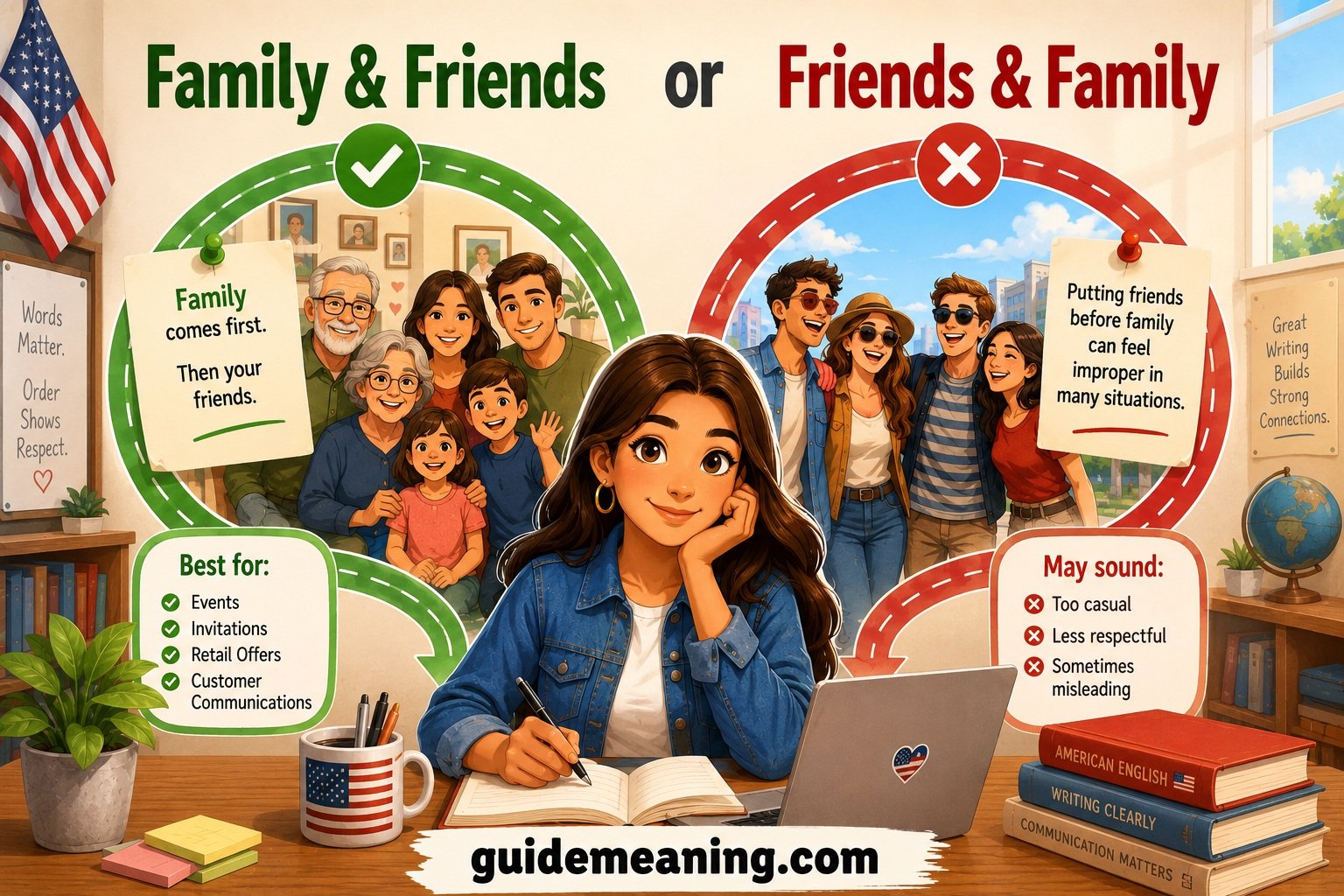
Family & Friends or Friends & Family? Both are correct in American English. “Family and friends” often feels more traditional and heartfelt, while “friends and family” often feels more casual and conversational.
TL;DR:
- Both “family and friends” and “friends and family” are grammatically correct.
- “Family and friends” often emphasizes family first.
- “Friends and family” is extremely common in everyday American English.
- The order rarely changes the basic meaning.
- Context, tone, and personal preference usually decide the better choice.
- Both phrases can describe a close support network.
Family & Friends vs. Friends & Family: What’s the Difference?
The main difference is word order, not basic meaning. Both expressions refer to people who matter to you and may share your celebrations, memories, and daily life.
However, the first word can receive slightly more attention. When family comes first, the phrase can feel more traditional. When friends come first, it can feel more relaxed or socially focused.
Family and Friends
“Family and friends” places family first.
This version often appears in heartfelt messages, ceremonies, speeches, and personal announcements. It can suggest that family provides an important foundation while friends form another important circle of support.
Friends and Family
“Friends and family” places friends first.
This version is also completely natural. In American English, it frequently appears in casual conversation, public announcements, promotions, and general references to a person’s close social circle.
Neither version automatically suggests that one group matters more. The surrounding sentence usually provides the real context.
Is Family and Friends Grammatically Correct?
Yes. “Family and friends” is grammatically correct, and so is “friends and family.”
English does not require one particular order for these two nouns. Instead, speakers choose an order based on rhythm, emphasis, habit, and context.
Why Both Forms Work
The conjunction and joins two nouns or noun phrases.
For example:
• My family and friends supported me.
• My friends and family supported me.
Both sentences communicate essentially the same idea. Changing the order doesn’t make either sentence incorrect.
Does Word Order Change the Meaning?
Usually, no.
The meaning can shift slightly in emphasis, but the basic reference remains the same. “Family and friends” does not mean only relatives, and “friends and family” does not exclude relatives.
In fact, American English uses both forms widely. The choice often comes down to what sounds most natural to the speaker.
What Does Family and Friends Mean?
“Family and friends” refers to relatives and people you consider friends or close companions.
The phrase can describe a person’s support network, social circle, or loved ones. It can also appear when someone is thanking people who helped them.
Common Meanings
Depending on context, the phrase can suggest:
• Relatives and close personal friends
• People invited to a private celebration
• A person’s emotional support network
• People connected through affection and trust
The phrase doesn’t require every person mentioned to have the same level of closeness. For example, “family and friends” at a large wedding could include distant relatives and longtime friends.
Why It Feels Warm
“Family” often suggests roots, history, belonging, and long-term connection. “Friends” can suggest chosen relationships, shared experiences, and companionship.
Together, the words create a broad picture of personal connection.
What Does Friends and Family Mean?
“Friends and family” means friends and relatives considered together as an important social group.
It’s especially common in everyday American communication. You might hear someone say, “I’m spending the weekend with friends and family.”
Common Situations
You can use it when talking about:
• Holiday gatherings
• Personal celebrations
• Emotional support
• Social events
• Community activities
• Important life events
The phrase also appears frequently in business language. For example, a store might describe a special promotion as a “friends and family” event.
That use gives the expression a more casual and welcoming tone.
Which Comes First: Family or Friends?
There’s no universal grammar rule requiring one word to come first.
However, “family and friends” can sound slightly more traditional because family is often presented as the first social relationship. Meanwhile, “friends and family” has a very natural rhythm in everyday American speech.
A Simple Comparison
| Phrase | Common Feeling | Typical Context | Basic Meaning |
| Family and friends | Warm and traditional | Speeches, greetings, personal messages | Relatives and friends |
| Friends and family | Casual and conversational | Everyday speech, announcements | Friends and relatives |
| Family & Friends | Warm, polished | Titles, cards, event names | Family and friends |
| Friends & Family | Modern, informal | Promotions, social posts, events | Friends and family |
The difference is subtle. In most situations, readers understand either version immediately.
Family and Friends in American Culture
In the United States, family and friendship often overlap as important sources of belonging.
Americans frequently gather with both groups during holidays, birthdays, weddings, graduations, and other milestones. Pew Research Center found that 73% of U.S. adults said family time was one of the most important aspects of their lives in a 2023 analysis.
Holidays and Celebrations
Family and friends commonly come together for Thanksgiving, Christmas, Independence Day, birthdays, weddings, and graduations.
For example, Thanksgiving is strongly associated with gathering around a shared meal. The gathering may include relatives, friends, partners, neighbors, or other loved ones.
Christmas and other holiday celebrations can work the same way. Pew has found that large shares of Americans gather with extended family or friends during the holiday season.
A Broader Idea of Belonging
Modern American life also makes the boundary between family and friends less rigid.
Some people live far from relatives. Others build close friendships that function like family relationships. American folklore research has also examined how family and friendship narratives overlap and help maintain social groups.
Is Family and Friends More Formal Than Friends and Family?
Not necessarily, although “family and friends” can feel more formal or sentimental in certain settings.
For example, a wedding speech might begin with “Dear family and friends.” A casual social post might say, “Thanks to all my friends and family.”
Formal and Personal Settings
“Family and friends” can work well for:
• Wedding speeches
• Graduation ceremonies
• Memorial messages
• Holiday greetings
• Thank-you notes
“Friends and family” can work well for:
• Casual announcements
• Social media posts
• Everyday conversation
• Community messages
• Promotional events
Still, these are tendencies rather than strict rules. You can switch them without creating a grammar error.
Read More: Newfound vs. New-Found: Which Spelling Should You Use?
Family & Friends or Friends & Family for Invitations?
Both versions work on invitations.
The better option depends on the atmosphere you want. “Family & Friends” can sound warm and classic, while “Friends & Family” can sound relaxed and contemporary.
Examples for Invitations
For a traditional celebration:
To Our Family & Friends
For a casual gathering:
Friends & Family Game Night
For a birthday:
We’d Love to Celebrate With Family and Friends
For a community event:
Join Friends and Family for a Day Together
The ampersand can make a title feel shorter and more visual. In ordinary sentences, however, writing and is usually more natural.
Family and Friends in Emotional Language
The phrase carries more than a simple grammatical meaning.
It often signals connection, trust, loyalty, comfort, and shared history. That’s why it appears so often during emotional moments.
Why People Use the Phrase
Someone might mention “family and friends” when discussing:
• Support during difficult times
• Celebrating personal achievements
• Remembering someone who died
• Sharing important life changes
• Expressing gratitude
The phrase works because it brings two kinds of relationships together. Family can represent inherited bonds, while friendship often represents chosen bonds.
Chosen Family
The idea of “chosen family” has also become more visible in modern American culture.
It describes people who may not be related by blood but provide deep emotional support and belonging. Therefore, the word “family” can sometimes describe closeness rather than biology alone.
Friends and Family in Modern Communication
Digital communication has made both expressions even more flexible.
People use them in texts, captions, invitations, group messages, event titles, and online communities. The shorter “&” form is especially useful when space or visual design matters.
Social Media and Texting
You might see:
Love spending time with family & friends.
Or:
Weekend with friends & family!
Both are natural informal expressions. The ampersand gives the sentence a quicker, more casual appearance.
Event and Brand Language
“Friends & Family” is also common in promotional language.
Businesses may use the phrase for special events aimed at existing customers, employees, or personal networks. This usage gives the phrase a sense of familiarity and inclusion rather than strict literal meaning.
What Is the Emotional Difference Between the Two?
There is no fixed emotional rule, but word order can influence the tone readers feel.
“Family and friends” often sounds more rooted and sentimental. “Friends and family” can sound more conversational and socially broad.
Family First
Putting family first may suggest:
• Roots and heritage
• Long-term belonging
• Home and tradition
• Generational connection
Friends First
Putting friends first may suggest:
• Chosen relationships
• Social connection
• Shared experiences
• Casual togetherness
These impressions are not universal. A speaker may choose either order simply because it sounds better.
Are Family & Friends and Friends & Family Interchangeable?
In most everyday situations, yes.
Both phrases can describe the same group of people. However, you should consider the specific tone and purpose of your sentence.
When They Are Interchangeable
You can normally switch them in sentences such as:
“I’m visiting family and friends.”
“I’m visiting friends and family.”
The basic meaning stays the same.
When Context Matters More
The difference becomes more noticeable when the phrase is used as a title.
For example, Family & Friends might suit a formal celebration. Friends & Family might feel better for a casual event.
The choice is stylistic rather than grammatical.
Common Mistakes With Family and Friends
Most mistakes involve punctuation, capitalization, or confusion with similar phrases.
One especially important distinction is between family friends and friend’s family.
Family Friends vs. Friend’s Family
“Family friends” means friends of your family.
For example:
Our family friends live nearby.
“Friend’s family” means the family belonging to one friend.
For example:
I’m visiting my friend’s family.
The apostrophe changes the relationship.
Common Errors
Watch for these differences:
• “Family friends” means friends connected with your family.
• “Friend’s family” means the family of one friend.
• “Friends’ family” refers to families belonging to multiple friends.
• “Friends and family” joins two groups together.
These expressions look similar, but they don’t communicate exactly the same relationship.
Does Family or Friends Come First in American English?
American English has no strict rule that requires either word to come first.
Both expressions are established and widely understood. In fact, research on Americans’ social lives commonly discusses family and close friends together as important parts of everyday relationships.
A Practical Rule
If you’re unsure, choose the version that matches your purpose.
Use family and friends when you want a warm, traditional feeling. Choose friends and family when a casual, conversational tone feels more natural.
Most importantly, don’t worry that one choice is grammatically wrong.
How the Meaning Has Shifted Over Time
The relationship between family and friendship has never been completely fixed.
Historically, family ties often carried strong social and economic responsibilities. At the same time, friendships could create powerful networks of trust, cooperation, and mutual support.
Research on American history shows that the boundaries between family and friendship could blur. People sometimes treated close friends like family, while family relationships could also function through friendship-like affection and trust.
Modern American Usage
Today, the phrase can include a much wider range of relationships.
A person might call a childhood friend family. Another person may have relatives they rarely see but lifelong friends they consider their closest support.
That flexibility helps explain why “family and friends” remains such a useful expression.
FAQs:
Is “Family & Friends” grammatically correct?
Yes. Family & Friends is grammatically correct and commonly used in everyday English. It’s a natural phrase for invitations, messages, speeches, and social posts.
Is “Friends & Family” also correct?
Yes. Friends & Family is also correct. The two phrases have the same basic meaning, but the order can slightly change the emphasis or tone.
Which is more common, “Family & Friends” or “Friends & Family”?
Family & Friends is often more familiar because putting family first is a common convention. However, Friends & Family is also widely used and completely natural.
Should I use “and” or “&”?
Both can be correct. Use and in formal writing when you want a more traditional style. The ampersand (&) works well in invitations, headings, designs, and social media posts.
Does the word order change the meaning?
Not usually. Family & Friends and Friends & Family generally mean the same group of people. The order mainly changes which group receives slightly more emphasis.
Which phrase should I use in an invitation?
Either phrase works. Family & Friends can sound warm and traditional, while Friends & Family can feel equally friendly and welcoming. Choose the one that fits your style.
Is “Family And Friends” better than “Friends And Family”?
Neither is automatically better. Both are grammatically correct. Your context, audience, and preferred style should guide your choice.
Conclusion:
Family & Friends and Friends & Family are both correct phrases with the same basic meaning. The main difference comes from word order, emphasis, tone, and personal or cultural convention. Family & Friends may feel more traditional, while Friends & Family can give friends slightly more attention.
If you use them in an invitation, greeting, speech, message, or social post, you can confidently choose either version. The most important thing is that the phrase sounds natural and fits your audience and purpose.