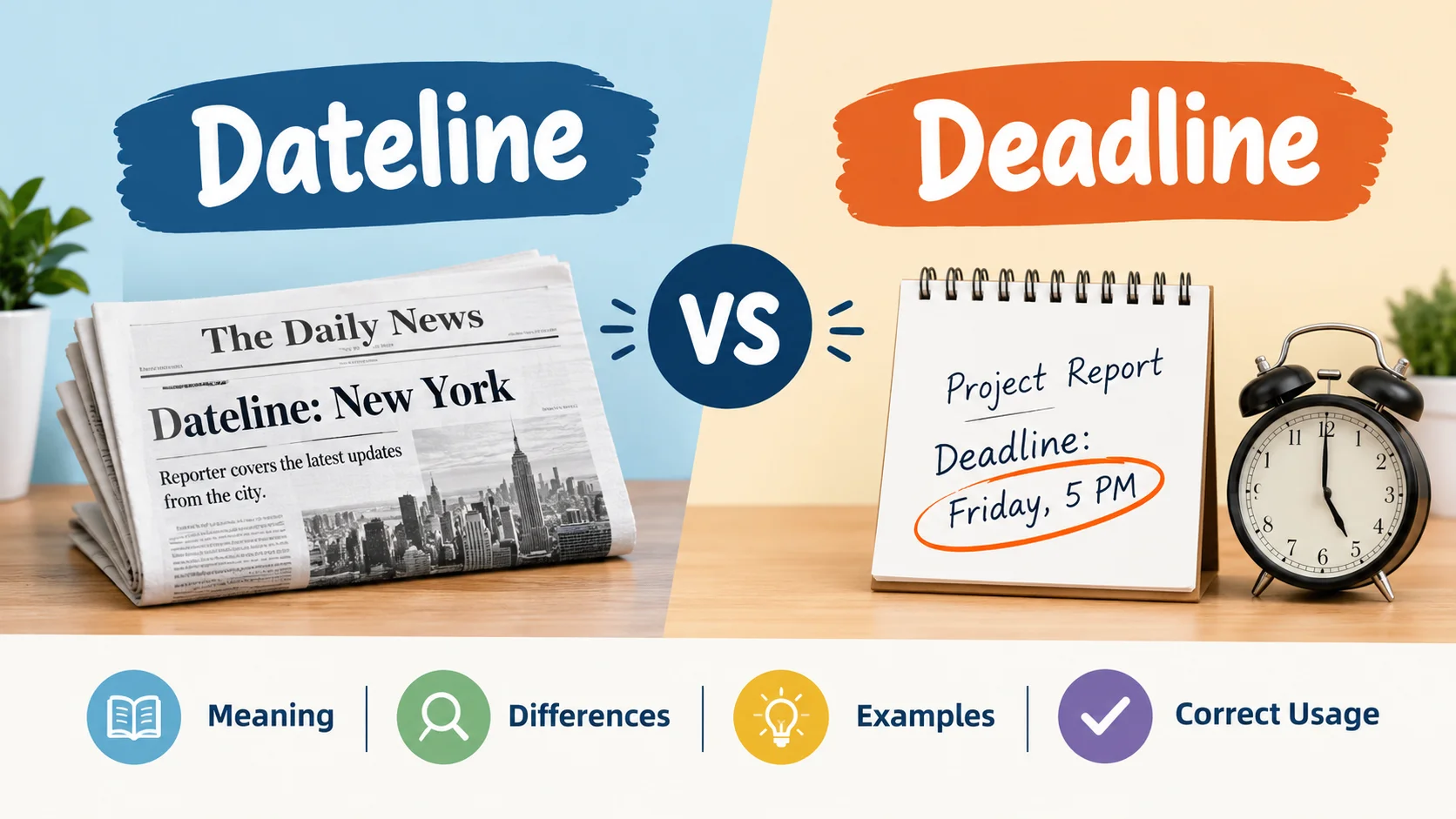

Dateline vs. Deadline can be confusing because these words look similar and sound almost the same, but their meanings differ in writing, journalism, business, and everyday communication.
At first glance, these terms may seem like distant cousins or twins in the English language family. However, when you dig deeper, you discover their different roles. A dateline marks the location and sometimes the date of a news report, while a deadline sets the final time for completing work. Mixing them up can create confusion, much like a ticking time bomb, especially when journalists prepare news articles or project managers handle schedules and projects. Understanding the difference helps prevent misunderstandings in professional settings and supports clear communication.
A dateline is a noun that appears as a written or printed line in a news article, story, or publication. It provides relevant information about the location and sometimes the date, time, issue, or composition of a piece. For example, an article’s dateline might read LONDON, identifying where the journalist filed the report or where the news report originated. A deadline, however, means the last time or final limit by which an assignment or task must be finished, completed, or submitted. It establishes the final date or time for completing tasks and tells people when work needs to be done. For example, if a project deadline is Friday, the work must be ready by Friday. A journalist may need to meet a deadline when preparing a news report, while a project manager often worries about deadlines when managing a team. The key difference is simple: a dateline provides information about a report, while a deadline sets a limit on work.
To learn the meaning, definitions, and common uses of these words, remember that they are not interchangeable. Consider these practical sentence examples: “The article’s dateline reads LONDON” identifies the report’s location, while “The project deadline is Friday” tells you when the assignment must be completed. These simple memory tricks can help you choose the correct word confidently. A dateline tells readers where a news report comes from, while a deadline tells people when a task must be done. Knowing this distinction helps you avoid spelling mistakes and other common mistakes in emails, school assignments, workplace messages, and news writing. Although both words relate to dates and time in some contexts, their purposes remain different. Keep practicing these examples to improve your writing and use each word correctly.
Let’s dive in!
Quick Answer:
Dateline vs. deadline: A dateline identifies reporting information, usually a location and sometimes a date, in a news report. A deadline is the latest time or date by which someone must finish or submit something.
Here are two simple examples:
- Dateline: PARIS, France — The government announced new measures on Tuesday. The opening identifies the location associated with the report.
- Deadline: The reporter must submit the article by 5 p.m. The sentence establishes a time limit for completing a task.
Remember this simple distinction:
- Dateline = Reporting location or date information.
- Deadline = Time limit for completing something.
A dateline gives readers context about a report. A deadline tells someone when work must be finished.
Comparison Overview
Although dateline and deadline share similar spelling, their meanings and uses differ significantly. The following table highlights the main differences.
| Feature | Dateline | Deadline |
| Part of speech | Noun | Noun |
| Primary meaning | Reporting information associated with a news story | The latest permitted time or date for completing something |
| Main purpose | Provides context about a report’s origin | Establishes a time limit |
| Common setting | Journalism, newspapers, and news publishing | Workplaces, schools, businesses, and everyday life |
| Typical association | Reporting location and sometimes date | Due date, cutoff time, or completion date |
| Common expressions | News dateline, international dateline | Meet a deadline, miss a deadline, extend a deadline |
| Example | The report carried a London dateline. | The report’s deadline was Friday. |
| Can the words replace each other? | No | No |
The most important distinction is their purpose. A dateline tells readers where a news report originates or is associated with, while a deadline tells people when something must be completed.
For example, a journalist covering an election might file a story from Washington, D.C. The article may carry a Washington dateline, while the newsroom imposes a deadline of 6 p.m. for submitting the report.
The two words can appear in the same situation without sharing the same meaning.
What Does Dateline Mean?
A dateline is a line or notation in a news report that identifies the place associated with the reporting. Depending on the publication, it may also include a date.
Journalists use datelines to give readers geographical context before they begin reading the main story. For instance, a report about an election might start with ISLAMABAD to indicate the location associated with the reporting.
Datelines are particularly common in newspaper articles, wire-service reports, and other forms of journalism. Their exact format depends on the publication’s editorial style.
Definition of Dateline
The word dateline is a noun. In journalism, it usually refers to information placed near the beginning of a news report to identify its reporting location, sometimes alongside a date.
Consider this example:
ROME — Officials announced a new transportation plan on Monday.
Here, ROME serves as the dateline. It tells readers which location the report is associated with before they encounter the main story.
A dateline can contain more than a city name. Some news organizations include a country, state, or date, depending on their reporting practices.
For example:
- NEW YORK — A location-based dateline.
- NEW YORK, October 24 — A dateline containing a location and date.
- KARACHI, Pakistan — A dateline identifying a city and country.
These examples illustrate possible formats rather than a universal standard. News organizations follow their own style guides, and not every article includes a dateline.
It’s also worth distinguishing a dateline from a timestamp. A timestamp may tell you exactly when an article was published or updated. A dateline instead provides information about the report’s geographical origin or reporting context.
How Dateline Is Used in Journalism
A dateline helps readers understand the geographical context of a news story. This information can be especially useful when a publication covers events across multiple cities or countries.
Imagine reading a report about a major earthquake. A dateline identifying Kathmandu immediately gives you a geographical reference for the report.
However, the dateline doesn’t necessarily identify the location where every event described in the article occurred. A journalist reporting from one city may investigate developments happening elsewhere.
Datelines also appear in syndicated news reports and wire-service journalism. When news organizations distribute stories to multiple publishers, a dateline can help preserve information about where the reporting originated.
Here are the main purposes of a dateline:
- Identify reporting location: Show the place associated with the report.
- Provide geographical context: Help readers understand where the reporting comes from.
- Support news attribution: Preserve reporting details when articles circulate between publications.
- Orient readers: Establish a location before the main story begins.
A dateline isn’t the same as a byline, headline, or publication date. Each element performs a different job.
| News element | Purpose | Example |
| Headline | Summarizes the story’s main point | City Announces New Transit Plan |
| Byline | Identifies the author or reporter | By Jane Smith |
| Dateline | Identifies the reporting location, sometimes with a date | BOSTON |
| Publication date | Shows when the article was published | October 24, 2026 |
| Deadline | Sets the time limit for submitting or completing work | Submit by 4 p.m. |
Understanding these distinctions helps you interpret news articles more accurately.
Dateline Examples in Sentences
The easiest way to understand dateline is to see how it works in different journalistic situations.
Example 1:
The newspaper published a report with a London dateline.
The sentence means that the report was associated with London as its reporting location.
Example 2:
The international news story carried a dateline from Nairobi.
Here, the dateline provides geographical context for the story.
Example 3:
The editor checked the dateline before publishing the article.
The editor verified the reporting information rather than the story’s submission time.
Example 4:
The article included a dateline identifying the reporter’s location.
This example highlights the dateline’s role in helping readers understand where the reporting originated.
Example 5:
The editor removed the dateline to match the publication’s house style.
Some publications use datelines selectively. Their editorial guidelines determine when and how to include them.
Notice that none of these sentences uses dateline to mean a due date. That meaning belongs to deadline.
Dateline in Other Contexts
Although journalism is its most familiar context, dateline can appear in other discussions involving news, reporting, and publishing.
For example, someone might refer to a foreign dateline when discussing international reporting. A media editor might also ask a reporter to verify the dateline before publication.
The word also appears in the name of the International Date Line, a geographical convention associated with changes in calendar dates across the Pacific Ocean. The International Date Line is not the same thing as a newspaper dateline, even though the expressions share the word date.
The International Date Line roughly follows the 180th meridian but bends around certain territories and island groups. These adjustments help keep neighboring places within practical calendar arrangements.
This geographical usage is worth recognizing, but it doesn’t change the ordinary distinction between dateline and deadline.
What Does Deadline Mean?
A deadline is the latest time or date by which someone must complete, submit, or deliver something. People use deadlines to organize work, coordinate responsibilities, and establish clear expectations.
Unlike dateline, which is closely associated with reporting information, deadline appears throughout everyday life. You might have a deadline for submitting a school assignment, completing a business proposal, paying a bill, or registering for an event.
For example, if your professor requires an essay by Friday at noon, that time is your deadline.
The central idea is simple: a deadline marks the limit for completing an action.
Definition of Deadline
Deadline is a noun that refers to a required completion or submission cutoff. It can identify a specific date, a particular time, or both.
Consider these examples:
- The application deadline is November 15.
- Our team must meet the project deadline.
- The editor extended the deadline until Monday.
- She missed the deadline for submitting her assignment.
Each sentence describes a time limit associated with an action or obligation.
A deadline doesn’t always mean that someone will face a penalty for being late. The consequences depend on the circumstances and the rules involved.
For example, missing a scholarship application deadline might make an applicant ineligible. Missing an informal personal deadline might simply delay a project.
Some deadlines are fixed, while others allow extensions. A court filing deadline, a school assignment deadline, and a workplace target may all operate under different rules.
It’s also important to distinguish a deadline from a general goal. A goal describes what you want to achieve. A deadline specifies when you must achieve it or complete a related task.
Common Situations Where Deadlines Apply
Deadlines help people coordinate activities across many areas of life. Their practical meaning remains the same, even when the setting changes.
In the workplace
Employees often work with deadlines for reports, presentations, client projects, and internal reviews.
Example: The marketing team must finish the campaign proposal by Thursday.
The deadline helps team members organize their responsibilities and coordinate the next stage of work.
In education
Students face deadlines for essays, examinations, applications, and research projects.
Example: The final deadline for submitting the assignment is December 10.
Submitting work after the deadline may affect the grade, depending on the instructor’s policy.
In business
Companies use deadlines for contracts, payments, financial documents, product launches, and customer orders.
Example: The supplier must deliver the equipment before the agreed deadline.
A missed deadline can disrupt other activities, particularly when several teams depend on the same deliverable.
In journalism and publishing
Editors set deadlines for article submissions, fact-checking, editing, and production.
Example: The reporter submitted the investigation before the newsroom deadline.
This context provides a useful connection between the two words. A newspaper story may have a dateline identifying its reporting location and a deadline governing when the reporter must submit it.
In everyday life
People also establish deadlines for personal projects, registrations, appointments, and household responsibilities.
Example: I set a deadline to finish organizing my office this weekend.
Personal deadlines may be flexible, but they can still help people manage their time.
Deadline Examples in Sentences
The following examples show how deadline works in natural English.
| Sentence | Meaning |
| I must meet the deadline for my assignment. | The assignment needs to be completed on time. |
| We missed the deadline for the application. | We submitted the application too late. |
| The manager extended the deadline by two days. | The manager allowed additional time. |
| Our deadline is Friday afternoon. | The work must be completed by Friday afternoon. |
| She finished the report ahead of the deadline. | She completed the work before the cutoff. |
| The team agreed on a new deadline. | The team selected a new completion time. |
| Please confirm the payment deadline. | Confirm the latest permitted payment date. |
These examples show that deadline often appears with verbs describing time management and task completion.
Common verbs include meet, miss, extend, set, establish, and confirm.
Common Expressions With Deadline
English speakers use several familiar expressions involving deadline. Learning them will help you sound more natural in professional and everyday conversations.
- Meet a deadline: Complete something by the required time.
- Miss a deadline: Fail to finish or submit something on time.
- Set a deadline: Establish the latest permitted completion time.
- Extend a deadline: Allow more time than originally planned.
- Work toward a deadline: Continue working with the cutoff in mind.
- Beat a deadline: Finish before the required time, often under pressure.
- Deadline for submission: The final time or date for submitting something.
- Tight deadline: A short or demanding period for completing work.
- Approaching deadline: A deadline that is getting closer.
- Past the deadline: Later than the permitted completion time.
For example, a project manager might say, “We have a tight deadline, so let’s finish the first draft today.”
Here, tight deadline communicates that the team has limited time available.
By contrast, the expression meet the dateline generally doesn’t communicate the same idea. When you mean completing work on time, use meet the deadline.
Read More: Result In or Result To: Which Phrase Is Correct? Just for You
Main Differences Between Dateline vs. Deadline
Although the words share several letters, dateline vs. deadline is a difference in meaning, purpose, and context. One belongs mainly to reporting information, while the other describes a time limit.
Let’s examine the key differences more closely.
Difference in Meaning
The most important distinction concerns what each word communicates.
A dateline identifies the place associated with a news report and may include a date. It helps readers understand the geographical context of the reporting.
A deadline establishes the latest time or date for completing a task. It tells someone when an action must be finished or submitted.
Consider these two sentences:
- The article carried a Washington dateline.
- The journalist had a Friday deadline.
The first sentence describes the report’s location. The second identifies the journalist’s submission cutoff.
Confusing these meanings can make a sentence inaccurate. If you mean that a reporter must submit an article by Friday, deadline is the correct word.
Difference in Purpose
A dateline and a deadline also serve different practical purposes.
A dateline provides information to readers. A deadline helps people organize work and meet time-sensitive requirements.
For instance, a news report about a storm might carry a Miami dateline. That information gives readers geographical context for the story.
Meanwhile, the editor might require the reporter to submit the article by 3 p.m. That requirement creates a deadline.
The distinction becomes particularly clear when both terms appear in the same situation:
MIAMI — Emergency crews continued rescue operations as the storm moved north.
The example begins with a dateline identifying Miami. The reporter’s deadline, however, might be 3 p.m. that afternoon.
One helps readers understand the report. The other governs when the report must be submitted.
Difference in Context
The two words appear in different contexts, although journalism can involve both.
| Context | Correct word | Example |
| Identifying a news report’s location | Dateline | The article carried a Delhi dateline. |
| Submitting a newspaper article | Deadline | The article’s deadline is 4 p.m. |
| Completing a school assignment | Deadline | My essay deadline is Monday. |
| Identifying a reporting location in international news | Dateline | The report included a Nairobi dateline. |
| Filing a business proposal | Deadline | The proposal deadline is next week. |
| Setting a cutoff for an application | Deadline | The application deadline is December 1. |
The table highlights an important pattern: deadline has a much broader everyday use than dateline.
You will frequently encounter deadlines at work, school, and home. Datelines appear more often in news reporting and related publishing contexts.
Difference in Sentence Structure
Both words function as nouns. However, the phrases surrounding them often reveal their intended meanings.
Common patterns with dateline:
- A news dateline
- A London dateline
- A dateline in the article
- A report with a Washington dateline
Examples:
- The editor corrected the dateline.
- The report included a dateline from Islamabad.
- The journalist checked the dateline before publication.
Common patterns with deadline:
- A project deadline
- A submission deadline
- A strict deadline
- A deadline for applications
- A deadline of October 30
Examples:
- We need to meet the deadline.
- The manager extended the deadline.
- The application deadline falls on Friday.
Notice the verbs associated with each word. You might check, include, or correct a dateline. You might set, meet, miss, or extend a deadline.
These patterns aren’t absolute rules, but they provide helpful clues when you’re choosing between the words.
Dateline vs. Deadline: Side-by-Side Examples
Comparing the words in similar situations makes their meanings easier to remember.
Example pair: News reporting
- Correct: The article carried a Paris dateline.
- Correct: The reporter had a deadline of noon.
The first identifies reporting information. The second specifies when the reporter must finish or submit the work.
Example pair: Newspaper editing
- Correct: The editor checked the dateline for accuracy.
- Correct: The editor moved the submission deadline to Friday.
The editor checks the dateline for correct reporting context. The deadline determines when the article is due.
Example pair: International reporting
- Correct: The report included a Tokyo dateline.
- Correct: The newsroom established a deadline for the final draft.
Both words belong in journalism, but they describe separate things.
Example pair: School assignments
- Incorrect: My essay dateline is Monday.
- Correct: My essay deadline is Monday.
The corrected sentence uses deadline because Monday marks the required submission date.
These examples demonstrate why similar spelling doesn’t make two words interchangeable.
Dateline vs. Deadline in Real-World Examples
Understanding dictionary definitions is useful. Seeing how people apply these words in realistic situations makes the distinction even clearer.
In Newspapers and Online News
News articles often contain several pieces of information that readers can easily confuse.
A headline introduces the main subject. A byline identifies the author. A dateline may identify the location associated with the reporting. The publication timestamp shows when the article appeared online.
A newsroom deadline serves a different purpose. It tells the reporter or editor when a particular stage of work must be completed.
Consider a reporter covering a national election from Islamabad. The article might carry an Islamabad dateline, while the editor requires the final draft by 6 p.m.
In this scenario:
- Dateline: Islamabad.
- Deadline: 6 p.m.
- Purpose of the dateline: Provide geographical context.
- Purpose of the deadline: Establish a submission cutoff.
This example shows that a single news story can involve both concepts without confusing their meanings.
In the Workplace
Imagine a marketing team preparing a product launch. The team must finish its campaign proposal before a scheduled client meeting.
The project manager announces, “Our deadline is Thursday at noon.”
That statement establishes when the team must finish its work. The word dateline wouldn’t communicate the intended meaning.
A dateline might become relevant if the team also prepares a news release containing reporting information. However, it wouldn’t replace the deadline for submitting the campaign proposal.
Workplaces commonly use deadlines to coordinate tasks, allocate resources, and prevent delays. A missed deadline can affect other employees when their responsibilities depend on the same deliverable.
In Schools and Colleges
Students frequently use deadline when discussing assignments, applications, and academic projects.
For example:
“My research paper deadline is November 5.”
This sentence means the paper must be submitted by the specified date, subject to the instructor’s rules.
Using dateline here would be incorrect in standard usage because the sentence concerns a submission cutoff rather than news-reporting information.
Students can remember the distinction by asking one simple question: Am I identifying a news report’s location or describing when work is due?
If you’re talking about an assignment’s due date, use deadline.
In Publishing and Broadcasting
Editors, producers, and reporters often manage several deadlines during a single production cycle.
A journalist might have one deadline for submitting a draft, another for completing revisions, and a final cutoff before publication. Each deadline marks a required stage of work.
A news report may also carry a dateline indicating the location associated with its reporting.
For example, an international news service might publish a report with a London dateline. The editor could still require the completed story by 2 p.m.
The dateline identifies reporting context. The deadline determines when the story must be ready.
This distinction also matters when discussing news production with colleagues. Using the correct word helps everyone understand whether you’re referring to reporting information or a scheduling requirement.
Common Mistakes When Using Dateline and Deadline
Because these words look similar, writers sometimes substitute one for the other. Fortunately, a few simple corrections can prevent most mistakes.
Using Dateline to Mean a Due Date
One common mistake is using dateline when referring to the date an assignment or project must be completed.
Incorrect: The deadline for the application is Friday, so submit it before the dateline.
Correct: The deadline for the application is Friday, so submit it before the deadline.
The second sentence uses the correct word for a submission cutoff.
You can also avoid repetition by writing, “The application is due Friday, so submit it on time.”
The key is to use deadline whenever you mean the latest permitted time for completing or submitting something.
Using Deadline to Describe a News Location
Another mistake involves using deadline to identify where a report originated.
Incorrect: The article included a London deadline.
Correct: The article included a London dateline.
The corrected sentence identifies London as the location associated with the reporting.
However, the original sentence could make sense in a different context if London were part of a description of a deadline. For example, a journalist might discuss a deadline imposed by a London-based newsroom.
Context matters, but the words themselves retain different meanings.
Confusing a Dateline With a Byline
A dateline and a byline both appear in some news articles, but they identify different information.
A dateline identifies the location associated with reporting and may include a date. A byline identifies the author or reporter.
For example:
- Dateline: LONDON
- Byline: By Sarah Williams
The first gives geographical context. The second tells readers who wrote the story.
Not every publication uses both elements. Their placement and format also vary by editorial style.
Assuming Dateline Always Includes a Date
The word dateline can create the impression that every dateline must display a calendar date. In practice, journalistic formats vary.
A publication might use only a city name. Another might include the city and country, while a third could include a date as well.
For example, BOSTON can function as a dateline even without an accompanying calendar date.
A publication date displayed elsewhere on the page doesn’t automatically become a dateline. The function and placement of the information matter.
Treating Dateline and Deadline as Synonyms
The most important mistake is assuming that the two words mean the same thing.
Consider this sentence:
The reporter checked the dateline before submitting the article by the deadline.
Both words work because they refer to separate parts of the process.
The reporter checks the dateline for accurate reporting information. The reporter submits the article before the required cutoff.
Replacing one word with the other would change the intended meaning or make the sentence confusing.
How to Remember the Difference Between Dateline and Deadline
If you frequently confuse these words, a simple memory trick can help.
Dateline = Date or location information associated with news reporting.
Deadline = The limit for finishing a task.
Think of a newspaper article that begins with a location such as LONDON. That location may serve as its dateline.
Now imagine the reporter must submit the story before 5 p.m. That cutoff is the deadline.
You can also remember the words through their common expressions:
- You check a dateline.
- You meet a deadline.
- A report may carry a dateline.
- A project may have a deadline.
- An editor may correct a dateline.
- An editor may extend a deadline.
These expressions aren’t rigid grammatical rules, but they reflect common usage.
When you’re unsure which word to choose, identify the meaning you want to express before writing the sentence.
If you’re describing the reporting location of a news story, a dateline is usually appropriate. If you’re describing a required completion time, choose the deadline.
FAQs:
What is the main difference between dateline and deadline?
A dateline identifies the location and sometimes the date of a news report. A deadline is the final date or time by which a task must be completed.
Is a dateline used in journalism?
Yes, a dateline is commonly used in journalism. It appears at the beginning of a news report and usually identifies where the story was reported or filed.
What does deadline mean in simple English?
A deadline is the latest time or date when you must finish or submit something. For example, if your assignment is due Friday, Friday is your deadline.
Can I use dateline and deadline interchangeably?
No, these words have different meanings. A dateline provides information about a news report, while a deadline sets a time limit for completing work.
What is an example of a dateline in a news article?
An example is LONDON — followed by the news story. This dateline tells readers where the report originated.
What is an example of a deadline in a sentence?
Here is an example: “The project deadline is Friday.” This means the project must be completed by the required time on Friday.
How can I remember the difference between dateline and deadline?
Remember that the dateline relates to a news report’s location, while the deadline relates to finishing work on time. A dateline tells you where a story comes from, and a deadline tells you when a task must be finished.
Conclusion:
Understanding dateline vs. deadline becomes easier when you remember their distinct purposes. A dateline provides location and date information in journalism, while a deadline establishes the final time for completing a task. Although the words look and sound similar, they are not interchangeable. Use dateline when discussing news reports and deadlines when referring to assignments, projects, or time limits. Choosing the correct word will help you communicate clearly and avoid confusion in professional and everyday writing.




1 thought on “Dateline vs. Deadline: Meaning, Differences, Examples, and Correct Usage”