
In today’s digital world, language can shift quickly, and new words often appear with new meanings. Moots is a popular piece of internet slang used on social media to describe people who connect and follow each other online. You may see “moots?” in a comment or “we should be moots” in a direct message.
The term is common on Instagram, TikTok, Snapchat, WhatsApp, X, X (Twitter), and Threads. People use “wanna be moots?”, “Looking for moots!”, or “Love my moots” to connect with friends, creators, and online communities. For beginners and non-native speakers, understanding this simple word makes online conversations easier and reduces confusion.
The meaning of moots goes beyond following someone. It can show connection, friendship, trust, identity, and digital belonging in modern online culture. In American online culture and the United States, this social media slang helps people communicate naturally, relate to others, and build a real connection through modern communication.
Let’s dive in!
Quick Answer: What Does “Moots” Mean in Text?
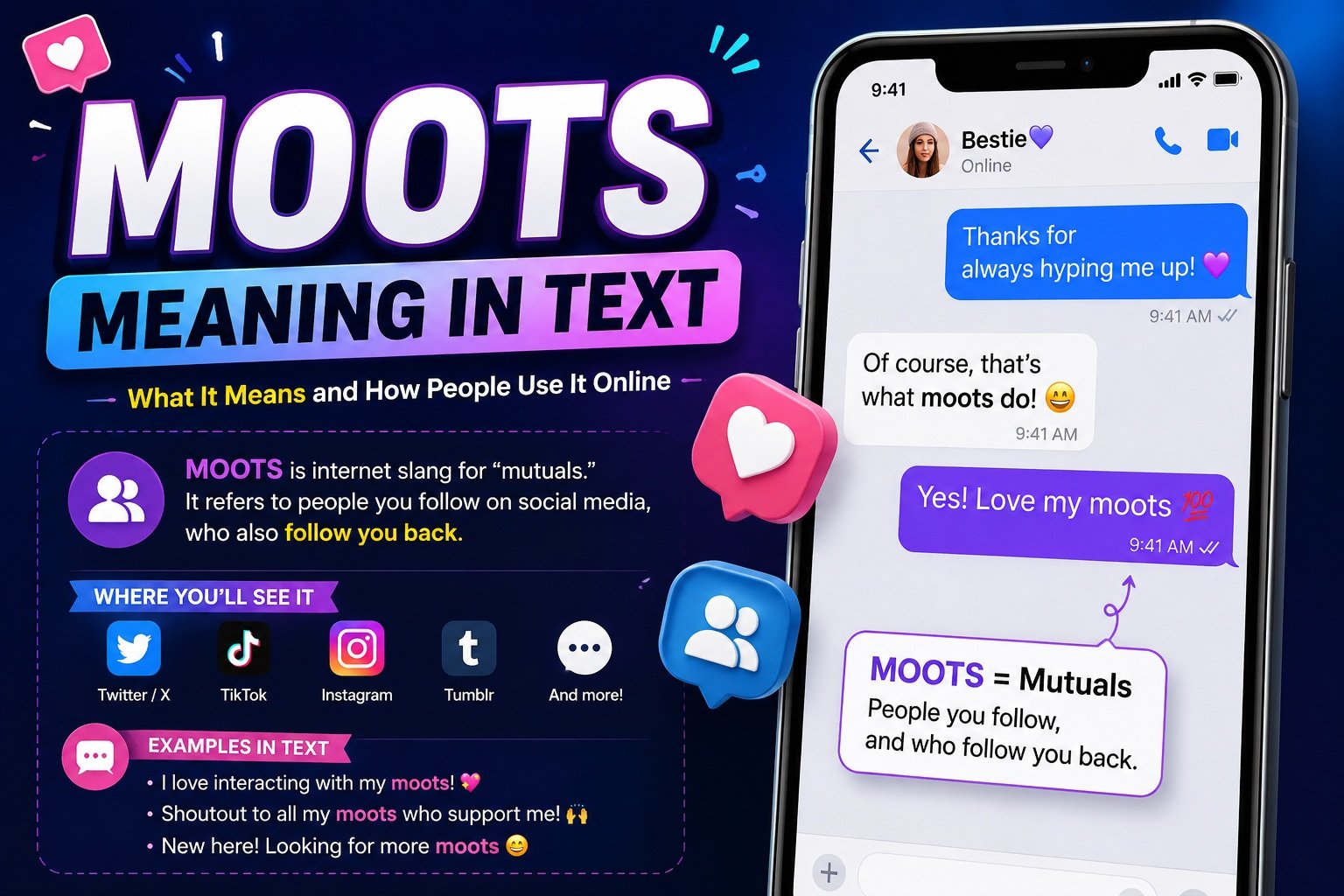
“Moots” is internet slang for “mutuals,” meaning people who follow each other on social media.
For example:
“Looking for new moots!”
This usually means:
“I’m looking for people who want to follow each other and interact online.”
Likewise:
“My moots are hilarious.”
means:
“The people who follow me and whom I follow back are hilarious.”
The term moot is the singular form, while moots is plural.
| Term | Meaning |
| Moot | One mutual follower |
| Moots | Multiple mutual followers |
| Mutual | Someone who follows you and whom you follow |
| Mutuals | Multiple reciprocal followers |
Dictionary.com describes the social-media sense of moot as a shortening and phonetic respelling connected to mutual follower. Merriam-Webster also now lists the informal social-media noun moot separately from the older meanings of the word.
What Does “Moots” Mean in Texting?
When someone uses moots in a text message, DM, comment, caption, or social-media post, they’re usually talking about their online mutuals.
The basic idea is simple:
You follow them → they follow you back → you’re moots.
The relationship doesn’t necessarily go beyond that.
For instance, imagine you follow someone because you both enjoy the same music. They notice your posts, follow you back, and you occasionally comment on each other’s content. You could call that person your moot.
You don’t have to know each other offline. You don’t even have to message every day.
That’s one reason the term is useful. “Moot” describes a specific kind of online connection without necessarily calling someone a friend.
Social-media glossaries commonly define moots as mutual followers, particularly on platforms such as X, TikTok, Instagram, and Tumblr.
What Is a “Moot” on Social Media?
A moot is generally one person with whom you have a reciprocal social-media connection.
Suppose your account follows 500 people. Of those 500 accounts, 150 follow you back. Those 150 people could be described as your moots.
The important part is reciprocity.
A follower isn’t automatically a moot.
If Sarah follows Alex but Alex doesn’t follow Sarah, Sarah is Alex’s follower. She isn’t necessarily his moot.
If Alex follows Sarah back, the relationship becomes mutual.
Follower vs. Moot
| Relationship | Follows you? | You follow them? | Usually a moot? |
| Follower only | Yes | No | No |
| Someone you follow | No | Yes | No |
| Mutual follower | Yes | Yes | Yes |
| Close online friend | Yes | Yes | Often, but not required |
This distinction matters because people sometimes use moot and friend as if they mean exactly the same thing. They don’t.
A moot can become a friend. The label itself doesn’t guarantee friendship.
Why Do People Say “Moots” Instead of “Mutuals”?
The short answer is convenience.
“Mutuals” is already a casual social-media term. Online communities shortened and reshaped it into “moots.” Dictionary.com describes the slang form as a shortening and phonetic respelling associated with mutual follower.
Internet language does this constantly.
Words get shortened, reshaped, combined, or given new meanings because online conversation rewards speed and familiarity. A term that’s easy to type and recognizable within a particular community can spread quickly.
There’s also a social element. Saying “my moots” can feel warmer and more community-oriented than saying “my mutual followers.”
Compare:
“Thanks to all my mutual followers for supporting this post.”
with:
“Thanks, moots!”
The second sounds much more natural in an informal online community.
What Does “Moots” Mean on TikTok?
On TikTok, moots generally refers to people who follow each other.
Someone might write:
“Any booktok accounts want to be moots?”
They’re essentially inviting other users with similar interests to connect through reciprocal follows.
The term can also appear in comments, captions, bios, or direct messages.
For example:
“Need more moots who love horror movies.”
This means the person wants more mutual followers who share an interest in horror movies.
The exact culture around the term varies between communities. In fandoms and interest-based groups, becoming moots can be an easy first step toward regular interaction.
What Does “Moots” Mean on Instagram?
On Instagram, moots usually means people who follow each other.
For example:
“My moots always support my art.”
The person is talking about mutual followers who regularly interact with their posts.
Instagram also makes the underlying concept fairly easy to understand because users can see whether accounts follow one another. Still, “moot” isn’t an official Instagram relationship label. It’s informal internet slang.
That’s an important distinction.
The platform provides the follow relationship. Users provide the slang.
What Does “Moots” Mean on X or Twitter?
On X, formerly known as Twitter, moots has been especially common in fandom and interest-based communities.
A user might say:
“Looking for new moots who like anime.”
They’re looking for people with similar interests who may follow each other and interact.
The word works particularly well on platforms where users can follow one another without needing a formal two-way friendship system. Slang references commonly identify X/Twitter, TikTok, Tumblr, and Instagram as places where the term appears.
What Does “Moots” Mean in Fandom Communities?
Fandom communities give the word an extra layer of meaning.
People who share an interest in a musician, television series, game, fictional character, sports team, or other subject often discover one another through posts and hashtags.
A simple follow can turn into:
follow → follow-back → comments → DMs → shared interests → online friendship
That’s why some users casually describe moots as online friends. However, the terms still aren’t identical.
Someone can be your moot without ever becoming your friend.
Example
Imagine two people who both post about a popular video game.
They follow each other because they enjoy each other’s posts. They occasionally comment on each other’s screenshots and react to new content.
They’re moots.
After several months, they start chatting regularly and eventually move their conversations into DMs. At that point, they may reasonably consider each other online friends too.
The moot relationship came first. The friendship developed afterward.
Read More: FR Meaning in Text: What Does “FR” Mean in Texting, Chat, and Social Media?
34+ Examples of “Moots” in Text
The easiest way to understand internet slang is to see it in context. Here are common examples and what each one means.
“Looking for moots!”
The person wants to find new mutual followers.
“Who wants to be moots?”
They’re asking people to establish a reciprocal follow.
“Let’s be moots.”
This is a direct invitation to become mutual followers.
“Are we moots?”
The person is asking whether you both follow each other.
“My moots are the best.”
They’re talking about their mutual followers.
“I love my moots.”
The speaker appreciates their online mutuals. The phrase may suggest familiarity, but it doesn’t automatically mean they’re close friends.
“New moots!”
The person has recently gained new mutual followers.
“I made three new moots today.”
They established three new reciprocal connections.
“I need more moots.”
They want to build a larger group of mutual followers.
“Moots, what should I post?”
The speaker is asking their mutual followers for ideas or opinions.
“Moots, help me choose.”
They’re asking their mutuals to help make a decision.
“Which moots are awake?”
They’re asking which mutual followers are currently active.
“Moots, drop your usernames.”
They’re asking mutual followers to share their account names.
“Tag your moots.”
They’re asking users to tag their mutual connections.
“Shoutout to my moots.”
The speaker is publicly recognizing or thanking mutual followers.
“Moot appreciation post.”
The post is dedicated to appreciating mutual followers.
“My favorite moot posted again.”
The speaker is referring to one particular mutual follower they especially like.
“I met one of my moots in person.”
An online mutual has become an offline acquaintance or friend.
“My moots keep making me laugh.”
Their mutual followers regularly post funny content.
“My moots understand.”
The speaker expects their mutual followers to understand the context or joke.
“Moots only.”
The phrase indicates that something is intended for mutual followers.
“Follow me if you want to be moots.”
The person is inviting reciprocal follows.
“Anyone into gaming want to be moots?”
They’re looking for mutual followers who share an interest in gaming.
“Any anime fans want to be moots?”
They’re looking for anime-focused mutuals.
“I miss my old moots.”
The speaker is talking about former or inactive mutual connections.
“I haven’t talked to my moots in forever.”
They haven’t interacted with their mutual followers for a long time.
“My moots have great taste.”
The speaker is complimenting their mutual followers.
“Thanks, moots!”
A casual way to thank mutual followers.
“Moot check!”
Usually a prompt encouraging mutual followers to identify themselves or interact.
“New moot unlocked.”
A playful way to announce a new mutual connection.
“We should be moots.”
A suggestion that two users should follow each other.
“One of my moots sent me this.”
The speaker received something from a mutual follower.
“I recognize most of my moots.”
The speaker knows or recognizes many of their mutual connections.
“My moots are online.”
The speaker believes their mutual followers are currently active.
“I want more active moots.”
They want mutual followers who regularly post or interact.
“Rate this, moots.”
The speaker wants opinions from their mutual followers.
“Moots, which one is better?”
They’re asking their mutuals to choose between options.
These examples show an important pattern: the word itself stays fairly stable while the surrounding sentence changes its purpose.
Does “Moot” Mean Friend?
Not necessarily.
This is one of the biggest misunderstandings surrounding the term.
A moot is usually defined by a reciprocal social-media connection. Friendship involves a deeper relationship.
Someone might follow you because they like your artwork. You follow them because you enjoy their photography. Neither of you knows the other personally.
You’re still moots.
Think of it like this:
Moot = connection status
Friend = relationship
The two can overlap, but they’re not interchangeable.
Community discussions also reflect this distinction. Users often describe moots as people who interact regularly without necessarily considering them close friends.
Does “Moots” Mean Online Friends?
Sometimes, but that’s a broader interpretation rather than the core definition.
A person might call their moots online friends because they chat regularly, share jokes, discuss interests, and support one another.
Another person might use moot much more literally: anyone who follows them back.
Both uses can appear in casual conversation.
The safest interpretation is therefore:
Moots are mutual online connections. Some moots are friends, while others aren’t.
Is “Moots” Flirty or Romantic?
No. The word itself isn’t romantic.
If someone asks:
“Want to be moots?”
they’re generally asking whether you’d like to become mutual followers.
The context could become flirtatious. The term itself doesn’t create that meaning.
For example:
“Looking for cute moots who love K-pop.”
is still fundamentally about finding mutual online connections.
Don’t read romantic intent into the word alone. Look at the rest of the conversation.
Is “Moots” Positive or Negative?
Usually, moots is neutral or friendly.
The surrounding language determines the emotional tone.
Positive
“My moots are amazing!”
The speaker appreciates their mutual followers.
Neutral
“Which of my moots posted this?”
The speaker is simply identifying a mutual.
Negative
“I blocked one of my moots.”
The speaker is describing a negative interaction.
The word itself doesn’t carry the positive or negative emotion.
What Is the Traditional Meaning of “Moot”?
Here’s where things get interesting.
Moot existed in English long before social media.
Merriam-Webster traces the traditional noun to Old English mōt or gemōt, referring to a meeting or assembly. The traditional word later developed several related meanings.
Today, moot can function as a noun, verb, or adjective.
Moot as an adjective
It can mean open to debate or discussion.
For example:
“Whether the policy will work remains a moot question.”
In American English, moot can also mean something that has become irrelevant or has no practical significance.
For example:
“The argument became moot after the rule changed.”
Merriam-Webster lists both major adjective senses: something debatable and something deprived of practical significance.
Moot as a verb
As a verb, to moot means to raise something for discussion or debate.
Cambridge Dictionary gives examples involving ideas or possibilities that someone has suggested for consideration.
Moot as a noun
Historically, a moot could refer to a deliberative assembly. The word also appears in legal and academic contexts.
That’s why you may hear the term moot court, where students argue hypothetical legal cases as part of legal education.
“Moot Point” vs. “Moots”: What’s the Difference?
These two expressions look identical at first. They’re actually different uses of the word.
“That’s a moot point.”
Here, moot has its traditional English meaning.
Depending on context, the speaker may mean the issue is debatable or that it no longer has practical significance.
“She’s one of my moots.”
Here, moot is internet slang for a mutual follower.
The two meanings developed separately.
Merriam-Webster now lists the social-media noun moot as an informal sense derived by shortening and altering “mutual.” It dates that particular sense to 2017, while the traditional senses are centuries older.
That’s a useful fact because it explains why the word can feel strangely familiar while still having a completely new meaning online.
Moots vs. Mutuals: Are They the Same?
In most social-media contexts, yes.
| Word | Typical meaning |
| Moot | One mutual follower |
| Moots | Multiple mutual followers |
| Mutual | One person who follows you and whom you follow |
| Mutuals | Multiple reciprocal followers |
“Moots” is generally the shorter, more slang-heavy option.
“Mutuals” is easier for someone unfamiliar with internet slang to understand immediately.
Moots vs. Followers
These terms aren’t identical.
A follower is someone who follows your account.
A moot generally refers to someone who follows you and whom you follow back.
Consider this example:
- 1,000 people follow you.
- You follow 300 people.
- 180 of those 300 people follow you back.
You might have 1,000 followers, but only around 180 mutuals or moots.
The numbers aren’t interchangeable.
Moots vs. Online Friends
The difference is even more important here.
| Term | What it tells you |
| Follower | Someone follows an account |
| Moot | Two accounts follow each other |
| Online acquaintance | People interact online but may not have a close relationship |
| Online friend | A stronger personal relationship developed online |
| Close friend | A deeper relationship involving substantial trust and familiarity |
A moot can become an online friend. However, a mutual follow alone doesn’t establish friendship.
How Do You Become Moots With Someone?
Usually, it happens naturally.
- Follow the person.
- They notice your account or content.
- They follow you back.
- You now have a mutual connection.
- You may begin interacting through comments, likes, reposts, or messages.
Some users make the process more direct by posting:
“Looking for moots!”
or:
“Anyone want to be moots?”
People with similar interests can respond and follow each other.
However, a reciprocal follow isn’t an obligation. Someone can decline, ignore the request, or simply choose not to follow back.
How Should You Respond to “Want to Be Moots?”
Your response depends on what you want.
If you want to say yes
“Sure! I’d love to.”
Or simply:
“Yeah, let’s be moots!”
If you want to learn more first
“Sure! What kind of content do you post?”
That’s useful when you don’t know the person yet.
If you don’t want to
You don’t need a complicated explanation.
A polite:
“Thanks, but I usually keep my follows pretty limited.”
is enough.
The term is casual. Your boundaries can be casual too.
Common Misunderstandings About “Moots”
“Moots means close friends.”
Not necessarily. It primarily describes a mutual online connection.
“Every follower is a moot.”
No. A follower generally becomes a moot only when the follow is reciprocal.
“Moots means dating.”
No. The word has no inherent romantic meaning.
“Moots means moot point.”
No. Social-media moot is a slang form related to mutual. The traditional moot has a different history.
“Moot is only internet slang.”
No. The traditional word predates social media by centuries.
“You have to talk to someone to call them a moot.”
Not necessarily. Reciprocal following is the core idea. Some communities use the term more loosely for people they regularly interact with online.
How to Understand “Moots” From Context
When you’re unsure what someone means, look at the words around it.
If you see words about followers
“Looking for moots to follow.”
It’s almost certainly referring to mutual followers.
If you see fandom language
“My moots are obsessed with this character.”
Again, the meaning is probably mutual online connections.
If you see debate language
“That’s a moot point.”
Now you’re dealing with the traditional English word.
If you see legal language
“The case became moot.”
That’s also the traditional meaning, specifically the sense of having no remaining practical significance.
Context is the quickest decoder.
A Simple Real-Life Case Study
Imagine Maya creates an Instagram account focused on digital art.
She follows 50 artists whose work she enjoys. Twenty of them follow her back. She occasionally comments on their posts, and several of them comment on hers.
Those 20 accounts are her moots.
One artist, Jordan, starts chatting with Maya regularly. They exchange advice about drawing software and eventually become close online friends.
Jordan is still Maya’s moot. But now Jordan is also her online friend.
That distinction illustrates why moot is useful. It describes the social-media connection, while friend describes the relationship that grew from it.
What Does “Moots Meaning in Text” Really Come Down To?
The modern slang meaning is surprisingly straightforward.
Moots = mutuals = people who follow each other on social media.
The term can imply more than a reciprocal follow when people interact frequently. In fandoms and online communities, moots may become genuine friends. Still, the word itself doesn’t promise closeness, trust, or romance.
At the same time, don’t confuse internet slang with the traditional word moot. The older word has a long history connected with discussion, debate, assemblies, and legal education.
FAQs:
1. What does “moots” mean in text?
Moots means mutual online friends or people who follow and interact with each other on social media.
2. What does “wanna be moots?” mean?
“Wanna be moots?” is a casual way of asking someone if they want to become mutual online friends.
3. Where is the word “moots” commonly used?
You can see moots on platforms such as Instagram, TikTok, X, Threads, and other online communities.
4. Is “moots” the same as followers?
Not exactly. Followers may simply follow an account, while moots usually refers to people who follow each other and have some form of online interaction.
5. Is “moots” formal English?
No. Moots is informal internet slang commonly used in casual online conversations, especially among younger social media users.
Conclusion:
Understanding moots meaning in text is easier once you know how the term is used in online conversations. Moots usually refers to people who follow each other and interact on social media, such as Instagram, TikTok, X, or Threads. Unlike regular followers, moots often have a stronger sense of connection, friendship, and digital belonging.
You may see phrases like “moots?”, “wanna be moots?”, or “Looking for moots!” in comments, posts, and direct messages. As internet slang continues to evolve, learning terms like this can help you understand modern online language and communicate more naturally with digital communities.