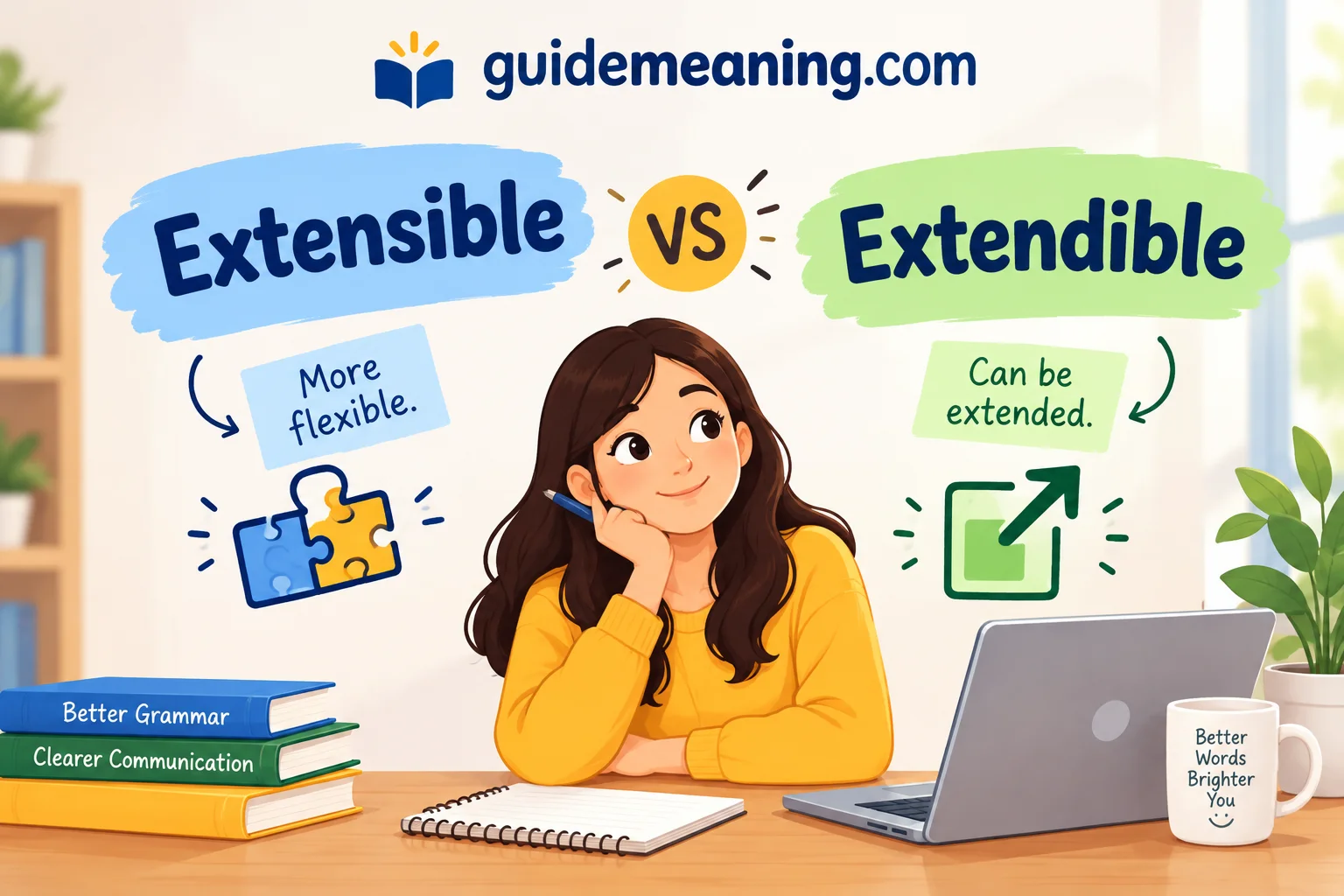

Extensible vs. Extendible can confuse writers because the two words look alike, yet each fits a different context in technical and everyday usage. The difference becomes clearer when you understand how these two words work. Although they appear almost identical, people often use them interchangeably and assume they mean the same thing. Their meanings can shift depending on whether you are talking about technology, physical products, language, or everyday life. This in-depth guide offers a clear, friendly, and practical way to learn what each word truly means, which term suits different concepts, and where these terms show up in software and engineering. The goal is to clear up the confusion once and for all.
The words are used in different situations because something can be expanded or made larger in different ways. Extensible commonly applies to systems that allow adding new features, while extendable can describe physical objects that become stretched or lengthened. The spelling may look simple, but it shows why choosing the right term matters. In real usage, some words can quietly split into different worlds. They may behave differently, and mixing them in writing can sound technically out of place. In technical and everyday writing, developers work with extensible systems, architects build extensible frameworks, and product catalogs may mention extendible tables and ladders. Both can sound correct in isolation, but context helps writers make the right choice. Real-world usage, physical design, and the distinction between the terms make the pattern easier to remember.
When wondering about these closely related and legitimate English words, examine their contexts and usage. Both can describe something extended, expanded, or made larger, yet extensible remains a common choice when discussing software, systems, designs, and frameworks that accept additional features. Extendible can fit when emphasizing something that can be physically or practically extended in length, size, or scope. Once you understand this pattern, you can choose the most natural word for each sentence without second guessing yourself, especially in technical contexts.
Let’s dive in!
Quick Answer:
Extensible and extendible are both valid English adjectives. They share the basic idea of being capable of extension, but extensible has a particularly established use in computing and system design.
Extensible often describes something that can accept new functions, features, components, or capabilities. Cambridge specifically uses the word for computer programs and languages that users can change to suit their needs.
Extendible generally means capable of being extended or lengthened. Collins defines it as equivalent to “extensible” and “extendable,” while Oxford lists extendible as another form of extendable.
| Word | Core meaning | Common association | Example |
| Extensible | Capable of being extended or expanded | Software, systems, functionality | The platform has an extensible architecture. |
| Extendible | Capable of being extended | Length, duration, physical objects, formal contexts | The contract is extendible for another year. |
| Extendable | Capable of being made longer or lasting longer | General English | The lease is extendable. |
One important point: don’t treat extendible as a misspelling of extensible. It is a real English word. The better choice depends on context.
What Does Extensible Mean?
Extensible means capable of being extended, expanded, or adapted. In contemporary English, the word has developed a particularly strong identity in computing and technology.
Cambridge’s definition specifically describes an extensible computer program or language as one that users can change to make it suitable for their needs.
That technical meaning goes beyond simply making something physically longer.
Imagine buying a basic software platform today. Six months later, you need a reporting module, a payment integration, or a new data format. If the platform was designed so developers can add those capabilities without rebuilding its foundation, you can describe it as extensible.
Examples of Extensible
Here are some natural examples:
- The software has an extensible architecture.
- The platform uses an extensible plugin system.
- The application provides an extensible framework for developers.
- The database supports an extensible data model.
- The language has an extensible syntax.
- The system is highly extensible.
Notice the pattern. The word often appears beside concepts that can grow in capability.
Extensible in Software and Technology
This is where extensible becomes especially important.
In software engineering, extensibility refers to how readily a system can accommodate new functionality. IEEE describes extensibility as a design property involving the ability to add functionality without disturbing components already in use.
Oracle similarly describes software extensibility as the ability to expand a system’s capabilities without major rewriting of its code or fundamental architecture.
That distinction matters.
A system might receive a major update every year and still be difficult to extend. An extensible system, by contrast, is intentionally structured so that new capabilities can fit into the existing design.
Think of it like a house with modular rooms. Adding another room still requires work, but the original structure anticipates the possibility. You aren’t tearing the entire house apart every time your family grows.
A Practical Software Example
Suppose an e-commerce platform initially supports credit-card payments.
Later, developers want to add:
- PayPal
- Apple Pay
- bank transfers
- cryptocurrency payments
- regional payment gateways
If the architecture lets developers add these payment methods through defined extension points or modules, the platform can reasonably be called extensible.
The key idea isn’t merely that the platform can become larger. It is that its design accommodates future additions.
That’s why extensible appears so often in software documentation.
Cambridge’s corpus examples include phrases involving extensible machines, ontologies, command languages, function sets, records, platforms, and systems.
What Does Extendible Mean?
Extendible means capable of being extended.
The word is fully legitimate. It isn’t a typo that needs to be changed every time you see it.
Collins lists extendible as an adjective meaning “extensible” and “extendable.” Dictionary.com likewise identifies it as a word derived from extend and provides examples involving physical objects and technical descriptions.
For example:
- an extendible ladder
- an extendible handle
- an extendible shaft
- an extendible contract
- an extendible term
The basic meaning remains the same: something can be extended.
Examples of Extendible
Consider these sentences:
The dining table is extendible when extra guests arrive.
The agreement is extendible for another twelve months.
She bought an extendible ladder for the renovation.
The equipment has an extendible handle.
The loan period is extendible under certain conditions.
These examples focus on something being capable of additional length, duration, or scope.
Extensible vs. Extendible: The Main Difference
The easiest way to understand the distinction is to focus on the kind of extension involved.
Extensible often describes something that can gain new capabilities or functionality.
Extendible generally describes something that can be lengthened, prolonged, or extended.
However, this is a usage tendency rather than an absolute grammatical rule.
That’s important because dictionaries overlap in their definitions. Collins explicitly treats extendible as synonymous with extensible and extendable.
So don’t create a rigid rule such as:
“Extensible is for software, and extendible is only for physical objects.”
Real English doesn’t behave that neatly.
Cambridge’s examples demonstrate that extensible can also describe physical or structural things, while extendable appears in technical and abstract contexts.
Extensible Often Emphasizes Added Capability
When you describe a system as extensible, you often mean that someone can add something to it.
For example:
The application has an extensible plugin architecture.
Here, “extend” doesn’t mean physically making the application longer. It means increasing what the application can do.
The same idea appears in:
- extensible software
- extensible architecture
- extensible framework
- extensible API
- extensible platform
- extensible database
- extensible language
- extensible interface
This is why the word has become strongly associated with technology.
Extendible Often Emphasizes Extension
With extendible, the emphasis can fall more naturally on the possibility of making something longer or continuing it.
For example:
The lease is extendible for another six months.
The lease doesn’t gain a new feature. Its duration becomes longer.
Likewise:
The ladder is extendible.
The ladder can physically become longer.
Oxford gives examples such as an extendable ladder and a period or visa that can be extended. It also identifies extendible as a variant of extendable.
Are Extensible and Extendible Interchangeable?
Sometimes, but not always naturally.
Because the two words overlap in meaning, replacing one with the other won’t necessarily create a grammatical error. The bigger issue is natural usage.
For example:
The software is extensible.
This sounds very natural in technical English.
You could theoretically say:
The software is extendible.
The meaning is understandable. However, extensible fits the established vocabulary of software architecture much more naturally.
Now consider:
The lease is extendible.
That works naturally because the lease can be prolonged.
You could also encounter:
The lease is extendable.
That’s especially straightforward because extendable directly describes something that can be made longer or continue for a longer period. Cambridge uses “extendable” for both physical length and duration.
So the question isn’t simply “Which word is correct?”
A better question is:
“Which word sounds natural for this particular meaning and field?”
Extensible vs. Extendible in Different Contexts
In Software
When you’re discussing software architecture, extensible is usually the natural choice.
Examples include:
- extensible software
- extensible architecture
- extensible framework
- extensible API
- extensible platform
- extensible plugin system
For instance:
The application was built around an extensible architecture.
This tells readers that developers can add functionality without redesigning everything from scratch.
Modern technology documentation uses this sense extensively. Fivetran’s 2026 explanation of extensibility describes software that can accommodate new integrations, capabilities, and features over time.
In Contracts and Agreements
When you’re talking about a period that can be prolonged, extendible can work well.
For example:
The agreement is extendible for another year.
However, extendable is also common:
The agreement is extendable for another year.
Oxford specifically gives extendable for something that can be made valid for a longer period.
Therefore, don’t assume that extendible automatically wins simply because you’re discussing duration.
With Physical Objects
Both forms can occur with physical objects, although extendable is often especially natural.
Examples include:
- extendable ladder
- extendable handle
- extendable pole
- extendible ladder
- extendible handle
- extendible shaft
Dictionary.com provides real examples of extendible handles, batons, and shafts, demonstrating that the form is used for physical objects.
Cambridge also gives extendable ladder as a straightforward example.
In Mathematics and Formal Technical Writing
Technical writing can introduce another wrinkle.
Words such as extensible, extendible, and extendable may appear in specialized terminology. Their precise meaning can depend on the discipline.
For example, a mathematical statement might discuss whether a function, structure, solution, or concept can be extended to a larger domain.
In such cases, don’t substitute a different adjective simply because it sounds more familiar. Established terminology within the field matters.
Why Do Extensible and Extendible Both Exist?
English frequently creates multiple adjectives from the same verb.
The verb here is extend.
From it, English has developed forms including:
- extendable
- extendible
- extensible
- extension
- extensibility
- extendibility
- extendability
These forms aren’t interchangeable in every sentence. Yet they overlap considerably.
That’s one reason spelling-based rules can become misleading.
You might be tempted to think:
extend + ible = extendible
extend + able = extendable
therefore extensible must mean something completely different.
English doesn’t guarantee that kind of neat mathematical relationship.
The dictionary evidence shows considerable overlap. Collins explicitly defines extendible through extensible and extendable, while Oxford treats extendible as a variant of extendable.
Extensible vs. Extendible vs. Extendable
A third word deserves attention because leaving it out can make the comparison misleading.
Extendable is extremely useful in everyday English.
Cambridge defines it as something that can be made longer. It can also describe something that can be made to last longer.
Compare these examples:
| Sentence | Main idea |
| The software is extensible. | New capabilities can be added. |
| The contract is extendible. | The contract can be extended. |
| The contract is extendable. | The contract can be made to last longer. |
| The ladder is extendable. | The ladder can become longer. |
| The ladder is extendible. | The ladder can be extended. |
| The framework is extensible. | Developers can add functionality. |
This three-way comparison gives you a clearer picture than treating extensible vs. extendible as a strict either-or contest.
Common Collocations With Extensible
A collocation is a combination of words that naturally appear together.
Some common combinations with extensible include:
- extensible architecture
- extensible framework
- extensible platform
- extensible software
- extensible system
- extensible interface
- extensible language
- extensible model
- extensible data format
- extensible plugin system
These combinations are particularly useful in technology writing.
Why Collocations Matter
Suppose you’re writing technical documentation and have two choices:
The platform has an extensible architecture.
The platform has an extendible architecture.
Both can be understood. However, the first sentence aligns more closely with established technical usage.
That’s the kind of situation where natural usage matters more than a simplistic spelling rule.
Common Collocations With Extendible
You may encounter extendible with words such as:
- extendible contract
- extendible agreement
- extendible term
- extendible period
- extendible ladder
- extendible handle
- extendible shaft
- extendible structure
- extendible instrument
Dictionary.com examples include extendible baton, extendible handle, and extendible shaft, showing that the adjective appears in real-world descriptions of physical equipment.
Read More: Congratulations On vs. Congratulations For: Which One Is Correct?
Is Extendible a Correct Word?
Yes.
There is no good reason to automatically mark extendible as wrong.
Collins lists it as an English adjective, and Oxford’s American dictionary identifies extendible as another form of extendable.
For example:
The table is extendible.
The agreement is extendible.
The handle is extendible.
All are understandable uses of the word.
The more important question is whether extendible is the most natural choice for your particular sentence.
Is Extensible a Correct Word?
Yes.
Extensible is an established adjective with a particularly important technical meaning.
Cambridge defines it in an IT context as describing a computer program or language that users can modify to suit their needs.
Technology provides many familiar examples:
The platform uses an extensible architecture.
The application has an extensible plugin system.
The programming language is highly extensible.
The data format is extensible.
The word is also part of the established name Extensible Markup Language, better known as XML. Oxford defines XML as “Extensible Markup Language,” a system for marking the structure of text on computers.
That alone illustrates how deeply extensible is embedded in computing terminology.
Common Mistakes With Extensible and Extendible
Mistake: Calling Extendible a Misspelling
This is the most obvious mistake.
Extendible is a real word.
It doesn’t need automatic correction to extensible.
Mistake: Assuming They Have Completely Different Meanings
Their meanings overlap substantially.
Both can communicate the basic idea of something being capable of extension.
The difference often comes from usage, collocation, and technical convention rather than a hard grammatical boundary.
Mistake: Using Extensible Everywhere
The popularity of extensible in computing doesn’t make it the best adjective in every situation.
For example:
The lease is extendable for six months.
This is direct and natural.
There’s no need to force technical-sounding vocabulary into a simple sentence.
Mistake: Assuming Extendible Is Only for Physical Objects
That’s also too restrictive.
Extendible can describe periods, agreements, contracts, and other abstract things. Dictionary sources provide examples involving contracts and duration as well as physical objects.
A Simple Way to Choose the Right Word
When you’re unsure, look at what exactly can be extended.
Choose “Extensible” When:
- You’re writing about software.
- You’re discussing system architecture.
- You’re describing added functionality.
- You’re talking about plugins or modules.
- You’re describing a platform designed for future expansion.
- You’re using established computing terminology.
Example:
The application has an extensible plugin architecture.
Choose “Extendible” When:
- You want to say something can be extended.
- You’re describing a physical object that can lengthen.
- You’re discussing a term or period that can continue.
- Your field traditionally uses extendible.
- The context makes the meaning clear.
Example:
The contract is extendible for an additional six months.
Consider “Extendable” When:
- You’re writing ordinary, general English.
- Something can be made longer.
- Something can continue for a longer period.
- You want a very transparent adjective.
Example:
The ladder is extendable.
The lease is extendable.
Cambridge uses precisely these kinds of examples in its definition of extendable.
Extensible vs. Extendible: Practical Examples
Here are some side-by-side examples to make the distinction easier to remember.
| Context | Better natural choice | Example |
| Software architecture | Extensible | The system has an extensible architecture. |
| Plugin framework | Extensible | The application uses an extensible plugin framework. |
| Programming language | Extensible | The language is highly extensible. |
| Data format | Extensible | The format provides an extensible structure. |
| Contract duration | Extendible / Extendable | The contract is extendible for another year. |
| Lease | Extendable | The lease is extendable after the initial term. |
| Ladder | Extendible / Extendable | We bought an extendible ladder. |
| Handle | Extendible / Extendable | The tool has an extendible handle. |
| Physical structure | Extendible / Extendable | The structure has an extendible section. |
The table isn’t a rigid grammar rule. Context and established terminology still control the final choice.
Case Study: Choosing a Word for Software Documentation
Imagine you’re documenting a customer-management platform.
The platform initially supports basic customer records. Developers can later add:
- custom fields
- reporting tools
- third-party integrations
- authentication methods
- automated workflows
You write:
The platform has an extensible architecture that allows developers to add new functionality.
That’s a strong fit because the sentence describes future capabilities rather than physical length.
The concept of extensibility is central to modern software architecture. IEEE describes extensibility in terms of accommodating new functionality while minimizing disruption to existing components.
Now imagine a different situation.
Your company has a service contract that expires after one year, but the agreement allows the parties to continue it for another six months.
You could write:
The agreement is extendible for an additional six months.
Or:
The agreement is extendable for an additional six months.
Here, the subject isn’t gaining new functionality. Its duration is being prolonged.
That’s the practical distinction readers need.
A Useful Rule to Remember
Think about what grows.
If the thing grows by gaining new capabilities, extensible is often the natural technical choice.
If the thing grows by becoming longer or lasting longer, extendible or extendable may fit.
The Memory Trick
Extensible → capabilities can expand.
Extendible → the thing can be extended.
Extendable → the thing can be made longer or last longer.
This isn’t an absolute dictionary rule. It’s simply a useful way to approach the choice.
FAQs:
Is extensible the same as extendible?
They have overlapping meanings and can both describe something capable of extension. However, extensible has a particularly established technical use for systems, software, and functionality. Extendible is also a legitimate adjective meaning capable of being extended.
Is extendible a real word?
Yes. Extendible is a standard English adjective. Collins lists it as meaning extensible or extendable, and Oxford identifies it as a variant of extendable.
Should I say “extensible software” or “extendible software”?
Extensible software is the more established choice in modern computing terminology. Cambridge specifically uses extensible for computer programs and languages that can be changed to meet users’ needs.
Should I say “extensible contract” or “extendible contract”?
If you mean that the contract can continue for a longer period, extendible contract can work. Extendable contract is also possible. The choice depends on your organization’s terminology and the style of the document.
Is extendible a misspelling of extensible?
No. Both words exist. They overlap in meaning, although their usage patterns differ.
Which is more common in technology?
Extensible is strongly established in computing and software terminology. Cambridge specifically labels its definition as IT usage, while technology sources routinely use extensibility to describe systems that accommodate new capabilities.
What is the difference between extensible and expandable?
Expandable usually emphasizes becoming larger or increasing in size, scope, or capacity. Extensible often emphasizes the ability to add functionality or extend an existing system, especially in technology. The exact distinction depends on context.
Conclusion:
Extensible and extendible are both correct English words, but their common uses differ. Extensible is widely used for software, systems, and frameworks that can accept new features. Extendible describes something capable of being extended in length, size, or scope. When choosing between them, consider what you are describing and how the word fits your sentence. Understanding the context will help you write more naturally and avoid unnecessary confusion.



1 thought on “Extensible vs. Extendible: Meaning, Difference, and Correct Usage”