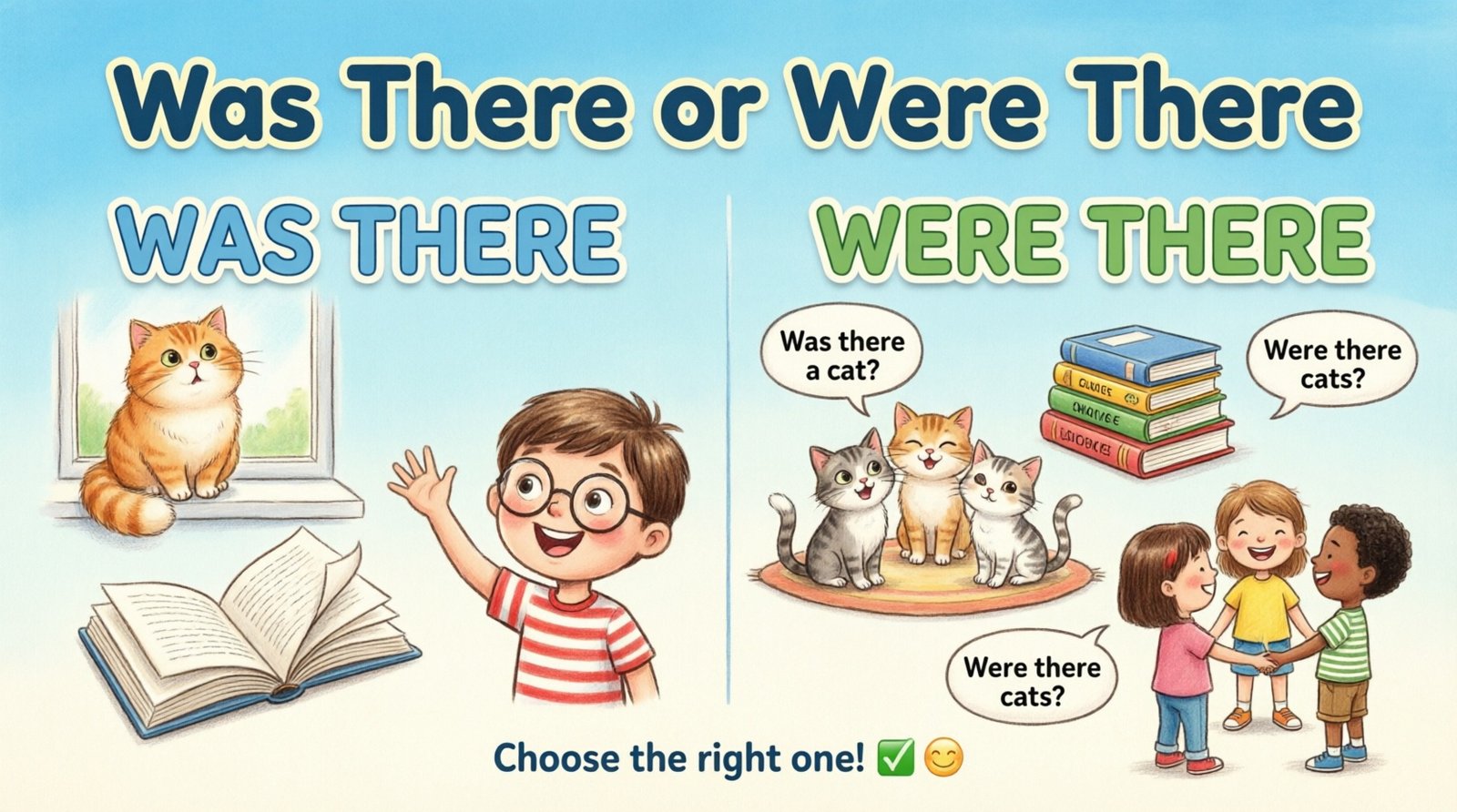

When English learners feel confused about Was There or Were There, the key is to notice the meaning, noun, and sentence structure before choosing the right form. Was and were are forms of the simple past tense of the verb to be, so they’re used for things that existed in the past. There was normally refers to one thing or one person, while there were refers to more than one thing or more than one person. For example, there was a book on the table, but there were three books on the shelf. The same pattern works with someone at the door, some people in the yard, or one thing in a room.
To understand the difference, look at the noun that comes after there. Countable singular nouns usually take was, while countable plural nouns take were, and uncountable nouns generally take was. This rule works in positive sentences, negative sentences, and questions, such as there was a cat, there wasn’t a cat, was there a cat, there were some apples, there weren’t any apples, and were there any apples? These simple rules make grammar easier to remember and help students avoid common mistakes in everyday conversations, especially when discussing events, places, objects, situations, and experiences. A useful comparison is Was there a problem? versus Were there any problems?
The first item in a list can also guide the choice: there was a book, two pens, and a notebook on the desk, but there were two pens, a book, and a notebook on the desk. Was is used with the first person and third person singular, as in I was and he was, while were is used with the second person, such as you were, and plural subjects like they were and we were. The second-person singular is an exception, and the subjunctive mood creates another important case. In hypothetical situations, an imaginary situation, or wishful thinking, were can be the correct choice with a singular subject, especially after if, wish, or as though. The right choice depends on the context, so learners don’t need to rely only on memorizing rules. With clear examples, tables, comparisons, daily conversation examples, and easy tricks, the goal is to make English grammar feel more painless and build confidence in speaking and writing English.
Let’s dive in!
Quick Answer:
Was There or Were There? Mastering the Rules of Usage ✨ depends on the noun that follows. Use was there for singular or uncountable nouns, and were there for plural nouns.
TL;DR
• Was there works with singular nouns and uncountable nouns.
• Were there works with plural nouns.
• “There” introduces something that exists or existed.
• Ask what noun comes after “there” before choosing the verb.
• In questions, put was or were before “there.”
• The same agreement rule works in statements and negative sentences.
What Does “Was There” Mean?
The phrase was there is the past-tense question form used for one thing or an uncountable amount. It asks whether something existed, appeared, or was present at a particular time.
For American English speakers, this structure appears constantly in conversation. You might ask about an event, location, object, person, or amount.
Singular nouns
Use was there when the noun is singular.
Examples include:
- Was there a problem with the order?
- Was there a restaurant nearby?
- Was there a reason for the delay?
- Was there one seat left?
The noun after there is what matters. In “Was there a problem?” the noun problem is singular.
Uncountable nouns
You also use was there with nouns that normally aren’t counted individually.
For example:
- Was there enough water?
- Was there much traffic?
- Was there any information available?
- Was there enough time?
Here, water, traffic, information, and time are treated as uncountable nouns.
What Does “Were There” Mean?
Were there is the past-tense question form used with plural nouns. It asks whether two or more people, objects, events, or other countable things existed or were present.
This form is especially common when asking about numbers. For example, you might ask about people at a meeting or cars in a parking lot.
Plural nouns
Use were there when the noun is plural.
Consider these examples:
- Were there any problems?
- Were there three students?
- Were there enough chairs?
- Were there several restaurants nearby?
Each noun represents more than one countable item.
Why “there” causes confusion
Many learners accidentally treat there as the subject. However, in this structure, “there” introduces the real subject.
Compare:
Was there a dog outside?
The important noun is dog, which is singular.
Now compare:
Were there three dogs outside?
The important noun is dogs, which is plural.
The difference is only one letter in the verb. Yet that small change creates correct grammatical agreement.
Was There vs. Were There: The Main Rule
The easiest way to remember the difference is to look immediately after there. Find the noun and decide whether it is singular, uncountable, or plural.
The simple formula
Use this quick pattern:
Was there + singular noun?
Was there + uncountable noun?
Were there + plural noun?
For example:
| Question | Noun type | Correct form | Example |
| Singular | Singular | Was there | Was there a mistake? |
| Uncountable | Uncountable | Was there | Was there enough food? |
| Plural | Plural | Were there | Were there any mistakes? |
| Plural | Plural | Were there | Were there five guests? |
| Uncountable | Uncountable | Was there | Was there enough space? |
A useful mental trick
Ignore there for a moment.
Ask yourself what comes next.
If you see a car, choose was.
If you see two cars, choose were.
This simple trick works in most everyday situations.
There Was and There Were in Statements
The same agreement rule applies when you make a statement instead of asking a question.
The question form simply moves was or were before there.
Singular statements
Use there was with singular nouns.
Examples:
- There was a storm last night.
- There was a strange sound outside.
- There was a new store downtown.
- There was an empty chair near the window.
Each sentence describes one thing.
Plural statements
Use there were with plural nouns.
Examples:
- There were several storms that summer.
- There were three people outside.
- There were many choices available.
- There were two empty chairs.
The noun controls the verb in each sentence.
Compare the pairs
Look at these examples side by side:
- There was a problem.
- There were several problems.
- There was one student.
- There were twenty students.
- There was a car outside.
- There were three cars outside.
The pattern stays consistent. Singular gets was, while plural gets were.
How to Use “Was There” in Questions
Questions with was there usually ask whether one thing existed or was present. They can also ask about an amount of something that isn’t normally counted.
Common question patterns
You can use:
Was there + a/an + singular noun?
For example:
- Was there a meeting yesterday?
- Was there an accident nearby?
- Was there a reason for the change?
- Was there an empty table?
You can also use:
Was there + uncountable noun?
For example:
- Was there enough water?
- Was there any noise?
- Was there much traffic?
- Was there enough room?
Short answers
Short answers usually repeat was.
For example:
Was there a problem?
Yes, there was.
Was there enough food?
No, there wasn’t.
This makes the structure easy to recognize in conversation.
Read More: GC Meaning in Text: What Does GC Mean in a Text?
How to Use “Were There” in Questions
Use were there when the noun is plural. These questions often involve several people or things.
Common question patterns
Examples include:
- Were there any mistakes?
- Were there enough seats?
- Were there many visitors?
- Were there two entrances?
The plural noun follows there, so the verb must be were.
Short answers
Short answers use were too.
Were there any problems?
Yes, there were.
Were there enough chairs?
No, there weren’t.
This pattern is especially useful in everyday American conversation.
Why “Was There Many” Is Usually Wrong
One of the most common mistakes is saying “Was there many people?”
The standard form is:
Were there many people?
That’s because people is plural.
Find the real subject
Consider:
Were there many people at the concert?
The word there comes first, but people determines the verb.
The same idea applies here:
- Were there several options?
- Were there many questions?
- Were there enough tickets?
- Were there any customers?
All four use were because their nouns are plural.
What about “a lot of”?
This phrase can cause confusion because the noun after it determines the form.
Correct examples include:
Was there a lot of traffic?
Here, traffic is uncountable.
But:
Were there a lot of people?
Here, people is plural.
The phrase a lot of doesn’t decide the verb. The noun does.
Was There or Were There With “Any,” “Some,” and “Many”
Words such as any, some, and many can make the choice seem harder. However, the same rule still applies.
With “any”
Use was with singular or uncountable nouns:
- Was there any water?
- Was there any information?
- Was there a problem?
Use were with plural nouns:
- Were there any problems?
- Were there any students?
- Were there any tickets?
With “some”
Again, look at the noun.
- Was there some confusion?
- Was there some food left?
- Were there some people waiting outside?
The noun determines the verb, not the word some.
With “many”
Many normally refers to plural countable nouns.
Therefore:
- Were there many people?
- Were there many cars?
- Were there many questions?
The standard form is not “Was there many people?”
Common Mistakes With Was There and Were There
Most errors come from looking at the wrong word. Fortunately, these mistakes are easy to fix once you understand the pattern.
Mistake 1: Matching “there”
Incorrect:
Was there two options?
Correct:
Were there two options?
The noun options is plural.
Mistake 2: Using “were” with an uncountable noun
Incorrect:
Were there enough information?
Correct:
Was there enough information?
In standard English, information is uncountable.
Mistake 3: Confusing location with existence
Consider:
Was there a doctor?
This asks whether a doctor was present or existed in that situation.
However:
Was the doctor there?
This asks whether a known doctor was at a particular place.
The two sentences look similar, but their structures have different purposes.
Mistake 4: Forgetting the question structure
A question should use:
Was there…?
or
Were there…?
Not:
There was…?
or:
There were…?
The latter forms normally belong to statements.
Was There or Were There in American English?
American English follows the same basic agreement rule. Singular and uncountable nouns generally take was, while plural nouns take were.
Everyday American examples
You’ll hear these forms in many settings:
- Was there a game last night?
- Were there any tickets left?
- Was there traffic on the highway?
- Were there many people downtown?
- Was there enough parking?
- Were there several stores nearby?
These structures are common in casual speech, workplace conversations, classrooms, and writing.
Formal and informal use
The grammar itself doesn’t become different because a sentence is formal. However, informal American speech sometimes uses agreement patterns that differ from careful edited writing.
For clear writing, matching the verb to the noun is the safest choice.
Was There or Were There in Negative Sentences?
Negative forms follow exactly the same rule. Add not after was or were.
Singular and uncountable negatives
Use wasn’t:
- There wasn’t a problem.
- There wasn’t enough food.
- There wasn’t much time.
- There wasn’t any traffic.
Plural negatives
Use weren’t:
- There weren’t any problems.
- There weren’t enough chairs.
- There weren’t many people.
- There weren’t any tickets.
The same distinction appears in questions and statements.
Was There or Were There in Different Contexts?
Grammar becomes easier when you see it in realistic situations. These examples show how the structure works across everyday American life.
At home
You might ask:
- Was there a package at the door?
- Were there any messages?
- Was there enough milk?
- Were there dishes in the sink?
At work
You might ask:
- Was there a meeting yesterday?
- Were there any changes?
- Was there enough information?
- Were there several applicants?
While traveling
You might ask:
- Was there a hotel nearby?
- Were there any restaurants open?
- Was there enough parking?
- Were there many tourists?
The setting changes, but the grammar stays the same.
When “There Was” and “There Were” Sound Tricky
Some sentences become difficult because several nouns appear together. In these cases, identify the noun directly connected to the verb.
Compound descriptions
Consider:
There was a table and four chairs in the room.
In careful formal writing, some speakers prefer there were because the combined subject includes multiple items. However, agreement in sentences with coordinated subjects can vary depending on structure and dialect.
For simple writing, it’s often clearer to avoid the uncertainty:
A table and four chairs were in the room.
This version removes the problem completely.
Rewriting when you’re unsure
You can often make a sentence clearer by changing its structure.
Instead of:
Was there many people at the event?
Write:
Did many people attend the event?
Instead of:
Was there several reasons?
Write:
Were there several reasons?
The second version is grammatically direct and natural.
Was There or Were There: Easy Memory Rules
You don’t need to memorize dozens of examples. A few simple habits can help you choose correctly.
The “count the noun” method
Look after there and ask:
Can I count these as separate things?
If there is one thing, use was.
If there are multiple things, use were.
For uncountable nouns, use was.
The three-question test
Before choosing, ask:
- Is the noun singular?
- Is the noun uncountable?
- Is the noun plural?
If it’s singular or uncountable, choose was.
If it’s plural, choose were.
Quick comparison
| If you see… | Use… | Example |
| a problem | Was there | Was there a problem? |
| enough time | Was there | Was there enough time? |
| any problems | Were there | Were there any problems? |
| three cars | Were there | Were there three cars? |
| much traffic | Was there | Was there much traffic? |
This simple table covers most everyday cases.
How the Rule Has Developed Over Time
The forms was and were come from the long history of the English verb to be. Modern speakers usually learn them as past-tense forms, but their different forms reflect older patterns of grammatical agreement.
Older English foundations
English has used different forms of to be for centuries. Earlier stages of English had more grammatical forms than modern American English.
Over time, many of those forms disappeared or merged. Modern English kept important distinctions such as was and were.
Modern English
Today, the distinction is much simpler.
Was generally connects with singular subjects.
Were generally connects with plural subjects.
The same pattern appears in structures beginning with there, even though the noun comes after the verb.
Why the rule still matters
Modern English is flexible in many areas. However, standard written English still expects subject-verb agreement in these constructions.
That makes the basic rule useful for school assignments, professional writing, emails, and everyday communication.
FAQs:
What is the difference between “was there” and “were there”?
Was there is generally used with one person, one thing, or an uncountable noun. Were there is used with plural people or things. For example, “Was there a problem?” and “Were there any problems?”
When should I use “was there”?
Use was there when you’re asking about one thing, one person, or something uncountable in the past. For example, “Was there a meeting yesterday?” or “Was there any water in the glass?”
When should I use “were there”?
Use were there when you’re asking about two or more people or things. For example, “Were there many people at the party?” or “Were there any books on the table?”
Is “was there” singular or plural?
Was there is normally singular. It works with a singular noun or an uncountable noun, such as “Was there a cat?” or “Was there any information?”
Is “were there” always plural?
In ordinary questions about existence, were there is used with plural nouns. For example, “Were there three students in the room?” Here, “students” is plural, so were is correct.
Can “was” and “were” be used for hypothetical situations?
Yes. In the subjunctive mood, were can be used with singular subjects for hypothetical or unreal situations, such as “If I were you.” This is different from the normal past-tense agreement.
What is an easy way to remember “was there” vs. “were there”?
Look at the noun that follows there. If it’s singular or uncountable, use was. If it’s plural, use were. This simple check can help you choose the correct form quickly.
Conclusion:
Understanding Was There or Were There becomes much easier when you focus on the noun that follows there. Use was with singular and uncountable nouns, and use were with plural nouns. The same rule applies to statements, negative sentences, and questions. Once you practice examples such as “Was there a problem?” and “Were there any problems?”, the pattern becomes natural. Remembering this basic structure can help you speak and write English more clearly and confidently.