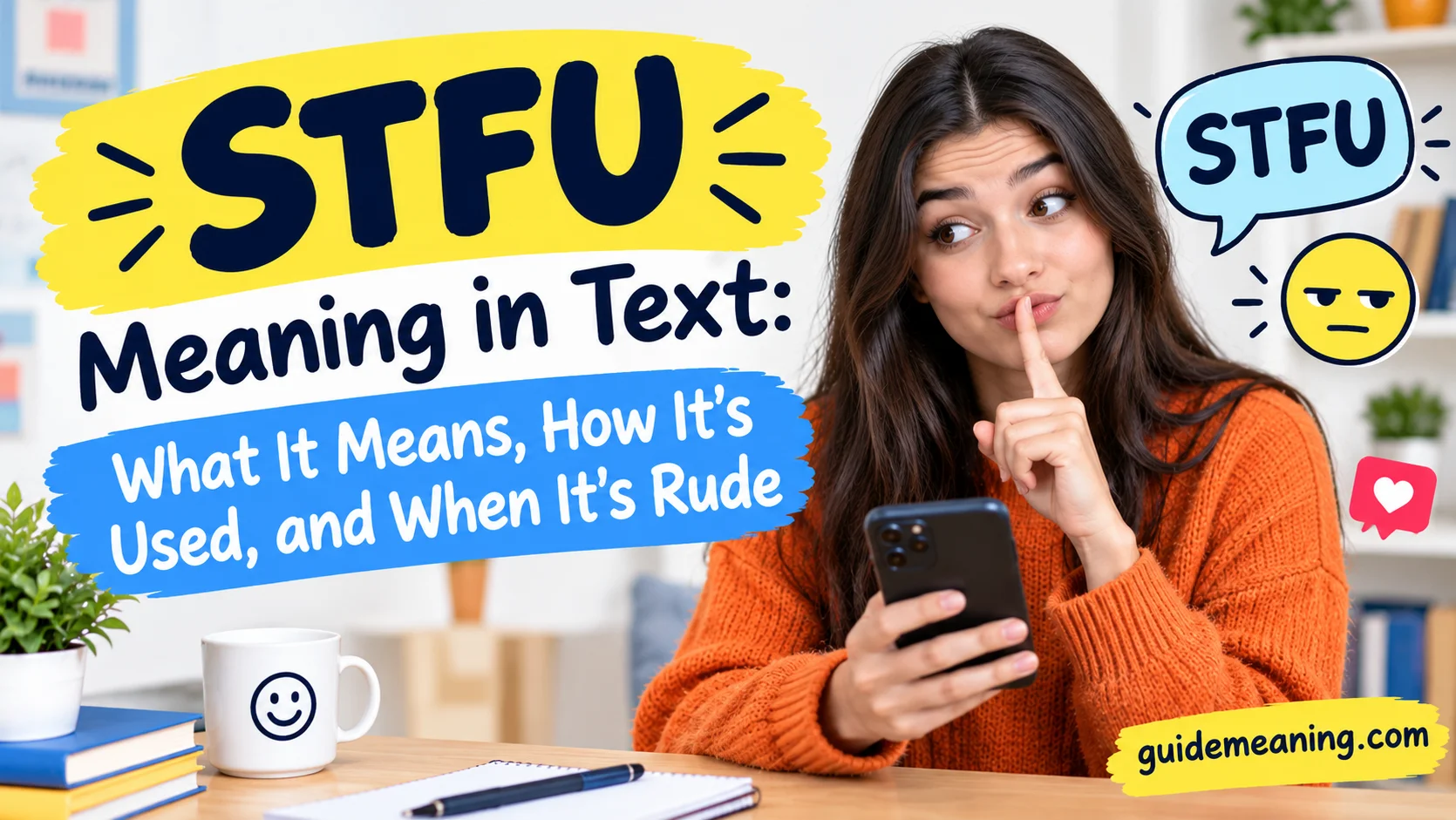

STFU Meaning in Text explains a strong internet slang expression often seen while chatting online, texting, or scrolling through social media.
When you see STFU in messages, comments, memes, or a group chat, it’s a recognizable abbreviation and informal expression that can tell someone to be quiet. It belongs to internet slang, online slang, texting abbreviations, and common texting abbreviations. The same letters may sound funny, friendly, rude, sarcastic, or offensive, depending on the conversation, situation, tone, and context. Millions of people search and have searched for slang queries because they feel confused or shocked and want to know what the sender means. The meaning of STFU is simple when understood correctly, but taking it literally can cause misunderstandings.
You may see STFU in a chat, gaming chats, fast-paced online conversations, fast-paced texting conversations, TikTok comments, Snapchat, WhatsApp, and other platforms. Across different social media platforms, people may use it jokingly during playful banter with friends, while another sender may use it aggressively during arguments because of anger, frustration, or strong disbelief. In online conversations, social media replies, and a text, the expression can feel very direct, creating strong emotional expressions and emotions. When explaining online slang, it helps to consider where the word appears, who sends it, and what happened before it. This can help you understand whether someone is joking, angry, serious, or simply using popular internet slang.
Let’s dive in!
Quick Answer:
STFU means “shut the fuck up.” It’s an informal and vulgar way to tell someone to stop talking or stop what they’re saying.
Depending on context, STFU can also express surprise, disbelief, excitement, amusement, or playful teasing between people who are comfortable using strong language.
| STFU use | Likely meaning | Tone |
| “STFU. I’m done talking.” | Stop talking | Angry |
| “STFU 😂 You actually won?” | No way! | Playful |
| “STFU, that’s hilarious.” | I can’t believe how funny that is | Amused |
| “Can you just STFU?” | Be quiet | Hostile |
| “STFU 😭 You look amazing.” | Stop, you’re making me blush | Playful |
| “STFU and listen.” | Stop talking and listen | Aggressive |
The important distinction is this: STFU has one literal meaning, but people can use it for several conversational purposes.
What Does STFU Stand For?
STFU stands for “shut the fuck up.”
Each letter represents the first letter of the words:
- S = Shut
- T = The
- F = Fuck
- U = Up
It’s commonly described as an initialism, meaning people normally read the individual letters rather than pronounce STFU as a regular word. Wiktionary classifies it as internet and text-messaging slang and specifically labels it vulgar.
The phrase behind the abbreviation is essentially a much stronger version of “shut up.”
That extra word matters.
Compare these:
“Be quiet.”
“Shut up.”
“STFU.”
All three can tell someone to stop talking. However, they don’t carry the same social weight. STFU is the bluntest and most profane option of the three.
Collins specifically describes STFU as slang used particularly in social media and text messages.
What Does STFU Mean in Simple Terms?
In its most literal sense, STFU means “stop talking” or “be quiet.”
However, people don’t always use it literally.
For example:
Person A: I just got tickets to the concert.
Person B: STFU 😭
Person B probably isn’t demanding silence. They’re expressing shock and excitement.
In everyday language, the second message might translate to:
- “No way!”
- “You’re kidding!”
- “Are you serious?”
- “I can’t believe you!”
- “That’s confused!”
The profanity adds emotional intensity.
STFU vs. “Shut Up”
The two expressions are closely related, but STFU is more explicit.
| Expression | General meaning | Strength |
| Be quiet | Stop talking | Mild |
| Please stop | Stop doing something | Mild |
| Shut up | Stop talking | Direct |
| STFU | Shut the fuck up | Strong and vulgar |
Interestingly, even “shut up” can function as an expression of amazement rather than a literal command. Dictionary.com notes that “shut up” can be rude when used to silence someone, but it can also express amazement or excitement.
STFU inherited some of that flexibility while adding a much stronger dose of profanity.
Is STFU Rude or Offensive?
Yes, STFU is generally considered rude and vulgar.
That doesn’t mean every person who types it intends to offend someone. Context can soften the expression considerably. Still, the phrase itself contains profanity and directly tells another person to stop talking.
Dictionary.com describes STFU as an expression often used when people are angry or upset.
When STFU Is Clearly Rude
The meaning is usually hostile when someone sends it during an argument.
For example:
“You keep interrupting me. STFU.”
Here, there isn’t much ambiguity. The sender is telling the other person to stop talking.
Another example:
“Nobody asked for your opinion. STFU.”
That’s openly dismissive. The sender isn’t simply reacting to surprising news.
STFU is also a poor choice when speaking to:
- A teacher or professor
- A manager
- A customer
- A client
- Someone you barely know
- Someone discussing a serious issue
- Someone who has already asked you to stop using profanity
The relationship matters, but so does the situation.
When STFU Can Be Playful
Close friends sometimes use strong language as part of their normal banter.
For example:
“I met your favorite actor today.”
“STFU 😂 Where?”
In that exchange, STFU probably means something closer to “No way!”
The phrase hasn’t magically become polite. Instead, the relationship and surrounding context change how the profanity is interpreted.
Think of it like teasing. A phrase that sounds funny between longtime friends can sound insulting from a stranger.
The Different Meanings of STFU in Texting
Although “shut the fuck up” is the literal definition, the practical meaning can shift considerably.
STFU Can Literally Mean “Stop Talking”
This is the most direct use.
“STFU. I’m trying to hear the announcement.”
Here, the sender genuinely wants the other person to become quiet.
STFU Can Show Anger
During an argument, STFU often works as an aggressive command.
“You keep blaming me for everything. STFU.”
The sender isn’t expressing surprise or amusement. They’re attempting to shut down the other person’s contribution to the conversation.
STFU Can Mean “No Way!”
Among friends, STFU can become an exaggerated reaction to surprising information.
“I got accepted!”
“STFU 😭 Congratulations!”
In this case, translating STFU literally would completely miss the point.
The intended meaning is closer to:
“Seriously? That’s amazing!”
STFU Can Express Disbelief
Someone might use it after hearing something difficult to believe.
“I won the entire thing without practicing.”
“STFU 😂”
That doesn’t necessarily mean “stop talking.” It can mean:
“You’re kidding me.”
STFU Can Show Excitement
The same expression can also signal excitement.
“Guess who bought us front-row seats?”
“STFU!!!”
Here, the profanity acts almost like an emotional exclamation mark.
STFU Can Be Playful Teasing
Friends may use STFU when joking around.
“You know I’m the best cook in this group.”
“STFU 😂 You burned water last week.”
The phrase helps create an exaggerated, teasing tone.
STFU Can Be Sarcastic
Sarcasm makes text especially complicated because readers can’t hear the speaker’s voice.
“STFU, you’re obviously the greatest singer alive.”
The sender may actually mean the opposite.
Without the broader conversation, though, the intended sarcasm can be difficult to identify.
Why Context Matters So Much With STFU
The four letters alone don’t tell you the sender’s intention.
You need to examine the surrounding conversation.
Imagine receiving:
“STFU 😂”
Now compare it with:
“STFU.”
And then:
“STFU. I’m not discussing this anymore.”
The words haven’t changed. The context has.
| Message | More likely interpretation |
| “STFU 😂” | Playful disbelief |
| “STFU 😭” | Shock, excitement, or embarrassment |
| “STFU!!!” | Strong emotional reaction |
| “STFU.” | Potentially serious or hostile |
| “Can you STFU?” | Direct request for silence |
| “STFU and listen.” | Aggressive command |
These aren’t rigid rules. Someone can use punctuation differently. Still, the surrounding language provides valuable clues.
The Relationship Between the People
Ask yourself:
Do these people normally talk this way?
If two close friends regularly use profanity and joking insults, STFU may not carry much hostility.
If a stranger sends it unexpectedly, the safest interpretation is more cautious.
The Topic of Conversation
The subject can reveal intent.
If someone sends:
“STFU, you’re actually going to meet her?”
after hearing exciting news, the phrase may be playful.
If someone sends:
“STFU. We’re not talking about this anymore.”
during an argument, it’s almost certainly hostile.
Emojis Can Change the Impression
Emojis don’t automatically make STFU friendly. However, they can provide useful context.
For example:
“STFU 😂”
often looks more playful than:
“STFU.”
Likewise:
“STFU 😭”
can indicate exaggerated disbelief, laughter, embarrassment, or emotional overload.
Don’t treat emojis as a foolproof decoding system. They’re clues, not guarantees.
What Does STFU Mean From a Friend?
When a friend texts STFU, don’t immediately assume they’re angry.
Close friendships often involve exaggerated language that would sound harsh in another relationship.
Example of Playful STFU
Friend: I finally asked her out.
You: STFU 😭
The likely meaning is:
“No way! You actually did it?”
Example of Angry STFU
Friend: You never listen when I talk.
You: STFU.
That’s different. The conversation already contains conflict, so the phrase is more likely intended literally.
A Simple Test
Look at what happened immediately before STFU.
If the conversation contains:
- Good news
- A funny story
- A surprising confession
- A ridiculous claim
- Friendly teasing
then playful use becomes more plausible.
If it contains:
- Accusations
- Insults
- Personal conflict
- Repeated interruptions
- Frustration
then a hostile interpretation becomes more likely.
What Does STFU Mean From a Guy or Girl?
There isn’t a separate male or female meaning for STFU.
The abbreviation itself doesn’t reveal someone’s romantic interest, personality, or intentions.
That’s worth emphasizing because people sometimes search for hidden meanings such as “What does STFU mean when a guy texts you?” or “What does STFU mean from a girl?”
The answer remains context-dependent.
If STFU Appears During Flirting
Suppose someone says:
“You look really good tonight.”
The response:
“STFU 😭”
could be playful embarrassment.
In that situation, it might effectively mean:
“Stop, you’re making me blush.”
But don’t treat STFU as a secret flirting code.
If the person frequently uses profanity with everyone, the message may have nothing to do with romance.
The surrounding conversation carries more information than the abbreviation itself.
What Does STFU Mean on Social Media?
On social platforms, STFU appears in comments, posts, replies, memes, and direct messages.
Its short format makes it useful for quick emotional reactions.
Someone might comment:
“STFU 😭 this is too funny.”
Or:
“STFU, this can’t be real.”
The expression can work as an exaggerated reaction because social media communication often favors short, punchy language.
Public Comments Are Different
A message between two friends can look very different when posted publicly.
Consider:
“STFU 😂”
In a private group chat, everyone might understand the joke.
Under a stranger’s public post, the same comment may look like an insult.
Audience changes interpretation.
That matters especially on social platforms where strangers don’t share the background needed to understand a joke.
STFU in Gaming and Online Communities
Gaming culture has long embraced blunt, abbreviated language.
Players may use STFU during:
- Competitive matches
- Voice-chat arguments
- Trash talk
- Team disagreements
- Jokes between teammates
- Reactions to an unexpected play
For example:
“STFU 😂 You actually hit that?”
could be friendly banter.
By contrast:
“STFU and stop blaming the team.”
is confrontational.
The distinction isn’t unique to gaming. Competitive environments often normalize stronger language. That doesn’t mean every participant welcomes it.
Banter only works when both sides understand the social rules.
Is STFU Appropriate at Work?
Generally, no.
Even if your workplace has a casual culture, STFU is risky professional language. It combines profanity with a direct command to silence another person.
That can make a joke sound like disrespect.
Better Alternatives to STFU at Work
| Instead of saying | Try saying |
| “STFU.” | “Let me finish my point.” |
| “STFU and listen.” | “Could you hear me out?” |
| “STFU, seriously?” | “Wait, are you serious?” |
| “STFU 😂” | “No way!” |
| “Can you STFU?” | “Could we pause for a moment?” |
The goal isn’t to make every workplace conversation sound robotic. It’s to choose language that communicates the same idea without unnecessary friction.
How to Tell If Someone Is Actually Angry When They Say STFU
Text makes emotional interpretation messy.
You can’t hear someone’s voice. You can’t see whether they’re smiling. You don’t know whether they typed the message while laughing or genuinely furious.
Instead of analyzing one word in isolation, look for several signals.
Check the Conversation Before STFU
Was there already an argument?
If yes, the phrase probably carries more hostility.
Look at the Surrounding Words
Compare:
“STFU 😂”
with:
“STFU. You’re so annoying.”
The second message provides additional evidence of hostility.
Consider Your Relationship
Someone who has known you for years may use profanity casually.
A stranger has less shared context.
Look at What Happens Next
A person who sends STFU and immediately follows with laughing emojis may be joking.
Someone who stops responding or continues with insults may be genuinely angry.
Don’t Overdecode Punctuation
Punctuation can help, but it isn’t a scientific emotional meter.
A period doesn’t automatically mean anger. Capital letters don’t automatically mean shouting.
Context beats punctuation.
How to Respond When Someone Texts “STFU”
Your response should depend on what you think they meant.
If It Seems Playful
You can match the energy:
- “You know I’m right 😂”
- “Nope, I’m telling everyone.”
- “I’m serious!”
- “You wish.”
- “I knew you’d say that.”
If You’re Unsure
Don’t spend twenty minutes trying to decode four letters.
Ask:
“Wait, are you joking?”
Or:
“You good?”
A short clarification can prevent a needless argument.
If It Feels Disrespectful
You can set a boundary without escalating.
Try:
“You can disagree with me without talking to me like that.”
Or:
“If we’re going to talk about this, let’s keep it respectful.”
If They’re Genuinely Angry
Respond to the underlying issue rather than the profanity.
For example:
“I can see you’re frustrated. Let’s talk about what happened.”
Sometimes the smartest response to an aggressive message is simply not to escalate it.
Case Study: The Same STFU Message Can Mean Three Different Things
Consider the message:
“STFU 😂”
Now place it in three different conversations.
Scenario One: Exciting News
Alex: I got us tickets to the championship game.
Jordan: STFU 😂
Likely meaning: “No way! That’s amazing.”
Scenario Two: A Ridiculous Claim
Alex: I could beat any professional player.
Jordan: STFU 😂
Likely meaning: “You’re kidding. That’s ridiculous.”
Scenario Three: An Argument
Alex: You’re the reason this happened.
Jordan: STFU.
Likely meaning: “Stop talking.”
The abbreviation didn’t change.
The social context did.
That’s the key to understanding STFU in text.
STFU vs. Similar Text Abbreviations
STFU belongs to a larger family of internet shorthand.
| Term | Meaning | Tone |
| STFU | Shut the fuck up | Very strong, vulgar |
| STHU | Shut the hell up | Strong, less explicit |
| Shut up | Stop talking | Direct |
| Be quiet | Stop talking | Mild |
| STFD | Shut the front door | Euphemistic/playful |
| Stop | Stop what you’re doing/saying | Context-dependent |
Wiktionary lists STHU, meaning “shut the hell up,” as a related expression to STFU.
The differences aren’t merely cosmetic. Choosing one expression over another changes the emotional temperature of the message.
Is STFU an Acronym or Initialism?
People commonly call STFU an acronym, especially in everyday online conversation.
More precisely, initialism is the better linguistic description because the letters are normally pronounced individually rather than as one spoken word.
Wiktionary categorizes STFU as an English initialism, internet slang term, text-messaging expression, and vulgarity.
So both labels may appear online, but initialism is the more precise term.
Where Did STFU Come From?
The exact origin of the abbreviation isn’t completely settled.
The underlying expression “shut up” is much older than internet culture. Its meaning evolved over centuries, eventually becoming a way to tell someone to become silent. Dictionary.com traces the modern imperative sense back to the 1800s and notes that “shut up” later developed an additional use as an expression of amazement or excitement.
The abbreviated form STFU became associated with internet communication because online conversations rewarded compact expressions.
One documented early online use comes from February 1999, when the phrase appeared in the newsgroup alt.comp.virus. Know Your Meme records the example and notes that STFU also appeared in other online communities during 1999.
A Brief Timeline
| Period | Development |
| 1800s | “Shut up” develops its modern silencing sense |
| Late 20th century | Stronger versions such as “shut the fuck up” circulate in spoken language |
| 1999 | Early documented online uses of STFU appear |
| 2000s | Internet forums and messaging help spread the abbreviation |
| 2010s | Social media and memes make STFU widely recognizable |
| 2020s | STFU remains common in texting, comments, gaming, and online slang |
The abbreviation’s history shows why it fits naturally into digital communication: four letters can carry a surprisingly large emotional payload.
Common Misunderstandings About STFU
STFU Always Means Anger
False.
It can express anger, but it can also communicate disbelief, excitement, amusement, or teasing.
STFU Always Means “I Hate You”
Not necessarily.
Someone may be reacting to what you said rather than expressing hostility toward you personally.
STFU Is Always Funny Between Friends
No.
Friendship doesn’t erase boundaries. One friend may find the phrase hilarious while another finds it disrespectful.
Capital Letters Always Mean Anger
Not necessarily.
People capitalize abbreviations for emphasis all the time.
An Emoji Makes STFU Harmless
No.
An emoji can soften the tone, but it doesn’t remove the profanity or guarantee that the recipient will interpret the message as friendly.
STFU Is a Secret Romantic Code
No.
It can appear in flirting, but the expression itself isn’t inherently romantic.
Quick Facts About STFU
- Full form: “Shut the fuck up”
- Type: Internet slang and initialism
- Register: Informal and vulgar
- Common settings: Texting, social media, gaming, online chats
- Literal meaning: Stop talking or be quiet
- Possible contextual meaning: No way, seriously?, I can’t believe you
- Can it be playful? Yes
- Can it be offensive? Absolutely
- Is it professional? Generally not
- Does context matter? Very much
Collins explicitly labels STFU as slang and a taboo expression used particularly in social media and text messages.
FAQs:
What does STFU mean in text?
STFU meaning in text is a strong and informal way to tell someone to be quiet. Its tone can be rude, joking, sarcastic, or aggressive depending on the context.
Is STFU rude?
Yes, STFU can sound rude or offensive, especially when used with strangers or during an argument. Close friends may sometimes use it jokingly.
What does STFU mean on social media?
On platforms such as TikTok, Snapchat, WhatsApp, and other social media, STFU usually carries the same meaning: telling someone to stop talking or be quiet.
Can STFU be used jokingly?
Yes. Friends sometimes use STFU as playful banter when reacting to something surprising, funny, or unbelievable. The relationship and tone matter.
How should I respond when someone says STFU?
Your response depends on the situation. If they’re joking, you can respond casually. If they sound angry or offensive, staying calm and avoiding further conflict is usually better.
Conclusion:
Understanding STFU meaning in text helps you recognize its tone before responding. Although it’s a common internet abbreviation, it can sound funny and playful between friends or rude and aggressive during an argument. The meaning depends heavily on the conversation, platform, relationship, and context. Before using STFU yourself, think about how the other person might interpret it. When someone sends it to you, consider their tone and the situation instead of taking the abbreviation literally. Knowing these differences can help you communicate more clearly and avoid unnecessary misunderstandings in online conversations