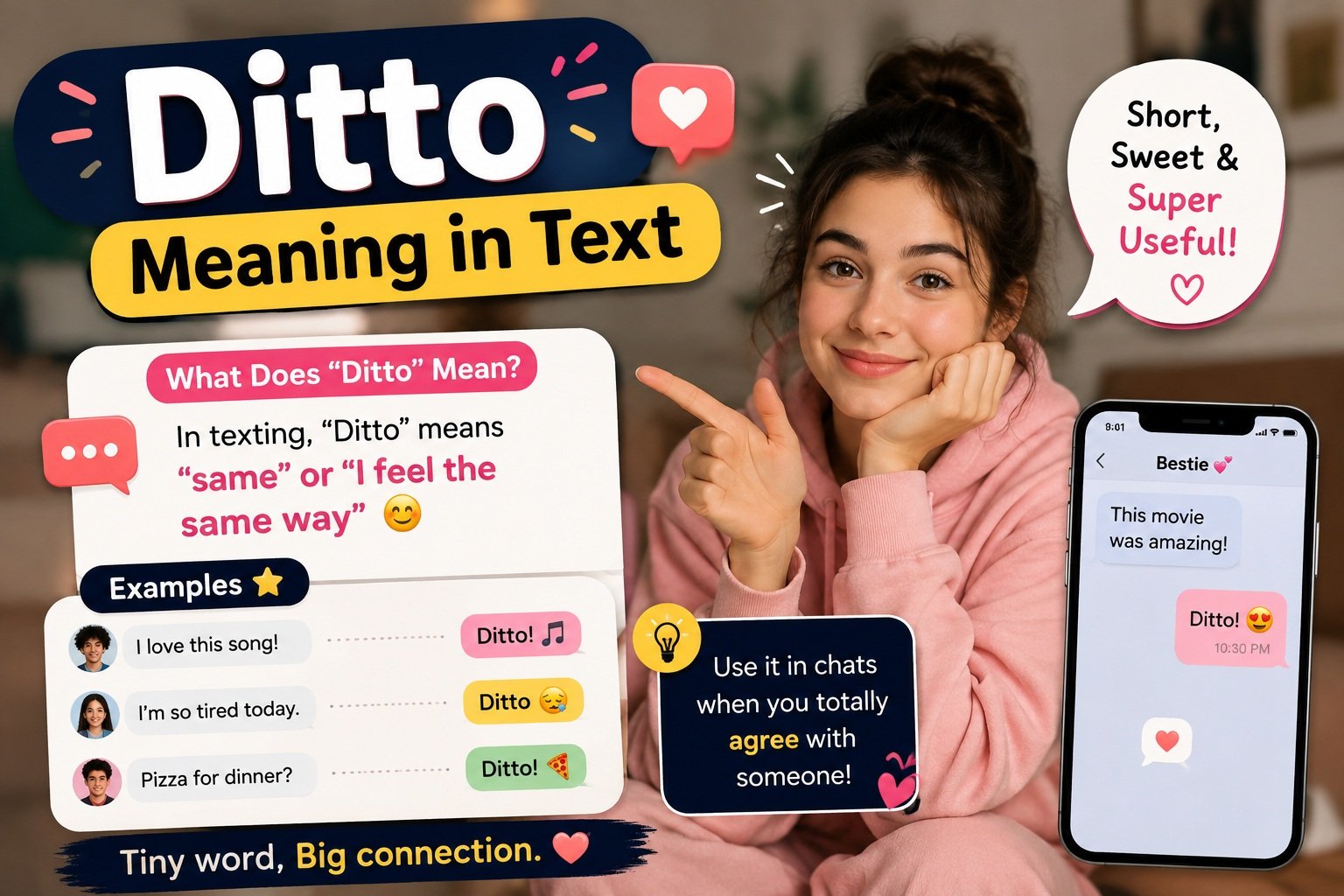

Ditto Meaning in Text usually means same, me too, or I agree, showing that the sender shares the person’s idea without typing a longer sentence.
In everyday texting, this short phrase can save time and make fast-paced communication clearer. The meaning in text depends on the context, tone, and platform, while words, slang, and expressions may seem confusing to users new to internet conversations or social media. In casual chats, people may use ditto with friends, family, classmates, or coworkers when a previous message already expresses their thoughts. Unlike many internet abbreviations, ditto is not a brand-new slang term. It is an older word used for centuries, and its meaning has evolved over time from a literal symbol of repetition to an emotional signal or social signal in modern digital communication.
The commonly used word appears in digital conversations, chatting, WhatsApp, TikTok comments, Instagram, Snapchat, Instagram DMs, Snapchat chats, WhatsApp messages, dating app replies, and romantic conversations. People use it when expressing agreement, repeating a previous statement, or showing shared feelings. In simple terms, ditto can replace “I agree,” “me too,” or “same.” This makes the simple word useful in casual texting, social media replies, and online conversations, especially when people prefer short responses.
Let’s dive in!
Quick Answer: What Does Ditto Mean in Text?
“Ditto” in text usually means “same,” “me too,” or “I agree.”
The exact meaning depends on the message it responds to:
| Text message | Reply: “Ditto” | What it means |
| “I’m so tired.” | “Ditto.” | I’m tired too. |
| “I love this song.” | “Ditto.” | I love it too. |
| “That movie was awful.” | “Ditto.” | I agree. |
| “I ordered the blue one.” | “Ditto.” | I ordered the same one. |
| “I miss you.” | “Ditto.” | I miss you too. |
| “Have a great weekend!” | “Ditto!” | Same to you / likewise. |
So, if someone sends “ditto” by itself, look at the message immediately before it. That’s usually the key to understanding what they’re saying.
What Does “Ditto” Mean in Texting?
In everyday texting, ditto is a short way to echo someone else’s statement.
It can communicate agreement without making the sender repeat the entire thought. Cambridge Dictionary defines ditto as a word used to agree with something just said or to avoid repeating something already stated. It also recognizes the word as an informal expression meaning “as said before” or “similarly.”
Consider this exchange:
Person A: “I can’t wait for Friday.”
Person B: “Ditto.”
Person B isn’t simply saying “yes.” They’re saying:
“I can’t wait for Friday either.”
That’s why ditto works so naturally in text conversations. The first message supplies the information. The second person simply points back to it.
The simplest meanings of “ditto” include:
- Same
- Me too
- I agree
- Likewise
- The same thing
- That applies to me too
However, these aren’t always interchangeable. Context determines which interpretation fits best.
What Does “Ditto” Literally Mean?
The core idea behind ditto is “the same” or “the same as what was just mentioned.”
The word has an interesting history. English adopted ditto from Italian usage. Etymonline traces it to the Tuscan form ditto, related to Italian detto, meaning “said.” In the 1600s, the word was used to avoid repeating month names in dates. Its broader English sense of “the same thing” or “the same as above” developed later in the 17th century.
That history explains modern texting surprisingly well.
Imagine an old written list:
| Item | Description |
| January | 31 days |
| February | 28 days |
| March | Ditto |
Instead of writing the same information again, ditto tells the reader to use what appeared before.
Texting does essentially the same thing.
“I’m completely worn out.”
“Ditto.”
The second person doesn’t need to repeat “I’m completely worn out.” The single word points back to the previous statement.
What Does Ditto Mean in a Text Message?
The meaning usually falls into one of four practical categories.
Ditto Means “Me Too”
This is probably the most common interpretation in casual texting.
“I need a vacation.”
“Ditto.”
Translation:
“I need a vacation too.”
The person is sharing the same feeling, desire, or experience.
You might see this with statements about:
- Tiredness
- Hunger
- Stress
- Excitement
- Preferences
- Plans
- Emotions
- Experiences
For example:
“I’m starving.”
“Ditto.”
“I’m nervous about tomorrow.”
“Ditto.”
“I want pizza tonight.”
“Ditto.”
In each case, ditto essentially means “me too.”
Ditto Means “I Agree”
Sometimes the person isn’t sharing an emotion. They’re agreeing with an opinion.
“That restaurant is seriously overrated.”
“Ditto.”
Here, ditto means:
“I agree with you.”
The distinction matters because “me too” isn’t always the best substitute.
If someone says:
“That ending made no sense.”
A reply of:
“Me too.”
sounds strange because the original person isn’t describing something they did. They’re giving an opinion.
“Ditto” works better because it can mean “I share that opinion.”
Ditto Means “The Same Thing”
Another use is more literal.
“I ordered the chicken sandwich.”
“Ditto.”
This could mean:
“I ordered the same thing.”
In this context, the word isn’t expressing an emotion or agreement. It’s identifying an identical choice.
You might encounter this when people discuss:
- Food orders
- Clothing
- Products
- Travel plans
- Classes
- Appointments
- Purchases
The underlying idea remains the same: don’t repeat the information because it already exists above.
Ditto Means “Likewise”
Sometimes ditto works as a casual substitute for “likewise.”
For example:
“Have a great weekend!”
“Ditto!”
The intended meaning is:
“The same to you.”
This use is especially common when someone wants a quick, friendly response without repeating the greeting.
Ditto Meaning in Different Texting Contexts
The beauty and occasional confusion of ditto comes from context. The word stays the same while the implied message changes.
When Someone Says “I Miss You”
“I miss you.”
“Ditto.”
Here, the meaning is straightforward:
“I miss you too.”
Because the original statement expresses affection, ditto inherits that emotional meaning.
However, the word itself doesn’t create the romantic meaning. The message being echoed creates it.
That’s an important distinction.
When Someone Says “I Love This Song”
“I love this song.”
“Ditto.”
This means:
“I love this song too.”
The response confirms shared taste.
When Someone Says “I’m Exhausted”
“I’m exhausted today.”
“Ditto.”
This means:
“I’m exhausted too.”
It’s short, natural, and conversational.
When Someone Gives an Opinion
“That was the worst ending.”
“Ditto.”
Here, ditto means:
“I completely agree.”
It acts almost like a verbal nod.
When Someone Mentions a Choice
“I picked the window seat.”
“Ditto.”
This most naturally means:
“I picked the window seat too.”
The meaning isn’t “I agree with your opinion.” Instead, it means “I made the same choice.”
Is “Ditto” Positive, Negative, or Neutral?
Ditto isn’t inherently positive or negative.
Its emotional tone comes from whatever statement it echoes.
Compare these examples:
“I’m having an amazing day.”
“Ditto.”
Positive.
“I’m having a terrible day.”
“Ditto.”
Negative.
“I booked the 6 p.m. appointment.”
“Ditto.”
Neutral.
This makes ditto unusually flexible. Think of it as an echo word. The original message provides the emotional color.
Is “Ditto” Formal or Informal?
“Ditto” is generally informal in everyday communication.
It’s perfectly natural in:
- Text messages
- Casual chats
- Social media
- Friendly emails
- Informal conversations
It’s less useful when precision and formality matter.
For example, in a professional report, instead of writing:
“Ditto.”
you’d usually write something specific such as:
“The same applies to the second category.”
That isn’t because ditto is incorrect. It’s because formal writing often benefits from explicit wording.
How the alternatives compare
| Expression | Tone | Common meaning |
| Ditto | Casual | Same / I agree |
| Same | Very casual | I feel the same |
| Me too | Casual | I also feel or do that |
| Likewise | Neutral | The same applies to me |
| I agree | Neutral | I share your opinion |
| Same here | Casual | I have the same experience |
In a friendly text, “Ditto” can sound playful and slightly more distinctive than “same.”
What Does “Ditto” Mean From a Girl or Guy?
A common question is whether “ditto” has a special meaning when a girl or guy sends it.
It doesn’t.
The sender’s gender doesn’t change the dictionary meaning of the word. What matters is what they’re responding to and the broader context of the conversation.
For example:
“I miss you.”
“Ditto.”
That usually means:
“I miss you too.”
But:
“That meeting was painfully boring.”
“Ditto.”
means:
“I agree. It was boring.”
The word remains the same. The preceding message changes its meaning.
Don’t overinterpret the word
A single “ditto” can’t reliably tell you whether someone is:
- Flirting
- Being romantic
- Being sarcastic
- Feeling distant
- Showing affection
- Simply agreeing
Look at the whole conversation, not one word.
How to Respond When Someone Texts “Ditto”
Your best response depends on what they’re agreeing with.
If they simply confirm a shared feeling, you can keep the conversation moving:
You: “I’m so ready for the weekend.”
Them: “Ditto.”
You: “Any plans yet?”
If they’re agreeing with an opinion, ask a follow-up:
You: “That ending was disappointing.”
Them: “Ditto.”
You: “What would you have changed?”
If the message involves affection, you can respond more warmly:
You: “I miss you.”
Them: “Ditto ❤️”
You: “Then we definitely need to see each other soon.”
The important point is that “ditto” doesn’t necessarily close the conversation. It simply confirms that the other person shares the statement.
Read More: ISK Meaning in Text: What Does ISK Mean When Someone Texts You?
How to Use “Ditto” in a Text
Using ditto is easy once the context is clear.
Use “ditto” when:
- You mean “same.”
- You agree with someone’s statement.
- You share the same experience.
- You made the same choice.
- You want a short, casual response.
- Repeating the original sentence would feel unnecessary.
Avoid “ditto” when:
- The original message is ambiguous.
- The person needs a detailed answer.
- Your response requires additional information.
- A one-word reply could appear dismissive.
- You’re communicating something important in a professional setting.
For example:
“I think we should move the deadline.”
A simple “Ditto” may confirm agreement, but it doesn’t explain why.
If the discussion involves an important decision, something like “I agree. Moving it to Friday makes more sense.” provides much more useful information.
“Ditto” vs. “Same” vs. “Me Too” vs. “Likewise”
These expressions overlap, but they’re not identical in tone or use.
| Phrase | What it usually communicates | Tone |
| Ditto | Same, I agree, same thing | Casual |
| Same | I feel exactly that way | Very casual |
| Me too | I also feel/do that | Casual |
| Same here | My situation is similar | Casual |
| Likewise | The same applies to me | Neutral |
| I agree | I share your opinion | Neutral |
Is “Ditto” the Same as “Same”?
Usually, yes.
In texting, both can express shared feelings or opinions.
“I’m exhausted.”
“Same.”
and:
“I’m exhausted.”
“Ditto.”
communicate essentially the same idea.
The difference is mostly stylistic. “Same” tends to feel especially casual and contemporary, while “ditto” can sound a little more playful or deliberately old-fashioned.
Is “Ditto” the Same as “Me Too”?
Often, but not always.
“I love chocolate.”
“Me too.”
is completely natural.
“I love chocolate.”
“Ditto.”
also works.
However, ditto has a broader range. It can refer to agreement with an opinion or repetition of information, whereas “me too” most directly signals that the same thing applies to the speaker.
Is “Ditto” the Same as “Likewise”?
They can overlap.
“Have a great day!”
“Likewise!”
means:
“Have a great day too.”
“Have a great day!”
“Ditto!”
can carry the same meaning in a casual conversation.
Still, “likewise” tends to sound more neutral or polished. “Ditto” feels more conversational.
Examples of “Ditto” in Text Messages
Here are practical examples showing how the meaning changes with context.
Sharing a Feeling
“I’m exhausted.”
“Ditto.”
Meaning: I’m exhausted too.
Sharing an Opinion
“That movie was overrated.”
“Ditto.”
Meaning: I agree.
Sharing a Preference
“I prefer the first design.”
“Ditto.”
Meaning: I prefer the first design too.
Sharing an Experience
“I couldn’t sleep last night.”
“Ditto.”
Meaning: I couldn’t sleep either.
Sharing a Plan
“I’ll be there at 8.”
“Ditto.”
Meaning: I’ll be there at 8 too.
Returning Affection
“I miss you.”
“Ditto.”
Meaning: I miss you too.
Agreeing With a Complaint
“This weather is awful.”
“Ditto.”
Meaning: I agree. I feel the same way.
Agreeing With Praise
“She did a fantastic job.”
“Ditto.”
Meaning: I agree. She did a fantastic job.
Does “Ditto” Sound Rude in Texting?
Not inherently.
Still, a one-word response can sometimes feel colder than a fuller reply. That’s a feature of texting in general, not something unique to ditto.
Compare:
“I can’t wait to see you.”
“Ditto.”
with:
“I can’t wait to see you.”
“Ditto ❤️”
The first is concise. The second adds an obvious emotional cue.
Neither has a fixed meaning outside its context.
Why can “ditto” sometimes feel dismissive?
Because the word requires almost no effort. If someone sends you a heartfelt paragraph and you respond only with “Ditto,” they may feel that you haven’t engaged with what they said.
For a casual exchange, that’s usually fine.
For an emotionally important conversation, a little more detail can make your response feel warmer:
“Ditto. I’ve really missed talking to you.”
That keeps the concise agreement while adding substance.
Can “Ditto” Be Sarcastic?
Yes. “Ditto” can be sarcastic, but the word itself isn’t inherently sarcastic.
Context creates the sarcasm.
For example:
“Another two-hour meeting that could’ve been an email.”
“Ditto.”
This could simply mean:
“I agree.”
But depending on the conversation, it could also carry a dry, sarcastic tone.
Another example:
“Fantastic. Another Monday morning meeting.”
“Ditto.”
The response may echo the speaker’s frustration.
The same word can therefore sound sincere, amused, annoyed, or dry depending on the surrounding language.
Common Misunderstandings About “Ditto”
“Ditto” Always Means “I Agree”
Not quite.
It can mean “I agree,” but it can also mean “same,” “me too,” “likewise,” or literally “the same thing.”
The sentence being echoed determines the most natural interpretation.
“Ditto” Always Sounds Romantic
No.
If someone says:
“I miss you.”
and receives:
“Ditto.”
the response may have romantic or affectionate meaning.
But:
“I’m hungry.”
“Ditto.”
obviously doesn’t carry romantic significance.
The original message creates the emotional context.
“Ditto” Is Pure Texting Slang
It isn’t.
Ditto predates texting by centuries. Modern messaging simply gives people another place to use its basic meaning: “the same as what you just said.”
“Ditto” Is Only Used in Written English
No.
People can use ditto in speech as well:
“I hate early mornings.”
“Ditto.”
The word works because the listener already knows what statement it refers to.
“Ditto” Always Reveals How Someone Feels
Not necessarily.
A single word rarely provides enough information to determine someone’s intentions. If the context is emotional or ambiguous, consider the person’s other messages, tone, and behavior rather than treating ditto as a secret code.
How to Tell What “Ditto” Means in Your Conversation
When someone texts “ditto,” use the surrounding conversation as your guide.
Look at the message immediately before it
Ask:
What exactly is the person agreeing with?
If the previous message says:
“I’m hungry.”
then ditto probably means “I’m hungry too.”
If it says:
“That show was terrible.”
then it probably means “I agree.”
Identify the type of statement
Is it a:
- Feeling?
- Opinion?
- Preference?
- Experience?
- Choice?
- Greeting?
- Compliment?
- Complaint?
This usually reveals the intended meaning quickly.
Replace “ditto” with “same”
This is a useful mental shortcut.
“I’m exhausted.” → “Same.”
Makes sense.
Therefore:
“I’m exhausted.” → “Ditto.”
probably means “Same here.”
Consider the wider conversation
Don’t interpret the word in isolation.
A message such as:
“I had such a great time with you.”
“Ditto.”
can sound affectionate.
Meanwhile:
“I forgot my keys again.”
“Ditto.”
simply describes a shared experience.
Same word. Different context.
A Simple Case Study: Why Context Matters
Consider three conversations involving exactly the same reply.
Case One: Shared emotion
Alex: “I’m nervous about the interview.”
Sam: “Ditto.”
Interpretation: Sam is nervous too.
Case Two: Shared opinion
Alex: “That restaurant wasn’t worth the price.”
Sam: “Ditto.”
Interpretation: Sam agrees with Alex’s opinion.
Case Three: Shared choice
Alex: “I bought the black version.”
Sam: “Ditto.”
Interpretation: Sam bought the black version too.
The word doesn’t change.
The context does.
That’s the central principle behind understanding ditto in text messages.
FAQs:
1. What does “ditto” mean in text?
“Ditto” usually means same, me too, or I agree. It shows that someone shares the same opinion, feeling, or experience.
2. Is “ditto” considered slang?
It can be used casually like slang, but ditto is actually an older word that has been used for centuries.
3. How do people use “ditto” in texting?
People use it as a short reply when they agree with a previous message instead of repeating the complete statement.
4. Can “ditto” be used on social media?
Yes. You may see “ditto” in WhatsApp messages, Instagram DMs, TikTok comments, Snapchat chats, and other online conversations.
5. Does “ditto” always mean agreement?
Usually, yes. However, its exact meaning can depend on the context, tone, and situation in which it is used.
Conclusion:
Ditto Meaning in Text is simple once you understand how the word works in everyday communication. It commonly means same, me too, or I agree, allowing someone to respond without repeating a complete sentence.
Although ditto is an older word rather than a modern internet abbreviation, it fits naturally into today’s texting and social media culture. You may encounter it in casual conversations, messages, comments, and direct replies across different platforms. The tone can also add a slightly different feeling, so always consider the surrounding message. Understanding this small word can make online conversations easier to follow and help you respond naturally.