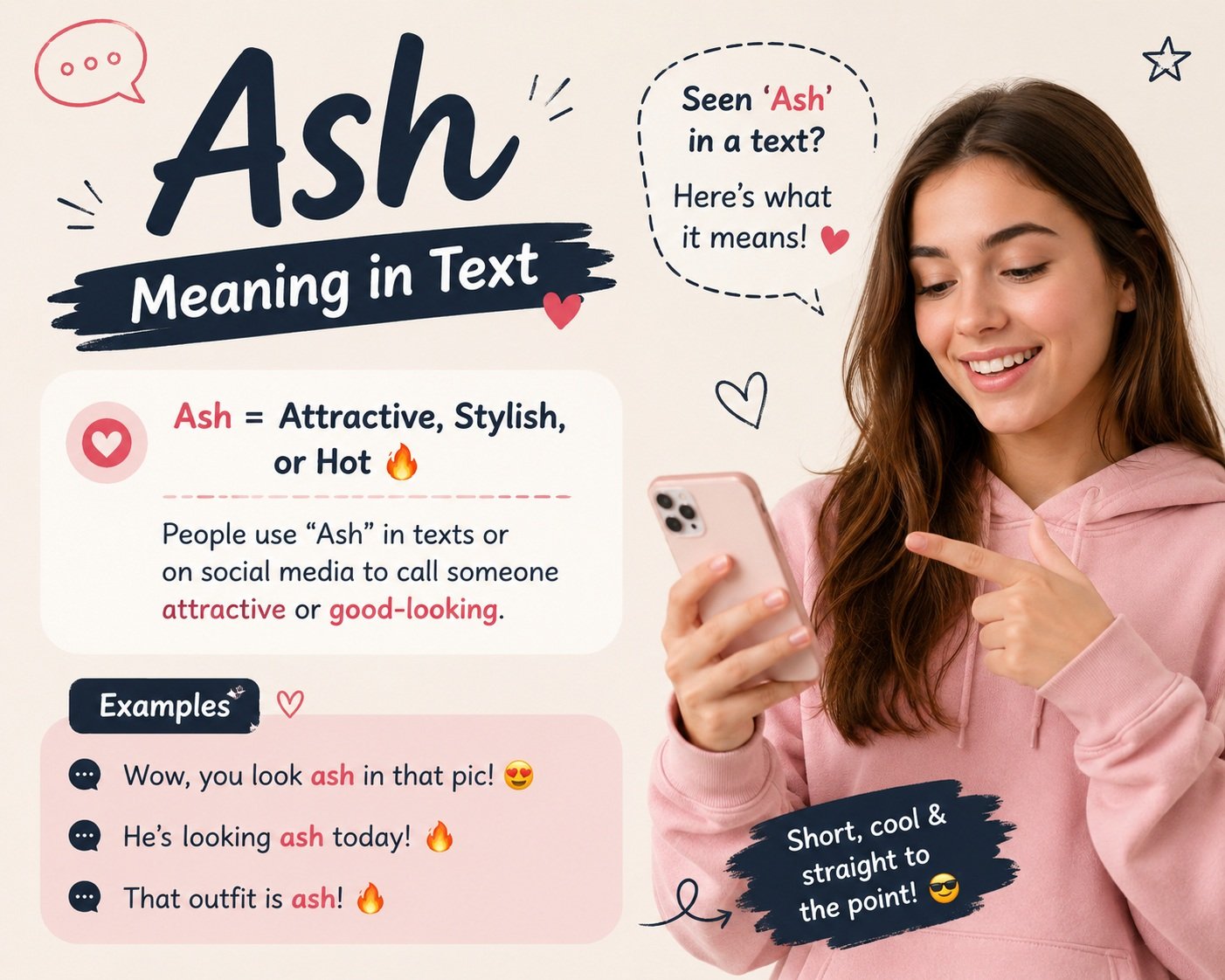

Have you ever received a text containing “ash” and wondered what the sender actually meant? You’re not alone. As internet slang continues to evolve, short words and abbreviations can take on meanings that aren’t obvious at first glance. The Ash Meaning in Text can be confusing because its interpretation often depends on the sentence, tone, and overall context.
You may come across “ash” while chatting with friends or browsing TikTok, Instagram, Snapchat, or other social media platforms. In casual online conversations, people often use slang to communicate quickly, add humor, or make their messages feel more natural. That’s why understanding the meaning behind these terms can help you follow conversations without second-guessing every unfamiliar word.
In this guide, we’ll explore what ASH means in text, how people use it in everyday conversations, and why its meaning can change depending on the situation. We’ll also look at common examples, the cultural side of internet slang, and the context clues that can help you understand what someone is trying to say. By the end, you’ll have a clear understanding of how to recognize and interpret “ash” when you see it online.
Let’s dive in!
Quick Answer: What Does Ash Mean in Text?
“Ash” usually refers to a person’s name or nickname when it appears in a casual text conversation. It can also mean the powdery residue left after something burns, or it may refer to a character, username, place, brand, or context-specific acronym.
There isn’t one universally accepted texting slang meaning for “Ash.”
| Meaning of “Ash” | Typical context | Example |
| Person’s name | Personal conversations | “Ask Ash if she’s coming.” |
| Nickname | Friends, family, social media | “Ash sent me the photos.” |
| Burned material | Fire, cigarettes, fireplaces | “There’s ash everywhere.” |
| Volcanic ash | Weather, volcanoes, news | “The airport closed because of ash.” |
| Character or public figure | Movies, games, TV, books | “Ash is my favorite character.” |
| Username | Gaming and social media | “Ash just joined the server.” |
| Acronym | Specific organizations or industries | “What does ASH mean here?” |
The context determines the meaning. Capitalization can offer a clue, but it isn’t enough by itself.
What Does Ash Mean in a Text Message?
The most common interpretation depends on the sentence.
When Ash appears with a capital letter in an ordinary conversation, it often works as a proper name. Ash is frequently used as a standalone name or as a shortened form of names such as Ashley, Ashton, and Asher.
For example:
“I talked to Ash yesterday.”
Here, “Ash” almost certainly refers to a person if the conversation is about friends or family.
On the other hand:
“Clean the ash out of the fireplace.”
Here, “ash” clearly refers to the solid residue produced by burning.
The same spelling can therefore point to completely different things. That’s why dictionary-style definitions alone don’t always solve a texting question.
Ash as a Person’s Name
Ash is commonly used as a first name and nickname. It can stand on its own or serve as a shortened version of a longer name.
Some names commonly associated with the nickname Ash include:
- Ashley
- Ashton
- Asher
- Ashleigh
However, you shouldn’t assume someone’s full name from “Ash.” A person may simply be named Ash.
Consider these messages:
- “Ash is picking me up.”
- “Can you send this to Ash?”
- “I haven’t heard from Ash today.”
- “Ash said the meeting starts at 10.”
In each case, the word functions like any other person’s name.
Ash as a Nickname
People often shorten longer names in everyday conversation. Ash is short, easy to type, and natural in casual messaging.
A text might say:
“I’ll ask Ash and let you know.”
The sender isn’t necessarily using slang. They’re simply referring to someone by their familiar name.
This distinction matters because online searches sometimes classify every short or unusual word as “texting slang.” In real conversations, however, ordinary names account for many appearances of words like Ash.
Ash as a Literal Word
The lowercase word ash has a well-established English meaning.
Ash is the solid residue left after a material burns. Depending on what burned and how it burned, ash can contain minerals, salts, and other noncombustible material.
You’ll commonly encounter the word in discussions about:
- Wood fires
- Fireplaces
- Campfires
- Cigarettes
- Wildfires
- Cremation
- Volcanic eruptions
- Industrial combustion
For example:
“The campfire left a layer of ash.”
That’s not texting slang. It’s simply the ordinary meaning of the word.
Ash as a Character or Fictional Reference
Sometimes Ash refers to a fictional character.
One famous example is Ash Ketchum from the Pokémon franchise. A gaming conversation might contain:
“Ash finally won.”
If everyone in the conversation is discussing Pokémon, the intended meaning becomes obvious.
The same thing can happen with characters from movies, television shows, books, comics, or video games.
Context acts like a decoder ring. You don’t need a special slang dictionary if the surrounding conversation already identifies the subject.
Is “Ash” a Texting Slang or Abbreviation?
Generally, no. “Ash” isn’t a universal texting abbreviation with one fixed meaning.
This is an important distinction.
Common texting abbreviations such as LOL, BRB, and IDK have widely recognized meanings. “Ash” doesn’t operate in quite the same way.
Instead, it can function as:
- A normal English word
- A person’s name
- A nickname
- A username
- A character’s name
- A reference to a specific subject
- An acronym in a particular context
That doesn’t mean nobody ever uses “ash” as slang. Internet communities constantly create new expressions. However, a niche or community-specific use shouldn’t automatically be presented as the standard meaning.
If someone tells you that “Ash” always means a particular phrase in texting, be cautious. The claim may come from a narrow slang database rather than widespread usage.
Ash Meaning in Different Texting Contexts
The easiest way to understand Ash meaning in text messages is to examine the setting.
Ash in a Casual Conversation
In a conversation between friends, Ash is often someone’s name.
“Ash is coming over later.”
Unless the conversation involves fire or another obvious topic, there’s little reason to interpret “Ash” as anything else.
Ash in a Relationship Conversation
Suppose someone texts:
“I think Ash knows what happened.”
Here, Ash probably refers to another person involved in the situation.
The word itself doesn’t indicate romance, attraction, jealousy, or any other emotional meaning.
The relationship context creates that meaning, not the word “Ash.”
Ash in Social Media Comments
Social media creates more possibilities.
A comment such as:
“Ash understood the assignment.”
could refer to:
- A creator
- A friend
- A celebrity
- A fictional character
- A username
- Someone featured in the post
Without seeing the post or previous comments, there’s no reliable reason to choose one interpretation.
Ash in Gaming Chats
Gaming communities frequently use short usernames and character names.
For example:
“Ash joined the lobby.”
Here, Ash could be another player’s username.
Alternatively:
“I’m using Ash this round.”
could refer to a playable character, depending on the game.
This is why community context matters. A word that seems mysterious in a general text can become completely obvious inside a gaming chat.
Ash in Workplace Messages
In a workplace conversation, “Ash” may simply be a colleague’s name.
For example:
“Ash will send the revised report.”
However, uppercase ASH could potentially represent an organization, department, project, or industry-specific term.
If you’re unsure, check the workplace’s terminology rather than guessing.
Examples of “Ash” Used in Text Messages
Realistic examples make the distinction much clearer.
Example: Ash Refers to a Person
“Ash said she’ll be here around seven.”
Meaning: Ash is someone’s name.
Example: Ash Is a Nickname
“I asked Ash to send me the address.”
Meaning: Ash is probably a nickname or shortened name.
Example: Ash Means Burned Material
“There’s ash all over the table.”
Meaning: The message refers to residue produced by burning.
Example: Ash Refers to a Fireplace
“Can you empty the ash before we use it again?”
Meaning: The sender is talking about fireplace residue.
Example: Ash Refers to Volcanic Material
“Flights were delayed because of volcanic ash.”
Meaning: The message concerns fine particles produced during a volcanic eruption.
Example: Ash Refers to a Character
“Ash was always my favorite.”
Meaning: The conversation probably identifies which Ash the sender means.
Example: Ash Is a Username
“Ash just joined the server.”
Meaning: Ash may be an online username.
These examples highlight one important point: the surrounding words often tell you more than the word itself.
Read More: Ditto Meaning in Text: What Does “Ditto” Mean in a Text Message?
How to Tell What “Ash” Means in a Text
When the meaning isn’t immediately clear, use a simple context check.
Read the Entire Sentence
Don’t interpret “Ash” in isolation.
Compare:
“Ash is running late.”
with:
“The ash is still warm.”
The grammar and surrounding words immediately create different interpretations.
Check Capitalization
Capitalization can provide a useful clue.
- Ash → may be a name or proper noun.
- ash → often refers to the substance.
- ASH → may indicate an acronym.
Still, capitalization isn’t conclusive. People frequently ignore capitalization when texting, especially on phones.
Look at the Conversation Topic
Ask what everyone was discussing immediately beforehand.
| Conversation topic | Likely meaning |
| Friends or family | Person named Ash |
| Fireplace or campfire | Burned material |
| Volcanoes | Volcanic ash |
| Gaming | Username or character |
| Movies or TV | Character or actor |
| Social media | Person, username, trend, or reference |
| Workplace | Person or organization-specific abbreviation |
This approach is much more reliable than memorizing a long list of alleged slang definitions.
Identify Names and References Around It
If the conversation contains names such as “Sarah,” “Mike,” and “Ash,” there’s a strong chance Ash is another person.
Likewise, if the conversation repeatedly mentions Pokémon, “Ash” may refer to Ash Ketchum.
Context creates probability.
Ask for Clarification
Sometimes the message genuinely doesn’t provide enough information.
There’s nothing wrong with asking:
- “Who do you mean by Ash?”
- “Do you mean Ash the person?”
- “Are you talking about ash from the fire?”
- “What does ASH mean here?”
A five-second clarification can prevent a surprisingly awkward misunderstanding.
Ash vs. Similar Words
The word ash sometimes gets confused with other combustion-related terms. These words aren’t interchangeable.
Ash vs. Ashes
Ash generally refers to the residue itself.
Ashes often refers to the remains collectively, particularly when discussing a person’s cremated remains or the residue from a fire.
For example:
- “There was ash in the fireplace.”
- “The ashes were scattered according to his wishes.”
The exact distinction can vary with context and ordinary usage.
Ash vs. Soot
Soot and ash aren’t the same thing.
Soot consists mainly of very fine carbon-rich particles formed during incomplete combustion. It commonly creates black deposits on chimneys, walls, glass, and other surfaces.
Ash is generally the inorganic residue that remains after combustible material burns.
So:
“The chimney is covered in soot.”
doesn’t mean exactly the same thing as:
“The fireplace contains ash.”
Ash vs. Smoke
Smoke is a mixture of gases and suspended particles released during burning.
Ash is solid residue left after combustion.
Think of it this way:
Fire → smoke released into the air + ash remaining behind
The two are related, but they aren’t synonyms.
Ash vs. Charcoal
Charcoal is primarily a carbon-rich material produced by heating wood or other organic material with limited oxygen.
Ash is what remains after combustible material has burned further.
That difference matters in scientific, cooking, environmental, and fire-related conversations.
Does “Ash” Have a Hidden Meaning in Texting?
Not necessarily.
Short words sometimes develop slang meanings within particular online communities. However, “Ash” doesn’t have one secret meaning that applies across texting platforms.
If you see claims that the word always means a particular phrase, consider three questions:
- Who uses the expression?
- Where is it commonly used?
- Does the surrounding conversation support that definition?
These questions separate genuine usage from unsupported slang lists.
Why Slang Definitions Can Be Confusing
User-generated slang websites can contain highly localized meanings. One community might use a term in a particular way that another community never recognizes.
That’s normal for internet language.
Language behaves more like a living ecosystem than a fixed instruction manual. New expressions appear, spread, change meaning, and sometimes disappear within months.
For that reason, a niche definition shouldn’t be treated as the universal answer to “Ash meaning in text.”
What Does “ASH” Mean in Text?
Uppercase ASH deserves separate attention because it may function as an acronym.
Acronyms don’t have one universal meaning. Their definitions depend heavily on the subject being discussed.
For example, an acronym used in medicine could mean something entirely different from one used in business, education, technology, or an online community.
So if someone writes:
“ASH is required for the project.”
the surrounding conversation matters enormously.
Don’t automatically convert ASH into a texting abbreviation.
If the sender uses the term repeatedly, look at earlier messages. They may already have explained the abbreviation.
How to Reply When Someone Texts “Ash”
Your response should depend on what you understand.
When Ash Clearly Refers to a Person
“Sure, I’ll message Ash.”
No special interpretation is necessary.
When the Meaning Isn’t Clear
“Who do you mean by Ash?”
This is the safest response when several people or references could fit.
When You Think It’s a Character
“Do you mean the character?”
A quick question can confirm the reference.
When You Think They Mean Literal Ash
“Do you mean the ash from the fire?”
This works well when the conversation involves burning, fireplaces, cigarettes, or similar topics.
When “ASH” Appears as an Acronym
“What does ASH stand for here?”
That’s more useful than guessing.
Common Misunderstandings About Ash Meaning in Text
“Ash” Always Means Slang
False.
In many messages, Ash is simply someone’s name.
“ASH” Always Has One Acronym Meaning
False.
Acronyms depend on their field and context.
Capitalization Always Determines the Meaning
Not necessarily.
People frequently type names and ordinary words inconsistently in casual messages.
Every Slang Website Gives the Correct Meaning
Not always.
Online slang dictionaries can contain niche, regional, outdated, humorous, or user-submitted definitions.
The strongest interpretation comes from actual conversational context.
Ash Has a Universal Romantic Meaning
No.
The word itself doesn’t inherently communicate romance, attraction, affection, or rejection.
If someone uses “Ash” while discussing a relationship, the relationship context—not the word provides the emotional meaning.
Case Study: Why Context Changes the Meaning of “Ash”
Imagine receiving these three messages from different conversations:
“Ash will pick us up at eight.”
Here, Ash almost certainly represents a person.
Now consider:
“Don’t touch the ash yet. It’s still hot.”
This clearly refers to combustion residue.
Finally:
“Ash was the best part of the series.”
That statement could refer to a character, actor, or another person. You’d need the previous conversation to know which one.
What changed?
The spelling barely changed at all.
The context did the heavy lifting.
That’s the key lesson when interpreting unfamiliar words in texts. Meaning doesn’t always live inside a word. Sometimes it lives in the sentence surrounding it.
FAQs:
1. What does “ash” mean in text?
In texting and internet slang, “ash” is often used as a shortened form of “as hell” to add emphasis. For example, “tired ash” means “very tired.”
2. Is “ash” the same as “as hell”?
In many casual online conversations, yes. It is commonly used as a slang abbreviation for “as hell,” especially when someone wants to strongly emphasize an adjective.
3. Where is “ash” commonly used?
You may see “ash” on platforms such as TikTok, Instagram, Snapchat, and other messaging or social media apps. Its use is especially common in informal conversations.
4. Is “ash” appropriate for formal conversations?
Usually, no. Since “ash” is internet slang, it’s better suited to casual chats with friends or online communities rather than professional emails, academic writing, or formal communication.
5. How can I understand “ash” in a sentence?
Look at the words around it and consider the context. In phrases such as “funny ash” or “boring ash,” it generally adds emphasis to the adjective.
Conclusion:
Understanding ash meaning in text becomes much easier once you recognize how internet slang works. In casual conversations, “ash” is commonly used to add emphasis, often as a shortened form of “as hell.” You may encounter it on TikTok, Instagram, Snapchat, messaging apps, and other online platforms.
However, its meaning can depend on the sentence, tone, and context. Paying attention to the surrounding words will help you understand what someone intends to express. While this term works well in informal conversations, it usually isn’t suitable for professional or academic writing. Knowing these differences can make online communication clearer and easier.