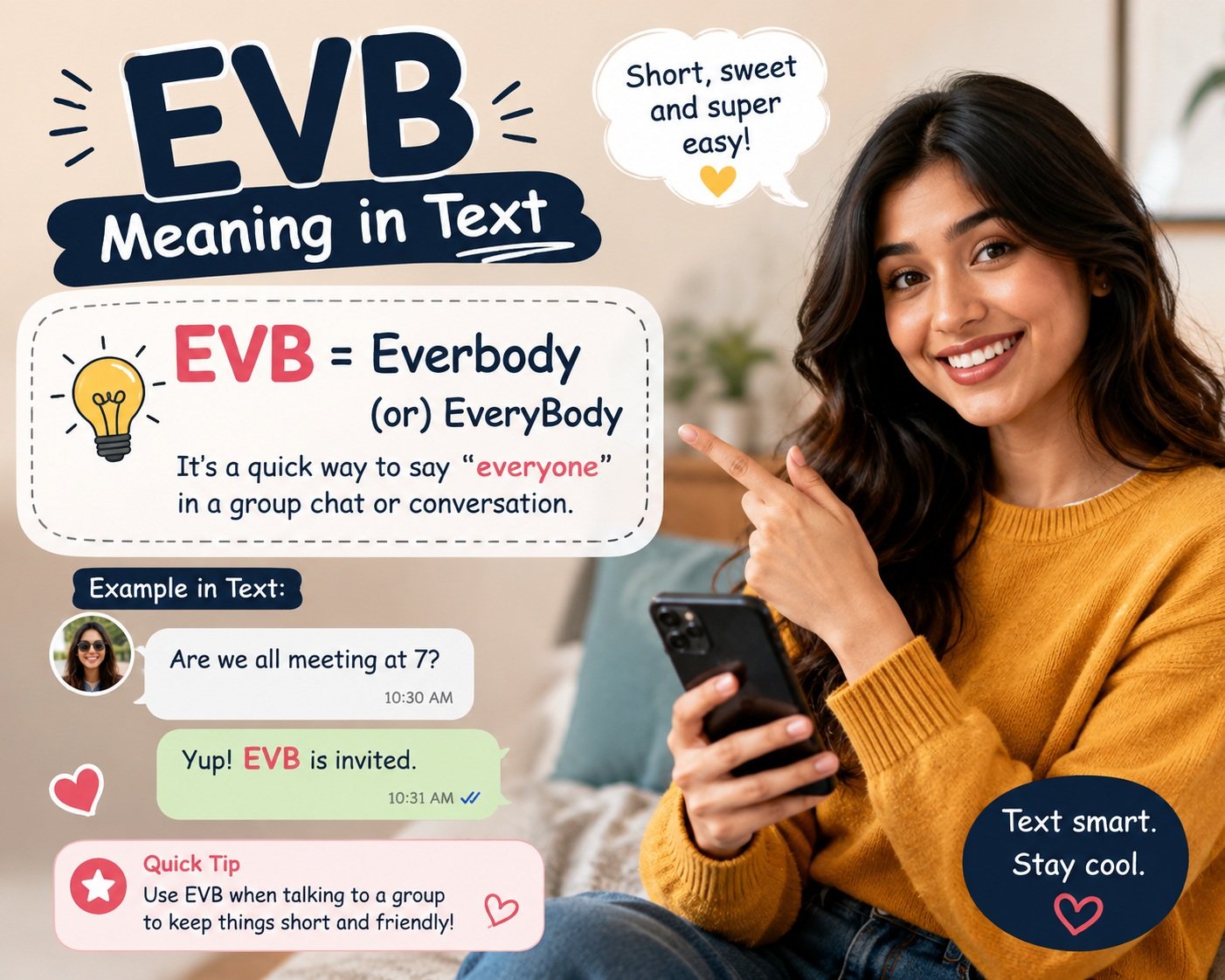

EVB Meaning in Text explains how this short form appears in texting, messages, and online chats when the meaning is unclear. If you encounter EVB in a text message, social media comment, or internet slang, it may seem short, unclear, or mysterious. In digital communication, abbreviations, slang terms, and shorthand terms are an essential part of communication because users can save time in a fast-paced digital world. The EVB meaning most often refers to everybody, including people in a group, community, or audience, although different meanings may appear in different contexts. Its use and usage can vary across online platforms, casual interactions, online conversations, and real conversations, especially when friends are chatting on WhatsApp, TikTok, Instagram, or Snapchat.
Similar common abbreviations, such as LOL and BRB, are familiar forms of texting slang, while online messaging, group messages, gaming chats, social media captions, and casual chats may follow their own texting culture. Context, tone, intent, age group, and background knowledge help with understanding of abbreviations and can prevent confusion or being misunderstood. When someone sends EVB, knowing the surrounding words makes it easier to respond or reply confidently.
Understanding the term is also about decoding letters, how people express emotion and identity, and how digital language works as compressed digital language. As texting language changes, a term can become popular, shift in meaning, or develop a new possible meaning, so practical understanding, confident usage, clarity, and confidence matter. This complete guide, Complete Guide, and 2026 Update also consider where it came from, common misunderstandings, examples, and replies, helping explain why EVB can feel confusing in modern communication and digital culture.
Let’s dive in!
Quick Answer: What Does EVB Mean in Text?
EVB usually means “everybody” in text messages, chats, and casual social media conversations.
It refers to all the people in a particular group or situation.
| Text | Meaning |
| “Is EVB ready?” | Is everybody ready? |
| “EVB knows already.” | Everybody knows already. |
| “Tell EVB to come over.” | Tell everybody to come over. |
| “Why is EVB so quiet?” | Why is everybody so quiet? |
| “I invited EVB.” | I invited everybody. |
EVB is best understood as an informal abbreviation, rather than a traditional acronym in which every letter represents a separate word. The shortened form comes from the spelling of everybody → EVB.
If the sentence makes sense after replacing EVB with everybody, you’ve probably found the intended meaning.
What Does EVB Stand for in Texting?
In ordinary texting, EVB stands for “everybody.”
People use it when they want to talk about a group of people collectively. It can refer to friends, classmates, coworkers, followers, teammates, family members, or virtually any other group.
For instance:
“EVB needs to be here by 8.”
The natural full version is:
“Everybody needs to be here by 8.”
Nothing else changes. EVB simply compresses the word.
This kind of shortening fits the broader culture of digital communication. Texting encourages people to communicate quickly, especially when they’re sending short messages from a phone. Instead of writing every word in full, users often shorten familiar terms when the meaning remains obvious.
EVB Means “Everybody,” Not “Everyone”
You’ll sometimes see explanations that say EVB means “everyone.” That’s understandable because everybody and everyone have essentially the same meaning in ordinary English.
However, there’s an important distinction.
EVB is formed from “everybody,” not “everyone.”
So:
- Everybody → EVB
- Everyone → equivalent meaning in many sentences
Consider this example:
“EVB is invited.”
The closest expansion is:
“Everybody is invited.”
You could also say:
“Everyone is invited.”
The second sentence communicates the same idea, but it isn’t the source of the abbreviation.
Why Do People Use EVB in Text Messages?
The main reason is simple: speed and convenience.
Typing “everybody” takes considerably longer than typing three letters. In a fast-moving group chat, that small difference can make shorthand feel natural.
EVB also matches the relaxed style of online communication. A message such as:
“EVB coming?”
looks casual and conversational.
Writing:
“Is everybody coming?”
is perfectly normal too. It simply feels more complete and conventional.
Common reasons people use EVB
- Faster typing
- Shorter messages
- Casual communication
- Group-chat convenience
- Social-media shorthand
- Informal online conversations
- Space-saving in short posts or comments
The abbreviation works especially well when everyone involved already understands the shorthand.
That’s the key. Texting abbreviations only save time when the reader understands them.
If the recipient doesn’t recognize EVB, the shortcut creates more work rather than less.
How Is EVB Used in a Text?
The easiest way to understand EVB is to look at its position in a sentence.
Because EVB usually replaces everybody, it can take the same grammatical role as the original word.
EVB as the subject
“EVB wants pizza.”
Means:
“Everybody wants pizza.”
Here, EVB refers to the people doing the action.
EVB as the object
“I told EVB about the change.”
Means:
“I told everybody about the change.”
Here, EVB refers to the people receiving the information.
EVB after a preposition
“This message is for EVB.”
Means:
“This message is for everybody.”
Again, the abbreviation simply takes the place of the longer word.
A useful replacement test
When you’re unsure what EVB means, try this:
Replace EVB with “everybody.”
If the sentence suddenly makes perfect sense, you’ve probably solved it.
| Message | Expanded version |
| “EVB left early.” | Everybody left early. |
| “Did you tell EVB?” | Did you tell everybody? |
| “EVB wants to go.” | Everybody wants to go. |
| “I invited EVB.” | I invited everybody. |
| “EVB keeps asking me.” | Everybody keeps asking me. |
| “Why didn’t EVB come?” | Why didn’t everybody come? |
This simple method is more reliable than guessing from the three letters alone.
EVB Meaning in Different Texting Situations
The surrounding conversation often tells you more than the abbreviation itself.
EVB in a group chat
Group chats are one of the most natural settings for a term that means “everybody.”
Someone might write:
“Can EVB bring something to eat?”
That means:
“Can everybody bring something to eat?”
The group provides the missing context. You already know who “everybody” refers to because you’re participating in the conversation.
Another example:
“EVB meet downstairs at 7.”
The sender is addressing the whole group.
EVB in a one-on-one text
EVB can still appear in a private conversation when the sender is talking about a larger group.
For example:
“EVB from school is going to the game.”
Here, EVB doesn’t mean the sender and recipient alone. It refers to the broader group mentioned in the sentence.
Context does the heavy lifting.
EVB on social media
EVB may also appear in comments, captions, replies, or direct messages. Current online references describe the abbreviation as being used in casual social-media conversations, including platforms such as TikTok, Instagram, Snapchat, WhatsApp, and similar messaging spaces.
For example:
“EVB is talking about this song.”
The intended meaning is:
“Everybody is talking about this song.”
On social media, “everybody” doesn’t necessarily mean literally every person on Earth. It can mean everyone in the relevant audience, community, comment section, friend group, or social circle.
That’s an important bit of context.
What Does EVB Mean on TikTok?
On TikTok and similar social platforms, EVB generally means “everybody” when it is used as casual slang. A TikTok-specific explanation also identifies “everybody” as the primary meaning while noting that EVB can have unrelated meanings outside social-media slang.
For example:
“EVB doing this trend now.”
The sentence means:
“Everybody is doing this trend now.”
The word can also refer to a more limited group:
“EVB in the comments is asking the same thing.”
Here, EVB clearly refers to the people participating in that particular discussion.
What Does EVB Mean on Instagram?
The same basic interpretation applies to Instagram.
You might see:
- “EVB loved this.”
- “Why is EVB posting this?”
- “EVB needs to see this.”
- “EVB is talking about the new song.”
In each case, replace EVB with everybody and the meaning becomes clear.
The exact group can change, though. It might mean everyone’s followers, everyone in the comments, or everyone involved in a particular conversation.
What Does EVB Mean on WhatsApp?
In WhatsApp group chats, EVB can function as a quick way to address the entire group.
For example:
“Can EVB confirm the time?”
means:
“Can everybody confirm the time?”
Similarly:
“Tell EVB the meeting moved to 6.”
means:
“Tell everybody the meeting moved to 6.”
If you’re texting family members, older relatives, coworkers, or anyone unfamiliar with internet shorthand, writing “everybody” may be clearer.
Read More: Ash Meaning in Text: What Does “Ash” Mean in a Text Message?
EVB Meaning in Text vs. Other Meanings of EVB
Here’s where context becomes especially important.
EVB isn’t limited to texting slang. The same three letters appear as an abbreviation in specialized fields.
For example, EVB can mean “electric vehicle battery” in discussions about electric vehicles and battery technology. It can also refer to an evaluation board in electronics contexts.
That doesn’t conflict with the texting definition. It simply shows why abbreviations need context.
| Context | Possible meaning of EVB | Likelihood in casual texting |
| Texting | Everybody | High |
| Social media | Everybody | High |
| Group chats | Everybody | High |
| Electric-vehicle discussions | Electric vehicle battery | Low |
| Electronics | Evaluation board | Low |
| Scientific or technical writing | Field-specific abbreviation | Depends on the subject |
So, if a friend texts:
“EVB is invited.”
“Everybody” is the obvious interpretation.
If an engineer writes:
“The EVB requires testing before deployment.”
you shouldn’t automatically interpret EVB as “everybody.” The surrounding technical discussion may point to a completely different expansion.
EVB in Casual Texting vs. Professional Writing
EVB belongs primarily in informal communication.
That doesn’t mean using it is wrong. Texting has its own conventions, and abbreviations can make casual conversations faster.
However, professional communication has different expectations.
Casual situations where EVB can fit
- Texting friends
- Group chats
- Casual social-media comments
- Informal DMs
- Gaming communities
- Personal conversations
Situations where “everybody” is better
- Business emails
- Academic assignments
- Formal reports
- Customer communication
- Official announcements
- Legal documents
- Professional presentations
For example, compare these two messages:
“EVB needs to submit the form by Friday.”
and:
“Everybody needs to submit the form by Friday.”
The second version is clearer and more professional. There’s no real advantage to shortening “everybody” in a formal document.
Clarity beats brevity when the audience may not know the abbreviation.
EVB Meaning: Real-World Case Studies
Looking at context makes the distinction easier to understand.
Case study: A school group chat
A student writes:
“EVB has to bring their permission slip tomorrow.”
Because the conversation concerns a class, EVB most naturally means everybody in the group.
The sentence expands to:
“Everybody has to bring their permission slip tomorrow.”
No specialized definition is necessary.
Case study: A social-media comment
Someone comments:
“EVB is obsessed with this song.”
The person probably isn’t making a literal claim about every human being alive. In casual online speech, “everybody” often means a large number of people within the relevant audience.
The conversation’s subject tells you which group the writer has in mind.
Case study: An engineering conversation
Now imagine seeing:
“We tested the EVB before connecting the prototype.”
If the conversation concerns circuit design, “everybody” makes no grammatical or logical sense.
In electronics, EVB can refer to an evaluation board, a hardware platform used to evaluate or test a component or system.
The same three letters now have a completely different job.
That’s why context matters more than capitalization or the letters themselves.
How to Figure Out What EVB Means in a Text
If someone sends you “EVB” and you’re not sure what they mean, don’t immediately assume the answer.
Use the surrounding clues.
Read the entire sentence
Don’t isolate the abbreviation.
For example:
“EVB was there last night.”
“Everybody” fits naturally.
Now consider:
“The EVB passed the hardware test.”
A technical meaning becomes much more plausible.
Identify the topic
Ask yourself what the conversation is about.
Is it about:
- Friends?
- School?
- A party?
- Social media?
- Gaming?
- Work?
- Electronics?
- Electric vehicles?
- Science?
The topic can eliminate most possible meanings immediately.
Look at the sender’s usual language
Some people use abbreviations constantly. Others almost never do.
If someone normally writes “everybody” in full, EVB could be an unusual personal abbreviation or something unrelated.
Check capitalization
You may see EVB, evb, or occasionally other capitalization patterns.
Capitalization can provide a clue, especially when you’re dealing with a formal acronym. However, it doesn’t prove the meaning.
A person may capitalize a casual abbreviation simply because it appears at the beginning of a sentence or because they prefer uppercase shorthand.
Ask the sender
When nothing else works, ask:
“What do you mean by EVB?”
There’s no prize for solving an ambiguous abbreviation through detective work.
A quick question can prevent an awkward misunderstanding.
Common Mistakes When Interpreting EVB
Assuming EVB has only one possible meaning
In casual texting, “everybody” is the main interpretation. Outside that environment, other meanings exist.
Treat the context as part of the definition.
Confusing “everybody” with the exact word “everyone”
The two words are close in meaning. However, EVB is derived from “everybody.”
“Everyone” is a natural equivalent in many sentences, not the literal source of the abbreviation.
Treating every online definition as universal
Internet slang isn’t a perfectly regulated language.
A phrase may be common in one community and virtually unknown in another. Some websites also publish competing definitions without strong evidence.
That’s why a sensible interpretation should consider actual context and usage, not just a random acronym list.
Using EVB in formal writing
Even when the reader understands it, casual shorthand can make formal writing look unnecessarily informal.
Use the full word everybody in professional or academic material.
Assuming EVB means “everyone be”
One online source currently promotes “Everyone Be” as an EVB texting meaning. However, that interpretation conflicts with the broader set of current texting references that identify “everybody” as the common meaning.
Unless the surrounding conversation clearly supports “everyone be,” “everybody” is the safer interpretation in ordinary texting.
EVB vs. Similar Texting Shortcuts
EVB belongs to the wider world of digital shorthand. Some abbreviations are extremely familiar, while others remain niche.
The important difference is that not every three-letter combination has a universally recognized texting definition.
| Term | Meaning | Typical use |
| EVB | Everybody | Casual texting |
| IDK | I don’t know | Casual messages |
| TBH | To be honest | Texts and social media |
| BRB | Be right back | Chats and messaging |
| LMK | Let me know | Texts and DMs |
| NGL | Not gonna lie | Casual online communication |
Unlike highly established shortcuts such as IDK and BRB, EVB appears to be less universally familiar. That’s one reason someone might see it in a message and immediately search for its meaning.
Should You Use EVB in a Text?
You can use it when the situation is casual and the people you’re messaging are likely to understand it.
For example:
“EVB ready for tonight?”
works naturally in a friendly group chat.
However, you don’t need to force the abbreviation into every message.
Sometimes the full word is better:
“Is everybody ready?”
That’s especially true when you’re speaking to people who may not know the shorthand.
A simple rule
Use EVB when familiarity makes it clearer, not merely because it’s shorter.
Good communication isn’t about using the fewest characters possible. It’s about getting the meaning across without making the reader stop and decode your message.
FAQs:
1. What does EVB mean in text?
EVB most commonly means “everybody” in texting and online conversations. The exact meaning can change depending on the context and conversation.
2. Where is EVB commonly used?
You may see EVB in text messages, online chats, social media comments, group messages, gaming chats, and casual conversations on platforms such as WhatsApp, Instagram, and TikTok.
3. Is EVB a common texting abbreviation?
EVB is less common than abbreviations such as LOL or BRB, so some people may find it confusing when they first encounter it.
4. How should I respond when someone says EVB?
First, check the surrounding conversation, tone, and context. If EVB means “everybody,” you can respond normally based on what the person is discussing.
5. Can EVB have different meanings?
Yes. Abbreviations can have different meanings depending on the platform, conversation, age group, and context. When unsure, consider the words around EVB before replying.
Conclusion:
EVB is a short form that can appear in texting, online chats, social media comments, and group conversations. In most casual digital communication, EVB means “everybody,” but context still matters because abbreviations can have different meanings. Understanding the surrounding words, tone, and intent can help you avoid confusion and respond naturally.
If you see EVB on WhatsApp, Instagram, TikTok, Snapchat, or in gaming chats, knowing common texting slang makes online communication easier. As digital language continues to change, staying familiar with new shorthand terms can improve your confidence when chatting with friends, communities, and wider audiences.