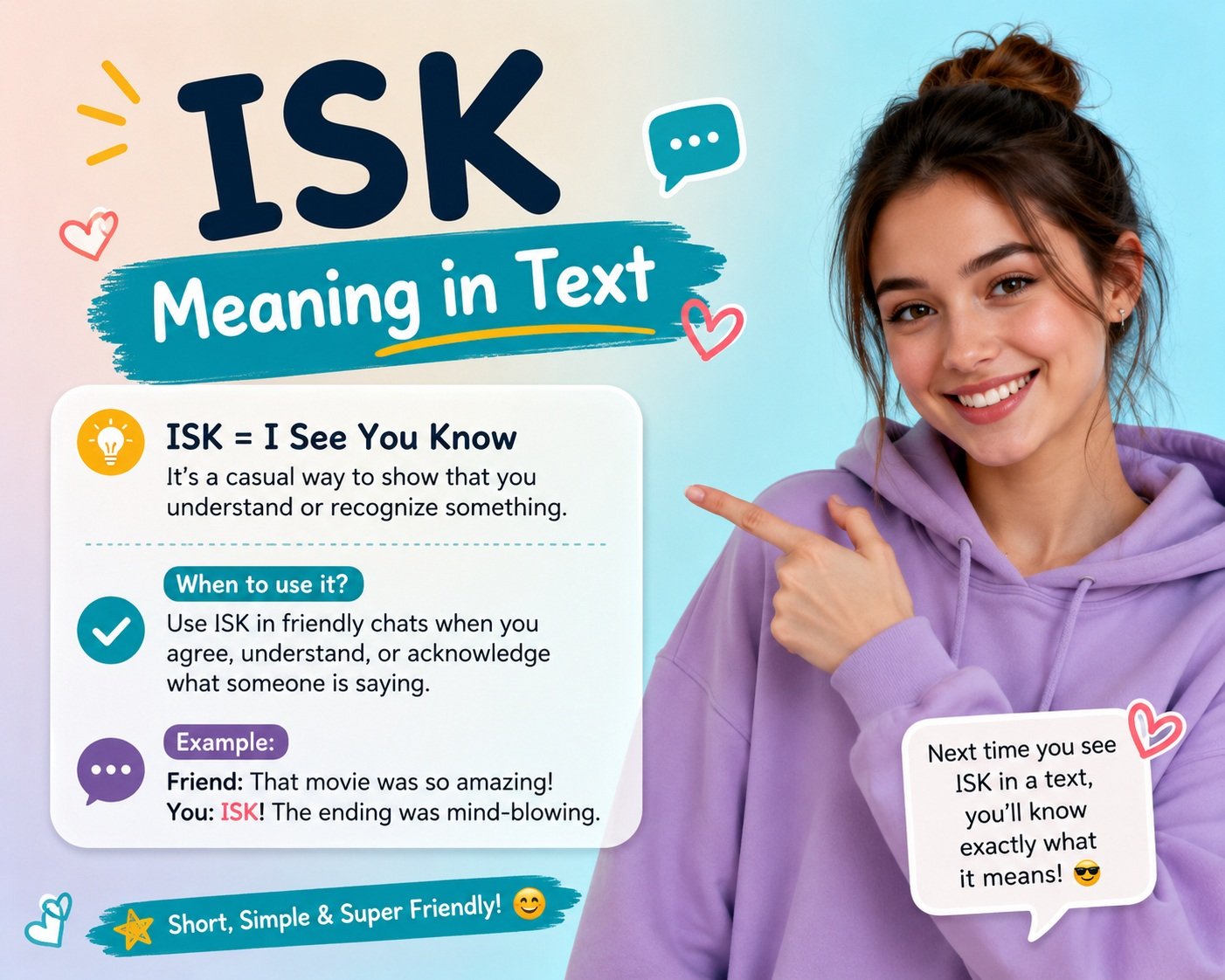

If you’ve ever received ISK in a message and stopped to wonder what it means, you’re not alone. ISK Meaning in Text is commonly searched because people use many abbreviations, short forms, and texting slang in everyday digital communication. In simple terms, isk meaning texting can refer to “I don’t know,” especially when isk is used as a fast typing mistake for idk. However, the exact meaning may change based on the context, tone, person, and surrounding conversation. You might see it in text messages, a casual chat, group chat, DM, online conversations, social media chats, gaming chats, or online discussions.
People use internet slang, online slang, text abbreviations, texting shortcuts, and digital shorthand because they make communication faster and more casual. The same applies across social media, messaging apps, WhatsApp, TikTok, Instagram, Snapchat, and online games. In some gaming situations, ISK can even relate to gaming currency, which shows why understanding the conversation context matters. When you know the surrounding words, it becomes easier to understand what the sender wants to express, whether that is uncertainty, emotion, or a casual tone.
This guide looks at the slang definition, origin, popularity, common uses, and real-life examples of ISK. It also explains how language changes across texting culture and online communication culture, helping you avoid misunderstandings and confusion. Whether you’re in the United States or elsewhere, knowing how these expressions work can help you communicate clearly and effectively.
Let’s dive in!
Quick Answer: What Does ISK Mean in Text?
ISK most commonly means “I Should Know” when used as a casual texting abbreviation.
Someone might use it when they feel they should already know an answer, remember something, or understand a situation.
For example:
Friend: “What time does the movie start?”
You: “ISK, I should’ve checked.”
Here, ISK means “I Should Know.” The speaker recognizes that they ought to have the information.
However, “isk” can also appear as a typo or informal substitute for “IDK” (“I Don’t Know”). Several slang references document this usage, which means you shouldn’t interpret the three letters in isolation.
Outside texting, the meaning changes completely:
| Context | Meaning of ISK |
| Casual texting | I Should Know |
| Informal typo/slang usage | Sometimes I Don’t Know |
| Finance or travel | Icelandic króna |
| EVE Online | InterStellar Kredits |
The surrounding words usually reveal which meaning fits.
What Does ISK Stand for in Texting?
In its “I Should Know” usage, ISK is a shortened form of the phrase “I Should Know.”
The phrase itself carries more meaning than a simple statement of knowledge.
Compare these:
- “I know.”
- “I don’t know.”
- “I should know.”
“I know” expresses certainty.
“I don’t know” expresses a lack of knowledge.
“I should know” sits somewhere between the two. It suggests that the person expects themselves to know, even if they don’t have the answer immediately.
That subtle difference explains why someone might use ISK after forgetting a familiar fact.
For example:
“What’s your sister’s birthday again?”
“ISK 😭”
The speaker isn’t necessarily saying, “I know the answer.” They’re saying something closer to “I should know this, but I’ve forgotten.”
That distinction becomes especially important when interpreting tone.
What Does “I Should Know” Really Mean?
The phrase “I should know” usually implies familiarity, responsibility, experience, or an expectation of knowledge.
Imagine someone asking a restaurant manager what time the kitchen closes.
If the manager says:
“I should know.”
The sentence suggests that knowing the answer is part of their role.
In a casual text, however, the same phrase can be much lighter:
“What was the name of that coffee shop we went to?”
“ISK 😂”
Here, the speaker recognizes that they were there and probably ought to remember.
ISK can communicate several shades of meaning
Depending on the conversation, it may suggest:
- Self-awareness: “I realize I should know this.”
- Mild embarrassment: “I can’t believe I forgot.”
- Familiarity: “I’ve dealt with this before.”
- Responsibility: “This is something I ought to know.”
- Humor: “Of all people, I should know this.”
- Sarcasm: “Obviously I should know that.”
The abbreviation doesn’t automatically tell you which emotion is present. The surrounding conversation does.
How Is ISK Used in Text Messages?
People generally use ISK in short, informal conversations where abbreviations feel natural.
It can appear as a standalone response or as part of a longer sentence.
When Someone Thinks They Should Know the Answer
This is the clearest use.
A: “When does your class finish?”
B: “ISK. I have the schedule somewhere.”
The speaker probably knows that the information is available to them. They simply don’t have it at hand.
When Someone Is Embarrassed They Forgot
An emoji can make the tone much clearer.
A: “What’s Mom’s favorite restaurant?”
B: “ISK 😭”
The crying emoji changes the feel of the response. Instead of sounding cold, it makes the message sound more self-deprecating.
When Someone Is Being Self-Critical
ISK can also acknowledge a personal mistake.
A: “Did you remember to send the application?”
B: “ISK. I completely forgot.”
Here, ISK essentially introduces the thought: “I should have known or remembered this.”
When Someone Is Being Sarcastic
Tone becomes more important when sarcasm enters the conversation.
A: “Who knows everything about this subject?”
B: “ISK 😂”
The abbreviation alone doesn’t create the sarcasm. The question and the laughing emoji do most of the work.
That’s why reading only “ISK” without the surrounding messages can be misleading.
ISK Meaning in Different Texting Contexts
The same abbreviation can carry different shades of meaning depending on the situation.
Casual Conversations
Among friends, ISK may simply acknowledge that someone should already know something.
The tone tends to be relaxed and conversational.
Group Chats
Group conversations create more room for humor and sarcasm.
For example:
A: “Who knows what we’re supposed to bring tomorrow?”
B: “ISK 😭”
C: “Great. We’re all prepared.”
Here, ISK helps create a quick, playful exchange rather than a formal statement.
Social Media Messages
Informal abbreviations can also appear in DMs and social conversations. However, there’s no universal rule that every person or platform uses ISK in exactly the same way.
That’s important.
Text slang isn’t a dictionary with fixed definitions for every user. People sometimes create abbreviations, reuse them differently, or make accidental typos that become understandable from context.
Online Communities
Online communities can develop their own vocabulary. Gaming is a particularly good example because ISK has a specific established meaning in EVE Online.
That means someone discussing ships, markets, or in-game wealth isn’t necessarily talking about texting slang at all.
What Does ISK Mean in a Text From a Guy?
If a guy texts “ISK,” the abbreviation itself doesn’t have a special male-specific meaning.
The interpretation still depends on context.
For example:
“ISK why I forgot that 😂”
This could simply mean “I should know why I forgot that.”
Likewise:
“ISK, I’ve worked with that system for years.”
Here, the sender is emphasizing familiarity or experience.
It also shouldn’t automatically be interpreted as flirting.
ISK isn’t inherently romantic, sexual, or suggestive. If a message has romantic undertones, those usually come from the larger conversation rather than the abbreviation itself.
What Does ISK Mean in a Text From a Girl?
The same rule applies when a girl sends ISK.
There is no separate standard definition based on the sender’s gender.
Consider:
“ISK 😭 I literally wrote it down yesterday.”
The likely meaning is still “I should know.”
To understand the tone, examine:
- The messages before and after ISK
- Emojis
- Punctuation
- The subject being discussed
- The relationship between the people
- Whether the sender appears to be joking or being serious
Context is the decoder ring.
Is ISK a Good or Bad Word?
No. ISK isn’t inherently good or bad.
It’s an abbreviation. The emotional meaning comes from how someone uses it.
Compare these three messages:
“ISK.”
“ISK 😂”
“ISK, I literally work there.”
They all contain the same abbreviation, yet they don’t sound identical.
The first can feel blunt.
The second sounds playful.
The third can sound mildly defensive or self-aware.
This is common with texting because written messages don’t carry the facial expressions, voice inflection, or gestures that normally help people interpret tone.
A tiny emoji can change the entire temperature of a sentence.
Read More: LMY Meaning in Text: What Does LMY Mean in Texting?
Is ISK Rude in Texting?
ISK isn’t normally considered rude.
Still, a one-word response can feel abrupt depending on the situation.
For example:
“Do you know where the documents are?”
“ISK.”
That response may sound dismissive even if the sender simply meant “I should know.”
Compare it with:
“ISK 😭 Give me a second and I’ll check.”
The second response gives the reader more information and feels considerably warmer.
What can change the tone?
| Element | Possible effect |
| ISK. | Short or blunt |
| ISK 😂 | Playful |
| ISK 😭 | Embarrassed or frustrated |
| ISK, let me check. | Helpful and neutral |
| ISK lol | Casual and light |
| I should know that 😅 | More explicit and conversational |
So, if someone sends ISK and you’re unsure whether they’re annoyed, don’t judge the tone from the abbreviation alone.
Examples of ISK in Text Conversations
Realistic examples make the distinction easier to understand.
Example 1: Forgetting Familiar Information
A: “What’s your cousin’s new number?”
B: “ISK 😭 I changed phones recently.”
Meaning: “I should know, but I don’t have it right now.”
Example 2: Forgetting an Appointment
A: “What time is your dentist appointment?”
B: “ISK. I need to check the reminder.”
Meaning: The sender expects to have the information but needs to verify it.
Example 3: Familiarity With a Subject
A: “Have you worked with this software before?”
B: “ISK. I’ve used it for years.”
Meaning: The sender believes they should know the answer because of their experience.
Example 4: Self-Deprecating Humor
A: “What was the name of the movie we watched last night?”
B: “ISK 😂 My memory is terrible.”
Meaning: “I should know this, but I’ve forgotten.”
Example 5: Sarcastic Use
A: “Who would know the most about this?”
B: “ISK 😂”
Meaning: The sender jokingly suggests that they should obviously know.
ISK vs. Similar Texting Abbreviations
One of the easiest ways to understand ISK is to compare it with abbreviations that look or sound similar.
| Abbreviation | Meaning | Main idea |
| ISK | I Should Know | I ought to know this |
| IDK | I Don’t Know | I don’t have the answer |
| IK | I Know | I already know |
| IKR | I Know, Right? | Strong agreement |
| IMO | In My Opinion | Personal viewpoint |
| TBH | To Be Honest | Introducing an honest statement |
ISK vs. IDK
This is the most important distinction.
IDK = I Don’t Know.
ISK = I Should Know.
Consider:
“What time does the meeting start?”
“IDK.”
The person doesn’t know.
Now consider:
“What time does the meeting start?”
“ISK. It’s on the calendar.”
The second person believes they should know and may simply need to check.
However, there’s an important wrinkle: some online references document “isk” as a typo or informal variation of “idk.” Because of that, context can be decisive.
ISK vs. IK
IK = “I Know.”
It’s a direct confirmation.
ISK = “I Should Know.”
The extra word “should” introduces expectation or responsibility.
That tiny difference changes the meaning significantly.
Other Meanings of ISK
Texting isn’t the only place you’ll encounter ISK.
In fact, two other meanings are well established and far more technical.
ISK as the Icelandic Króna
ISK is the currency code for the Icelandic króna, Iceland’s national currency.
This meaning appears in:
- Travel websites
- Hotel prices
- Financial information
- Currency converters
- Bank transactions
- Iceland-related business documents
The Central Bank of Iceland publishes reference exchange rates for the Icelandic króna against major currencies. Its official exchange-rate data identifies the currency through the ISK code.
For example:
“The hotel costs 30,000 ISK per night.”
In this sentence, ISK clearly has nothing to do with “I Should Know.”
It’s a monetary amount.
ISK in EVE Online
Gamers may use ISK to mean InterStellar Kredits, the main in-game currency of EVE Online.
The official EVE Online support documentation describes ISK as the game’s primary currency. Players earn it through activities such as mining, missions, trading, exploration, piracy, and production. They can then use it for in-game purchases and market transactions.
For example:
“I made 20 million ISK from that trade.”
In this context, the speaker is talking about in-game money, not texting slang and not Icelandic currency.
This overlap is particularly interesting because the same three letters represent both the Icelandic currency code and EVE Online’s fictional currency.
How to Tell Which ISK Meaning Someone Intended
When you encounter ISK, don’t guess immediately. Instead, scan the surrounding context.
Use this quick checklist:
- Is this a casual text conversation?
“I Should Know” becomes a strong possibility. - Does the message look like a typo for IDK?
If so, the sender may simply mean “I Don’t Know.” - Does ISK appear beside a number and a price?
It probably refers to Icelandic króna. - Is the conversation about EVE Online?
ISK likely means InterStellar Kredits. - Are there emojis or casual slang around it?
The texting interpretation becomes more plausible. - Does replacing ISK with “I Should Know” make the sentence work?
If it does, you’ve probably found the intended meaning.
A simple context test
| Message | Likely interpretation |
| “ISK 😭 I forgot.” | I Should Know |
| “ISK, let me check.” | I Should Know |
| “I paid 15,000 ISK.” | Icelandic króna |
| “I earned 10 million ISK.” in EVE | InterStellar Kredits |
| “ISK what happened.” | Possibly IDK typo/variant |
The last example deserves caution because slang isn’t perfectly standardized. A sender’s personal typing habits can matter more than a dictionary definition.
Why ISK Can Be Confusing
The confusion comes from semantic overlap.
The same three letters can belong to completely different communication systems:
Everyday texting → “I Should Know”
Informal typo/slang → “I Don’t Know”
International finance → Icelandic króna
Online gaming → InterStellar Kredits
That’s why searching for a single definition isn’t always enough.
Think of ISK as a road sign with several destinations. You need the surrounding road to know where you’re headed.
How to Respond When Someone Says ISK
If the context clearly indicates “I Should Know,” your response can be casual.
For example:
“Haha, you should!”
Or:
“No worries. Check and let me know.”
You could also keep the conversation playful:
“Then you’re officially in charge of finding out 😂”
If the meaning isn’t clear, there’s nothing wrong with asking:
“What do you mean by ISK?”
That’s better than confidently assuming the wrong meaning.
If you’re texting someone you don’t know well, clarification can prevent a tiny abbreviation from turning into a surprisingly large misunderstanding.
Is ISK Formal or Informal?
ISK is informal texting language.
It works best in:
- Text messages
- Casual chats
- Group conversations
- Informal DMs
- Online communities
It generally doesn’t belong in professional correspondence unless everyone involved already uses that style.
For example, instead of writing:
“ISK why the report wasn’t submitted.”
A professional message would be clearer:
“I should know why the report wasn’t submitted. I’ll check the records and follow up.”
Formal communication benefits from precision. Texting can afford shortcuts.
Common Misunderstandings About ISK
“ISK always means I Should Know.”
Not necessarily.
Although “I Should Know” is a recognized texting interpretation, some sources document isk as a typo or informal substitute for “IDK.”
“ISK means I Don’t Know.”
Not universally.
IDK is the standard abbreviation for “I Don’t Know.” ISK may be used that way by some people, but you shouldn’t automatically assign that meaning to every occurrence.
“ISK has a romantic meaning.”
There is no standard romantic meaning attached to ISK.
If someone uses it during a flirtatious conversation, the romantic tone comes from the broader exchange rather than the abbreviation itself.
“ISK always refers to texting.”
Definitely not.
The Icelandic króna and EVE Online currency both use ISK in established contexts.
What Does ISK Mean on Social Media?
On social media, ISK can carry the same informal meanings found in texting, particularly “I Should Know.”
However, social platforms also expose users to gaming, finance, travel, and international communities. That makes alternative meanings more likely.
For instance:
Comment: “How much did the trip cost?”
Reply: “About 250,000 ISK.”
That’s clearly a currency reference.
Meanwhile:
Comment: “Do you remember what happened?”
Reply: “ISK 😭”
That’s much more likely to be informal slang.
The platform itself isn’t enough to determine the definition. The conversation is.
FAQs:
1. What does ISK mean in text?
ISK can mean “I don’t know” in casual texting, especially when it is used as a typing mistake for IDK. Its exact meaning depends on the context.
2. Is ISK a common texting abbreviation?
ISK is less common than IDK, but some people may use it in casual chats, social media, and online conversations.
3. What does ISK mean on Snapchat or Instagram?
On Snapchat or Instagram, ISK may be used as casual texting slang. Check the surrounding conversation to understand what the sender means.
4. Can ISK have other meanings?
Yes. ISK can have different meanings depending on the situation. In gaming, for example, it can refer to a currency, so context matters.
5. How should I reply to ISK?
If ISK means “I don’t know,” you can respond naturally by asking another question, providing more information, or simply continuing the conversation.
Conclusion:
Understanding ISK meaning in text becomes easier when you look at the surrounding conversation instead of focusing only on the letters. In casual texting, ISK may mean “I don’t know,” particularly when someone makes a quick typing mistake.
However, internet slang, gaming chats, and social platforms can give abbreviations different meanings. Checking the context, tone, and situation can help you avoid confusion and misunderstandings.
Whether you see ISK on WhatsApp, TikTok, Instagram, Snapchat, or in a group chat, taking a moment to read the full message usually makes the intended meaning clear.