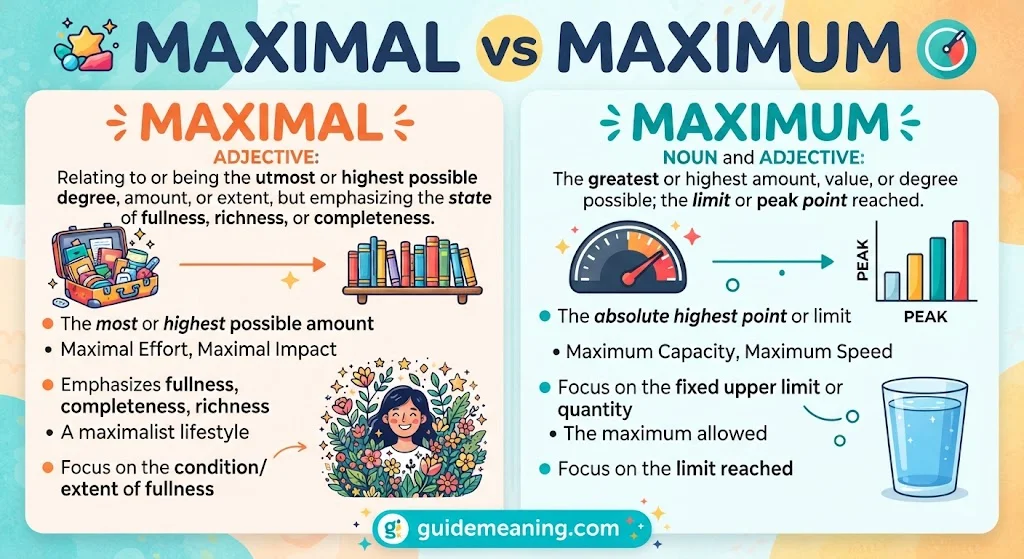

Maximal vs. Maximum can confuse English learners and writers because both words suggest the highest level, yet their usage and meaning can differ. In English, native speakers, students, professionals, and writers may treat them as the same thing, but they are not always identical or interchangeable. Maximum usually describes the highest possible value, amount, degree, or level that is possible, allowed, or legally permitted, such as a speed limit on a road. Maximal, on the other hand, often describes a great result within a specific situation or condition, with attention to effort, extent, or intensity rather than an absolute ceiling.
This subtle but big difference matters in everyday life, academic writing, professional communication, and technical fields, where precision, clarity, and accuracy are important. The distinction becomes sharper in mathematics, math, science, logic, computer science, graph theory, optimization, and abstract algebra, where the mathematical meaning of each term can affect a mathematical statement. A maximum is the greatest element in a set, while a maximal element cannot be extended or made larger under a specific condition, even though a larger element may exist. This idea appears in partially ordered sets, while real life examples can also show the difference: a sports science case study may describe maximal effort during training, whereas a measured maximum can mean the highest recorded value.
These practical examples, usage contexts, and grammatical functions make the distinct meanings easier to remember. One useful memory trick is to connect maximum with a fixed top value and maximal with something that cannot go further under its current conditions. This simple comparison can prevent common mistakes and common errors when you describe the greatest within constraints. A wrong word can make writing sound awkward, imprecise, or technically incorrect, and a small slip can change the point of an article, cause misunderstanding, or create serious misunderstandings.
Let’s jump in!
Quick Answer:
Maximum usually refers to the greatest amount, number, degree, size, speed, or limit that is possible or allowed.
Maximal means as great or large as possible and is especially common in specialized or technical writing.
| Word | Part of Speech | Main Meaning | Typical Example |
| Maximal | Adjective | As great or large as possible | The treatment produced a maximal effect. |
| Maximum | Adjective | Greatest amount, degree, or limit possible or allowed | The maximum speed is 100 mph. |
| Maximum | Noun | The greatest amount, value, or limit | The maximum is 100. |
A simple way to remember the difference is this:
Maximum often names or describes the upper limit. Maximal describes something that reaches the greatest possible degree.
That isn’t a rigid rule for every specialized field. Context still matters.
What Does “Maximal” Mean?
Maximal is an adjective meaning as great, large, or high as possible. Cambridge gives the meaning “largest or greatest” and identifies the word as specialized. Oxford similarly defines it as “as great or as large as possible” and marks it as specialist vocabulary.
For example:
- maximal effort
- maximal effect
- maximal performance
- maximal response
- maximal strength
- maximal workload
The word often appears when writers need to describe the highest degree within a particular set of conditions.
Consider this sentence:
The researchers observed a maximal response under the test conditions.
Here, maximal describes the response. It tells you that the response reached its greatest relevant level under the conditions being discussed.
How “Maximal” Works in a Sentence
Because maximal is an adjective, it normally modifies a noun.
For example:
- The athlete demonstrated maximal strength.
- The experiment produced a maximal response.
- The system operates at maximal efficiency.
- The medication reached its maximal effect.
- The machine requires maximal power during the final stage.
Notice the pattern. In each example, maximal describes the degree or level of something.
Oxford lists examples such as maximal effect and identifies the word as specialist usage.
Examples of “Maximal”
The following examples show how maximal can work in different contexts:
Science:
The reaction occurs at a maximal temperature of 40°C under the specified conditions.
Medicine:
The treatment produced a maximal effect after several weeks.
Sports:
The athlete trained to achieve maximal performance during the test.
Academic writing:
The model was designed to achieve maximal accuracy under controlled conditions.
Technology:
The processor operates at maximal capacity during intensive workloads.
In each case, the writer focuses on the greatest possible degree or level within the relevant context.
What Does “Maximum” Mean?
Maximum has a broader role in English. It can function as both an adjective and a noun.
As an adjective, it means the greatest amount, number, degree, or limit that is possible or allowed. Cambridge gives examples such as maximum speed, maximum effort, and maximum temperature.
Oxford likewise defines maximum as something that is as large, fast, or great as possible, or the most that is possible or allowed.
You might write:
- maximum speed
- maximum capacity
- maximum temperature
- maximum number
- maximum amount
- maximum volume
- maximum score
- maximum penalty
For example:
The elevator has a maximum capacity of 10 people.
Here, maximum establishes an upper limit. Ten people is the greatest number the elevator is allowed to carry.
“Maximum” as an Adjective
As an adjective, maximum commonly appears before a noun.
Examples include:
The car reached its maximum speed.
The room has a maximum capacity of 200 people.
The machine can operate at a maximum temperature of 80°C.
The company allows a maximum payment of $500.
The class has a maximum number of 30 students.
This construction is extremely common because maximum works naturally with measurements, quantities, restrictions, and limits.
“Maximum” as a Noun
Maximum can also function as a noun.
For example:
The maximum is 100.
The temperature reached a maximum of 90°F.
You can spend a maximum of $100.
The building has a maximum of 500 occupants.
Oxford defines the noun maximum as the greatest amount, size, speed, or similar quantity that is possible, recorded, or allowed.
This noun usage is one major difference between maximum and maximal.
Maximal vs. Maximum: The Main Difference
The easiest distinction comes down to function and context.
Maximum commonly identifies the greatest amount or an upper boundary.
Maximal describes something that is at its greatest possible degree.
Think of a speed limit.
If a road allows cars to travel at 70 mph, you can say:
The maximum speed is 70 mph.
Here, maximum identifies the upper limit.
Now imagine a scientific experiment measuring how strongly an object responds to a particular stimulus. A researcher might describe the strongest observed response as a maximal response.
The concepts overlap, but the emphasis changes.
| Feature | Maximal | Maximum |
| Basic meaning | Greatest possible degree | Greatest possible amount or limit |
| Common part of speech | Adjective | Adjective and noun |
| Everyday usage | Less common | Very common |
| Technical usage | Common | Common |
| Often expresses a limit | Sometimes | Very often |
| Often describes a degree | Yes | Yes |
| Can stand alone as a noun | Generally no | Yes |
Maximal = Greatest Degree in a Context
Maximal often works naturally when you’re describing the highest degree reached or possible within a particular situation.
For example:
The treatment produced a maximal response.
The focus is on the degree of response.
Another example:
The athlete generated maximal force during the final repetition.
The word emphasizes the greatest force the athlete could generate under those circumstances.
Maximum = Greatest Amount or Upper Limit
Maximum works especially well when you’re identifying the greatest permitted or possible quantity.
For example:
The maximum load is 500 pounds.
The sentence establishes a limit.
Likewise:
The maximum number of guests is 20.
Here, maximum tells readers the highest permitted number.
Cambridge specifically defines maximum in terms of the largest amount or number allowed or possible.
Maximal vs. Maximum as Adjectives
Both words can function as adjectives, which explains much of the confusion.
Consider these sentences:
The athlete made a maximum effort.
The athlete made a maximal effort.
Both can be grammatically correct. The difference is mainly one of usage and nuance.
Maximum effort is natural and widely understood in general English.
Maximal effort sounds more specialized. It may fit better in scientific, medical, sports-science, or academic writing where the writer is discussing a defined level of performance.
Oxford and Cambridge both treat maximal as specialized vocabulary.
That means you shouldn’t assume that maximal is simply a more sophisticated replacement for maximum.
Sometimes it is the precise word. Sometimes it only makes the sentence sound unnecessarily technical.
Maximal vs. Maximum in Technical English
The distinction becomes sharper in technical subjects.
Maximal vs. Maximum in Mathematics
Mathematics provides one of the clearest examples of why these words shouldn’t always be treated as synonyms.
A maximum is a greatest value within the relevant set or function.
A maximal element, however, can have a different technical meaning, especially in discussions of ordered sets.
Suppose a set contains several elements that can be compared according to a particular relationship. A maximal element is one for which there is no strictly larger element above it according to that relationship.
Importantly, a maximal element doesn’t necessarily have to be the single greatest element of the entire set.
Here’s a simple conceptual example.
Imagine several objects arranged according to two different properties. One object might not be worse than another in every relevant way, yet another object may also be impossible to improve upon under the same comparison rule.
You can therefore have multiple maximal elements.
A maximum, by contrast, is the greatest element when a greatest element exists under the relevant ordering.
That’s why replacing maximal with maximum in a mathematical definition can change the meaning.
This is more than a style preference. It’s a technical distinction.
Maximal vs. Maximum in Science and Medicine
Scientific writing frequently uses both words.
Maximum often describes a measured value, upper boundary, or recorded peak:
The instrument recorded a maximum temperature of 85°C.
Maximal can describe the greatest response, effect, or performance under defined conditions:
The experiment produced a maximal response at the tested concentration.
The Cambridge Dictionary’s examples include maximal temperature, maximal performance, and maximal response, showing how the word appears in scientific and specialized contexts.
The important point is that neither word automatically makes a sentence more scientific. The surrounding concept determines which term fits.
Maximal vs. Maximum in Engineering and Technology
Engineering documents frequently use maximum when discussing limits.
For example:
- maximum load
- maximum pressure
- maximum voltage
- maximum temperature
- maximum capacity
- maximum operating speed
These phrases tell users what a system can tolerate, handle, or reach.
Maximal may appear when engineers or researchers discuss a highest level of performance within a defined model or operating condition.
For instance:
The system achieved maximal efficiency under controlled conditions.
That’s different from:
The system has a maximum operating temperature of 80°C.
The first sentence describes a highest degree of performance. The second establishes a hard upper boundary.
Read More: Install In vs. Install On: What’s the Difference ? 2026
Maximal vs. Maximum in Everyday English
For ordinary conversation, maximum is usually the safer and more natural choice.
You would normally say:
The maximum speed is 65 mph.
You could also encounter:
The machine operates at maximal speed.
The second sentence isn’t necessarily wrong. It simply sounds more specialized.
This difference matters when you’re writing for a broad audience. Technical vocabulary can be accurate yet still feel out of place.
For everyday writing, these combinations are especially natural:
| Common Expression | Natural Example |
| maximum speed | The car has a maximum speed of 120 mph. |
| maximum capacity | The hall has a maximum capacity of 300 people. |
| maximum amount | You can withdraw a maximum amount of $500. |
| maximum number | The maximum number of guests is 10. |
| maximum temperature | The oven reaches a maximum temperature of 500°F. |
| maximum effort | Give it your maximum effort. |
By comparison, maximal appears more often in specialized descriptions:
- maximal response
- maximal effect
- maximal performance
- maximal strength
- maximal workload
Common Collocations With “Maximal”
A collocation is a group of words that commonly appear together.
Here are some useful combinations with maximal:
- maximal effort
- maximal effect
- maximal performance
- maximal response
- maximal strength
- maximal workload
- maximal value
- maximal impact
- maximal level
- maximal capacity
For example:
The researchers attempted to measure the maximal response.
The training program aims to improve maximal strength.
The software was tested under maximal workload conditions.
These combinations tend to sound more formal than their everyday alternatives.
Oxford specifically lists maximal as a specialist adjective and gives maximal effect as an example.
Common Collocations With “Maximum”
Maximum has a much wider range of everyday collocations.
Common examples include:
- maximum amount
- maximum number
- maximum speed
- maximum capacity
- maximum temperature
- maximum volume
- maximum score
- maximum load
- maximum pressure
- maximum limit
- maximum penalty
- maximum benefit
- maximum efficiency
- maximum effort
For example:
The maximum number of passengers is eight.
The device has a maximum output of 35 watts.
The car reached a maximum speed of 130 mph.
Cambridge provides similar examples involving maximum output, speed, temperature, and capacity.
Can “Maximal” and “Maximum” Be Used Interchangeably?
Sometimes, yes.
They overlap because both words can describe something at its greatest possible level.
For example:
The machine operates at maximum efficiency.
The machine operates at maximal efficiency.
Both sentences can communicate the general idea of very high or greatest efficiency. However, maximum efficiency is more familiar to most general readers.
In specialized writing, the choice may carry more precise meaning.
Compare:
The maximum number of participants is 50.
The maximal number of participants is 50.
The first sentence is the natural choice when you’re stating a permitted upper limit.
The second sentence sounds unusual in ordinary English.
Now consider:
The experiment produced a maximal response.
That wording can make sense in a technical context where the response has a defined range or experimental ceiling.
The Practical Rule
Don’t swap the words mechanically.
Instead, ask what the sentence actually needs to communicate.
If you’re stating a limit, maximum is usually the right choice.
If you’re describing a greatest degree within a specialized context, maximal may be more precise.
Maximal vs. Maximum: Common Mistakes
Using “Maximum” When “Maximal” Has a Technical Meaning
In specialized fields, replacing maximal with maximum can erase an important distinction.
This matters particularly in mathematics, where maximal and maximum have different technical meanings.
If a textbook defines a mathematical object as maximal, don’t automatically replace the word with maximum simply because both suggest “greatest.”
Treating Them as Perfect Synonyms
The words are related, but they’re not identical in every context.
Maximum can function as a noun:
The maximum is 100.
Maximal generally cannot be substituted in that structure.
You wouldn’t normally write:
The maximal is 100.
That’s a clear grammatical problem.
Assuming “Maximal” Is Simply a More Formal “Maximum”
This is another common misconception.
Maximal isn’t just maximum wearing a tuxedo.
It has its own grammatical and technical uses.
Cambridge explicitly labels maximal as specialized and lists maximum as a comparison word.
Overusing “Maximal” in Everyday Writing
A word can be correct yet still be a poor stylistic choice.
If you’re writing a general article, saying:
The maximum number of people is 20.
is usually clearer than:
The maximal number of people is 20.
The first version sounds natural because maximum number is a standard everyday expression.
Maximal, Maximum, Maximize, and Maximally
These four words belong to the same word family, but they don’t perform the same grammatical job.
| Word | Part of Speech | Meaning | Example |
| Maximal | Adjective | As great as possible | maximal performance |
| Maximum | Noun/Adjective | Greatest amount or upper limit | maximum capacity |
| Maximize | Verb | Make something as great as possible | maximize efficiency |
| Maximally | Adverb | To the greatest possible degree | work maximally |
Maximal
The test measured maximal strength.
Here, maximal modifies strength.
Maximum
The maximum strength was recorded at 80 units.
Here, maximum functions as a noun.
Maximize
The company wants to maximize efficiency.
Here, maximize is a verb meaning to make efficiency as great as possible.
Maximally
The system must operate maximally under these conditions.
Here, maximally functions as an adverb.
Learning the entire word family makes the distinction much easier.
Maximal vs. Maximum Examples
The following examples show how the words behave in different contexts.
Everyday English
Maximum:
The maximum number of guests is 12.
Maximal:
The team demonstrated maximal effort during the competition.
The first sentence establishes a numerical limit. The second describes the highest degree of effort.
Academic Writing
Maximum:
The study recorded a maximum score of 98 points.
Maximal:
The intervention produced a maximal response under controlled conditions.
The first identifies a recorded highest value. The second describes the greatest response produced within the study’s conditions.
Science
Maximum:
The solution reached a maximum temperature of 90°C.
Maximal:
The reaction showed a maximal response at the selected concentration.
Both words can appear naturally in scientific writing. Their exact meanings depend on what the researcher is measuring.
Business
Maximum:
Customers can receive a maximum discount of 20%.
Maximal:
The strategy was designed to achieve maximal market coverage.
The first states a clear numerical ceiling. The second describes the greatest desired degree of coverage.
Technology
Maximum:
The device supports a maximum load of 50 pounds.
Maximal:
The processor delivered maximal performance during the benchmark.
Again, the distinction is clear. One expresses a limit. The other describes a highest performance level.
How to Choose Between Maximal and Maximum
Choosing the right word doesn’t have to be complicated.
Ask Whether You’re Describing a Limit
If you’re telling someone the greatest amount, number, speed, capacity, or value permitted or possible, maximum is usually the natural choice.
For example:
The maximum capacity is 100 people.
The maximum speed is 80 mph.
You can spend a maximum of $200.
Ask Whether You’re Describing the Greatest Degree
If you’re describing something reaching its highest degree within a defined situation, maximal may fit.
For example:
The experiment produced a maximal response.
The athlete reached maximal strength.
The treatment produced a maximal effect.
Consider Your Audience
If general readers will see your writing, maximum will often be easier to understand.
If you’re writing a research paper, technical report, mathematical explanation, or specialized document, maximal may be the more precise term.
The goal isn’t to choose the longer or more sophisticated-looking word. The goal is to communicate the exact idea.
A Simple Memory Trick for Maximal vs. Maximum
Here’s an easy way to remember the difference:
Maximum = the greatest amount or limit.
Maximal = the greatest degree or level.
Think about a parking lot.
Maximum capacity: 100 cars.
That’s a limit.
Now think about a scientific test.
Maximal performance was observed under controlled conditions.
That’s a level of performance.
The words overlap, but the mental picture helps separate them.
Maximal vs. Maximum: Quick Comparison
| Question | Maximal | Maximum |
| Is it an adjective? | Yes | Yes |
| Can it be a noun? | Generally no | Yes |
| Does it mean greatest? | Yes | Yes |
| Does it commonly express a limit? | Less commonly | Yes |
| Is it common in everyday English? | Less common | Very common |
| Is it used in technical writing? | Yes | Yes |
| Does it describe a highest degree? | Yes | Yes |
| Can it refer to a greatest numerical value? | In some contexts | Yes |
| Is it specialist vocabulary? | Often | Generally not |
| Example | maximal response | maximum response/limit |
Case Study: Maximum Speed vs. Maximal Performance
Imagine a new electric car undergoing testing.
The manufacturer states:
The car has a maximum speed of 150 mph.
Here, maximum clearly expresses the upper speed limit.
During testing, engineers also measure how well the car performs under different conditions. They might report:
The vehicle delivered maximal performance under the specified test conditions.
The two phrases describe different ideas.
Maximum speed identifies a measurable upper boundary.
Maximal performance describes the highest level of performance achieved or possible within the relevant conditions.
This example shows why the words shouldn’t be treated as interchangeable simply because both relate to “the most.”
FAQs:
Is “maximal” the same as “maximum”?
Not always. Both words relate to the idea of being greatest or highest. However, maximum commonly refers to the greatest amount, number, value, or upper limit. Maximal is an adjective meaning as great or large as possible and is especially common in specialized contexts.
Is “maximum” an adjective or a noun?
Maximum can be both an adjective and a noun.
As an adjective:
The maximum speed is 100 mph.
As a noun:
The maximum is 100 mph.
Oxford lists both uses and defines the noun as the greatest amount, size, speed, or similar quantity that is possible, recorded, or allowed.
Is “maximal” a proper English word?
Yes. Maximal is a standard English adjective. Major dictionaries such as Cambridge and Oxford list it. Both dictionaries identify it as specialized or specialist vocabulary.
Which is more common, maximal or maximum?
Maximum is much more common in ordinary English. You regularly encounter phrases such as maximum speed, maximum capacity, and maximum amount. Maximal appears more often in specialized, scientific, academic, and technical contexts.
Should I say “maximum effort” or “maximal effort”?
Both expressions can be grammatical. Maximum effort is the more familiar choice for general English. Maximal effort can be appropriate in specialized contexts where the writer is describing the highest attainable or measured degree of effort.
What is the difference between maximal and maximum in mathematics?
In mathematics, the distinction can be technical. A maximum is a greatest element or value when such a greatest element exists. A maximal element is one that cannot be made greater under the relevant ordering, but there may be several maximal elements. Therefore, the two terms shouldn’t be casually substituted in mathematical writing.
What is the difference between maximal and maximally?
Maximal is an adjective, while maximally is an adverb.
For example:
The experiment produced a maximal response.
The system operated maximally under the test conditions.
The first word describes a noun. The second modifies an action or state.
Conclusion
Maximal vs. Maximum can seem confusing because both words are connected with the idea of being great or reaching a high level. However, they serve different purposes. Maximum generally points to the highest possible value, while maximal often describes something that cannot be increased within a particular set of conditions.
Once you understand this distinction, choosing the right word becomes much easier. If you’re writing about mathematics, science, academic writing, or everyday situations, paying attention to the exact meaning will help you communicate with greater clarity and precision.




1 thought on “Maximal vs. Maximum: What’s the Difference? 2026”