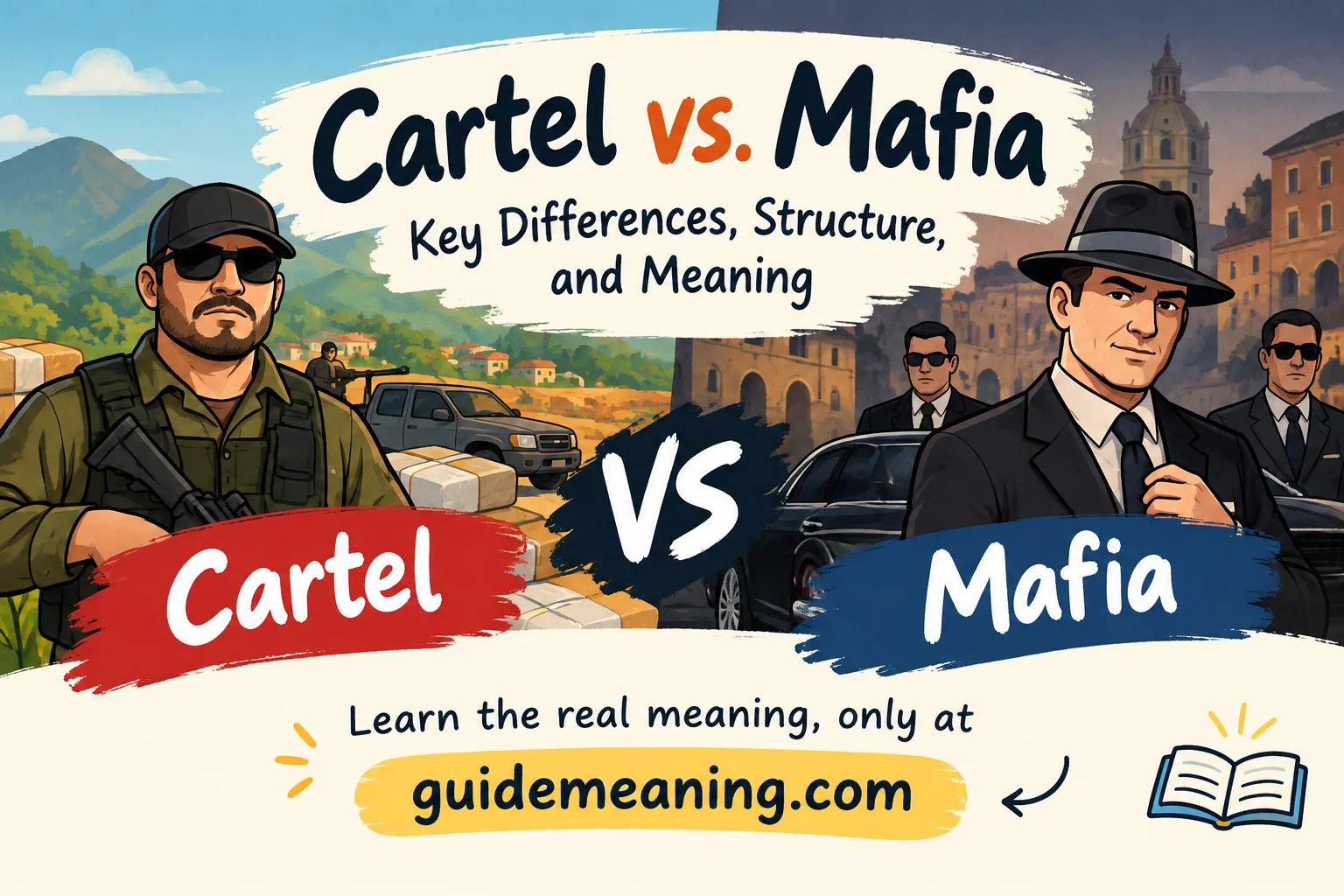

Cartel vs. Mafia becomes clearer when you look beyond movies, documentaries, media portrayals, and dramatic headlines. Both are criminal groups and powerful organizations involved in organized crime, but they can operate, organize, and grow in different ways. A cartel can act as a loose alliance between separate entities, with a purpose that may involve collusion, market control, price-fixing, or agreements involving illegal markets such as drugs and oil. A Mafia, however, is often described as a single, structured syndicate with internal command, strict hierarchy, centralized authority, and a family-based criminal organization built around loyalty, protection, enforcement, and territorial control. This distinction gives each term a more precise meaning when discussing criminal systems, illegal power structures, and real-world operations.
The history, origin, and origins of these organizations also explain their structure, leadership style, geographical influence, economics, tactics, and territorial power. Cartels may use a decentralized, business-style alliance for controlling markets, while mafias can depend on strict, hierarchical systems for racketeering power and controlling territory. Both can make money, spread, influence millions, and shape society through illegal businesses, secrecy, violence, corruption, and other actions. Their activities have influenced politics, changed lives, and created massive underground economies that still attract attention today. International crime reports, law enforcement strategies, crime reports, global news, and geopolitical discussions examine these powerful criminal systems because their real-world behavior can affect society behind the scenes. In real life, the terms can also be used interchangeably, creating confusion about how these organizations work and why their similarities can hide important differences.
For academic knowledge, a deep guide or detailed guide should explain everything from definitions and structures to operations, key differences, and global influence. Examples such as “the X cartel” or “the Y mafia” provide specific names instead of relying on figurative use. In careful writing, these terms function as nouns, while collude and control can function as verbs, and organized and illegal can function as adjectives. Checking verb tense, subject–verb agreement, and modifier placement can make each sentence clearer. These choices improve clarity and accuracy in an article about Cartel vs. Mafia, especially when written in simple English. They also make the terms, examples, and cases easier to understand while keeping the discussion connected to real-world evidence and the fundamentally different ways these criminal systems can function.
Let’s dive in!
Quick Answer:
A cartel generally refers to a criminal organization or alliance that coordinates an illicit market. In everyday usage, the term is strongly connected with drug-trafficking organizations.
A mafia generally refers to an organized criminal group with durable internal relationships and a history of territorial, economic, and social influence. Mafia organizations may engage in extortion, gambling, drug trafficking, money laundering, corruption, racketeering, and legitimate-business infiltration.
The simplest distinction looks like this:
| Feature | Cartel | Mafia |
| Basic meaning | Organization or alliance involved in controlling illicit markets | Organized criminal group with durable criminal and territorial influence |
| Common association | Drug trafficking and smuggling | Extortion, racketeering, corruption, gambling, and diversified crime |
| Structure | Can be hierarchical, decentralized, or networked | Often associated with families, clans, or established hierarchies |
| Main focus | Illicit market and supply-chain control | Criminal enterprise, territorial influence, and diversified revenue |
| Territory | May control trafficking routes or markets | Often develops strong local or territorial influence |
| Criminal activities | Often includes drug trafficking and related crimes | Often includes several different forms of organized crime |
| Membership | Can involve changing alliances and networks | Often emphasizes longer-term relationships and loyalty |
| Overlap | Can include mafia-like characteristics | Can participate in cartel-like market coordination |
These descriptions are general patterns rather than strict rules. Organized criminal groups can combine several structures and change their methods over time. UNODC notes that criminal organizations can range from rigid hierarchies to loose networks.
What Is a Cartel?
The word cartel can have different meanings depending on context.
In economics, a cartel can describe businesses that coordinate prices, production, or markets in ways that violate competition laws. In criminal contexts, however, the word often refers to groups that coordinate the production, transportation, distribution, or sale of illegal goods.
Drug trafficking is the strongest modern association.
A criminal cartel may control several stages of an illicit supply chain. One part of the network might handle production while another manages transportation. Other participants may arrange distribution, money laundering, corruption, or logistics.
That doesn’t mean every cartel has one central boss controlling every participant.
Modern organized crime can be surprisingly fluid. A 2023 UNODC analysis of cocaine trafficking found that large-scale drug trafficking increasingly involved small- and medium-sized criminal groups operating as networks rather than clearly defined organizations with stable membership and a fixed chain of command.
How Cartels Operate
Depending on the organization, cartel-related activity can involve:
- Drug production
- Drug trafficking
- Smuggling
- Wholesale distribution
- Market control
- Extortion
- Corruption
- Money laundering
- Weapons trafficking
- Cooperation with other criminal groups
The important point is that “cartel” doesn’t automatically describe one organizational structure.
Some groups can be highly centralized. Others can rely on semi-independent cells or temporary partnerships.
What Is a Mafia?
The term mafia has a more specific historical background.
The modern concept of the Mafia is strongly connected with Sicily and the development of Sicilian organized crime. The FBI explains that Italian organized crime groups developed over long historical periods before the Sicilian Mafia emerged as an organized criminal force.
The word is also used more broadly today. People may use mafia to describe organized criminal groups that share characteristics such as hierarchy, secrecy, territorial influence, long-term membership, extortion, and infiltration of legitimate businesses.
In the United States, La Cosa Nostra became the most prominent Mafia tradition. The FBI describes it as a nationwide alliance of criminal groups organized into geographically based “families.”
How Mafia Organizations Operate
Mafia-type organizations can participate in a wide range of criminal activities, including:
- Extortion
- Protection rackets
- Illegal gambling
- Loan sharking
- Drug trafficking
- Money laundering
- Labor racketeering
- Fraud
- Weapons trafficking
- Corruption
- Business infiltration
The FBI reports that La Cosa Nostra groups have historically been involved in many of these activities, including drug trafficking, money laundering, illegal gambling, political corruption, extortion, and infiltration of legitimate businesses.
That variety is an important difference when comparing mafia vs. cartel.
A cartel is often identified by its role in an illicit market. A mafia organization may generate income from several criminal markets simultaneously.
Cartel vs. Mafia: Differences in Structure
Structure is one of the most useful ways to understand the difference.
Cartel Structure
A cartel may operate through a centralized hierarchy, but that isn’t required.
Some organizations use independent cells or loosely connected groups. These groups may cooperate because they have complementary skills, access to particular routes, or relationships with other criminal actors.
UNODC identifies several possible structures, ranging from rigid hierarchies to organized criminal networks based on shifting alliances.
This flexibility can make a criminal network difficult to describe with one simple organizational chart.
Mafia Structure
Traditional Mafia organizations are more commonly associated with enduring structures.
For example, the FBI describes La Cosa Nostra as consisting of different families or groups, generally organized geographically.
Historically, leadership positions could include a boss, underboss, and other ranks. The organization could also establish rules for membership and dispute resolution.
The structure wasn’t merely about crime. It helped create loyalty, secrecy, discipline, and continuity.
Why Structure Matters
Structure affects how an organization handles:
- Leadership
- Recruitment
- Communication
- Enforcement
- Money
- Disputes
- Expansion
- Relationships with other groups
- Law-enforcement pressure
However, the old image of every organized criminal group having one boss at the top doesn’t match all modern organizations.
Cartel vs. Mafia: Criminal Activities
The two categories overlap significantly.
Activities Commonly Associated With Cartels
Cartel-related organizations are commonly associated with:
- Drug trafficking
- Smuggling
- Distribution
- Market competition
- Money laundering
- Corruption
- Extortion
- Weapons trafficking
Drug trafficking remains one of the strongest associations with the word cartel.
Activities Commonly Associated With Mafia Organizations
Mafia organizations may participate in:
- Extortion
- Protection rackets
- Illegal gambling
- Loan sharking
- Drug trafficking
- Money laundering
- Labor racketeering
- Fraud
- Corruption
- Legitimate-business infiltration
The FBI’s historical account of La Cosa Nostra shows just how broad this criminal portfolio can become.
Where Cartels and Mafias Overlap
Here’s where things get blurry.
Both types of criminal organization can use:
- Corruption
- Intimidation
- Violence
- Money laundering
- Smuggling
- Extortion
- Illegal markets
- International connections
UNODC emphasizes that organized crime can involve illicit goods, illicit services, and infiltration of legitimate businesses or government.
Therefore, one organization can display characteristics commonly associated with both categories.
Cartel vs. Mafia: Territory and Market Control
Territory can matter to both.
A cartel may seek control over important parts of an illicit supply chain. That could involve access to production areas, transportation corridors, distribution markets, or other strategic locations.
A Mafia organization may place greater emphasis on territorial influence within a community or region.
Historically, Mafia groups have used territorial power to support extortion and protection rackets. They may pressure businesses to make payments in exchange for protection or compliance.
Still, territory isn’t an absolute dividing line.
A cartel can exercise territorial control. A Mafia organization can operate across national borders.
Modern organized crime often crosses traditional geographic boundaries. UNODC’s research also recognizes transnational criminal groups that operate across several countries and use different organizational models.
Cartel vs. Mafia: Violence and Intimidation
Violence often dominates fictional portrayals of both groups.
Reality is more complicated.
Criminal organizations can use violence or threats to:
- Enforce agreements
- Intimidate rivals
- Protect illicit markets
- Punish disloyal members
- Influence businesses
- Defend territory
- Discourage cooperation with authorities
However, violence isn’t the only source of power.
Corruption, money, relationships, secrecy, and economic influence can also protect criminal operations.
That matters because organized crime doesn’t always look like a street confrontation. Sometimes its influence can operate quietly through businesses, financial transactions, intermediaries, or corrupt relationships.
Cartel vs. Mafia: Money and Business
Both can function as criminal enterprises.
The central objective under the UN Convention against Transnational Organized Crime is obtaining financial or other material benefit. The Convention defines an organized criminal group as a structured group of at least three people that exists over time and works together to commit serious crimes for material benefit.
How Cartels Generate Revenue
A cartel can make money through control of illicit commodities and services.
The business model may involve multiple stages:
Production → Transportation → Wholesale Distribution → Retail Market → Money Laundering
Different participants may handle different stages.
How Mafia Organizations Generate Revenue
Mafia groups can diversify their income through several activities.
For example:
Extortion + Gambling + Racketeering + Drug Trafficking + Fraud + Business Infiltration
This diversification can make a criminal organization less dependent on one illegal market.
Cartel vs. Mafia: Similarities
Despite their differences, cartels and mafias share several characteristics.
Both Can Be Organized Crime
The broader category is organized crime.
UNODC doesn’t require an organized criminal group to have a formal hierarchy. The international definition deliberately covers both highly organized groups and loosely connected networks.
Both Can Adapt
Criminal organizations respond to changes in:
- Consumer demand
- Law enforcement
- Technology
- Borders
- Financial systems
- Communication methods
- Rival organizations
UNODC notes that modern criminal networks have become more fluid partly because technology and online markets make remote coordination easier.
Both Can Use Networks
A criminal organization doesn’t always resemble a traditional company.
Some groups operate through shifting relationships where individuals cooperate for specific tasks rather than remaining permanent members of one organization.
That model makes the phrase “cartel vs. mafia” less straightforward than it first appears.
Are Cartels and Mafias the Same Thing?
No.
The terms overlap, but they aren’t exact synonyms.
A cartel generally emphasizes coordination or control within an illicit market. The word is especially associated with drug trafficking.
A mafia generally describes an established type of organized criminal organization associated with long-term relationships, territorial influence, extortion, corruption, and diversified criminal activity.
However, these categories aren’t airtight.
A Mafia organization can traffic drugs. A cartel can engage in extortion and corruption. Either type can use legitimate businesses, financial networks, or international connections.
That’s why context matters.
Can a Mafia Be a Cartel?
Sometimes the characteristics can overlap, but the terms describe different concepts.
A Mafia group could coordinate an illicit market or control part of a supply chain. In that situation, someone might use cartel to describe its market role.
However, calling every Mafia organization a cartel would oversimplify the situation.
The same organization might be described differently depending on whether someone is discussing its structure, criminal activities, market role, or historical identity.
Can a Cartel Be a Mafia?
The same problem appears in reverse.
A cartel can develop characteristics associated with Mafia-style organizations.
For example, it may develop:
- Strong territorial influence
- Durable leadership
- Family connections
- Extortion operations
- Corruption networks
- Legitimate-business interests
- Long-term local relationships
That doesn’t automatically make it a Mafia.
The better approach is to describe the organization’s documented characteristics instead of forcing it into one label.
Real-World Examples of Mafia Organizations
Sicilian Cosa Nostra
Cosa Nostra, commonly called the Sicilian Mafia, is one of the best-known examples of a Mafia-type organization.
Its history is closely connected to Sicily. The FBI describes the organization as developing into an organized criminal group during the 20th century.
La Cosa Nostra in the United States
The American Mafia developed from Italian and Sicilian organized crime networks.
The FBI describes La Cosa Nostra as an alliance consisting of geographically organized criminal families. Its documented activities have included gambling, extortion, drug trafficking, money laundering, labor racketeering, corruption, and infiltration of legitimate businesses.
Camorra and ’Ndrangheta
Italy has several major organized crime traditions beyond Cosa Nostra.
The FBI identifies Cosa Nostra, Camorra, ’Ndrangheta, and Sacra Corona Unita among active Italian organized crime groups.
These groups shouldn’t be treated as one unified organization. Each has its own history, structure, geographic roots, and criminal networks.
Case Study: La Cosa Nostra and Organizational Structure
The history of La Cosa Nostra provides a useful example of how organized crime can develop formal structures.
According to the FBI, Salvatore Maranzano reorganized New York criminal groups in 1931 and established five major criminal families. Later, Charles “Lucky” Luciano created the Commission, which provided a mechanism for cooperation among Mafia families.
The case demonstrates an important point.
Mafia organizations haven’t always functioned as one giant criminal corporation. Instead, separate groups can retain their own leadership while cooperating through broader structures.
That arrangement resembles some modern descriptions of networked organized crime, although historical Mafia structures and modern criminal networks shouldn’t be treated as identical.
Case Study: The Pizza Connection
The Pizza Connection investigation illustrates how Mafia organizations could combine international drug trafficking with legitimate businesses.
The FBI describes the case as a major 1980s investigation involving a Sicilian Mafia-run heroin smuggling operation. Investigators from the United States and Italy worked together to uncover the network.
The case is particularly useful when studying cartel vs. mafia because it challenges simplistic categories.
The organization had Mafia roots yet operated heavily within an international drug-trafficking market.
In other words, criminal organizations can cross the boundaries that simple labels suggest.
Cartel vs. Mafia vs. Gang
People also frequently confuse cartels, mafias, and gangs.
A gang is a broader term. UNODC notes that there is no single internationally agreed definition of a gang, and some gangs may qualify as organized criminal groups depending on their structure and activities.
| Term | Typical meaning | Common characteristics |
| Cartel | Criminal organization or alliance associated with illicit-market coordination | Trafficking, market control, smuggling |
| Mafia | Established type of organized criminal organization | Territorial influence, extortion, racketeering, diversified crime |
| Gang | Broad term for a group involved in criminal activity | Local activity, group identity, varying organization |
| Organized criminal group | Broad legal and analytical category | Ongoing group activity for material benefit |
The categories can overlap.
A gang can become highly organized. A Mafia group can operate internationally. A cartel can contain several independent criminal networks.
How Law Enforcement Defines Organized Crime
Official terminology can be more precise than everyday language.
The UN Convention against Transnational Organized Crime defines an organized criminal group as a structured group of three or more people that exists for a period of time and acts together to commit serious crimes for financial or material benefit.
Importantly, the definition doesn’t require a formal hierarchy.
That detail matters.
A group doesn’t need a traditional boss, rigid ranks, or permanent membership to qualify as an organized criminal group under the Convention.
UNODC identifies several models, including:
- Hierarchical model
- Local or cultural model
- Enterprise model
- Networked model
These models can overlap.
Why Movies Make Cartels and Mafias Look Similar
Popular culture often compresses complicated criminal organizations into recognizable characters.
The Mafia becomes the suited boss with a family hierarchy. The cartel becomes the heavily armed trafficking organization.
Those images can help tell a story, but they aren’t complete descriptions of organized crime.
Real organizations may include accountants, intermediaries, corrupt contacts, legitimate businesses, transportation networks, financial channels, and loosely connected partners.
The criminal marketplace can be much more fluid than a movie plot.
Cartel vs. Mafia: The Biggest Difference
The clearest way to remember the distinction is to focus on what the label emphasizes.
Cartel generally emphasizes coordination or control within an illicit market.
Mafia generally emphasizes a durable criminal organization with established relationships, territorial influence, and diversified criminal activities.
Yet neither definition works as an absolute rule.
The real world is messier.
A Mafia organization can operate a drug-trafficking network. A cartel can use extortion and corruption. A criminal group can shift from a hierarchical structure toward a networked model as circumstances change.
That’s why serious analysis looks at the organization’s structure, activities, relationships, territory, markets, and history rather than relying on the label alone.
FAQs:
Is a cartel the same as a mafia?
No. A cartel generally refers to coordination or control within an illicit market, while mafia commonly refers to a durable organized criminal group with territorial, economic, and social influence. The two categories can overlap.
What is the main difference between a cartel and a mafia?
The main difference lies in what the terms usually emphasize. Cartel often emphasizes illicit-market coordination, while mafia commonly emphasizes an established criminal organization and diversified criminal activities.
Are cartels mainly involved in drugs?
Drug trafficking is strongly associated with the term cartel. However, criminal organizations can participate in multiple illegal activities, so the label doesn’t establish every activity a particular group performs.
Do mafias traffic drugs?
Yes. Drug trafficking has been documented among Mafia organizations. The FBI lists drug trafficking among the major criminal activities associated with La Cosa Nostra.
Are cartels and mafias organized crime?
They can both fall within the broader category of organized crime. Under the UN framework, an organized criminal group can operate through different structures and doesn’t need a formal hierarchy.
Can a cartel control territory?
Yes. A criminal organization described as a cartel can exercise territorial influence. However, territorial control isn’t a requirement for using the term cartel.
Why do people confuse cartels and mafias?
Both can involve money laundering, corruption, violence, extortion, trafficking, and international activity. Movies and news coverage also frequently use the terms broadly, which can blur their distinctions.
Conclusion:
The cartel vs. mafia distinction becomes much clearer once you stop treating the words as perfect categories.A cartel usually highlights illicit-market coordination, trafficking, or market control. The term is especially common when discussing drug-trafficking organizations.A mafia usually describes an established form of organized criminal organization associated with territorial influence, extortion, corruption, racketeering, and diversified criminal enterprises.